Classification of Pollutants
The pollutants are classified into following three types:
(i) Natural Pollutants
(ii) Primary Pollutants
(iii) Secondary Pollutants
4.2.1 Natural Pollutants
The pollutants that find their way into the atmosphere as a result of natural phenomena are referred as natural pollutants.
Some example of natural phenomena causing pollution include the following:• Forest fires started by lightening.
• Dispersal of pollen, soil erosion and volcanic eruptions.
• Discharge of volatile organic compounds from leaves and tree.
• Decomposition or putrefaction of organic matter.
• Natural radioactivity.
The natural pollutants have been known to cause atmospheric pollution since very early time; it is perhaps as old as the earth itself. Nature deals with such pollutants in its own way. Anyhow, the concentration of natural pollutants is generally quite low and does not cause any serious problems.
4.2.2 PrimaryPollutants
A primary pollutant is a pollutant that enters directly into the atmosphere as a result of natural or other activities. For example, when coal, oil, natural gas or wood is burnt, carbon monoxide and carbon dioxide are formed. ∣Automobiles are responsible for contributing considerable amount of carbon monoxide. Sulphur dioxide is passed into the atmosphere by burning coal and oil containing sulphur as impurities.The sulphur of the pyrite (iron pyrite, FeS2) that remains in coal is oxidised to sulphur dioxide.

Other primary pollutants include oxides of nitrogen, hydrocarbons and suspended particulate matter.
4.2.3 Secondary Pollutants
A secondary pollutant is the one that is formed by the further reaction of primary air pollutants. For example, sulphur dioxide reacts with oxygen in the atmosphere to form sulphur trioxide, which can further react with water vapours in the air to form sulphuric acid.
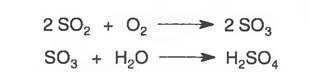
In the above case, both sulphur trioxide and sulphuric acid are secondary pollutants.
Another interesting example is that of nitric oxide (NO). It is formed by combination of the atmospheric nitrogen with oxygen of the atmosphere at very high temperature or in presence of electric sparks due to lightening etc. It is also obtained by the combustion of fuels in the internal combustion engines; which is a convenient route for the formation of nitric oxide (N2 + O2 → 2 NO). Thus, nitric oxide enters the atmosphere as a primary pollutant, where it further combines with atmospheric oxygen to form nitrogen dioxide NO2). The nitrogen dioxide thus formed, may react with water of the atmosphere to form nitric acid.

In the above example, both nitrogen dioxide and nitric acid are secondary air pollutants. Some other examples of secondary air pollutants include ozone, hydrogen peroxide, nitrates and sulphate salts (formed in the soil).
Thus, it can be summarised that the primary pollutants (e.g., CO, CO2, SO2, NO, hydrocarbons, particulate matter) enter into the atmosphere as a result of natural activities, exhausts from automobiles and from power generating units which use coal as the source of energy. These primary pollutants are converted into secondary pollutants (e.g. NO2, SO2, HNO3, H2SO4, H2O2, O3 etc.) by reacting with atmospheric oxygen and water vapours present in the atmosphere in the presence of solar radiation.