Density dependence has been observed in many populations
Density dependence can often be detected in natural populations (FIGURE 11.11). For example, in a study that combined field observations with controlled experiments, Arcese and Smith (1988) examined the effect of population density on reproduction in the song sparrow (Melospiza melodia) on Mandarte Island, British Columbia.
They found that the number of eggs laid per female decreased with density, as did the number of young that survived long enough to become independent of their parents (see Figure 11.11A). Because Mandarte Island is small and the birds were likely to suffer food shortages at high densities, Arcese and Smith predicted that if they provided food to a subset of nesting pairs when densities were high, the birds that were fed should be able to rear more young to independence. That is exactly what happened: nesting pairs that were fed reared nearly four times as many young to independence as did control birds that were not fed (see Figure 11.11A).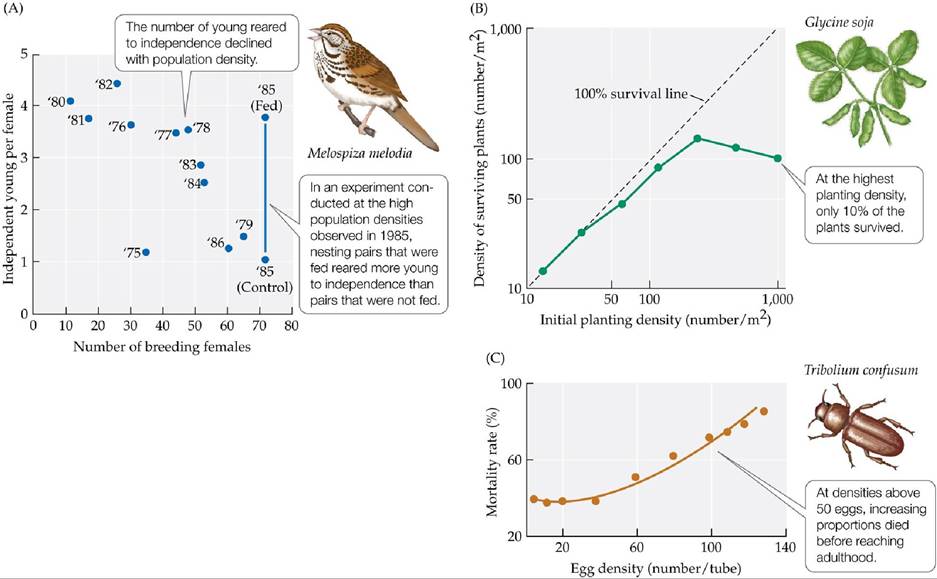
FIGURE 11.11 Examples of Density Dependence in Natural Populations (A) Numbers of young song sparrows reared to independence on Mandarte Island at different densities of breeding females. The number next to each point indicates the year of observation (1975-1986). (B) Density of surviving soybeans 93 days after they were planted at densities ranging from 10 to 1,000 seeds per square meter. (C) Mortality rates in flour beetles at various egg densities.
In (A), based on data from years other than 1975, how many young song sparrows per female would you have expected to be reared to independence in 1975? Explain your reasoning and describe factors that could have caused the observed results.
(A after P. Arcese and J. N. M. Smith. 1988. JAnim Ecol 57: 119-136; B after J. A. Yoda et al.
1963. JBiol 14: 107-120; C after T. S. Bellows, Jr. 1981. J Anim Ecol 50: 139-156.) View larger imageIn addition to density-dependent reproduction, density-dependent mortality has been observed in many populations. For example, when Yoda et al. (1963) planted soybeans (Glycine soja) at various densities, they found that at the highest initial planting densities, many of the seedlings had died by 93 days of age (see Figure 11.11B). Similarly, in an experiment in which eggs of the flour beetle Tribolium confusum were placed in glass tubes (each with 0.5 g of food), death rates increased as the density of eggs per tube increased—again revealing density dependence (see Figure 11.11C). Density dependence has also been detected in populations whose abundance is strongly influenced by factors usually considered to act in a density-independent manner, such as temperature or precipitation.
When birth, death, or dispersal rates show strong density dependence, population growth rates (λ or r) may decline as densities increase (FIGURE 11.12). Eventually, if densities become high enough to cause λ to equal 1 (or r to equal 0), the population stops growing entirely; if λ becomes less than 1 (or r < 0), the population declines. As we'll see in the next section, such density-dependent changes in the population growth rate can cause a population to reach a stable, maximum population size.
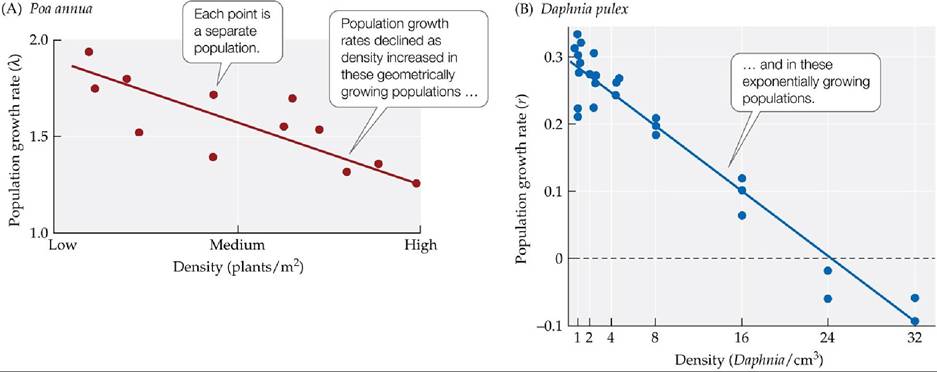
FIGURE 11.12 Population Growth Rates May Decline at High Densities Eachpoint represents one population. (A) The geometric population growth rate (λ) of the grass Poa annua is density dependent, as is (B) the exponential growth rate (r) of the water flea Daphnia pulex.
Are high-density populations increasing in size in (A)? In (B)? Explain.
(A after R. Law. 1975. Unpublished PhD thesis. University of Liverpool; B after P. W. Frank et al. 1957. Physiol Zooi 30: 287-305.) View larger image