Dispersal is a process that distributes organisms across the landscape
Organisms differ greatly in their capacity for movement. In plants, for example, dispersal occurs when seeds move away from the parent plant. Although events such as storms can transport seeds long distances (hundreds of meters to many kilometers; see Cain et al.
2000), dispersal distances in plants are usually small (one to a few tens of meters). In some cases, typical seed dispersal distances are so small that they hardly count as movement. For example, seeds of the forest plant Viola odorata have been seen to disperse only 0.002 to 0.02 m (0.008-0.8 inches) when ants are not present; when ants are present, they may carry these seeds for a few meters. At the other end of the spectrum, some whale species travel tens of thousands of kilometers in a single year. Overall, the spatial extent of populations varies tremendously—from very small, in organisms that disperse little, to very large, in species that travel great distances.Whales also migrate, which is a specific type of dispersal in response to seasonal variation in resources. Migration involves round-trip movement and usually includes the entire population. For example, five separate North Pacific populations of the humpback whale migrate more than 4,800 km (~3,000 miles) between their winter breeding grounds in the south (Mexico, Hawaii, and Japan) and their summer feeding grounds in the north (Northeast Pacific coast and Gulf of Alaska) (FIGURE 9.14). A 2006 survey of North Pacific humpback whales determined that these populations have rebounded since 1966, when commercial whaling of these populations was banned.
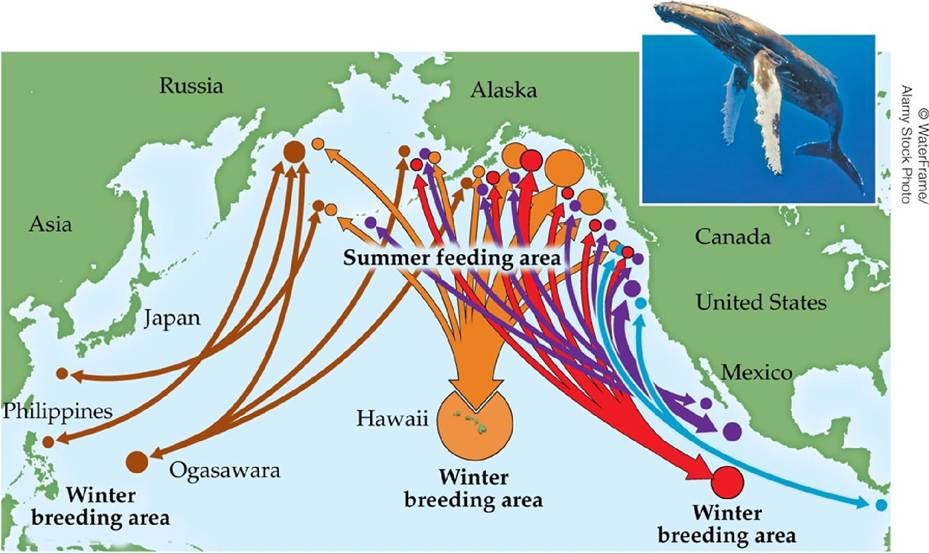
FIGURE 9.14 Migration of North Pacific Humpback Whales Five separate populations (represented by different-colored arrows) of the North Pacific humpback whale (Megaptera novaeangliae) migrate between their winter breeding grounds off Mexico, Hawaii, and Japan and their summer feeding grounds in the Gulf of Alaska and the Northeast Pacific coast. (Map after https://hawaiihumpbackwhale.noaa.gov/explore/humpback whale.html.
Migration data from SPLASH Research.) View larger imageAs demonstrated by the polar bear's absence from Antarctica, a species' limited capacity for dispersal can prevent it from reaching areas of suitable habitat—a phenomenon known as dispersal limitation. In another example, the Hawaiian Islands have only one native terrestrial mammal, the Hawaiian hoary bat
(Lasiurus cinereus), which was able to fly to the islands. No other land mammals have been able to disperse to Hawaii on their own, although cats, pigs, wild dogs, rats, goats, mongooses, and other mammals now thrive in Hawaii following their introduction to the islands by people.
Dispersal limitation can also occur on smaller spatial scales, preventing populations from expanding to nearby areas of apparently suitable habitat. An example of dispersal limitation was documented in a long-term study of the English bluebell (Hyacinthoides non-scripta). In 1960, 27 populations of 7 to 10 individuals each were established in apparently suitable forest habitat located near source populations (Van der Veken et al. 2007). Forty-five years later, only 11 (41%) of these experimental populations persisted, and most contained hundreds or thousands of individuals. These results suggested that dispersal limitation had prevented the bluebells from maintaining the majority of their original populations or creating new populations in areas nearby.
In the following section, let's consider in more detail how dispersal can create and maintain multiple populations and the role of these metapopulations in the conservation of endangered species.