Dust Storms of Epic Proportions: A Case Study
Dust is usually a subtle nuisance for most city dwellers, a reminder of neglect and lax housekeeping. Living in islands of asphalt and concrete, most urbanites see little bare soil, let alone clouds of blowing dust in the sky.
Yet in late spring of 1934, a massive dust storm shrouded the U.S. cities of Chicago and New York in a dark haze never seen before by their residents. People choked on the dust, and it burned their eyes. Twelve million tons of dust fell on Chicago—4 pounds for each resident—and an estimated 350 million tons of dust were carried by the storm to the Atlantic Ocean. As frightening as this event was to city dwellers, farmers in the southern Great Plains had suffered through multiple years of frequent severe dust storms throughout the 1930s (FIGURE 25.1). During this period, many people in that region, known as the Dust Bowl, suffered from an often-fatal dust-induced pneumonia similar to the black lung disease that was killing coal miners.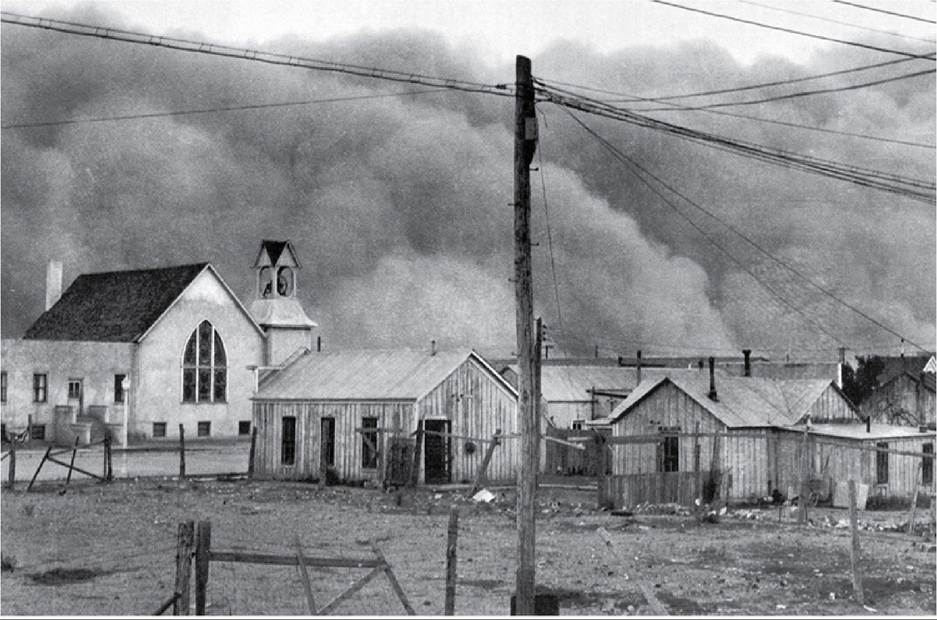
FIGURE 25.1 A Massive Dust Storm A wall of dust approaches the town of Clayton, New Mexico, on May 29, 1937. This storm was one of several “black dusters” that swept through the Dust Bowl during the 1930s. © Science History Images/Alamy Stock Photo View larger image
Since the mid-1990s, widespread dust storms have impacted parts of Asia, including China, South Korea, and Japan. Residents of Beijing, China, have had experiences similar to the residents of Chicago and New York who faced massive, unexpected dust storms. An April 2006 storm dropped more than 300,000 tons of dust on Beijing. Residents were encouraged to stay indoors to avoid inhaling the dust and getting it in their eyes. Many of those brave enough to venture out wore surgical face masks to protect their lungs. Some residents lined their windows and doors with rags in an attempt to keep the dust out of their houses and apartments.
More intense and frequent dust storms have occurred in the Middle East in the past decade. One storm in August 2015 was so bad that ports and airports throughout the region had to close. Several deaths and thousands of injuries were attributed to the dust. In addition to the direct health impact of dust on human respiratory systems, it can also spread disease such as meningitis.Large dust storms in urban areas are perceived as rare events, potentially linked to unsustainable land use practices such as overgrazing or farming on marginal lands. In the examples mentioned above, farming and grazing in arid areas had increased prior to the dust storms. There is evidence, however, that massive dust storms occur at regular, but infrequent, intervals irrespective of human activities, moving large amounts of soil across whole continents. Over the past century, these events have been associated with prolonged droughts. The urban dust storms in the United States during the 1930s were associated with a decade-long drought in the Dust Bowl (FIGURE 25.2). Similarly, the Beijing dust storms of the past two decades have been associated with drought in Mongolia. The increase in the Middle East dust storm frequency has been attributed to climate change and diversion of rivers for agriculture.
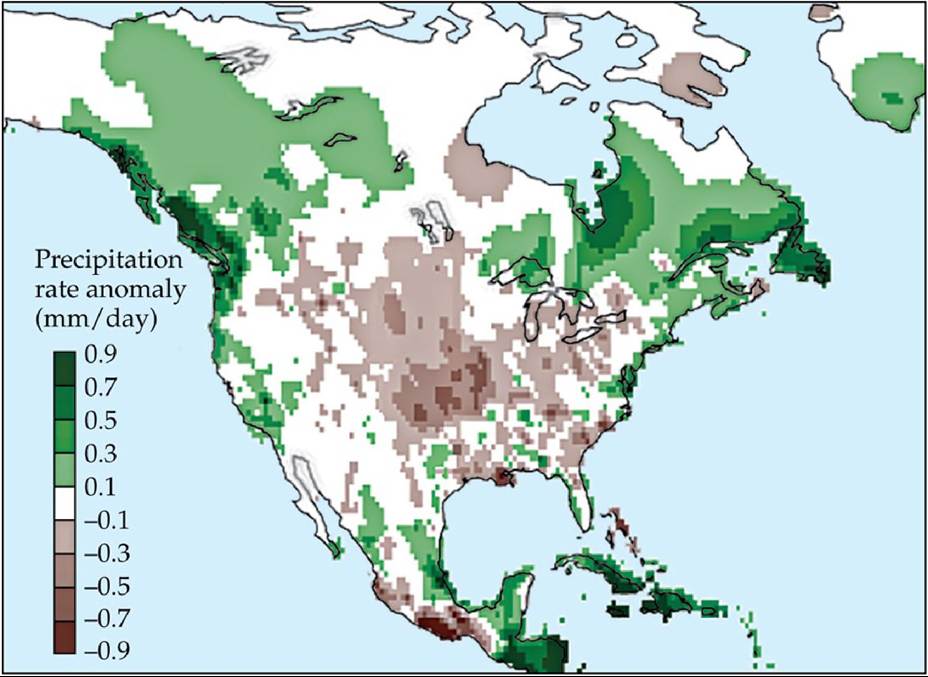
FIGURE 25.2 DroughtintheSouthernPlains During the 1930s, the southern Great Plains of the United States experienced the driest weather on record. The drought, in combination with loss of vegetation cover, created conditions conducive to dust input into the atmosphere. The values shown are anomalies (differences between averages for the period 1932-1939 and longterm averages). (After B. I. Cook et al. 2009. Proc NatlAcad Sci USA 106: 4997-5001. © 2009 National Academy of Sciences, U.S.A.) View larger image
Dust in the atmosphere is made up of soil particles blown from regions that lack vegetative cover to protect their soils from the wind. As discussed in Chapters 4 and 22, soils are important as sources of nutrients, determinants of terrestrial moisture availability, and habitat for organisms. Therefore, the redistribution of soils from one area to another has the potential to cause ecological change. How widespread are these ecological effects? What role have humans played in the dust storms of the past century? As we will see in this chapter, the movement of dust is an important component in the movement of elements at the global scale.