Eco-evolutionary feedbacks can occur over short periods of time
As we discussed earlier in this chapter, evolution can occur over short periods of time (as little as two generations). Because evolution occurs as organisms interact with each other and their physical environment, this suggests that reciprocal feedback effects between ecological and evolutionary factors also can occur over short periods of time.
Let's take a closer look at the causes of these rapid feedback effects.Feedback effects between ecological and evolutionary factors can occur when an ecological change, such as the addition or removal of a predator, alters the selective pressures that organisms face, thereby leading to evolutionary changes (FIGURE 6.22). Such evolutionary changes, in turn, can modify key aspects of populations, communities, or ecosystems. For example, in a 3-year field experiment (Agrawal et al. 2013), evolutionary changes in life span and flowering time in populations of the evening primrose (Oenothera biennis) led to consistent changes in the abundance of the moth Mompha brevivittella, which ate the seeds of this plant (FIGURE 6.23)—a demonstration that rapid evolution can cause rapid ecological change in a natural setting. Likewise, in the mountain streams of Trinidad, predator removal (an ecological change) leads to the evolution of larger body size in guppies over short periods of time, an evolutionary change that may increase the rate at which guppy populations add nitrogen to this freshwater ecosystem (El-Sabaawi et al. 2015).
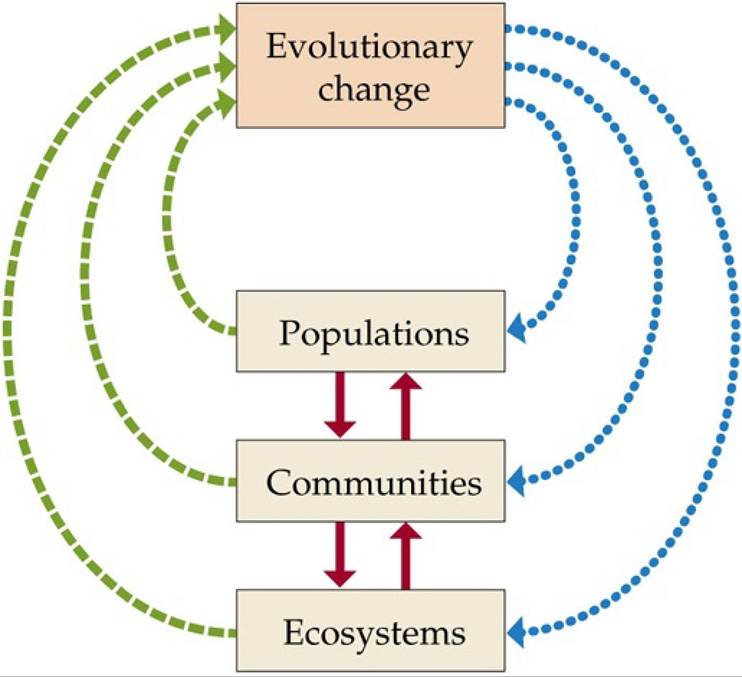
FIGURE 6.22 Rapid Feedback Effects Can Occur between Ecological and Evolutionary
Factors Ecological change in a population, community, or ecosystem can drive evolutionary change over short periods of time (green, dashed arrows). Similarly, evolutionary change can alter events at the population, community, or ecosystem level (blue, dotted arrows).
A change at one level of ecological organization can cause additional changes at other levels (red, solid arrows), as when an increase in the population size of one species alters nutrient cycling in ecosystems. View larger image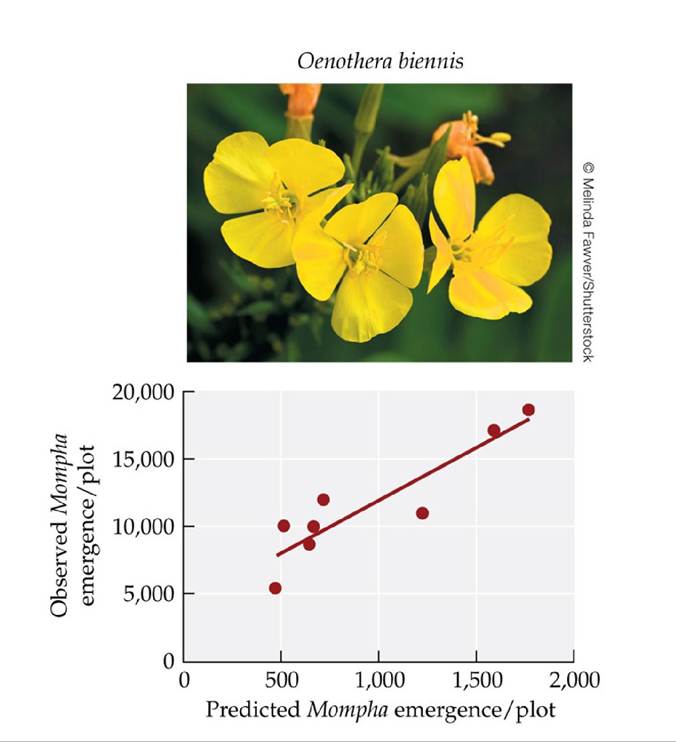
FIGURE 6.23 Feedback of Food Plant Evolution on Insect Abundance Caterpillarsofthe moth Mompha brevivittella eat the seeds of the evening primrose (Oenothera biennis). Some plant genotypes are more resistant to moth attack than others, indicating that moth abundance could change depending on plant genotype frequencies. In a 3-year field experiment, evolutionary changes in O. biennis genotype frequencies were correlated to moth abundance, indicating a feedback from evolution to ecology.
Suppose that eco-evolutionary feedbacks between changes in plant genotype frequency and moth abundance did not occur. Redraw this figure assuming that was the case.
(After A. A. Agrawal et al. 2013. Am Nat 181: S35-S45.) View larger image
A Case Study Revisited
Trophy Hunting and Inadvertent Evolution
Trophy hunters of bighorn sheep prefer to kill large males that carry a full curl of horns. The majority of these males are killed when they are between 4 and 6 years old, often before they have sired many offspring. As a result, hunting decreases the chance that alleles carried by males with a full curl of horns will be passed on to the next generation. Instead, it is males with relatively small horns who father most of the offspring, transmitting their alleles to the next generation. This change has caused the frequency of alleles encoding small horns to increase, thus leading to the observed 30year decrease in average horn size (see Figure 6.2). Overall, trophy hunting has inadvertently caused directional selection in bighorn sheep, favoring small males with small horns and changing allele frequencies in the population over time.
Humans have caused unintended evolutionary changes in a wide variety of other populations.
An early example was provided by the decline in the frequency of red foxes (Vulpes fulva) with coats that have a silver tint, a color preferred by hunters (FIGURE 6.24). In a medical example, shortly after antibiotics were discovered (ca. 1940), their use was highly effective against bacteria that cause diseases and lethal infections. But the use of antibiotics provided a strong source of directional selection, leading to the evolution of antibiotic resistance in bacterial populations (see Figure 1.10). Today, as a result of this directional selection, antibiotic treatments sometimes fail, even when very high doses are administered. Antibiotic resistance has enormous consequences for human health as well as financial costs; in the United States alone, efforts to cure patients infected with antibiotic-resistant strains costs an estimated $2 billion in medical expenses each year (Thorpe et al. 2018).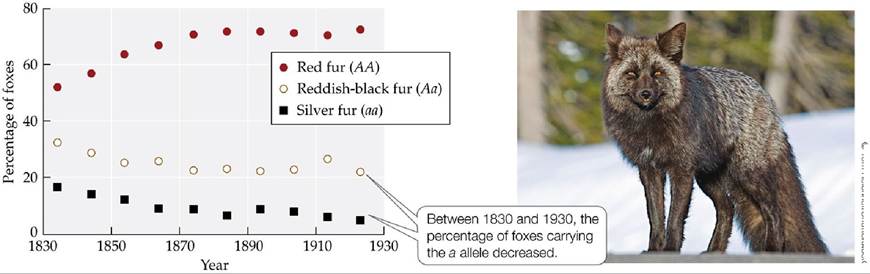
© Tom ReichnerZShutterstock
FIGURE 6.24 Hunting Resulted in the Decline of Silver Foxes Individualredfoxes (Vulpes fulva) of genotype AA have red fur, and individuals of genotype Aa have reddish- black fur. Individuals of genotype aa are known as “silver foxes” because the tips of their hairs have a silver tint (photo). Hunters preferentially killed silver foxes because their furs yielded 2.5-4 times the price of other red fox furs.
Based on the graph, estimate the initial (ca. 1832) and final (ca. 1923) frequencies of genotypes AA, Aa, and aa. Next, use the genotype frequencies that you estimated to compute the initial and final frequencies of the a allele. Hint: See footnote in Concept 6.1.
(After C. S. Elton. 1942. Voles, Mice and Lemmings: Problems in Population Dynamics. Oxford University Press: Oxford.) Vi6W larger imag6
We have seen throughout this chapter that human actions such as trophy hunting and antibiotic use act as selection pressures and hence may cause evolutionary change.
But does our influence on evolution extend beyond cases in which we selectively kill other organisms?Connections in Nature
The Human Impact on Evolution
Many human actions alter the environment and hence have the potential to alter the course of evolution. As we've seen, actions such as trophy hunting, antibiotic use, and commercial fishing are themselves powerful sources of selection. Other human actions, such as emissions of pollutants or introductions of invasive species, change aspects of the abiotic or biotic environment. By changing features of the environment, these and many other human actions can cause evolutionary change. In ANALYZING DATA 6.1, you'll analyze data related to a classic example of this process, in which the emission (and subsequent control) of pollutants caused evolution by natural selection in populations of the peppered moth (Biston betularia).
ANALYZING DATA 6.1
Does Predation by Birds Cause Evolution in Moth Populations?
The peppered moth (Biston betularia) has a light-colored and a dark-colored form. The first dark-colored moth was observed in 1848 near Manchester, England; 50 years later, most moths in the area were dark in color. Researchers hypothesized that dark-colored moths increased in frequency because when the moths rested on trees whose bark had been darkened by pollution, it was harder for predators to find dark moths than light moths. In particular, field studies by Kettlewell (1955,1956) indicated that natural selection by birds favored dark-colored moths in regions where tree bark was blackened by pollution, whereas light-colored moths were favored elsewhere.
After clean air legislation was enacted in England in 1956, tree surfaces lightened over time because of the reduction in soot and the growth of lichens on the trees' bark (lichens are light in color, and they grow poorly in polluted air). During this period, the dark-colored moths decreased in frequency.
Although the rise and fall in the frequency of dark-colored moths were consistent with typical results from natural selection by bird predation, criticisms have been leveled against aspects of this hypothesis.
For example, abnormally high densities of moths were released in some experiments, potentially increasing the impact of predation, because some predators preferentially attack abundant prey. Over the course of a 6-year experiment designed to address such criticisms, Michael Majerus released thousands of moths in an area where tree surfaces had been lightened. He determined the number of light- and dark-colored moths that were eaten. His results are reported in the table.1. The densities (and proportions) of the light- and darkcolored moths that Majerus released were similar to those he observed in the field. Why is this important to the validity of the experiment?
2. Use the proportions of dark moths that Majerus released to determine whether dark-colored moths were increasing or decreasing in frequency in the area where he conducted the experiment (Cambridge, England).
3. Calculate the percentages of released dark- and lightcolored moths that were eaten each year, and graph those percentages versus time. Do the results support the hypothesis that evolution by natural selection caused the frequency of dark-colored moths to change over time? Explain.
| Year | No. of light moths released | No. of dark moths released | No. of light moths eaten | No. of dark moths eaten |
| 2002 | 706 | 101 | 162 | 31 |
| 2003 | 731 | 82 | 204 | 24 |
| 2004 | 751 | 53 | 128 | 17 |
| 2005 | 763 | 58 | 166 | 18 |
| 2006 | 774 | 34 | 145 | 6 |
| 2007 | 797 | 14 | 158 | 4 |
Source: Cook, L.
M., et al. 2012. Selective bird predation on the peppered moth: The last experiment of Michael Majerus. Biology Letters 8: 609-612.
Still other human actions, such as habitat fragmentation (in which portions of a species' habitat are destroyed, leaving spatially isolated fragments of the original habitat), can also cause large evolutionary changes (FIGURE 6.25). In general, human actions that affect the environment can alter each of the three main mechanisms of evolution: natural selection, genetic drift, and gene flow. Because we know with certainty that our actions are causing great changes to environments worldwide, we can infer that they are also causing evolutionary changes in populations worldwide.
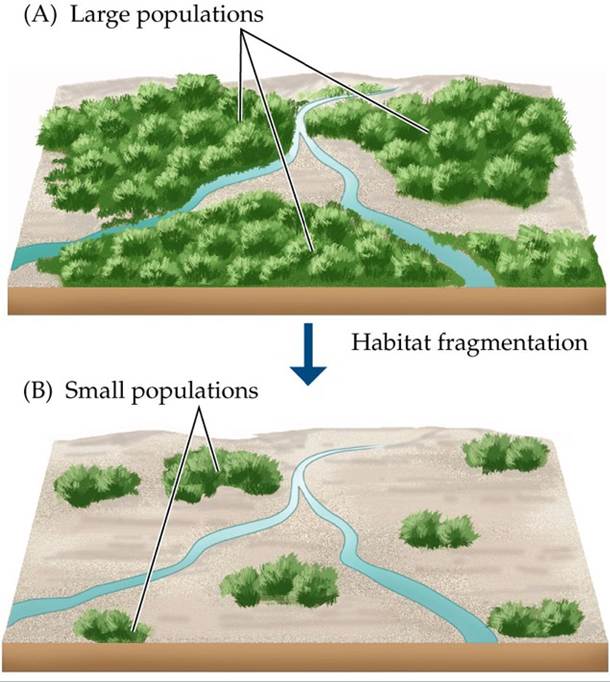
FIGURE 6.25 Evolutionary Effects of Habitat Fragmentation on a Hypothetical
Species (A) Prior to habitat fragmentation, there are many individuals in each population of the species, and the distances between populations are short. (B) When human activities remove large portions of the habitat, the population sizes shrink, and the distances between populations increase, causing evolutionary changes that decrease the potential for adaptive evolution of the species and increase its risk of extinction. Vi6W larger imag6
As another example of human-caused evolution, consider the effects of adding nutrients such as nitrogen from sewage and fertilizers to lakes. Such nutrient inputs can cause the clarity and oxygen concentration of the water to drop (see Concept 22.4), leading to unintended evolutionary effects. For example, nutrient inputs to European lakes have reduced the effectiveness of reproductive barriers that once isolated species of whitefish (Vonlanthen et al.
2012). Murky (low-clarity) waters can hinder the ability of females to recognize males of their own species, thus making it more likely that a female will select a male from another whitefish species as her mate. When interspecific mating is common, a “speciation reversal” can occur in which two previously isolated species fuse into a single, hybrid species. Vonlanthen et al. concluded that nutrient inputs have caused such speciation reversals, leading to the extinction of eight whitefish species. As we'll see in later chapters of this book, such reductions in the diversity of species can have wide-ranging ecological effects.
Human actions also have the potential to alter patterns of evolution over long time scales. For example, the extinction rate of species today is 100 to 1,000 times higher than the usual, or background, extinction rate seen in the fossil record for times when no mass extinction was taking place. Human actions such as habitat destruction, overharvesting, and introductions of invasive species are among the main reasons for this rise in the extinction rate (see Concepts 23.3 and 24.2). Climate change is likely to become a leading cause for extinction in the next several decades. Extinction is forever, so when human actions drive a species to extinction, the future course of evolution is altered in a way that cannot be reversed. If human activities cause a sixth mass extinction in the next few centuries or millennia, our actions will greatly and irreversibly change the evolutionary history of life on Earth.