Ecosystems
The term ecosystem was coined by Prof. Arthur Tansley in 1935. The prefix ‘eco’ means environment, so an ecosystem is an environmental system. Ecosystem refers to a biotic community and its abiotic components put together.
In other words, it includes both the living organisms, i.e. the biotic community and the non-living, i.e. abiotic environment.Each of the biomes can be subdivided into smaller units; these are referred to as ecological systems or ecosystems. It can also be said that the ecosystems are the subdivisions of the biosphere. An ecosystem may be natural (e.g. a pond, a lake, a river, an ocean or a forest) or it may be artificial or man made (e.g. an aquarium, a dam, a garden, an orchard etc.).
2.7.1 Types of Ecosystems
Broadly speaking, the ecosystems are of following two types:
(i) Terrestrial Ecosystems -They include grassland, forest, desert, and cropland ecosystems.
(ii) Aquatic Ecosystems -They include pond, sea etc.
Most of ecosystems are self sufficient for the survival of life, i.e. they contain all the components necessary for life processes.
2.7.2 Components of Ecosystems
An ecosystem has two main components. These are - abiotic components and biotic components.
(i) Abiotic Components
The abiotic components or the non-living or the physical components include the following:
• Soil, water, air and light.
• Inorganic components like carbon, sulphur, calcium, phosphorus etc.
• Atmospheric gases like oxygen, carbon dioxide, nitrogen etc.
• Organic components like amino acids, proteins; these are links between abiotic and biotic components and are synthesised by plants and living organisms by various biochemical procedures.
• Climate and weather conditions like temperature, wind, humidity, heat etc.
(ii) Biotic Components
The biotic components of an ecosystem interact with abiotic components; this interaction is the basis of supporting life.
These include the plants, animals and microorganisms. The organisms are of following types:a. Producers: These are the autotrophic members of the ecosystem and are capable of synthesising their own food from simple substances like carbon dioxide and water in the presence of sunlight. Some examples include certain bacteria and algae etc. Of course, green plants can synthesise their own food by the process of photosynthesis.
b. Consumers: These organisms cannot make their own food but depend on other organisms for food to meet their energy requirements to survive. These are referred to as heterotrophic members of the ecosystem. Examples of consumers are animals and humans which depend on other organisms for the food.
Animals such as goat, cow, deer and insects etc. which eat green plants are called primary consumers or herbivores. Organisms that eat an herbivores like a bird that eats grasshoppers are called secondary consumers. The organisms that eat secondary consumers are called tertiary consumers. The secondary and tertiary consumers are carnivores while the primary consumers are herbivores.
c. Decomposers: Microorganisms which attack the dead bodies of producers and consumers and decompose them into smaller compounds are called decomposers. This process of decomposition also releases inorganic nutrients. Examples of decomposers are certain bacteria and fungi.
The producers, consumers and decomposers interact with each other in many ways. These interactions constitute the food chain.
2.7.3 Energy in Ecosystems
It is well known that energy used for all life processes is derived from sun in the form of solar energy. The flow of solar energy is unidirectional. In the absence of solar energy, the ecosystem is bound to collapse. We know that plants produce their food from carbon dioxide and water with the help of solar energy by the process known as photosynthesis. By this process, the solar energy finds its way as chemical energy into the plants.
During photosynthesis, plants also incorporate in their protoplasm a number of inorganic elements and compounds. So the chemical energy is in the form of carbohydrates, fats and protein. A number of nutrients are also incorporated. When the animals (herbivores or carnivores) consume plant materials, the solar energy find its way into the animals. Finally, when the plants and animals (after death) decay, the nutrients etc. are returned to the soil by the decomposers and are again taken up by plants. In this way, the energy flows. This is exhibited in Fig. 2.3 below.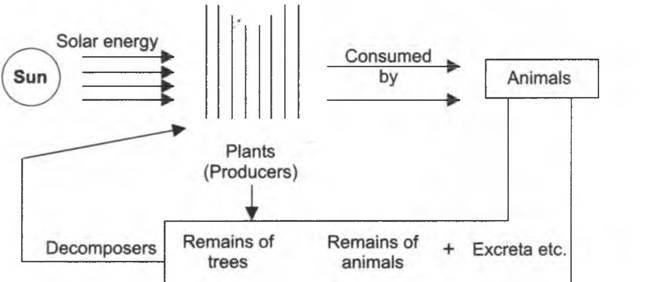
Fig. 2.3: Balancing the eco-system
When the trapped energy (in plants) is transferred to another system (e.g. animals etc.), it undergoes loss at each transfer along the chain. This is governed by the two laws of thermodynamics as given below:
According to the first law of thermodynamics, the energy can neither be created nor destroyed but can only change from one form to another. This is amply clear from the discussions in the above paragraph, wherein it is stated that solar energy is transformed into chemical energy in the plants in the form of carbohydrates etc. Thus, the energy is transformed but not lost. This chemical energy is transformed and used by the cells of the organisms via metabolism for numerous activities.
According to the second law of thermodynamics, par? of the useful energy is degraded into unusable waste as heat energy during every heat transformation; the waste energy escapes into the surroundings.
On the basis of the above, it is concluded that the ultimate source of all energy, which is required for the ecosystem to function, is the solar energy. It has been found that about 30% of the total solar radiation which enters the atmosphere is reflected back by the earth-atmospheric system. The remaining 70% of the radiation is absorbed by the earth’s atmosphere and the surface of the earth. The living world, thus, depends on the flow of energy and the circulation of nutrients through ecosystem.
2.8