Environmental temperatures vary greatly throughout the biosphere, as we saw in Chapter 2.
The Siberian boreal forest described earlier in this chapter represents one extreme of seasonal variation, with as much as an 80°C (144°F) swing from summer to winter. Tropical forests, on the other hand, experience far less seasonal variation in temperature, about 15°C (22°F).
Soil environments, which are home to many species of microorganisms, plant roots, and animals, are buffered from aboveground environmental temperature extremes, although soil surface temperatures may change as much as or more than air temperatures. Aquatic environments also experience temperature changes over seasonal and daily time scales. Open ocean environments tend to have very little temporal variation in temperature, because of the ocean's massive volume and heat capacity. In contrast, tide pools experience large variations in water temperature as the tides rise and fall, with as much as a 20°C (36°F) change over a 5-hour period.The survival and functioning of organisms are strongly tied to their internal temperatures. The extreme upper limit for metabolically active multicellular plants and animals is about 50°C (122°F) (FIGURE 4.7). Some archaea and bacteria that live in hot springs can function at 90°C (194°F) (Willmer et al. 2005). The extreme lower limit for organismal function is tied to the temperature at which water in cells freezes, typically between -2°C and -5°C (28°F-23°F). Some organisms can survive periods of extreme heat or cold by entering a state of dormancy, in which little or no metabolic activity occurs.
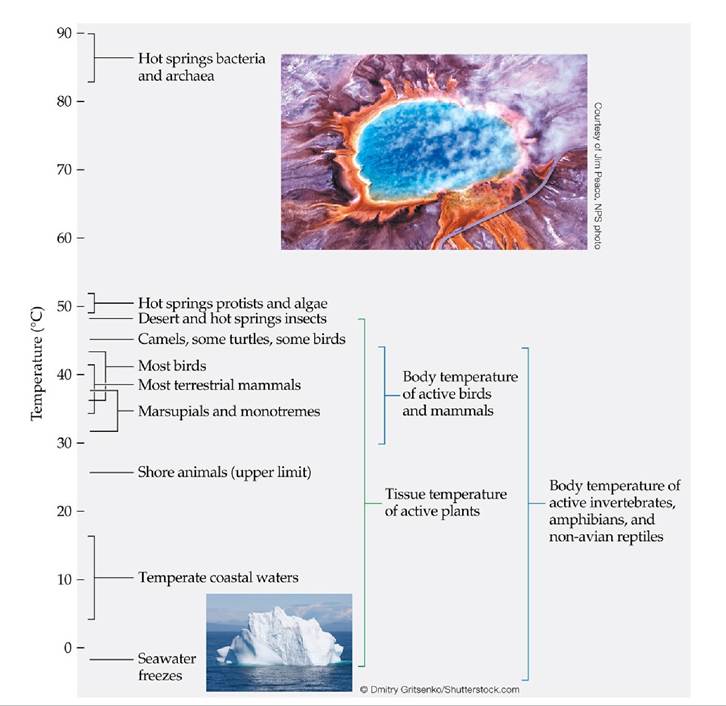
FIGURE 4.7 Temperature Ranges for Life on Earth Living organisms are known to exist in extreme environments, ranging from hot springs to freezing seas. (After P. Willmer et al. 2005. Environmental Physiology of Animals. Blackwell Publishing: Malden, MA.) View larger image
The internal temperature of an organism is determined by the balance between the energy it gains from and the energy it loses to the external environment. Thus, organisms must either tolerate changes in their internal temperature as the temperature of the external environment changes or modify their internal temperature by using some physiological, morphological, or behavioral means of adjusting these gains and losses. Environmental temperatures—particularly their extremes—are therefore important determinants of the distributions of organisms, as demonstrated by the relationship between biomes and global climate patterns discussed in Chapters 2 and 3.