A Fragile Crust: A Case Study
The Colorado Plateau in western North America includes vast expanses of isolated mountains, intricately folded sandstone formations, and deeply cut, multicolored canyons. One of the most unusual features found in this rugged and beautiful region, however, occurs at a very small scale: its patchy cover of dark, convoluted soil (FIGURE 22.1).
On closer examination, the soil looks like a miniature landscape of hills and valleys, covered with black, dark green, and white splotches resembling lichens. The comparison is apt, because this crust on the soil surface, known simply as a biological soil crust (or biocrust), is composed of a mix of hundreds of species of cyanobacteria, lichens, and mosses (Belnap 2003). Approximately 70% of the soils on the Colorado Plateau, a geographic province that covers parts of Utah, Arizona, Colorado, and New Mexico, have some biocrust development. Similar crusts, containing a surprisingly similar suite of species, cover approximately 12% of terrestrial ecosystems globally (Rodriguez-Caballero et al. 2018). The crusty nature of the soil is largely the work of filamentous cyanobacteria, which create a sheath of mucilaginous material as they move through the soil after a rain. When the soil dries out, the cyanobacteria withdraw to deeper soil layers, leaving behind the sheathing material, which helps bind the coarse soil particles together (FIGURE 22.2).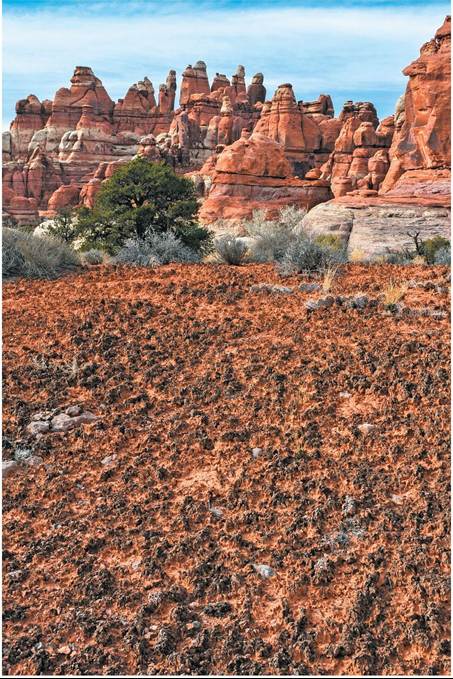
FIGURE 22.1 Biological Soil Crust on the Colorado Plateau Biologicalsoilcrustsarea common feature in the deserts of the Colorado Plateau. The surface topography and coloration of the crust are clearly visible in this photo. Courtesy of William Bowman View larger image
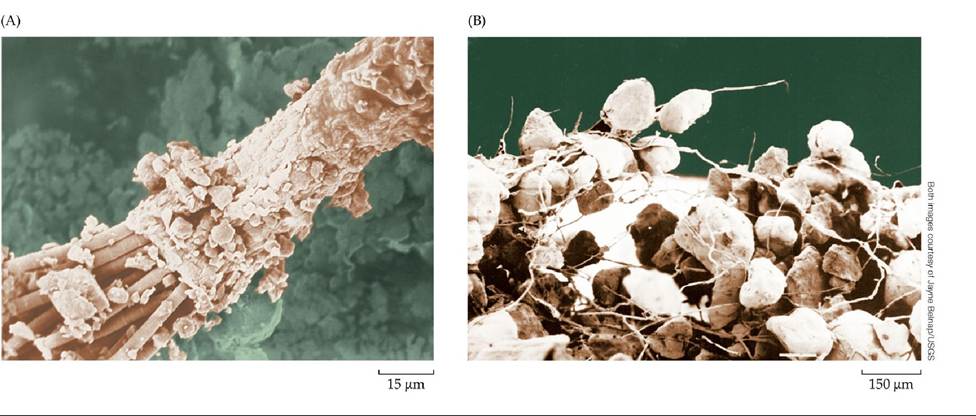
FIGURE 22.2 Cyanobacterial Sheaths Bind Soil into Crusts (A) Cyanobacterial strands surround themselves with a sheath of mucilaginous material as they move through the soil.
(B) The sheaths left behind by the cyanobacteria help to bind soil particles together and protect soils from erosional loss. View larger imageThe soils of the Colorado Plateau are exposed to tremendous climate variation and strong erosive forces (Belnap 2003). Surface temperatures can range from - 20°C (-4°F) in winter to 70°C (158°F) in summer. High evapotranspiration rates often dry out the soils, and the sparseness of the vegetation allows the strong surface winds to carry away fine soil particles. Precipitation in spring and summer often occurs as brief, intense thunderstorms. Biocrusts are critical for anchoring the soil in place in the face of high winds and torrential rains.
Although the Colorado Plateau is sparsely populated, humans have had a large and lasting effect on its landscape. Livestock grazing has been an important use of public lands in the region since cattle were introduced there in the 1880s. Most of the land has been affected to some degree by grazing, which has resulted in the trampling of biocrusts and overgrazing of vegetation. Until recently, grazing was the most important human-associated disturbance in the region. However, an increasing number of off-road vehicles have been using the region. Each year around 3 million people visit Moab, Utah, a town with a year-round population of 5,400. Many of these visitors use all-terrain vehicles, motorcycles, mountain bikes, or hiking to visit the surrounding red rock country. The majority of these users of the desert backcountry obey federal and local laws, staying on designated trails and roads. Unfortunately, some users drive their vehicles off designated roads and across soils covered with biocrusts. The extraction of fossil fuels has also increased substantially over the past several decades with the advent of new technologies (e.g., hydraulic fracturing, or “fracking”).
While the spatial extent of soil surface disturbance associated with off-road vehicle use, fossil fuel extraction, and livestock grazing has not been well quantified, it is clear that a large part of the landscape has been disturbed to some degree during the past 150 years, and that the rate of disturbance is increasing. The recovery of biocrusts following disturbance is extremely slow in arid environments: decades are required for the reestablishment of the cyanobacteria and up to centuries for recolonization by lichens and mosses (Belnap and Eldridge 2001).
What are the implications of the loss of biocrusts for the functioning of desert ecosystems? How important are they to the supply of nutrients in those ecosystems? Given the long-term nature of disturbances associated with livestock grazing across the Colorado Plateau, can we still find areas that can serve as controls for studies of the disturbance that has already occurred?