Genetic analyses are important conservation tools
As we saw in Concepts 6.2 and 11.3, small populations are more likely to go extinct than large populations due to genetic drift and inbreeding, lowering genetic variation and increasing the frequency of deleterious alleles.
A decrease in genetic variation can limit the extent to which a population can evolve in response to environmental change. An increase in the frequency of deleterious alleles is also of concern because it can cause birth or survival rates to drop, thereby decreasing the population growth rate.By increasing the risk of extinction in these ways, genetic problems resulting from small population sizes can hinder efforts to conserve a species. In some cases, conservation biologists have addressed this threat head-on by attempting the “genetic rescue” of populations that otherwise would appear doomed to extinction. Such an effort was used to help preserve the Florida panther (Puma concolor coryi), a subspecies of puma (pumas are also called panthers, cougars, and mountain lions). By the early 1990s, the number of panthers in Florida had decreased to fewer than 25 individuals. Compared with other puma populations, the Florida panther population had low genetic diversity and a high frequency of problems such as heart defects, kinked tails, poor sperm quality, and adult males in which one or both testes failed to descend properly. Models similar to those discussed in Concept 11.3 indicated a 95% chance that the population would become extinct within 20 years.
In 1995, to rescue the Florida panther from genetic decline and likely extinction, biologists captured eight female pumas from populations in Texas and released them in southern Florida. They selected females from Texas because historically gene flow occurred between the Florida and Texas puma populations. The results were striking (Johnson et al. 2010): panther numbers tripled by 2007, levels of genetic variation doubled, and the frequency of genetic abnormalities decreased substantially (FIGURE 23.16).
Increases in panther numbers no doubt were aided by other conservation efforts, including habitat protection and the construction of highway underpasses to reduce mortality from collisions with vehicles, but it is clear that genetic restoration has contributed to the recovery of the Florida panther. The population size has continued to increase, reaching around 200 individuals by 2020. Another example of successful genetic rescue includes the case of the greater prairie chicken (see Concept 6.2).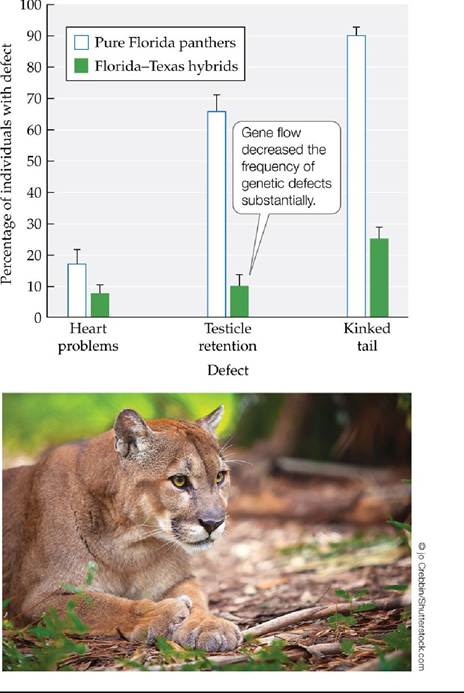
FIGURE 23.16 Genetic Rescue of the Florida Panther Withdepletedgeneticdiversity, frequent genetic defects, and a precariously small population size (fewer than 25 individuals), the Florida panther (Puma concolor coryi) seemed doomed to extinction in the early 1990s. The gene flow that resulted from the translocation of eight females from P. concolor populations in Texas helped to reverse these trends. Error bars show one SE of the mean. (After W. E. Johnson et al. 2010. Science 329: 1641-1645.) View larger image
Genetic rescue is not without risk, however. Introducing populations from other locations to help increase population sizes of endangered species can potentially introduce genes that are maladaptive to the new location and can have the opposite effect than what is desired. For example, ibex (Capra ibex) from the Middle East were introduced into the Tatra Mountains of Czechoslovakia in the 1950s to help rescue declining local populations of ibex (Templeton 1986). Unfortunately, the introduced ibex mated in the fall, rather than in the winter like the local populations. As a result, the young were born in the winter, when food was scarce, rather than in the spring, and the rescue effort failed when the population could no longer sustain itself due to low survival rates of young ibex.
As the Florida panther example suggests, genetic analyses can inform conservation decisions by revealing the genetic diversity present in a species and, in extreme cases, by guiding efforts to rescue a population or species from problems stemming from genetic decline.
Genetic techniques can also be used in forensic applications related to conservation biology. For example, molecular genetic analyses permitted the identification of illegally harvested whale species in meat that was sold in Japan and labeled as either dolphin or (Southern Hemisphere) minke whale, both of which are legal to hunt (Baker et al. 2002). Cycads have also been genetically “fingerprinted,” allowing tracking of these highly valuable and frequently poached plants (Little and Stevenson 2007). In ECOLOGICAL TOOLKIT 23.1, we explore how such “forensic conservation biology” is done and how it was used to track the source of a large shipment of contraband elephant ivory.ECOLOGICAL TOOLKIT 23.1
Forensics in Conservation Biology
As we saw in Concept 23.3, overexploitation of wildlife can lead to population declines across entire continents and throughout the world's oceans. In some cases, conservation biologists or wildlife authorities may know that individuals from protected populations have been captured or killed, but without further information they cannot determine the extent or source of such illegal harvests. This lack of information can make laws that protect threatened species difficult to enforce. Fortunately, in some species, molecular genetic techniques can be used to monitor the extent of illegal harvesting or
trace the source of illegally harvested wildlife products.
As an example, consider the trade in ivory. High demand for ivory led to the widespread slaughter of African elephants (Loxodonta africana), causing their numbers to drop from 1.3 million to 600,000 individuals between 1979 and 1987. As a response to this problem, an international ban on ivory trade was established in 1989. Initially the ban was successful, but soon an illegal ivory trade sprang up, leading to further declines in elephant populations.
The illegal trade in ivory proved hard to combat because even if a shipment was intercepted, it could be difficult to identify where the tusks had come from.
In June 2002, more than 5,900 kg (>13,000 pounds) of ivory were confiscated in Singapore—the largest seizure of ivory since the 1989 ban (FIGURE A). Law enforcement officials suspected that these tusks came from elephants killed in multiple regions of Africa. Were they correct?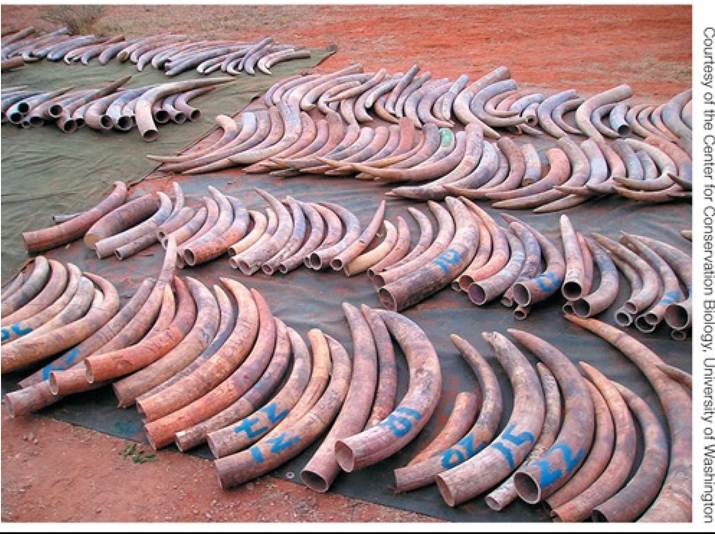
FIGURE A Ivory from the 2002 Seizure in Singapore View larger image
As in some human forensic cases, DNA evidence was used to answer this question. First, DNA was obtained from tusks seized in the June 2002 raid. As you may recall from your introductory biology class, the polymerase chain reaction (PCR) can be used to amplify (i.e., produce many copies of) specific regions of DNA that often differ from one individual to another. Such highly variable DNA segments can then be visualized in a computer scan, as shown in FIGURE B. By amplifying several of these highly variable segments, researchers can create a “DNA profile” that characterizes an individual’s genetic makeup.
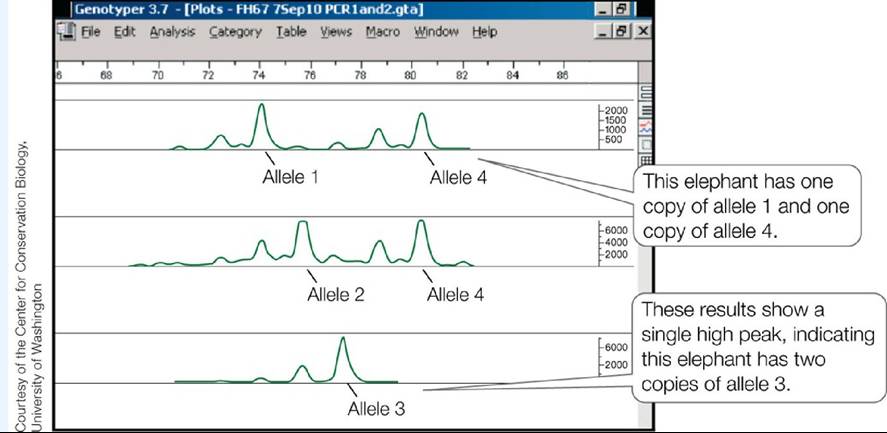
FIGURE B Identifying Individual Elephants DNA from elephant tusks can be analyzed using molecular genetic techniques that detect individual-specific alleles. The graphs show results for three elephants; the highest peak(s) on each graph represent(s) specific alleles. View larger image
To locate the source of the confiscated ivory, Samuel Wasser and colleagues amplified seven highly variable DNA segments and used them to produce a DNA profile for each of 37 of the confiscated tusks. The place of origin of each tusk was then estimated by comparing its DNA profile with those in a reference database of elephant DNA collected from known geographic locations (Wasser et al. 2007). Contrary to what law enforcement officials had originally suspected, the results indicated that all of the tusks came from a relatively small region in southern Africa, centered on Zambia (FIGURE C).
These findings enabled wildlife authorities to focus their investigation on a smaller area and fewer trade routes, and they led the Zambian government to improve its antipoaching efforts. More broadly, the approach described by Wasser and colleagues shows promise in forensic applications designed to limit illegal trade in a wide range of threatened animal and plant species.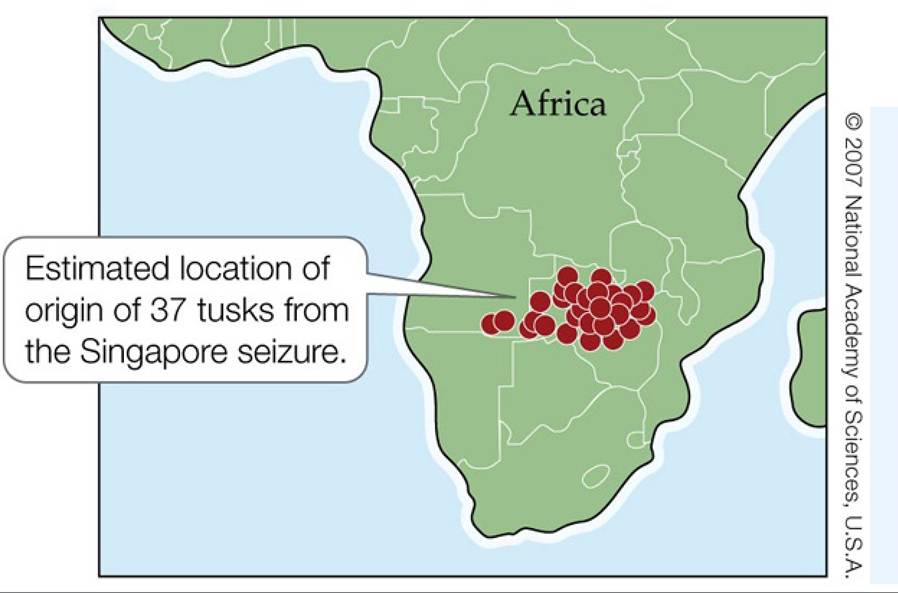
FIGURE C Tracking Contraband Ivory DNA methods indicated that the ivory shown in Figure A came from a relatively small geographic region—a finding that differed from what law enforcement officials had originally suspected. Each red dot shows the estimated location of origin of one individual elephant. (After S. K. Wasser et al. 2007. Proc NatlAcad Sci USA 104: 4228-4233.) View larger image
The availability of molecular genetic tools has enhanced our ability to understand the genetic problems faced by small populations and has helped us to address some of those problems. Let's turn next to some of the ways we can approach conservation at the population level.