Habitats
Habitat can be defined as a location in which a particular organism is able to conduct activities which contribute to survival and/or reproduction. This definition emphasizes the notion that the term habitat is organismspecific; that is, it focuses on the biotic and abiotic factors that affect the survival or reproduction of a particular type of organism, and on the areas that contain these factors.
On our planet, living organisms have acclimated four basic habitats: aquatic, terrestrial, soil and organism as a habitat.Water as a habitat has a variety of peculiar properties such as heavy density, heavy differential pressure, relatively low oxygen, strong absorption of sunburst, etc. Inhabitants of aquatic habitat are hydrobiontes. They inhabit ocean, inland bodies and underground water.
The ocean is categorized by several areas or zones (fig. 2).
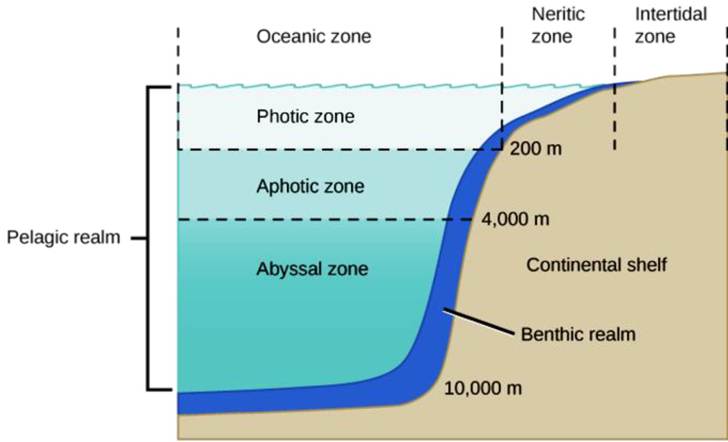
Figure 2 - Oceanic zones
All of the ocean's open water is referred to as the pelagic realm (or zone). The benthic realm (or zone) extends along the ocean bottom from the shoreline to the deepest parts of the ocean floor. Within the pelagic realm is the photic zone, which is the portion of the ocean that light can penetrate (approximately 200 m). At depths greater than 200 m, light cannot penetrate; thus, this is referred to as the aphotic zone. The majority of the ocean is aphotic, lacking sufficient light for photosynthesis. The deepest part of the ocean, the Challenger Deep (in the Mariana Trench, located in the western Pacific Ocean), is about 11,000 m deep. To give some perspective on the depth of this trench, the ocean is, on average, 4267 m deep. These realms and zones are relevant to freshwater lakes as well, as they determine the types of organisms that will inhabit each region.
The main characteristics of aquatic habitat:
> Water-mass density.
The pressure increases with depth about 1*105 Pa (1 atm.) for every 10 m. Water-mass density is the condition of soaring in water and many hydrobionts are adapted precisely to this way of life. Suspended, floating in the water organisms are united in a special ecological group of hydrobionts - plankton ("planktos" - soaring). The plankton consists of unicellular and colonial algae, protozoa, jellyfish, siphonophores, ctenophores, pteropodial and heteropodous mollusks, a variety of small crustaceans, benthic larvae, caviar and fish fry, and many others. A special kind of plankton is the ecological group of neuston ("nein" - to swim) - the inhabitants of the surface water film on the border with the air environment. The animals that are capable of rapid swimming and overcoming the strength of currents are united in the ecological group of nekton ("nectos" - floating). The representatives of nekton - fish, squid, dolphins.> Oxygen condition. In oxygenated water its content does not exceed 10 ml per liter, this is 21 times lower than in the atmosphere. Oxygen enters the water mainly due to photosynthetic activity of algae and diffusion from the air. Therefore, the upper layers of the water column are, as a rule, richer in this gas than the lower ones. The breathing of hydrobionts is carried out either through the surface of the body, or through specialized organs - gills, lungs, trachea. In this case the integument can serve as an additional respiratory organ.
> The salt regime. Maintaining the water balance of hydrobionts has its own specifics. The excessive amount of water in the cells leads to a change in their osmotic pressure and disruption in vital functions. Freshwater forms can not exist in the seas, the sea ones do not tolerate desalination. If the salinity of the water is subjected to change, the animals move in search of favourable environment
> The temperature regime of reservoirs is more stable than on land. The amplitude of annual temperature fluctuations in the upper layers of the ocean is no more than 10-15°C, in continental reservoirs - 30-35 ° C.
Deep layers of water are characterized by a constant temperature. In equatorial waters, the average annual temperature of surface layers is + (26-27)°C, in polar waters - about 0°C and lower. In hot land sources, the water temperature can approach + 100°C, and in the underwater geysers at a high pressure at the ocean bottom the temperature of +380°C is recorded.> Light conditions. Light in the water is much less than in the air. The rapid decrease in the amount of light with depth is due to the absorption of its water. The absorption of light is the stronger, the less the transparency of water, which depends on the number of particles suspended in it.
Terrestrial habitat is the most difficult on environmental conditions. Life on land required such adaptations, which were possible only if the level of organization of plants and animals was sufficient. Inhabitants of terrestrial habitat are aerobiontes.
The basic properties of terrestrial habitat:
> Gas structure of air in ground layer of atmosphere is homogeneous enough concerning the maintenance of the main components (nitrogen - 78,1 %, oxygen - 21 %, argon - 0,9 %, carbonic gas - 0,035 %) because of high diffused abilities of gases and constant intermixture by convection and wind flows.
> Ground properties and land topography also influence living conditions of land organisms, first of all plants. The properties of land surface having ecological influence on its inhabitants are edaphic factors of environment (from Greek «edaphos» - basis, soil).
> Climate features. The long-term mode of weather characterizes district climate. The concept climate includes not only average values of meteorological phenomena, but also their annual and daily course, deviations from it and their repeatability. The climate is defined by geographical conditions of area. For the majority of land organisms, especially small, the climate of area is not so important as conditions of their habitat. Very often local elements of environment (relief, exposition, vegetation, etc.) change the mode of temperature, humidity, light, air movement in a concrete site so that it considerably differs from region climate conditions.
Such local climate modifications in air-ground interface are called microclimate.Soil as a habitat. Soil structure results from the long-term interaction of climate, organisms, topography, and parent mineral material. Soil is a complex mixture of living and nonliving material upon which most terrestrial life depends. Inhabitants of soil are edaphobiontes.
Heterogeneity of conditions in soil is most sharply shown in a vertical direction. With depth a number of the major ecological factors influencing life of inhabitants of soil sharply changes. First of all it concerns soil structure. Soil structure can be observed by digging a soil pit, a hole in the ground 1 to 3 m deep. In a soil pit one can see one of the most significant aspects of soil structure, its vertical layering. Though soil structure usually changes gradually with depth, soil scientists generally divide soils into several discrete horizons. Soil profile is divided into O, A, B, and C horizons (fig. 3).
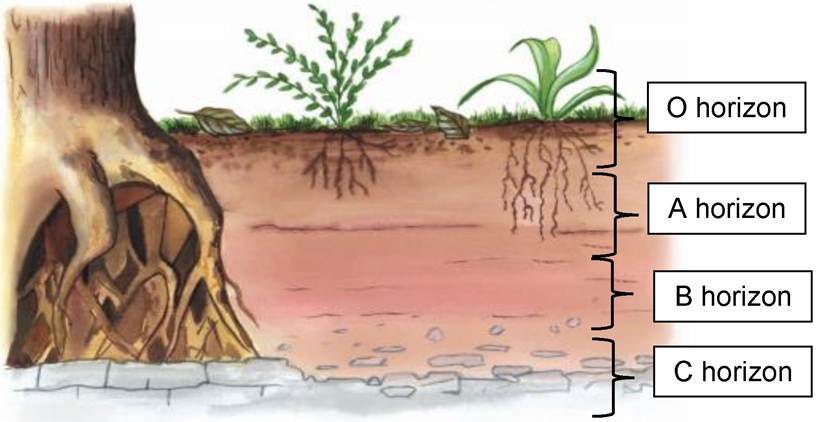
Figure 3 - Generalized soil profile, showing O, A, B, and C horizons
O - upper layer contains loose, somewhat fragmented plant litter. Litter in lower layer is highly fragmented.
A - mineral soil mixed with some organic matter. Clay, iron, aluminium, silicates, and soluble organic matter are gradually leached from A horizon.
B - depositional horizon. Materials leached from A horizon are deposited in B horizon. Deposits may form distinct banding patterns.
C - weathered parent material. The C horizon may include many rock fragments. It often lies on bedrock.
The moisture in soil is in various conditions:
1) combined water (hygroscopical and pellicular moisture) is strongly kept by the surface of soil particles;
2) capillary water occupies small pores and can move on them in various directions;
3) gravitational water fills larger emptiness and slowly filters downwards under the influence of gravity;
4) vaporous water is in soil air.
The structure of soil air is different. With depth the maintenance of oxygen strongly falls and concentration of carbonic gas increases. Because of the presence of decaying organic substances in soil air there can be a high concentration of such toxic gases as ammonia, hydrogen sulphide, methane, etc. While soil flooding or intensive rotting of plant residues, completely anaerobic conditions can arise in some places.
Temperature fluctuations are sharp only on a soil surface. Here they can even be stronger, than in a ground layer of air. However with each centimetre deep into daily and seasonal temperature changes become ever less and on depth of 1-1,5 m practically are not traced any more
Living organisms as a habitat. Many species of heterotrophic organisms throughout their life or part of the life cycle are found in other living beings whose bodies are used as a habitat, significantly different in properties from the outside. Virtually there is not a single species of multicellular organisms that do not have internal inhabitants. The higher the organisation of hosts, the greater the degree of differentiation of their tissues and organs, the more diverse the conditions they can provide to their cohabitants. Inhabitants of organisms are endobionts.