Environmental problems
Our planet is home to millions of different species of plant and animal, which are connected in different ways. Together, they make up the complex world of nature. Unfortunately, co-habiting with humans gives ecological problems.
For thousands of years people lived in harmony with environment. They thought to that natural riches were unlimited. However, with the development of civilization man's interference in nature began to increase. Large cities with thousands of smoky industrial enterprises appear all over the world today. The by-products of their activity pollute the air we breathe, the water we drink, the land we grow grain and vegetables.
Why Do We Have Environmental Problems?
As we run more and more of the earth's natural resources through the global economy, in many parts of the world, forests are shrinking, deserts are expanding, soils are eroding, and agricultural lands are deteriorating. In addition, the lower atmosphere is warming, glaciers are melting, sea levels are rising, and storms are becoming more destructive. And in many areas, water tables are falling, rivers are running dry, fisheries are collapsing, coral reefs are disappearing, and various species are becoming extinct. According to a number of environmental and social scientists, the major causes of these and other environmental problems are population growth, wasteful and unsustainable resource use, poverty, failure to include the harmful environmental costs of goods and services in their market prices, and insufficient knowledge of how nature works.
Ecological problem - this change of the natural environment as a result of anthropogenic influences, leading to disruption of the structure and functioning of nature. Problems associated with discernible human influence on nature, the reverse influence of nature on man and his economy.
Pollution is any influence in the environment that is harmful to the health, survival, or activities of humans or other organisms.
Pollutants can enter the environment naturally, such as from volcanic eruptions, or through human activities, such as burning coal and gasoline and discharging chemicals into rivers and the ocean. The pollutants we produce come from two types of sources. Point sources are single, identifiable sources. Examples are the smokestack of a coal-burning power or industrial plant, the drainpipe of a factory, and the exhaust pipe of an automobile. Nonpoint sources are dispersed and often difficult to identify. Examples are pesticides blown from the land into the air and the runoff of fertilizers and pesticides from farmlands, lawns, gardens, and golf courses into streams and lakes. It is much easier and cheaper to identify and control or prevent pollution from point sources than from widely dispersed non- point sources. There are two main types of pollutants. Biodegradable pollutants are harmful materials that can be broken down by natural processes. Examples are human sewage and newspapers. Nondegradable pollutants are harmful materials that natural processes cannot break down. Examples are toxic chemical elements such as lead, mercury, and arsenic. Pollutants can have three types of unwanted effects. First, they can disrupt or degrade life-support systems for humans and other species. Second, they can damage wildlife, human health, and property. Third, they can create nuisances such as noise and unpleasant smells, tastes, and sights.Ozone Layer Depletion. The ozone layer is an invisible layer of protection around the planet that protects us from the sun's harmful rays. Depletion of the crucial Ozone layer of the atmosphere is attributed to pollution caused by Chlorine and Bromide found in chlorofluorocarbons (CFC's). Once these toxic gases reach the upper atmosphere, they cause a hole in the ozone layer, the biggest of which is above the Antarctic.
Climate change is yet another environmental problem that has surfaced in last couple of decades. It occurs due to rise in global warming which occurs due to increase in temperature of atmosphere by burning of fossil fuels and release of harmful gases by industries.
Climate change has various harmful effects but not limited to melting of polar ice, change in seasons, occurrence of new diseases, frequent occurrence of floods and change in overall weather scenario.Global Warming. Climate changes like global warming is the result of human practices like emission of Greenhouse gases. Global warming leads to rising temperatures of the oceans and the earth' surface causing melting of polar ice caps, rise in sea levels and also unnatural patterns of precipitation such as flash floods, excessive snow or desertification.
Greenhouse effect. Scientists often use the term "climate change" instead of global warming. This is because as the Earth's average temperature climbs, winds and ocean currents move heat around the globe in ways that can cool some areas, warm others, and change the amount of rain and snow falling. As a result, the climate changes differently in different areas.
The "greenhouse effect" is the warming that happens when certain gases in Earth's atmosphere trap heat. These gases let in light but keep heat from escaping, like the glass walls of a greenhouse.
On Earth, human activities are changing the natural greenhouse. Over the last century the burning of fossil fuels like coal and oil has increased the concentration of atmospheric carbon dioxide (CO2). This happens because the coal or oil burning process combines carbon with oxygen in the air to make CO2. To a lesser extent, the clearing of land for agriculture, industry, and other human activities has increased concentrations of greenhouse gases.
Most climate scientists agree the main cause of the current global warming trend is human expansion of the "greenhouse effect" (fig. 1). The greenhouse gases include water vapor, carbon dioxide, methane, ozone, nitrous oxide, and chlorofluorocarbons. Approximately 70% of the solar energy shining on the earth is absorbed either by the atmosphere or by the earth's surface. This energy is reemitted as infrared radiation.
Some of the infrared radiation from the atmosphere is radiated into space, and some is radiated toward the surface of the earth. Most of the infrared radiation from the earth's surface is absorbed by greenhouse gases in the atmosphere and radiated back to the earth's surface. By radiating infrared radiation back to the earth's surface, greenhouse gases trap heat energy and raise the earth's surface temperature.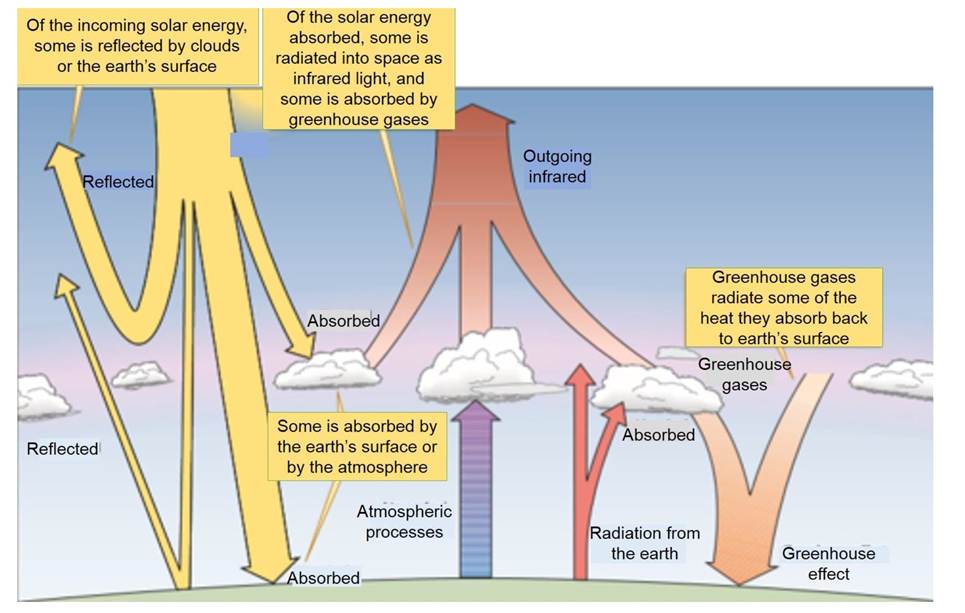
Figure 1 - The greenhouse effect: heat trapping by earth's atmosphere
Overpopulation. The population of the planet is reaching unsustainable levels as it faces shortage of resources like water, fuel and food. Population explosion in less developed and developing countries is straining the already scarce resources. Intensive agriculture practiced to produce food damages the environment through use of chemical fertilizer, pesticides and insecticides.
Loss of Biodiversity. Human activity is leading to the extinction of species and habitats and loss of biodiversity. Ecosystems, which took millions of years to perfect, are in danger when any species population is decimating. Balance of natural processes like pollination is crucial to the survival of the eco-system and human activity threatens the same.
Forests cover about 30% of the planet, but deforestation is clearing these essential habitats on a massive scale. What is deforestation?
Deforestation is clearing Earth's forests on a massive scale, often resulting in damage to the quality of the land.
The world's rain forests could completely vanish in a hundred years at the current rate of deforestation.
The biggest driver of deforestation is agriculture. Farmers cut forests to provide more room for planting crops or grazing livestock. Often, small farmers will clear a few acres by cutting down trees and burning them in a process known as slash and burn agriculture.
Logging operations, which provide the world's wood and paper products, also cut countless trees each year.
Loggers, some of them acting illegally, also build roads to access more and more remote forests - which leads to further deforestation. Forests are also cut as a result of growing urban sprawl as land is developed for dwellings.Not all deforestation is intentional. Some is caused by a combination of human and natural factors like wildfires and subsequent overgrazing, which may prevent the growth of young trees.
Deforestation is alarming, for example, tropical forests support half or more of earth's species and to influence global climate. Eliminating these forests may lead to losses of thousands of potentially useful species and substantial changes in world climate.
Ocean Acidification. It is a direct impact of excessive production of CO2. 25% of CO2 produced by humans. The ocean acidity has increased by the last 250 years but by 2100, it may shoot up by 150%. The main impact is on shellfish and plankton in the same way as human osteoporosis.
Acid rain occurs due to the presence of certain pollutants in the atmosphere. Acid rain can be caused due to combustion of fossil fuels or erupting volcanoes or rotting vegetation which release sulfur dioxide and nitrogen oxides into the atmosphere. Acid rain is a known environmental problem that can have serious effect on human health, wildlife and aquatic species.
Public Health Issues. The current environmental problems pose a lot of risk to health of humans, and animals. Dirty water is the biggest health risk of the world and poses threat to the quality of life and public health. Run-off to rivers carries along toxins, chemicals and disease carrying organisms. Pollutants cause respiratory disease like Asthma and cardiac-vascular problems. High temperatures encourage the spread of infectious diseases like Dengue.
Genetic modification of food using biotechnology is called genetic engineering. Genetic modification of food results in increased toxins and diseases as genes from an allergic plant can transfer to target plant.
Genetically modified crops can cause serious environmental problems as an engineered gene may prove toxic to wildlife. Another drawback is that increased use of toxins to make insect resistant plant can cause resultant organisms to become resistant to antibiotics.Answer these questions:
1. What does the word ecology come from?
2. Have people always understood the importance of their impact on the nature? Prove your opinion.
3. Is ecology a science? Why?
5. Which branches of science is ecology connected with?
7. Was Aristotle one of the first ecologists?
9. Who is often considered a father of ecology? Why?
10. How did ecology develop in the 19th century?
12. What was Suess's contribution to the development?
13. Who redefined the biosphere as the sum of all ecosystems in the 1920s?
14. When did the first ecological damages take place? Why?
15. Since what century has the term ecologist been in use?
16. When did ecology become the science of ecosystems?
17. What role does concentration of atmospheric CO2 play in the regulation of global temperature?
18. How does global warming affect your country?
19. What are the solutions you would advise to minimize greenhouse effect?
More on the topic Environmental problems:
- 1 Agricultural pollution – the problems.
- Background Context
- 3 Obligations as to Husbandry
- Building a GoodJobs Economy
- Introduction
- Agrawal M.. Textbook of Pediatrics. 3rd ed. — CBS Publishers,2025. — 973 p., 2025
- Diagnosis of Bovine Tuberculosis in Zambia
- Bovine Tuberculosis in Uganda
- THE STAIRWAY TO THE SKY
- Fundamental causes of income differences