Management of Hazardous Waste
Hazardous waste is produced in all countries. The amounts of wastes to be managed are enormous. There has been several practices for managing such wastes. The three main challenges in the waste management are as follows:
(i) Produce less waste.
(ii) Convert hazardous substances to less hazardous ones.
(iii) Proper and safe disposal of wastes
These are discussed below in detail:
(i) Reduction in the Amount of Waste
It is the safest and the least expensive option. The amount of hazardous waste generated by manufacturing and other processes can be reduced by changes in the chemical processes involved, equipment used, raw materials used, etc.
Recycling and reuse also eliminates hazardous waste. For example, certain solvents and acids can be recovered and recycled. This practice yields economic benefits both in terms of reducing cost of starting materials and cost involved in the handling of hazardous waste.
Also certain industries can mutually benefit by taking wastes from one industry and using it by another industry as raw materials.
(ii) Conversion to less Hazardous Substances
The toxicity or hazardous characteristics can be reduced by physical, chemical or biological methods.
Physical methods such as absorption on charcoal or resin filters for absorbing toxins can be used. Distillation is also useful at times. Precipitation and immobilization are also helpful in making wastes suitable for long term storage.
Chemical methods such as neutralization, oxidation, reduction, ion - exchange, etc. detoxify the waste.
Biological methods involve the use of bacteria, soil microorganisms and other species in reducing the hazardous characteristics of the waste.
Biodegradation can be accomplished by aerobic and anaerobic methods.
Incineration is a physical method of treatment. It is very important and has many advantages.
It involves heating of the waste to 1200oC for quite sometime to complete destruction. The volume of the waste is reduced by at least 90% and the resulting waste is safer to store in a landfill or other storage site. Incineration removes volatile, combustible and mobile organic matter from the wastes by converting them to CO2, water and other gases. It is a quick, easy and permanent solution for many hazardous wastes and can be used for even mixture of wastes.(Ш) Disposal Methods
The final and ultimate step in the management of hazardous wastes is its permanent storage. But after storing it, we should be able to regularly monitor its safe placement by drawing the samples. The two important methods of disposal are secure landfills and deep - well disposal.
(a) Secure Landfills : Land filling has been a very common and popular option for disposal Ofhazardous waste. But, the landfills should be secure. The modem secure landfills are specially designed for safe disposal of the waste. Such a landfill is shown in Fig. 10.7.
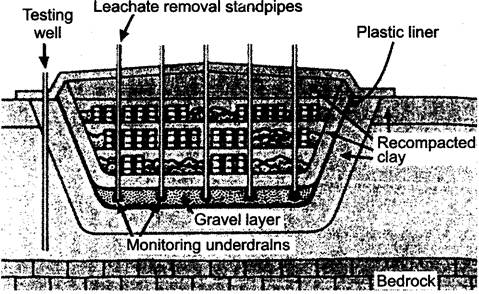
Fig. 10.7 : A Schematic Diagram of a Secure Landfill
The bottom of the ‘secure landfill’ is lined with compacted clay followed by a layer of gravel. The clay is flexible and resists cracking in case the ground shifts. A thick polythene liner is then placed over the gravel layer. A layer of soil or absorbent cushions the inner layers. The wastes are packed in drums and put into the landfill. The filled landfill is then finally covered with clay, plastic and soil. Vegetation is then placed for stabilizing the surface and improving the appearance. Sump well is there to collect the liquids present by leakage of drums, if any, or rainwater filtering into the landfill.
(b) Deep well Disposal : It involves injection of waste into deep wells. The waste is injected into a permeable rock layer several thousand metres below the surface, in geologic basins topped by relatively impervious, fracture resistant rock. This method requires careful monitoring after disposal.
Although, ocean dumping was used for disposal of wastes but due to marine pollution, this practice has been stopped.
10.5