Minerals and atmospheric gases are the ultimate sources of nutrients
All nutrients are ultimately derived from two abiotic sources: minerals in rocks and gases in the atmosphere. Over time, as nutrients are taken up and incorporated by organisms, they accumulate in ecosystems in organic forms (i.e., in association with carbon and hydrogen molecules).
Nutrients may be cycled within an ecosystem, repeatedly passing through organisms and the soil or water in which the organisms live. They may even be cycled internally within an organism, stored or mobilized for use as its needs for specific nutrients change. Here we describe the inputs of nutrients into ecosystems from minerals and the atmosphere. In the following sections, we will complete the steps that constitute nutrient cycling within an ecosystem.Mineral Sources of Nutrients
The breakdown of minerals in rock supplies ecosystems with nutrients such as potassium, calcium, magnesium, and phosphorus. Minerals are solid substances with characteristic chemical properties, derived from a multitude of geologic processes. Rocks are collections of different minerals. Nutrients and other elements are released from minerals in a two-step process known as weathering. The first step, mechanical weathering, is the physical breakdown of rocks. Expansion and contraction processes, such as freeze-thaw and drying-rewetting cycles, act to break rocks into progressively smaller particles. Gravitational mechanisms (such as landslides) and the growth of plant roots also contribute to mechanical weathering. Mechanical weathering exposes greater amounts of surface area of mineral particles to chemical weathering, in which the minerals are subjected to chemical reactions that release soluble forms of nutrients.
Weathering is one of the processes involved in soil development. Soil is formally defined as a mix of mineral particles; solid organic matter (detritus, primarily decomposing plant matter); water containing dissolved organic matter, minerals, and gases (the soil solution); and organisms.
Soils have several important properties that influence the delivery of nutrients to plants and microorganisms. One property is their texture, which is defined by the sizes of the particles that make up the soil. The coarsest soil particles (0.05-2 mm) are referred to as sand. Intermediate-sized particles (0.002-0.05 mm) are called silt. Fine soil particles (accumulate in the soil, and materials are leached and deposited in deeper soil layers. The rate of soil development is dependent on the climate, the parent material, and the organisms associated with the soil.Given what you’ve learned about primary production in Chapter 20 and about the climate factors that determine weathering and soil development in this chapter, what do you think the horizons of a desert soil would look like? (After N. C. Brady and R. R. Weil. 2001. The Nature and Property of Soils. Prentice-Hall: Upper Saddle River, NJ.) View larger image
Climate influences the rates of many of the processes associated with soil development, including weathering, biological activity (such as the input of organic matter from net primary production [NPP] and its decomposition in the soil), and leaching. In general, these processes occur most rapidly under warm, wet conditions. Thus, the soils of lowland tropical forest ecosystems, which have experienced high rates of weathering and leaching for a long time, are poor in mineral-derived nutrients such as calcium and magnesium. A high proportion of the nutrients in lowland tropical forest ecosystems are found in the living biomass of trees, in contrast to most other terrestrial ecosystems, in which these nutrients are mostly found in the soil. When lowland tropical forests are cleared and burned to make way for pastures or cropland, most of the nutrients are lost in smoke and ash and through soil erosion following the fires. As a result, these ecosystems may become severely nutrient-impoverished, and it may take them centuries to return to their previous state.
Soils in higher-latitude ecosystems have lower leaching rates and are usually richer in mineral-derived nutrients.Organisms—primarily plants, bacteria, and fungi—influence soil development by contributing organic matter, which is an important reservoir of nutrients such as nitrogen and phosphorus. Organisms also increase rates of chemical weathering through the release of organic acids (from plants and detritus) and CO2 (from metabolic respiration). Thus, rates of biological activity have a strong influence on the development of soils.
Atmospheric Sources of Nutrients
The atmosphere is composed of 78% nitrogen (as dinitrogen gas, N2), 21% oxygen, 0.9% argon, increasing amounts of carbon dioxide (0.041%, or 416 parts per million, in 2021), and other trace gases—some natural, others pollutants derived from human activities. The atmosphere is the ultimate source of carbon and nitrogen for ecosystems. These nutrients become biologically available when they are taken up from the atmosphere and chemically transformed, or fixed, by organisms. They may then be transferred from organism to organism before returning to the atmosphere.
Carbon is taken up by autotrophs as CO2 through photosynthesis and chemosynthesis. (These processes were described in Concept 5.2, and the global cycling of carbon is discussed in Concept 25.1.) Carbon compounds store energy in their chemical bonds, and they are important structural components of
autotrophs (e.g., cellulose) as well.
Although the atmosphere is a huge reservoir of nitrogen, it is in a chemically inert form (N2) that cannot be used by most organisms because of the high energy required to break the triple bond between the two atoms. The process of taking up N2 and converting it into chemically available forms is known as nitrogen fixation (see Connections in Nature in Chapter 17). Biological nitrogen fixation is accomplished with the aid of the enzyme nitrogenase, which is synthesized by around 150 species of bacteria.
Some of these nitrogen-fixing bacteria are free-living, and others are partners in mutualistic symbiotic relationships (see Figure 15.21). Nitrogen-fixing symbioses include associations between plant roots and soil bacteria, most notably between legumes and bacteria in the family Rhizobiaceae. Legumes “host” rhizobia in special root structures called nodules and supply them with carbon compounds as an energy source to meet the high energy demands of nitrogen fixation (FIGURE 22.5; see also Figure 17.21). In return for supplying the rhizobia with room and board, the plant gets nitrogen fixed by the bacteria. Other examples of nitrogen-fixing symbioses include associations between woody plants such as alders and bacteria in the genus Frankia (called actinorhizal associations), associations between Azolla ferns and cyanobacteria, lichens that include fungal and nitrogen-fixing symbionts, and termites with nitrogen-fixing bacteria in their guts. Humans also fix atmospheric nitrogen when they manufacture synthetic fertilizers using the Haber-Bosch process, in which ammonia is produced from atmospheric nitrogen and hydrogen under high pressures and temperatures using an iron catalyst. The Haber-Bosch process requires substantial energy input in the form of fossil fuels.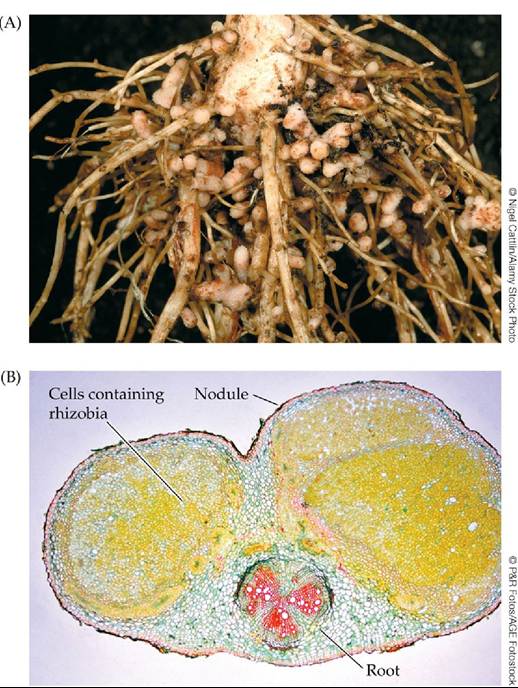
FIGURE 22.5 LegumesFormNitrogen-FixingNodules (A)Theseswollennodulesonthe roots of a red clover (Trifolium pratense) plant contain nitrogen-fixing bacteria. (B) Cells inside this soybean root nodule (yellow in this micrograph) are filled with rhizobia. View larger image
Natural nitrogen fixation also requires a large amount of energy. It consumes as much as 25% of the photosynthetic energy obtained by plants with nitrogenfixing symbiotic partners. Thus, nitrogen fixation provides these plants with a source of nitrogen, but it represents a trade-off with other energy-demanding processes such as growth, defense, and reproduction.
Allocation of energy to nitrogen fixation rather than to growth lowers the ability of nitrogen-fixing plants to compete for resources other than nitrogen. Nitrogen fixation is particularly important during the early stages of primary succession, as we saw in Chapter 17.In addition to carbon and nitrogen, the atmosphere contains fine soil particles (dust) and a collection of suspended solid, liquid, and gaseous particles known as aerosols. Some of this particulate matter enters ecosystems when it falls from the atmosphere because of gravity or in precipitation, a process known as atmospheric deposition. Atmospheric deposition represents an important natural source of nutrients for some ecosystems. Aerosols containing cations derived from sea spray, for example, may be an important source of nutrients in coastal areas. Atmospheric deposition of dust originating in the Sahara is an important input of iron into the Atlantic Ocean and of phosphorus into the Amazon Basin. On the other hand, some ecosystems have been negatively affected by atmospheric deposition associated with human industrial and agricultural activities. Acid rain, for example, is an atmospheric deposition process that has been associated with declines in forest ecosystems in the eastern United States and Europe (as we will see in Concept 25.3).
Now that we've seen how nutrients enter ecosystems, let's follow their movements within ecosystems as they are taken up and transformed. The next two sections will focus on terrestrial ecosystems; we will take a closer look at nutrient cycling in aquatic ecosystems in the final section.