A Natural Experiment of Mountainous Proportions: A Case Study
The eruption of Mount St. Helens was a defining moment for ecologists interested in natural catastrophes. Mount St. Helens, located in Washington State, is part of the geologically active Cascade Range, located in the Pacific Northwest region of North America (FIGURE 17.1).
The once frosty-topped mountain had a rich diversity of ecological communities. If you had visited Mount St. Helens in the summer, you could have seen alpine meadows filled with colorful wildflowers and grazing elk. At lower elevations, you could have hiked across the cool fern- and moss-covered forest floor under massive old- growth trees. You could have swum in the blue, clear water of Spirit Lake, or fished along its shores. But a few minutes after 8:30 a.m. on May 18, 1980, all that was living on Mount St. Helens would be gone. On the north side of the mountain, a huge magma-filled bulge had been forming for months. The bulge gave way that morning in an explosive eruption and the largest avalanche in recorded history.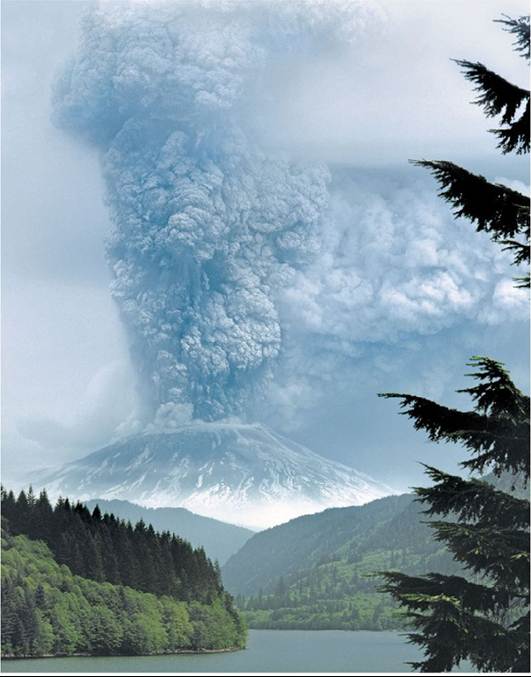
FIGURE 17.1 OnceaPeacefulMountain Before the eruption on May 18, 1980, Mount St. Helens, in southwestern Washington State, had a diversity of communities, including alpine meadows, old-growth forests, and lakes and streams. © Steve Terrill/Getty Images View larger image
Photos of the eruption show that mud and rock flowed down the face of Mount St. Helens and were deposited tens of meters deep in some areas (FIGURE 17.2). The wave of debris that passed over Spirit Lake was 260 m (858 feet) deep and decreased the lake's water depth by 60 m (200 feet). The bulk of the avalanche traveled 23 km (14 miles) in about 10 minutes to the North Fork Toutle River, where it scoured the entire valley, from floor to rim, with material from the volcano and left a truly massive pile of tangled vegetation at its tail end.
In addition to the avalanche, the blast produced a cloud of hot air that burned forests to ash near the mountain, blew down trees over a large area, and left dead but standing trees stretching for miles away from the mountain. Ash from the explosion blanketed forests, grasslands, and deserts located hundreds of kilometers away.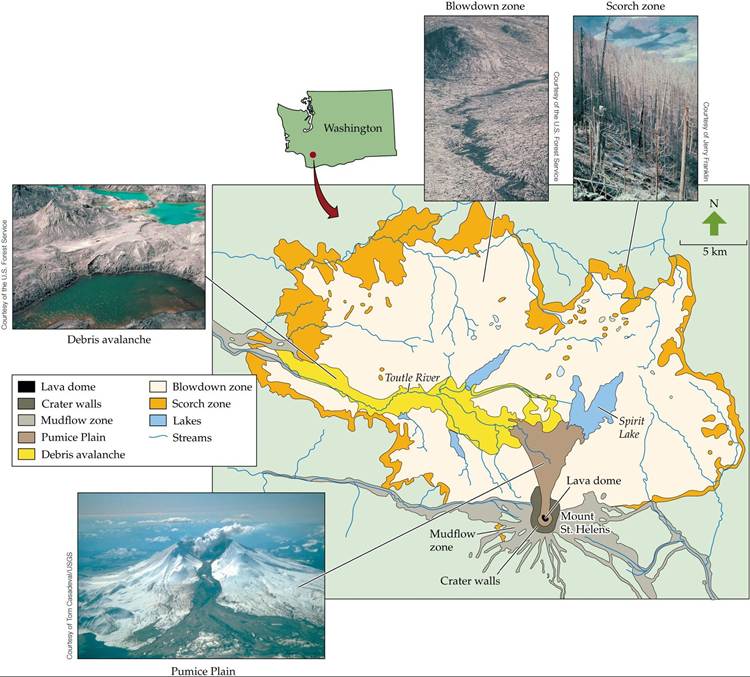
FIGURE 17.2 A Transformed Mount St. Helens Organisms on Mount St. Helens were scorched, pounded by pumice, covered in mud, and blown down by the eruption. The eruption had different effects on the geology of the mountain at different locations, creating many new habitats.
Given that the blast was directed to the north, which habitats experienced the most change and which experienced the least?
(Map after V. H. Dale et al. 2005. Ecological Responses to the 1980 Eruption of Mount St. Helens. Springer: New York.) View larger image
The destruction that ensued on that day created whole new habitats on Mount St. Helens, some of which were completely devoid of any living organisms. At one extreme, there was the Pumice Plain, a large, gently sloping moonscape of a place below the volcano, that had been pelted with hot, sterilizing pumice (see Figure 17.2). This harsh and geologically monotonic environment lacked life, or even organic matter, of any form. All life in Spirit Lake was extinguished, and huge amounts of woody debris were deposited there, some of which still floats on top of the lake today. But, not surprisingly, given the large forests that had surrounded the mountain, the majority of the landscape consisted of downed or denuded trees covered with rock, gravel, and mud tens of meters deep in some places (see Figure 17.2). Compared with the Pumice Plain, this blowdown zone had some hope of a biological legacy buried under the piles of trees and ash.
Shortly after the eruption, helicopters delivered the first scientists to the mountain to begin studying what was essentially a natural experiment of epic proportions. A few lucky ecologists recorded the first observations of the sequence of biological changes that began soon after the eruption. Field excursions in the summers of 1980 and 1981 were organized, and valuable baseline data were collected. Now, more than 40 years later, hundreds of ecologists have studied the reemergence of life on Mount St. Helens. For many, the experience has been life-changing, and their careers have been consumed by research on this fascinating study system. Much of what has been learned has been unexpected and has changed the way we view the recovery of communities and the persistence of life on Earth.