Nemo Grows Up: A Case Study
“Birds do it, bees do it, even educated fleas do it”1—they all produce offspring that perpetuate their species. But beyond that basic fact of life, the offspring produced by different organisms vary tremendously.
A grass plant produces seeds a few millimeters long that can wait, buried in the soil, for years until conditions are right for germination. A sea star spews hundreds of thousands of microscopic eggs that develop adrift in the ocean. A rhinoceros produces one calf that develops in her womb for 16-18 months and can walk well several days after birth, but requires more than a year of care before it becomes fully independent (FIGURE 7.1).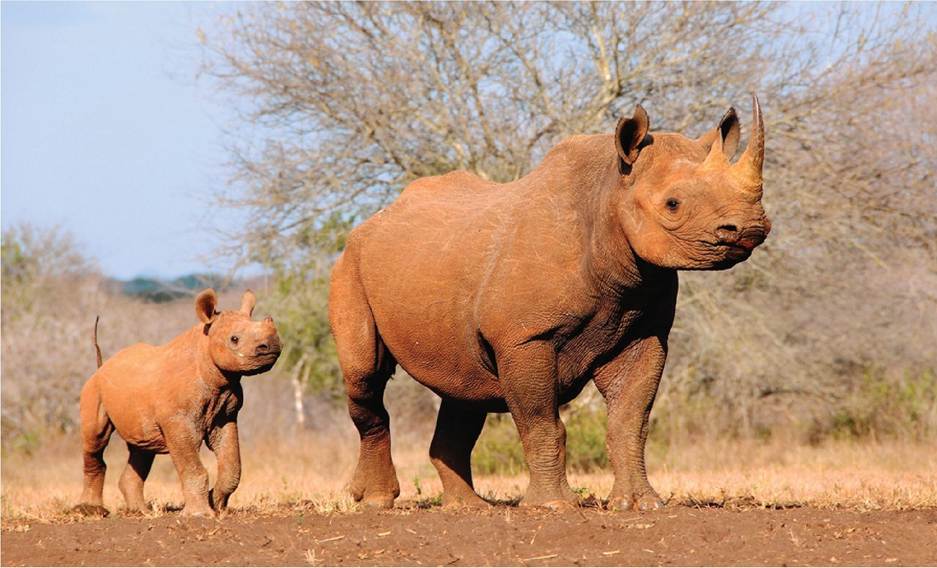
FIGURE 7.1 Offspring Vary Greatly in Size and Number Organismsproducealarge range of offspring numbers and sizes. A rhinoceros produces a single calf that weighs 40-65 kg (90-140 pounds). On the other end of the spectrum, many plants produce hundreds to thousands of seeds that are less than a millimeter long and weigh as little as 0.8 μg (roughly one fifty-billionth the weight of a rhinoceros calf). © Jiri Balek/Shutterstock.com View larger image
Even this broad range of possibilities barely begins to describe the different ways in which organisms reproduce. In popular media, we humans often depict other animals as having family lives similar to ours. For example, in the animated film Finding Nemo, clownfish live in families with a mother, a father, and several young offspring. When Nemo the clownfish loses his mother to a predator, his father takes over the duties of raising him. But in a more realistic version of this story, after losing his mate, Nemo's father would have done something less predictable: he would have changed sex and become a female.
Actually, the correspondence between the movie and biology breaks down long before Nemo loses his mother.
Clownfish spend their entire adult lives within a single sea anemone (FIGURE 7.2). Anemones are related to jellyfish, with a central mouth ringed by stinging tentacles. In what appears to be a mutually beneficial relationship, the anemone protects the clownfish by stinging their predators, but the clownfish themselves are not stung. The clownfish, in turn, may help the anemone by eating its parasites or driving away its predators.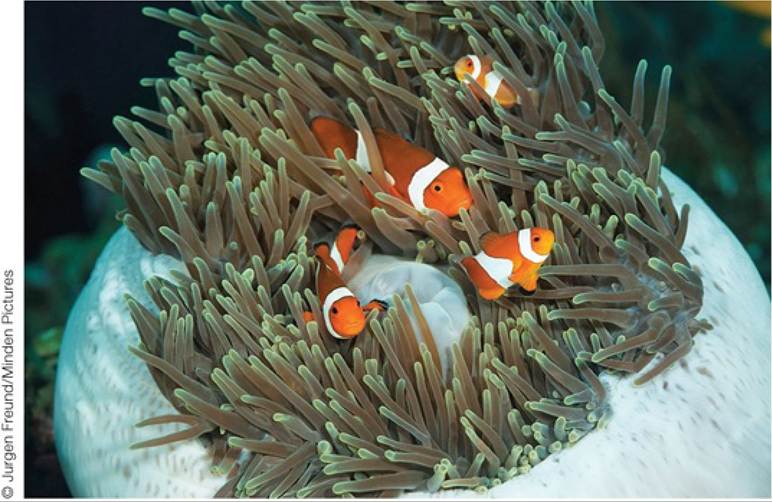
FIGURE 7.2 Life in a Sea Anemone Clownfish (Amphiprion percula) form hierarchical groups of unrelated individuals that live and reproduce among the tentacles of their anemone host (Heteractis magnifica).
Predict the sex of each of these clownfish (assuming that they live together as a group of four fish in an anemone host). Explain your answer.
View larger image
Two to six clownfish typically inhabit a single anemone, but they are far from a traditional human family—in fact, they are usually not related to one another. The clownfish that live in an anemone interact according to a strict pecking order that is based on size. The largest fish in the anemone is a female. The next fish in the hierarchy, the second largest, is the breeding male. The remaining fish are sexually immature nonbreeders. If the female dies, as in Nemo's story, the breeding male undergoes a growth spurt and changes sex to become a female, and the largest nonbreeder increases in size and becomes the new breeding male.
The breeding male clownfish mates with the female and cares for the fertilized eggs until they hatch. The hatchling fish leave the anemone to live in the open ocean, away from the predator-infested reef. The young fish eventually return to the reef and develop into juveniles. Then they must find an anemone to inhabit. When a juvenile fish enters an anemone, the resident fish allow it to stay there only if there is room. If there is no room, the young fish is expelled and returns to the dangers of an exposed existence on the reef.
This life cycle, with its expulsions, hierarchies, and sex changes, is certainly as colorful as the fish that live it. But why do clownfish engage in these complicated machinations just to produce more clownfish? Organisms have arrived at a vast array of solutions to the basic problem of reproduction. As we will see, these solutions are often well suited for meeting the challenges and constraints of the environment where a species lives.
1
- Lyrics from the song “Let’s Do It” written by Cole Porter.