Oxygen concentrations vary with elevation, diffusion, and consumption
There was no oxygen in the atmosphere when life on Earth first evolved, and oxygen was toxic to the earliest forms of life. Even today, there are organisms that are intolerant of oxygen.
However, with the exception of some archaea, bacteria, and fungi, most organisms require oxygen to carry out their metabolic processes and cannot survive in hypoxic (low-oxygen) conditions. Hypoxic conditions can also promote the formation of chemicals (e.g., hydrogen sulfide) that are toxic to many organisms. In addition, oxygen levels are important for chemical reactions that determine the availability of nutrients.Oxygen concentrations in the atmosphere have been stable at about 21% for the past 65 million years, so most terrestrial environments have invariant oxygen concentrations. However, the availability of atmospheric oxygen decreases with elevation above sea level. As we have seen, the overall density of air decreases with elevation, so there are fewer molecules of oxygen in a given volume of air at higher elevations. We will discuss the repercussions of this variation for human health in Concept 4.1.
Oxygen concentrations can vary substantially in aquatic environments and in soils. The rate of diffusion of oxygen into water is slow and may not keep pace with its consumption by organisms. Waves and currents mix oxygen from the atmosphere into ocean surface waters, so its concentration is usually stable there. Oxygen concentrations are low in the deep ocean and in marine sediments, where biological uptake is greater than replenishment from surface waters. The same holds true in deep lakes, lake sediments, and flooded soils (e.g., in wetlands). Oxygen concentrations are highest in freshwater ecosystems with moving water (streams and rivers) because mixing with the atmosphere is greatest there.
A Case Study Revisited
Climate Variation and Salmon Abundance
The research of Steven Hare and Robert Francis on salmon production in the North Pacific contributed to the discovery of the Pacific Decadal Oscillation (PDO).
As noted earlier, the PDO is a multi-decadal shift in sea surface temperature and atmospheric pressure cells. A review of existing records of sea surface temperatures over the past century indicated that the PDO was associated with alternating 20- to 30-year periods of warm and cool temperatures in the North Pacific (FIGURE 2.26A). The length of the phases of the PDO differentiates it from other climate oscillations, whose phases tend to be much shorter (e.g., 18 months-2 years for ENSO). The warm and cool phases of the PDO influenced the marine ecosystems that Pacific salmon depended on and thus shifted salmon production north or south, depending on the phase (FIGURE 2.26B).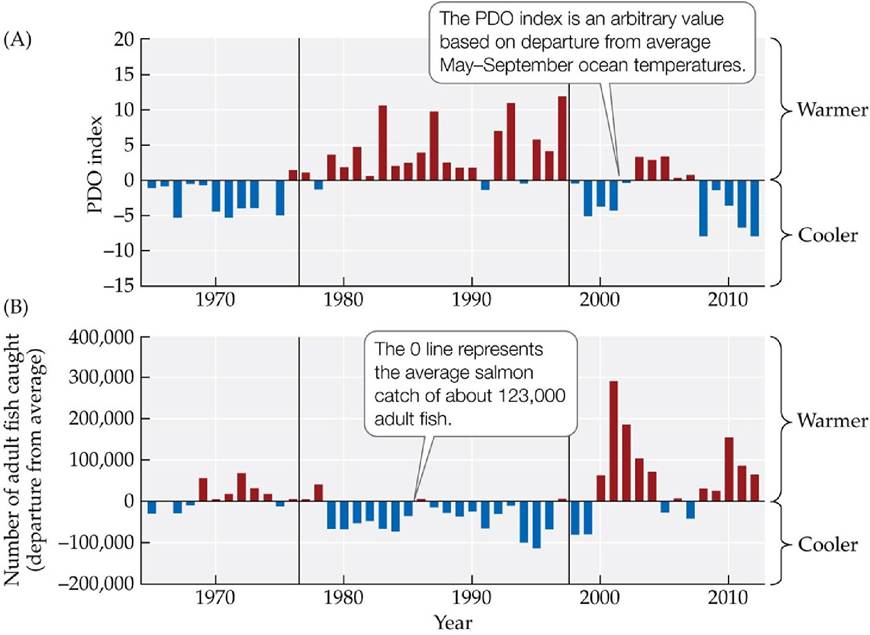
FIGURE 2.26 Effect of the PDO on Salmon Catch in the Northwest United States
(A) Summer average PDO index, 1965-2012. Red and blue bars indicate ocean temperatures that are warmer or cooler than average, respectively. (B) Departures from the average (123,131 fish) in numbers of adult Chinook salmon returning to the Columbia River (Washington and Oregon) to spawn, 1965-2012.
How frequently does the cool phase of the PDO correspond to a greater-than-average catch of salmon? Conversely, how often does a warm phase of the PDO correspond to a lower-thanaverage catch of salmon?
(After W. T. Peterson et al. 2013. Ocean Ecosystem Indicators of Salmon Marine Survival in the Northern California Current. National Marine Fisheries Service: Newport, OR; Seattle, WA.) View larger image
The PDO has been linked to changes in the abundances and distributions of many marine organisms and, through its climate effects, changes in the functioning of terrestrial ecosystems (Mantua and Hare 2002). Its effects have been found primarily in western
North America and eastern Asia, but effects have also been reported in Australia. Thus, the influence of the PDO on climate extends throughout the Western Hemisphere.
Evidence for the existence of climate changes associated with the PDO dates back to instrumental temperature records from the 1850s, and to the 1600s using climate signals from corals and tree rings. The mechanisms underlying the PDO are unclear, but its effect on climate is significant and widespread (TABLE 2.1).TABLE 2.1 Summary of Climate Effects of the Pacific Decadal Oscillation (PDO)
| Climate effect | Warm phase PDO | Cool phase PDO |
| Ocean surface temperature in the northeastern and tropical Pacific | Above average | Below average |
| October-March northwestern North American air temperature | Above average | Below average |
| October-March southeastern U.S. air temperature | Below average | Above average |
| October-March southern U.S./northern Mexico precipitation | Above average | Below average |
| October-March northwestern North American and Great Lakes precipitation | Below average | Above average |
| Northwestern North American spring snowpack and water year (October-September stream flow) | Below average | Above average |
| Winter and spring flood risk in the Pacific Northwest | Below average | Above average |
Source: N. J. Mantua. 2001. In The Encyclopedia of Global Environmental Change, Vol. 1, M. C. McCracken and J. S. Perry (Eds.), pp. 592-594. Wiley: New York.
Connections in Nature
Climate Variation and Ecology
Two aspects of the PDO are particularly important in the context of ecology.
First, the realization that the PDO existed was driven initially by an attempt to understand variation in the size of an animal population. This observation underscores the relationship between physical conditions (the topic of this chapter), the functioning of individual organisms and their growth and reproduction (Chapters 4 and 5), and population and community processes (Units 2 and 5, respectively). This relationship is one of the central themes of ecology that will form a common thread throughout this book. Ultimately, the physical environment, including climate and the myriad factors, such as the PDO, that control it, determines whether an organism can exist in a given location (as we'll see in Chapter 3). Extremes in the physical environment, including those that are driven by climate oscillations, play a critical role in our understanding of ecological phenomena.Second, the time scale of the climate variation associated with the PDO is long relative to the human life span. The abrupt changes in climate, and the associated ecological responses of the marine ecosystem, were therefore perceived by people as unusual events. Indeed, the phases of the PDO may be longer than the life spans of most of the organisms affected by it, limiting their ability to adapt to this climate oscillation. As a result, from the perspective of an ecological community, the PDO represents a disturbance, an event that detrimentally affects the populations of some species and disrupts the community.
Although we don't yet understand what causes it, the PDO has been a part of the climate system for at least the last 400 years. A better understanding of its effects will help us place other climate phenomena, including global climate change, in perspective.