Radioactive Waste
Radioactive waste is unique in nature because radioactive substances exhibit radioactivity i,e., they emit particles and energy in the form of radiation. The adverse effects of radiation on the health of human beings, other organisms and environment are a cause of concern for all.
10.2.1 Types of Radiation and their Characteristics
The emission of radiation is going on since the creation of the universe. The natural sources of radiation are cosmic rays which are high energy protons and electrons coming from the Sun and the space. The amount of cosmic radiation reaching the Earth varies with the altitude. The amount of radiation which can be tolerated by human beings is 0.01 roentgen / day.
Besides cosmic radiation, various radionuclides such as actinium, radium, thorium, uranium and radioactive isotopes of various elements such as carbon and potassium which are widely spread in nature, also emit radiation called terrestrial radiation. Cosmic radiation and terrestrial radiation are together known as background radiation.
In terms of nature of emission, the radiation is of three major types: alpha particles, beta particles and gamma rays. An alpha (α) particle consists of two protons and two neutrons. It is a helium nucleus in other words. The alpha particles have least penetrating power as compared to beta and gamma rays. In human tissues, they penetrate about 0.005 - 0.008 cm. Beta particles are electrons and have mass of 1/1840 of a proton. They are more penetrating than alpha particles. Gamma radiation is the most penetrating of all the three types. It is a form of electromagnetic radiation. Gamma rays travel long distances and are very energetic.
Each radioisotope has its characteristics emissions. Some emit only one type of radiation whereas others emit more than one type. Radioisotopes are those isotopes of an element which spontaneously undergo radioactive decay by emission of radiation.
An important concept associated with radioisotopes is their of half - life. It is the time required for one - half of a given amount of the isotope to decay. Some radioisotopes have very long half - life. For example, U235 has a half - life of 700 million years. Carbon - 14 has a half - life of 5570 years which is an intermediate value. Some other radioisotopes have very small half - life. An example of this category is Po218 which has a half-life of just about 3 minutes.
Various units are used for describing radioactivity. A commonly used unit for radioactive decay is Curie (Ci). It is named after Marie Curie who along with her husband Pierre Curie, discovered radium. They also discovered Polonium which was named after Poland, the homeland of Marie Curie. A curie is the amount of radioactivity from 1 gram of radium - 226 that undergoes about 37 billion nuclear transformations per second.
In the International System (SI) of measurement, radioactive decay is measured in Becqueral (Bq). One Becquerel is activity of a quantity of a radioactive material in which one nucleus decays per second.
Thus, one curie is 3.7 ? IO10 decays per second.
When considering the environmental effects, the actual dose of radiation is important which is measured in rads (rd) and rems. The corresponding SI units of absorbed dose of radiation are grays (Gy) and sieverts (Sv); 1 gray is equivalent to 100 rads and 1 sievert is 100 rem. Rem or sievert denote effective equivalent dose whereas the energy retained by exposed living tissue is called radiation absorbed dose (or rad). While dealing with small doses of radiation, millirem (mrem) or millisievert (mSv) are used. For gamma rays, the commonly used unit is roentgen (R) and the SI unit is Coulomb per kilogram (C∕kg).
10.2.2 Sources OfRadioactive Waste and Radiation
Here, the focus is on emission of radiation and generation of radioactive waste by human activities. These are as follows:
(a) Many radioisotopes are used for medical purposes.
Also, X - rays are used very commonly for diagnostic purposes. Thus, the patients and radiologists face the risk of exposure to radiation. Such an exposure ranges from 0.7 to 0.8 mSv / year.(b) The nuclear explosions carried out both for testing nuclear weapons and their actual use as in Hiroshima and Nagasaki release a large amount of radiation, heat and dust. The radioactive dust falling on the Earth after such explosions is known as radioactive fallout. 137Cs, 131I and 90Sr are some of the radioisotopes produced during nuclear explosions. These, after the nuclear fallout, reach the earth and enter into the food chain. They also undergo biomagnification and have different half-life periods in different organisms.
(c) Nuclear power plants also use radioactive materials for the generation of power. The nuclear fuel cycle starts with the mining and processing of uranium and it has various stages such as enrichment and processing of uranium to controlled fission, reprocessing of spent fuel and disposal of nuclear waste shown in Fig. 10.1. All of these generate some amount ofradiation.
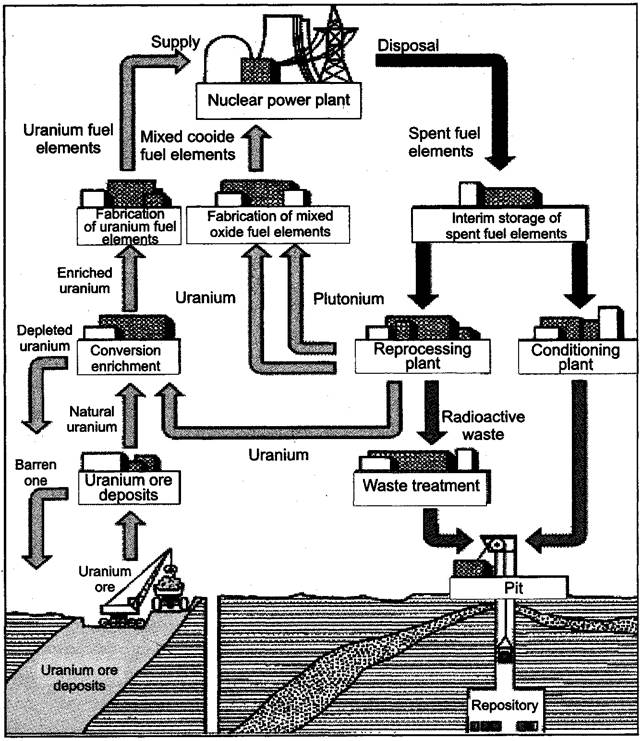
Fig. 10.1: Various Stages of Nuclear Fuel Cycle
The mining and milling operations leave a large quantity of tailings which contain radioactive materials. Similarly, the enrichment and fabrication processes also generate radioactive waste which must be carefully handled. Since the nuclear reactor is the most visible part of the facility, people are more concerned about the location of the plant and the risks or hazards associated with its proximity to their towns.
Certain countries such as India reprocess the spent fuel to recover uranium and plutonium whereas others like USA does not reprocess the spent fuel. The disposal of radioactive spent fuel also poses a lot of problems. At last, the nuclear plants may need modernization or decommissioning after they have been in operation for 20 to 30 years.
Then, the contaminated equipment poses storage and disposal problems.Further, the transport of radioactive materials needs special care. In addition, there is always a possibility of smuggling of weapon grade materials to other countries or to terrorists which must be taken care of.
Inspite of all care and precautions, there may be accidental leak of radioactivity from nuclear power plants. Various such incidents have occurred in the past. They have both immediate and long term effects on human health and environment.
Before knowing the details about these accidents, it would be beneficial to understand the functioning of a nuclear reactor. The generation of power using a nuclear reactor is shown in Fig. 10.2.
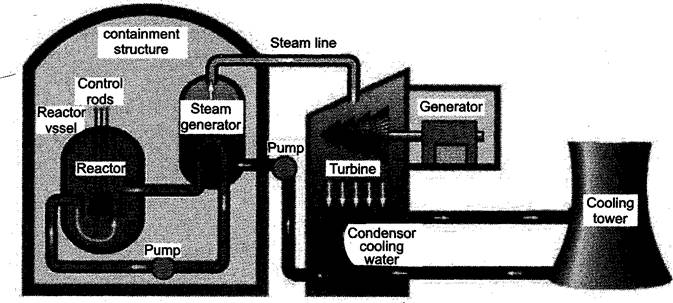
The fission reaction is carried out in the reactor. Its main components being the core, control rods, coolant and reactor vessel. The core comprises fuel and moderator. It is enclosed in a heavy stainless steel reactor vessel: The entire reactor is contained in a reinforced concrete building for extra safety and security.
The enriched uranium pallets are placed in fuel rods. These are packed together into fuel subassemblies in the core. A minimum concentration of the fuel is required to make the reactor critical which means that the chain reaction is self - sustaining. The control rods regulate the chain reaction by capturing the neutrons. When control rods are pulled out, the rate of reaction increases whereas when they are inserted in, the rate of reaction becomes slow. The heat produced by fission reaction is taken away by the coolant. Water can also be used as a coolant. It also functions as a moderator and slows down the fast moving neutrons. The other moderators used are heavy water and graphite.
The rest of the assembly contains pump, condenser, turbine and generator which use the heat produced during nuclear fission to generate steam and then electricity.
10.2.2.1 Accidents at Nuclear Power Plants
Although the chances of nuclear power plant accidents are very low, but accidents do happen and cause an irreversible damage. Some such accidents are described below:
(a) Three Mile Island, Harrisburg, USA
This accident occurred on 28th March 1979. During the night, the reactor 2
(Fig. 10.3) was working on full power when the cooling water supplies were cut off and begin to drain out. The operators, who were unaware about this, shut off the emergency pumps. This caused the overheating of the reactor which came Close to meltdown. However, the situation was controlled and 100,000 people had to evacuate the surrounding area. The accident released radioisotopes and radiation of ImSv into the environment. However, the radiation was intense near the site. Even on third day after the incident, 12mSv / hour was recorded near the site. The authorities were, however, not prepared to deal with the situation. Also, the long - term effects of the low doses of radiation were not known. However, this incident created an awareness about the importance of tackling emergency situations like this and better management of the nuclear power plants.
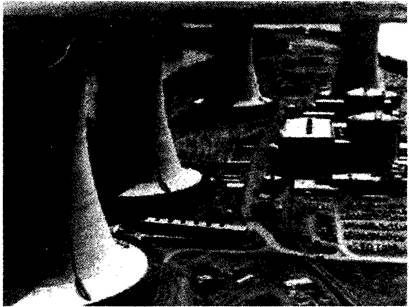
Fig. 10.3: The Reactors at Three Mile Island. Source: Wikipedia
(b) Wind Scale / Sellafield, UK, 1957
A major fire broke out at Windscale plutonium production plant which caused contamination in vegetation and milk supplies of adjoining area due to radiation leak. However, most of the radioactivity was trapped in the filter of the chimney in the plant (Fig. 10.4). The accident was kept confidential for 30 years. In 1973 also, there was contamination problem and the plant was shut down. A decade later, accidental discharge of radioactive ‘crude’ took place into the Irish Sea which was discovered by Green peace.
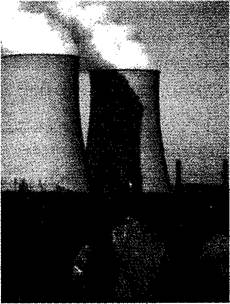
Fig.
10.4: Windscale reactor(c) Chernobyl, Ukraine, 1986
On April 26, 1986, the control rods of the fourth reactor were pulled out during the night shift as a part of deliberate but unauthorized experiment. The temperature of the reactant core went extremely high. The graphite in the core caught fire and this melted the part of the fuel. The pressure of hydrogen built up, led to the cracks in die ceilings and explosions removed the top of the building above the reactor. The fire produced a cloud of radioactive particles which went about 5000 ft in the atmosphere (Figi 10.5(a) and (b)).
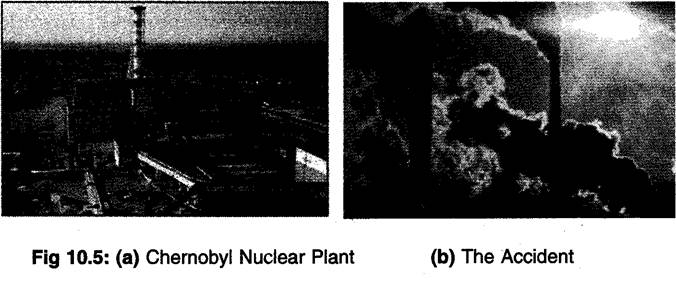
The radioactive cloud spread north-westwards and affected a large area of Ukraine, Byelorussia, Russia and Northern Europe. When high levels of radioactivity were recorded by workers of the nuclear power plant in Sweden, the accident became known to the public.
It was reported that 237 people suffered from acute radiation sickness and 31 people were dead. In the 30 km zone, approximately 115,000 people were evacuated and about 24,000 people received an average radiation of 0.43Sv. However, a total of about 3 billion people in the Northern Hemisphere received varying amounts of radiation. The radiation exposure would cause about 16,000 more deaths in 50 years time due to long term effects of radiation. Also, it is being observed that later, people were suffering from diseases like leukemia, thyroid, cancer, etc. due to radiation exposure.
The vegetation of the area within 7 km of the power plant was severely damaged. The pine trees showed the presence of radioactivity even after four years of the accident. The contamination of soil and water made the area inhabitable. It was estimated that the total cost of the accident would cross $ 200 billion. It was the biggest nuclear power plant accident happened so far. The studies oh long-term effects on exposure to radiation are still going on.
The above accidents have raised many questions about the safety and proper handling of the nuclear power plants. Even with best of the solutions, the risk of accidents would always be there and in case the accident occurs, the damage to the mankind would be enormous.
10.2.3 EffectsofRadiation
Since radiation has high energy associated with it, it can break the chemical bonds of any medium through which it passes. When radiation passes through living cells, it breaks the molecules present in them. The biological effects of radiation can be classified as somatic or genetic effects.
(a) SomaticEffects
The direct effects of radiation on body cells and tissues are called somatic effects. They may be immediate or delayed. They often include the conversion of normal cells to cancer cells and other changes that lead to a decline in life expectancy. A dose of400 - 500 roentgen* on whole body is fatal in about 50% of the cases. Large doses can lead to radiation sickness which shows vomiting, diarrhoea, nausea and often death. The delayed effects take some time to develop and include leukemia, cardiovascular disorders, eye cataracts, premature aging and reduced longevity.
* : Roentgen, a unit for measuring the dose of radiation is the amount of X-rays
or γ-rays which will produce ions charging electrostatic unit of electricity in 1 cubic centimetre of air.
(b) GeneticEffects
Genetic effects change the genetic make up of sex cells and they are transferred to the offspring. Radiation can damage chromosomes, genes and DNA which may induce cancer.
10.2.4 Management of Radioactive Waste
The radioactive waste is generated as a result of various activities associated with power generation using nuclear reactors, fuel processing plants, hospitals and research institutions. In addition to this, tailings which are materials removed by mining activity but not processed and remain at site, also constitute hazardous waste and need management.
Radioactive waste may be classified as high - level waste or low - level waste.
A high - level waste is extremely toxic and demands urgent attention. The spent uranium fuel comes under this category of waste. When the uranium - 235 concentration decreases from 3% to 1%, it can no longer be used for power generation and is called spent fuel. The splitting of U235 gives radioactive isotopes of smaller elements. However, some uranium atoms also capture neutrons to form heavier elements like plutonium. These heavier - than - uranium, i.e. transuranic elements take longer time to decay. They remain in high - level waste f∂r thousands of years to come. For example, Plutonium - 239 has a half - life of24,000 years whereas the smaller fission fragments such as strontium - 90 and cesium - 137 have half - lives of about 30 years.
Reprocessing separates residual uranium and unfissioned plutonium from fission products. These can again be used as fuel.
High-level wastes are hazardous to humans and other life forms. They have high radiation levels which are fatal even if the direct exposure is for short time. For example, even after ten years, the surface dose rate of a spent fuel assembly exceeds 10,000 rem / hour whereas the fatal whole body dose for humans is about 500 rem.
Also, if the high level waste components enter into ground water or rivers, they can enter into food chains.
Low-level wastes have sufficiently low concentrations of radioactivity. If handled properly, they do not pose much environmental hazard. Low-level waste includes residuals or solutions from chemical processing, solid or liquid plant waste, sludges and slightly Contaminatedequipment, tools, plastic, glass, wood and other materials. They are commonly disposed of in near-surface facilities and are monitored regularly from safety point of view.
The high-level radioactive waste is generally stored in geologic formations. The associated points which need to be considered for storage are as follows:
(a) Identification of proper storage sites which meet the criteria of ground stability and slow movement of ground water.
(b) Intensive survey for determination of geologic and hydrologic characteristic of the site.
(c) Prediction of future changes of variation in climate, ground water flow, erosion and earth movements for such sites.
(d) Correctness of the above predictions over thousands of years since the high level wastes would be stored there for such long periods of time.
Many geologic formations have remained undisturbed for million of years. It seems feasible to isolate radioactive wastes from the environment by burying in these repositories. Such a storage facility must be built at least 600 metres below the surface in a stable geologic formation. The location should be checked with respect to various factors such as rock type, rock strength, earthquake activity, ground water movement, surface characteristics, etc. The radioactive waste is solidified into a durable, leach resistant material such as vitrified glass. The solidified waste is sealed in corrosion resistant containers which are placed in the repository having a corrosion resistant lining. The repository is filled with additional material which have high sorptive characteristics.
The burial under deep-sea trenches is also one alternative for radioactive wastes. But again objections were raised for sea dumping because it would lead to concentration of radioactivity in marine organisms and hence eventually the entire food chain would be affected.
In India, the survey and exploration of uranium, thorium, rare metals and rare earths etc. is done by Atomic Minerals Directorate for Exploration and Research (AMD). The uranium mines are located at Jadugada, Bhatin and Naruapahar - all in Jharkhand. The mining and processing of uranium ores and mineral sands are done by the Uranium Corporation of India Ltd. (UClL) and Indian Rare Earths Ltd. (IREL), respectively.
There are seven heavy water plants under the Heavy Water Board. The fabrication of fuel bundles for power reactors is done by the Nuclear Fuel Complex (NFC), Hyderabad. The fuel reprocessing plants are located at Trombay, Tarapur and Kalapakkam.
The low medium level wastes are retreated in eco-friendly ways. The high level wastes which are generated in very small quantities are immobilized in glass matrix by vitrification. A Waste Immobilisation Plant (WIP) is in operation at Tarapur and two more plants are coming up at Trombay and Kalapakkam. The vitrification process involves the use of sodium borosilicate glass matrix with some modifiers. The process has been developed by BARC. This storage facility can store the radioactive waste generated by the operation of two nuclear reactors of 220 MWe capacities each for 40 years. The waste management facilities also exist at Rajasthan and Kalapakkam. The safety aspects such as radiological safety, industrial safety, occupational health, fire safety and environmental protection are all taken care of. The safety standards are at par with those recommended by various international bodies such as International Atomic Energy Agency (IAEA) and the International Commission on Radiological Protection (ICRP).
The Atomic Power Stations at Tarapur, Narora, Kakrapara and Kalapakkam have obtained the Environmental Management System (EMS) certification as per ISO -140001.
10.3