The field of conservation biology arose in response to global biodiversity losses
Scientists have long been aware that human activity affects the abundances and distributions of organisms. In the nineteenth century, Alfred Russel Wallace, the “father of biogeography” whose work we described in Concept 18.2, foresaw the current biodiversity crisis, warning in 1869 that humanity was at risk of obscuring the record of past evolution by bringing about extinctions.
In the United States, there was a rising public outcry over the rapid decline of bison in the West, the stunning harvest to extinction of the passenger pigeon (FIGURE 23.3), the extensive use of bird feathers in ladies' hats, and other assaults on animal populations.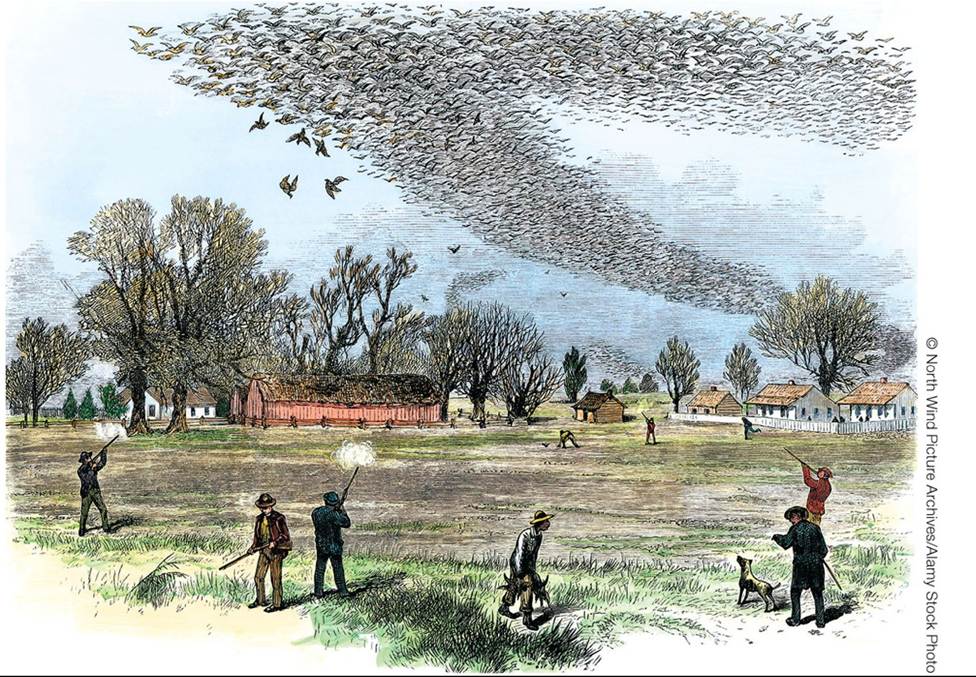
FIGURE 23.3 The Passenger Pigeon: From Great Abundance to Extinction The passenger pigeon (Ectopistes migratorius), once one of the most abundant birds in North America, was hunted extensively in the nineteenth century. The last passenger pigeon died in the Cincinnati Zoo in 1914. The ecological effects of its extinction on the eastern deciduous forest, coincident with the loss of the American chestnut (see Concept 13.4), are difficult to estimate but are presumed to be considerable. View larger image
Ecologists in the United States in the first half of the twentieth century were divided over how strongly they could advocate for the preservation of nature while still maintaining scientific objectivity (Kinchy 2006). Before 1945, the Ecological Society of America frequently lobbied Congress for the establishment of national parks or for better management of existing parks. In 1948, however, the society decided to separate “pure” science from advocacy, and the Ecologists' Union branched off as an independent entity focused on the preservation of nature. In 1950, this offshoot organization changed its name to
The Nature Conservancy, rising in prominence as a nonprofit organization that integrates science with advocacy and on-the-ground conservation work (Burgess 1977).
Conservation biology emerged as a scientific discipline in the early 1980s as ecologists and other scientists saw the need to apply their knowledge to the preservation of species and ecosystems. The Society for Conservation Biology, founded in 1985, arose in response to the biodiversity crisis. The emergence of professional journals dedicated to conservation biology during the 1980s and 1990s, and an ongoing increase in the number of academic programs for the training of graduate students and professionals, demonstrate the growing acceptance of and need for this specialized discipline.