The First Farmers: A Case Study
Humans first began to farm about 10,000 years ago. Agriculture was a revolutionary development that led to great increases in the size of our population as well as to innovations in government, science, the arts, and many other aspects of human societies.
But people were far from the first species to farm. That distinction goes to ants in the tribe Attini, a group of 210 species, most of which live in tropical forests of South America. These ants, known informally as the attines or fungus-growing ants, started cultivating fungi for food at least 50 million years before the first human farmers (FIGURE 15.1).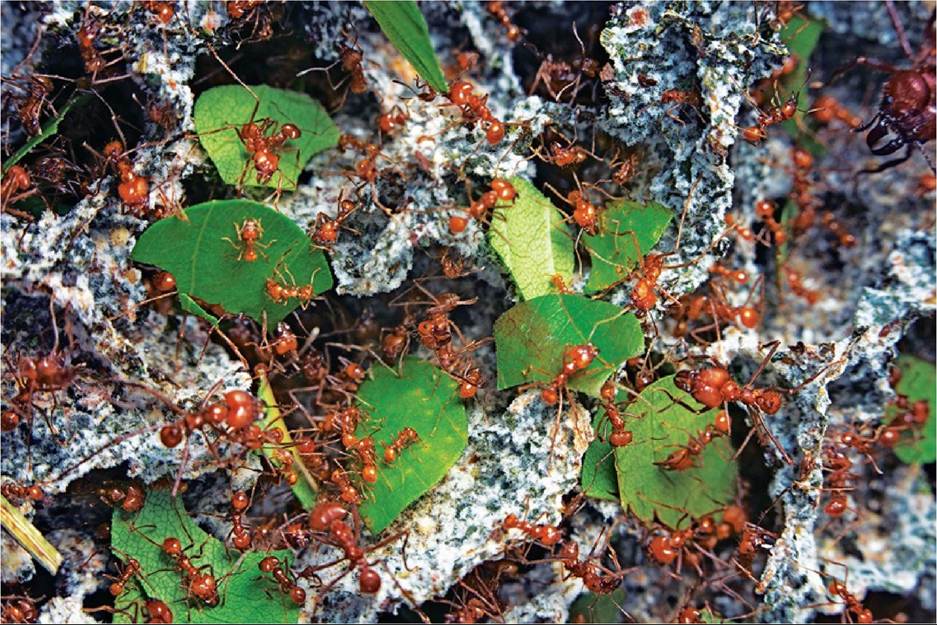
FIGURE 15.1 Collecting Food for Their Fungi Fungus-growing ants (Atta cephalotes) in
Costa Rica carry leaf segments to their colony, where the leaves will be fed to the fungus (the gray material) the ants cultivate for food. © Martin Dohrn/Minden Pictures View larger image
Like human farmers, the ant farmers nourish, protect, and feed on the species they grow, forming a relationship that benefits both the farmer and the crop. The attines cannot survive without the fungi they cultivate; many of the fungi depend on the ants as well. When a virgin queen ant leaves her mother's nest to mate and begin a new colony, she carries in her mouth some of the fungi from her birth colony. The fungi are cultivated in subterranean gardens (FIGURE 15.2). An ant colony may contain hundreds of gardens, each roughly the size of a football; these gardens can provide enough food to support 2-8 million ants. Some attines occasionally replace the fungi in their gardens with new, free-living fungi that they gather from surrounding soils. Other species, such as leaf-cutter ants in the genera Atta and Acromyrmex, do not cultivate fungi found in the environment.
Instead, the fungi in their gardens come only from propagules passed from a parent ant colony to each of its descendant colonies.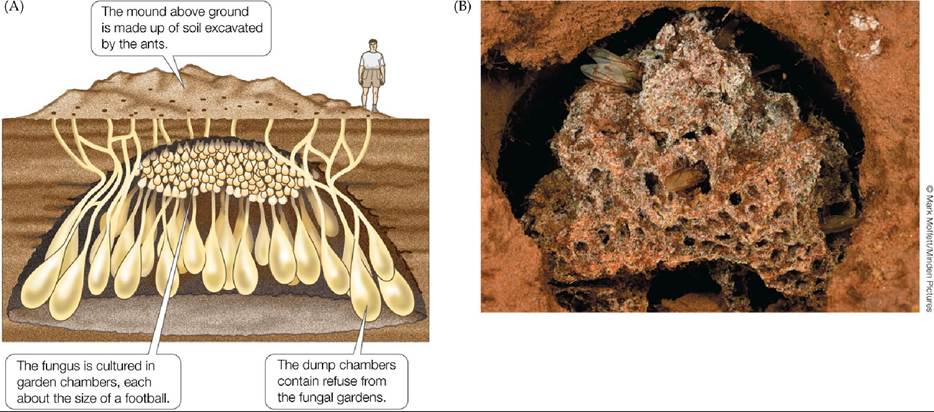
FIGURE 15.2 The Fungal Garden of a Leaf-Cutter Ant (A) A diagrammatic representation of a large Atta leaf-cutter ant colony. (B) This photo shows a cutaway view of a garden chamber in
a central Paraguay colony of the leaf-cutter ant Atta laevigata. Inside the chamber is a specialized structure called a gongylidia, which is produced by the cultivated fungus and eaten by the ants. (A after B. Holldobler and E. O. Wilson. 1990. The Ants. Belknap Press of Harvard University Press: Cambridge, MA; modified from J. C. M. Jonkman, in Weber 1979.) View larger image
As their name suggests, leaf-cutter ants cut portions of leaves from plants and feed them to the fungi in their gardens. Back at the nest, the ants chew the leaves to a pulp, fertilize them with their own droppings, and “weed” the fungal gardens to help control bacterial and fungal invaders. In turn, the cultivated fungi produce specialized structures, called gongylidia, on which the ants feed. The partnership between leaf-cutter ants and fungi has been called an “unholy alliance” because each partner helps the other to overcome the formidable defenses that protect plants from being eaten. The ants, for example, scrape a waxy covering from the leaves that the fungi have difficulty penetrating, while the fungi digest and render harmless the chemicals that plants use to kill or deter insect herbivores.
But all is not perfect in the gardens. Nonresident fungi, which themselves would benefit from ant cultivation, periodically invade leaf-cutter ant colonies. Furthermore, pathogens and parasites that attack the cultivated fungi occasionally outstrip the ants' ability to weed them out. What prevents such unwanted guests from destroying the gardens?