THE PRECAUTIONARY PRINCIPLE
Fisheries
Fishing involves the risks that catch levels will cause fish populations to collapse and that by catching one species other species may be adversely affected. The magnitudes of these risks are unknown because of scientific and management uncertainties.
The ability of scientists to calculate just how many fish can be caught without jeopardising fish populations is limited:Scientific uncertainties arise because ecosystems are complex and dynamic, and subject to long-term change as well as chaotic and chance events. These factors contribute to uncertainty in predicting stock recruitment, the responses of fish stocks to changing fishing effort, or the interactions between fisheries and other aspects of the environment. (JNCC 2005)
It is difficult to assess existing population numbers, let alone how far they can safely be reduced. One fisher claimed that assessing fish numbers 'is like counting sheep from a helicopter on a cloudy day' (Walker 2005). Assessing populations of fish species is 'an imprecise and difficult task' because there are considerable variations over time, due not only to overfishing but also to climatic variation and ecological effects. This means that estimates can be 20-30 per cent inaccurate. What is more, estimates made by fishing people are often quite different from those made by scientists (DEFRA 2003: 18).
Fish recovery
The managers of fisheries, and designers of ITQ systems, assume that when fish numbers start to decline, it is just a matter of reducing the allowable catch and stocks will rebound to former levels. However, the evidence for this is mixed. In some cases population numbers do recover, although not necessarily to their full healthy state. For example, after stocks of Peruvian anchovy collapsed in the early 1970s they recovered to 60 per cent of their former numbers by the 1990s.
But English salmon have never recovered from overfishing in the nineteenth century, nor have herring stocks in the North Sea recovered since a moratorium was put in place in the late 1970s. 'In other words, no one really knows to what extent fish stocks can recover from overfishing' (Hagler 1995: 74).Yet on the basis of the assumption that stocks do recover, scientists work out a maximum sustainable yield (MSY), which is the maximum amount of fish that can be caught in any one season that will still enable fish numbers to recover to the level they started at:
Essentially, MSY is a form of brinkmanship in which fishery managers attempt, as a matter of principle, to extract maximum yields from a natural resource, on the assumption that, if they get it wrong one year, they will be able to get it right the next. (Hagler 1995: 75)
MSY calculations usually do not take account of the time it may take a long-lived fish like the cod or the orange roughy to re-establish their numbers. Nor do they take account of species interactions, migration patterns, marine pollution, or the destruction of fish breeding grounds such as coral reefs and seagrass beds often caused by fishing trawlers (Hagler 1995: 75).
The MSY estimated by scientists is typically less than half the natural level of the population. A precautionary approach, on the other hand, would require that 'fisheries stocks must be maintained at levels of abundance which are not substantially below their range of natural fluctuation'. It would also ensure that some areas of habitat would be off limits for trawlers and especially for fishing gear that comes in contact with the sea bottom (Earle 1995: 70).
Management response
On top of the scientific uncertainties are the management uncertainties - how will different regulatory policies change fishing behaviour and will fishers comply with the policies? A precautionary approach requires fisheries managers to be able to adapt to new information quickly.
If it is found that fish numbers are declining to unsustainable levels, controls need to be implemented quickly to reverse the situation. This is difficult with a system of individual transferable fishing rights.It can take an ITQ management system some time to react and adjust total allowable catches, mainly because of the opposition from vested interests created through the allocation and trading of quotas (DEFRA 2003: 18). In New Zealand 'the final decision on TACs seems to owe more to the lobbying of the powerful fishing industry than to the best science available or the concerns of conservationists'. What is more, the TAC is often exceeded because of loopholes in the rules that allow fishers to have their unfilled quotas for one year carried over to the next, or make 'surrender payments' for excess (Duncan 1995: 99-101).
In Australia, where 17 out of 74 commercial fish species are overfished, government is having to buy fishers out at a cost of $220 million, which includes $149 million to buy back their licences (Darby 2005).
Incidental damage
A further uncertainty in scientific assessments of sustainable catches arises from the way they are based on officially recorded fish landings - which do not take account of by-catch, discarded fish and misreported landings. As we saw in the previous chapter, ITQ systems provide an incentive to cheat and misreport their catches, and by-catch can be significant: 'Scientists now receive more figures than ever before, but those figures are less reliable than ever' (Hannibalsson 1995).
Discards and by-catch may be very significant to an ecosystem. But because scientists know little about how fish species interact and because they focus on population numbers of specific commercial species, they do not take account of by-catch in their estimates of maximum sustainable yield. A precautionary approach would be more interested in overall fish mortality than in ensuring that a fleet was economically efficient and profitable and so counting only the fish caught for legal sale (JNCC 2005).
The incidental damage caused by modern fishing technology is also neglected by tradeable fishing quota systems. The impacts of trawlers on the marine environment, for example, are well documented. The precautionary principle requires that new fishing equipment and technologies be evaluated before being permitted to operate (Earle 1995: 70).
Water trading
Rivers and waterways require certain water flows at particular times to ensure the ecological health of the ecosystems of which they are part. Water trading is based on the assumption that rivers have the capacity to deal with a certain amount of water extraction without long-term ill effect. It is that capacity, like the assumed assimilative capacity of the air and water to take pollutants, that water trading seeks to allocate.
This is not a precautionary approach. It assumes that the amount of water that can be extracted without long-term ecological consequences can be accurately determined. However, as with other trading schemes, the capacity of a river system to deal with extraction of water is highly uncertain. It varies considerably with changes in climate, particularly in a country like Australia, where droughts are common.
Proponents of water trading argue that the environment can be protected by the appointment of environmental managers, who can manage an allocation for the environment, selling water during droughts at high prices and buying it back for the environment at low prices during flood times. It is argued that this would simulate actual environmental conditions - but it is doubtful whether any such manager would have the experience and knowledge to predict with any certainty when the environment needed water - and how much - and when it did not (Brennan amp; Scoccimarro 1999: 79). Nor would the periods of need necessarily coincide with periods of lower prices.
As with fisheries, a precautionary approach requires water managers to be able to adapt to new information quickly.
By giving water allowances the status of rights, it becomes difficult for the authorities to reduce allocations in the face of extraordinary weather conditions or new evidence that river flows need to be increased for ecological reasons. The existence of entitlements shifts the burden of proof back to the government, rather than requiring water users to carry it as the precautionary principle would require (Robinson amp; Ryan 2002: 23).Mitigation, stream and conservation banks
Mitigation banks are like carbon sinks in that they are supposed to offset damage done elsewhere and expand the ability of the environment to assimilate damage by replacing functions that are being destroyed. However, like the science of carbon sinks, the science of mitigation banks is highly uncertain, particularly when scientists try to recreate ecosystems such as wetlands.
Recreating nature
It is only by creating new wetlands that degraded or destroyed wetlands can be truly replaced without overall loss. However, wetland creation is most likely to result in failure, according to the Society of Wetland Scientists. This is because of the difficulty of recreating, from its components, a fully functioning ecosystem that has evolved over thousands of years and includes 'animal and plant communities that reflect precise relationships between wet and dry conditions'. Environmental scientists agree that wetland creation is experimental at best and claim that 'a priceless original is too often bargained away for a cheap counterfeit' (Roberts 1993; SWS 2005; Zinn 1997).
Perhaps the biggest gap is in the understanding of the interaction of soil, surface water, and groundwater on which the ecosystem depends. Getting it right, says Zedler, is a 'crap shoot.' And while it's easy to figure out which plants to bring in, where to put them - specifically, at what elevation - is not so clear. Planting them a few inches too high or too low, in relation to the tidal regime, can spell death to a newly introduced plant population.
(Roberts 1993)The enhancement and restoration of conservation areas is also problematic, particularly in situations where 'enhancement' involves the introduction of new species and plants which may do more harm than good. Additionally, a replacement wetland in another location seldom replaces the functions of the wetland being destroyed, because the functions that served depended on its location in the watershed and on the surrounding water uses.
Similarly, stream mitigation is of uncertain value because 'the dynamism and scale associated with streams often make it difficult to identify and rectify disturbances to their biological, chemical and hydrological functions'. This problem is exacerbated by the problems associated with equivalency and replacement value, that is, in deciding whether one stretch of water is equivalent to another. For example, 'a road construction project could affect 1,000 linear feet of a stream you'd need a canoe to cross, and for mitigation, the state highway department could purchase credits for 1,000 linear feet of a restored mountain brook that your child might jump across' (Gillespie 2005).
The assumption that humans can 'recreate ecological functions' and 'move them around the landscape, and yet not lose a part of our environment that we might not yet fully understand' is a dangerous one. Steve Moyer from Trout Unlimited, which is dedicated to protecting and restoring trout and salmon habitat, argues that some projects that impact on streams should never be permitted. Mitigation banking enables authorities to approve such projects in the false confidence that they can be replaced by an artificially maintained stream somewhere else (Gillespie 2005).
In the event of failure
Mitigation banking is supposed to overcome the problem of wetlands destruction by achieving the mitigation in advance of selling the credits, but often this does not happen. It can take several years for the success or failure of a wetland to be known, and commercial ventures cannot wait. The Environmental Law Institute (ELI) found that in the USA 92 per cent of mitigation banks sell credits before the wetlands have become fully functional and 42 per cent of credits are sold before any performance criteria have been achieved (ELI 2002a).
If a mitigation bank fails, not only is the original wetland lost but also the one that was supposed to replace it. Mitigation banks are subject not only to ecological failure but also to economic failure where they are owned by private entrepreneurs. Businesses go out of business all the time but mitigation banks are supposed to last forever. While most mitigation banks have contingency plans for such events, around one in four do not: 'only 31 percent of the banks with contingency plans specify potential enforcement mechanisms' (ELI 2002a). This is an important consideration, for even though 91 per cent of conservation banks are motivated by financial goals, many are not making a profit (see figure 15.1).
Figure 15.1 Economic success of conservation banks
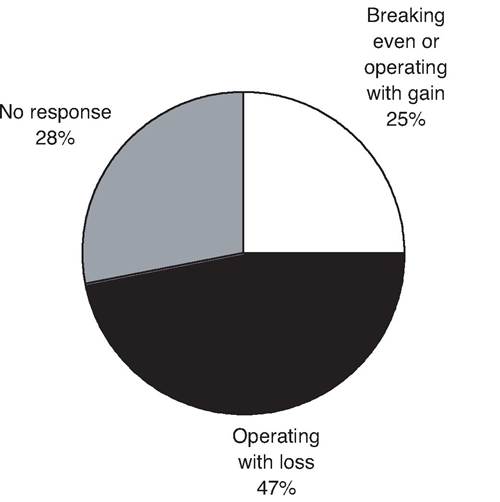
Source (Fox and Nino-Murcia 2005: 1004)
The Western Australian EPA suggests that a larger area of ecological value needs to be offset than that being destroyed to cover the risk that the offset area will fail to provide the environmental benefits expected. Making an area larger does not necessarily improve the chances of success, however. The EPA suggests in that case that the '[r]isks of failure could be reduced through, for example, putting offsets in more than one location' (WAEPA 2005: 10). 'The decision of whether to permit the destruction of a wetland', argues wetland scientist Mary Kentula, should 'be based on whether we can afford to lose that system', not on whether we think we might be able to replace it (quoted in Roberts 1993).
The uncertainty about whether mitigation will adequately replace wetlands lost through development means that regulatory authorities are supposed to insist on avoidance and minimisation of damage to existing wetlands wherever possible before considering mitigation as an alternative. 'Minimization might include redesigning or scaling back aspects of a proposal, or limiting proposed modifications to a portion of the project site' (Zinn 1997). Environmentalists, however, are concerned that having the easy option of mitigation banks available will mean that regulatory authorities will not take the precautionary approach, which is to avoid or minimise damage to sensitive ecosystems.