Toolmaking Crows: A Case Study
Humans employ a multitude of tools to enhance our ability to gather food to meet our energy needs. We use a highly mechanized system of planting, fertilizing, and harvesting crops to feed ourselves or the livestock that we consume.
For thousands of years, we have used specialized tools to increase our efficiency of hunting prey, including spears, bows and arrows, and rifles. We view our toolmaking capacity as something that differentiates us from other animals.However, we humans are not alone in using tools to enhance our food acquisition ability. In the 1920s, Wolfgang Kohler, a psychologist studying the behavior of chimpanzees, observed that chimps in captivity made tools to retrieve bananas stashed in areas that were difficult to reach (Kohler 1927). Jane Goodall, a prominent primatologist, reported observing chimpanzees in the wild using grass blades and plant stems to “fish” for termites in holes in the ground and in decaying wood (FIGURE 5.1). Although these reports challenged the commonly held belief that modern humans were the only makers of tools to enhance food acquisition, it was perhaps comforting to those clinging to this notion that the observations were associated with one of our closest extant relatives. No one would ever have suspected similar behavior in birds, touted as one of the least intelligent vertebrates, as evidenced by the dubious insult “birdbrain” exchanged between humans.

FIGURE 5.1 NonhumanToolUse This chimpanzee uses a plant stem as a tool to forage for termites. Chimpanzees were the first nonhuman animals documented using tools to forage for food. © Anup Shah/Minden Pictures View larger image
The corvids, a family of birds that includes crows, ravens, magpies, jays, and jackdaws, enter our cultural heritage with a reputation for being clever.
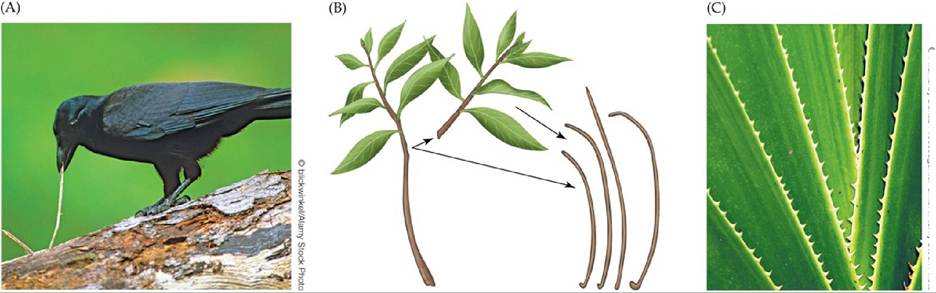
Even so, the discovery that crows use food-collecting tools manufactured from plants was unexpected. Gavin Hunt reported in 1996 that the crows (Corvus moneduloides) of New Caledonia, an island in the South Pacific, used tools to snag insect larvae, spiders, and other arthropods and pull them from the wood of living and decomposing trees (Hunt 1996) (FIGURE 5.2A). Hunt found that individual birds used one of two types of tools, either (1) a hooked twig fashioned from a shoot stripped of its leaves and bark (FIGURE 5.2B) or (2) a serrated leaf clipped from a Pandanus tree (FIGURE 5.2C). Both tools were thereforemanufactured, rather than just collected from materials lying on the ground.
© Prisma by Oukas Presssegentur GmbHZAIamy Stock Pfioto
FIGURE 5.2 Tools Manufactured by New Caledonian Crows (A)Crowsusethetoolsthey make to probe for food in the cavities and crevices of trees. (B) Hooked twig tools, made from shoots of trees. The birds use their bills to form the hook while holding the stick with their feet. (C) The crows also can create tools from the serrated leaves of Pandanus plants. (B after G. R. Hunt. 1996. Nature 379: 249-251.) View larger image
Hunt described a unique foraging style used by the New Caledonian crows. The birds probed tree cavities or areas of dense foliage using their tools as extensions of their bills. The birds used the tools repeatedly, carrying them from tree to tree. The presence of hooks on both types of tools suggested an innovative element that might increase the birds' efficiency in extracting prey from their refuges in the trees. The tools also appeared to be uniform in their construction; Hunt examined 55 tools manufactured by different birds and found that they differed little. When New Caledonian crows were captured and brought into the laboratory, they made hooked tools from wire, and experiments showed that the tools increased their food retrieval efficiency (Weir et al. 2002).
Toolmaking at a skill level equivalent to that shown by the crows appeared in humans only in the late Stone Age, approximately 450,000 years ago (Mellars 1989). How have these birds achieved a similar level of sophistication in their tool construction? The high numbers of New Caledonian crows using tools, and the consistency in the construction of the tools, indicate a cultural phenomenon —a skill learned socially within a population of animals—that had never before been observed in birds. How much of an energetic benefit do the crows gain by using tools rather than just their bills?