Toxins in Remote Places: A Case Study
The Arctic is considered one of most pristine regions on Earth. Human effects on its environment are thought to be slight relative to those in the temperate and tropical zones, where the vast majority of humans live.
Thus, the Arctic is one of the last places one would expect to find high levels of pollutants in living organisms.In the mid-1980s, Eric Dewailly, a toxicologist, was studying concentrations of polychlorinated biphenyls (PCBs) in the breast milk of mothers in southern Quebec. PCBs belong to a group of chemical compounds called persistent organic pollutants (POPs) because they remain in the environment for a long time. POPs originate from industrial and agricultural activities and from the burning of industrial, medical, or municipal wastes. Exposure to PCBs has been linked to increased incidence of cancer, impaired ability to fight infections, decreased learning ability in children, and lower birth weights in newborns.
Dewailly was seeking a human population from a pristine area that could be used as a control in his study. He enlisted the help of some Inuit mothers from Arctic Canada. The Inuit are primarily subsistence hunters, and they have no developed industry or agriculture that would provide direct exposure to POPs (FIGURE 21.1). Dewailly therefore assumed that Inuit mothers would have few or no PCBs in their breast milk, providing a benchmark against which to compare populations in more industrialized areas.
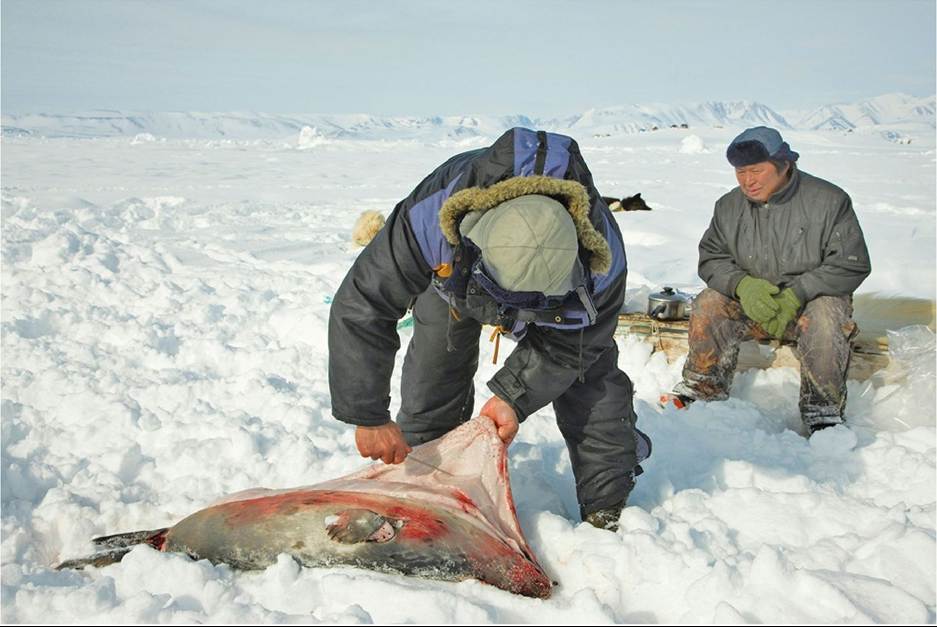
FIGURE 21.1 SubsistenceHunting Inuit hunters skin a seal they have successfully hunted in a remote, very sparsely populated Arctic region. © blickwinkel/Alamy Stock Photo View larger image
What Dewailly found was startling: the Inuit women had concentrations of PCBs in their breast milk that were seven times higher than those in women of southern Quebec (FIGURE 21.2) (Dewailly et al.
1993). These alarming findings were reinforced by the work of Harriet Kuhnlein, who at the same time found that approximately two-thirds of the children from an Inuit community in northeastern Canada had PCB levels in their blood that exceeded Canadian health guidelines (Kuhnlein et al. 1995). More extensive surveys found that POPs were widespread in Inuit populations. As many as 95% of the people in Inuit communities of Greenland had blood levels of PCBs that exceeded health standards (Pearce 1997).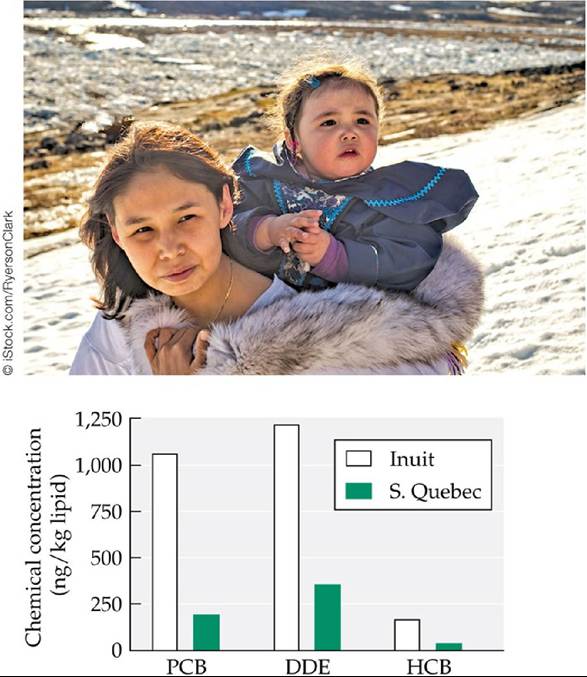
FIGURE 21.2 Persistent Organic Pollutants in Canadian Women ThebreastmilkofInuit mothers from Arctic Canada was found to contain substantially higher concentrations of polychlorinated biphenyls (PCBs) and two other POPs—dichlorodiphenyldichloroethylene (DDE, a pesticide similar to DDT) and hexachlorobenzene (HCB, an agricultural fungicide)—than that of mothers from southern Quebec. (After E. Dewailly et al. 1993. Environ Health Perspect 101: 618-620.) View larger image
How were these toxins finding their way into the Arctic environments where the Inuit live? The POPs that were found in the tissues of Inuit populations occur in gaseous form at most environmental temperatures. Produced in lower-latitude industrial areas, these compounds enter the atmosphere under warm temperatures, but when carried by winds into the colder regions of the Arctic, they condense into liquid forms and fall from the atmosphere, sometimes in snowflakes. The manufacture and use of most POPs has been banned in North America since the 1970s. Some developing countries continue to produce POPs, however, and they are important sources of the compounds found in Arctic regions. Although emissions of POPs have decreased, these compounds may remain in Arctic snow and ice for many decades, being released slowly during snowmelt every spring and summer.
While the source of the POPs was known, the high concentrations of these compounds in the Inuit were a mystery. The concentrations of POPs in their drinking water were not high enough to explain this phenomenon. One hint came from the correlation between the levels of the toxins in people and their preferred diets. Communities that had traditionally relied on marine mammals for their food tended to have the highest levels of POPs, while communities that consumed herbivorous caribou had lower levels. We will discover the ecological basis for this difference as we trace the flow of energy and materials through ecosystems in this chapter.