Trophy Hunting and Inadvertent Evolution: A Case Study
Bighorn sheep (Ovis canadensis) are magnificent animals, beautifully suited for life in the rugged mountains in which they are found. Despite their substantial size (males can weigh up to 127 kg, or 280 pounds), these sheep can balance on narrow ledges and can leap 6 m (20 feet) from one ledge to another.
Bighorn sheep are also noted for the male's large curl of horns, which are used in combat over females (FIGURE 6.1). Rams run at speeds of up to 20 miles per hour and crash their heads into each other, battling over the right to mate with a female.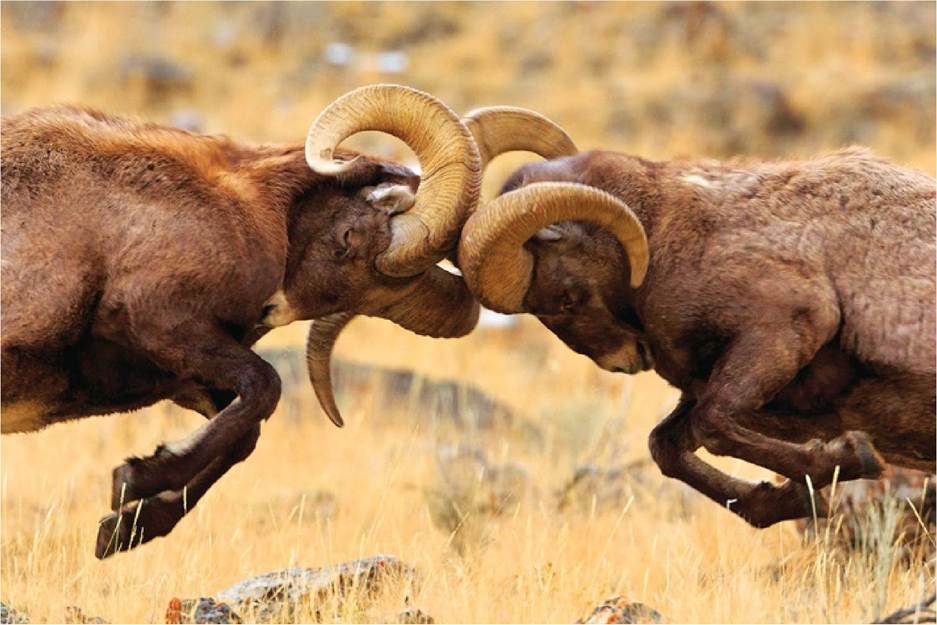
FIGURE 6.1 Fighting over the Right to Mate Two bighorn rams butt heads to establish dominance and mating rights. Large horns are beneficial to a ram's success with this dominance ritual. © Jason Savage View larger image
Ram horns have been collected as trophies for many centuries without drastically affecting sheep populations. Over the last 200 years, however, human actions such as habitat encroachment, hunting, and the introduction of domesticated cattle have reduced populations of bighorn sheep by 90%. As a result, the hunting of bighorn sheep has been restricted throughout North America. These restrictions make a world-class trophy ram (one with a large, full curl of horns) extremely valuable: permits to shoot one of these rams, which are sold at auction, can cost over $100,000.
Although funds raised by the auction of hunting permits are used to preserve bighorn sheep habitat, scientists have expressed concern that trophy hunting is having negative effects on today's small populations of bighorn sheep. Trophy hunting removes the largest and strongest males: in a population from which about 10% of the males were removed by hunting each year, both the average size of males and the average size of their horns decreased over a 30-year period (FIGURE 6.2).
Large and strong males are preferred by females and tend to sire more offspring than other males, so killing the largest and strongest males can make it harder for small populations to recover in abundance.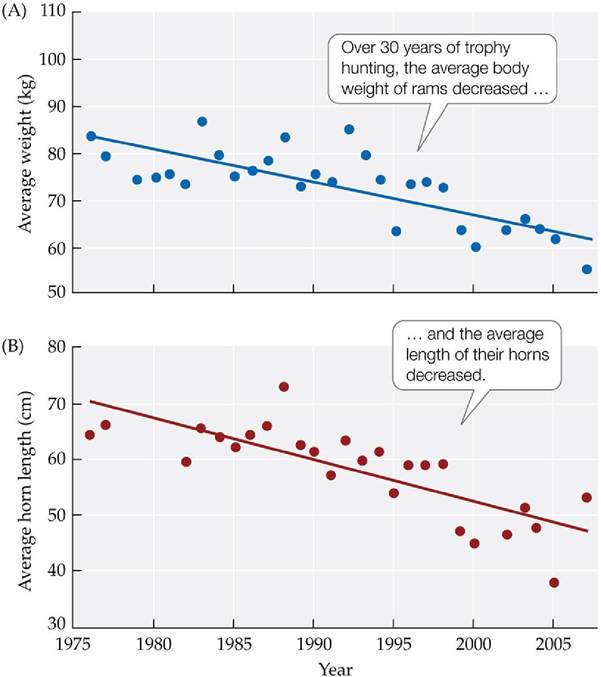
FIGURE 6.2 Trophy Hunting Decreases Ram Body and Horn Size Coltmanand colleagues tracked the body weights (A) and horn lengths (B) of rams in a bighorn sheep population on Ram Mountain (Alberta, Canada) that was subjected to trophy hunting over a 30year period. The changes in horn length occurred across multiple generations of sheep and thus indicate a change in the average characteristics of the sheep born from one generation to the next. (After D. W. Coltman et al. 2003. Nature 426: 656-658.) View larger image
Hunting, fishing, and other forms of harvest have affected a wide range of other species, including fishes, invertebrates, and plants (Darimont et al. 2009). For example, by targeting older and larger fish, commercial fishing for cod has led to a reduction in the age and size at which these fish become sexually mature. To see why this happens, first note that cod that mature at a younger age and smaller size are more likely to reproduce before they are caught than are fish that mature when they are older and larger. As a result, the genes of fish that mature at a younger age and smaller size are more likely to be passed on to the next generation than are the genes of other fish—hence, we would predict that over time, more and more fish will have genes that encode sexual maturity at a younger age and smaller size. Indeed, in experimental populations of guppies in which small or large individuals were selectively removed for harvest, van Wijk et al. (2013) documented such genetic changes in genes known to affect body size. Similarly, poaching for ivory appears to have resulted in genetic changes that have caused the proportion of female African elephants in a South African park that lack tusks to increase from 62% to 90% over a 20-year period.
The unintended effects of human harvesting on bighorn sheep, cod, and elephants illustrate how populations can change, or evolve, over time. What biological mechanisms cause these evolutionary changes? Do human actions other than harvesting produce evolutionary change?