Utilisation of Various Energy Sources
Various sources of energy can be classified as primary or secondary sources. Primary sources are those which are obtained directly from the environment. These include conventional sources, nuclear sources, geothermal sources and various forms of energy such as solar, wind and tidal.
On the other hand, secondary sources include sources which are obtained from primary sources. The secondary sources themselves are not present in nature but are derived from other sources. Their examples being petrol, electricity, hydrogen etc.1.5.1 ConventionalSources
The conventional sources of energy are coal, oil and natural gas. They are also known as fossil fuels. Fossil fuels were formed from the incomplete biological decomposition of dead organic matter (mostly plants and marine organisms). They are also called carbon or hydrocarbon fuels because they are based on organic compounds which contain the elements carbon and hydrogen.
a. Coal
When partially decomposed vegetation got deeply buried in a sedimentary environment, it slowly transformed into solid, brittle, carbonaceous rock called coal. The formation of coal is shown below in Fig. 1.2.
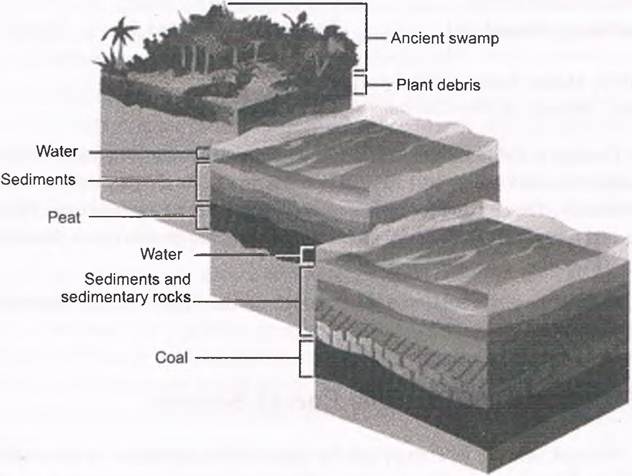
Fig 1.2 : Formation of Coal
Coal can be classified into various types according to its carbon and sulphur content. The characteristics of different types of coal are given in Table 1.3.
Table 1.3 Types of Coal
| Type | % Composition | Heat value or energy content million of joules kg~, | |||
| C | O | Volatile matter | Moisture | ||
| 1. Lignite | 60-70 | 18 | 45 | 35 | 13-16 |
| 2. Sub-bituminous | 75-83 | 15 | 40 | 17 | 16-23 |
| 3. Bituminous | 78-90 | 10 | 20 | 6 | 23-34 |
| 4. Anthracite | 92-98 | 3 | 5 | 1 | 30-34 |
In the due course of time, peat (a type of coal) gets compacted to lignite (a sedimentary rock with woody texture) because more partially decayed organic material accumulated on it. After further compaction and cementing (lithification), lignite transformed to bituminous coal which is soft black coal that burns with a smoky yellow flame.
Anthracite is a hard black coal. It bums slowly but gives off intense heat. It is formed by folding and hardening of sedimentary strata containing bituminous coal. Anthracite is the highest ranking coal whereas lignite is the lowest ranking. Anthracite has relatively low volatile constituents (oxygen, hydrogen and nitrogen) and its moisture content is also less.
The quality of coal is also rated according to its sulphur content. The low sulphur is advantageous because it causes less environmental pollution. Thus, it is a more desirable fuel for power plants.
Coal is considered by many people to be a dirty fuel as there are many environmental impacts associated with mining, processing, transporting and use of coal.
Coal deposits are exploited mainly by strip mining. It involves surface mining in which overlying layer of soil and rock is stripped off to get the coal. Strip mining is easier than underground mining and hence, it has become a common practice for mining the coal. In underground mining, about 50% of the coal must stay as such to support the mine roof.
There are several environmental problems associated with strip mining.
It involves removal of vegetation and topsoil using bulldozers, shovels and scrapers. Then, the exposed coal beds are drilled and blasted to fracture coal. The coal is then removed using trucks. Finally, the land is filled, topsoil is replaced and the vegetation is restored. This land reclamation minimizes the damage caused by strip mining. The damage would otherwise include total destruction of the ecosystem and turning of such a land into a barren desert.Also, rainwater or surface water can infiltrate into rock debris left after removal of the coal. This water on reaction with sulphide minerals such as pyrite (FeS2) produces sulphuric acid which pollutes streams and ground water resources. Such acid drainage is a serious problem around the coal mine areas. Their strip mining can destroy scenic, water, biological and other land resources.
Underground mining, on the other hand, has hazards of collapse, explosion and fire. Respiratory illnesses are common amongst miners. Land subsidence over mines can also occur.
Transport of coal from mines to areas of actual usage over long distances is presently handled by railways. It also has its own associated problems. Although coal can be converted to more easily transportable synthetic oil, synthetic gas or electricity, but these alternatives require large amount of water, good technology and are very expensive also.
Burning of coal also produces sulphur dioxide, nitrogen oxides and carbon dioxide. Sulphur dioxide leads to acid rain whereas carbon dioxide is a significant contributor to global warming.
The harmful effects of these gaseous pollutants are discussed in detail in Chapter 4 on air pollution. The combustion of coal yields ash which ranges from 5% to 20% of the amount of coal burnt. Also, the scrubbing of coal, i.e. treatment of gases obtained after combustion with calcium carbonate to remove sulphur dioxide, yields calcium sulphate as sludge.
The disposal or use of ash, sludge or boiler slag (cinder produced in the furnace) is also of environmental concern.
b. OiIandNaturalGas
Crude oil or petroleum is found along with natural gas primarily along tectonic belts. Oil and natural gas are derived from organic materials which got buried with marine or lake sediments. The high temperature and pressure are responsible for the conversion of organic materials into oil and gas.
India draws most of its oil from Bombay High, Upper Assam, Cambay, Krishna-Godavari and Cauvery basins. The oil reserves are estimated to be 4.7 billion barrels.
The consumption of petroleum products rose from 57 million tonnes in 199192 to 107 million tonnes in 2000. It is estimated to be 163.8 million tonnes in 2005. The India Hydrocarbon Vision puts future refinery demand at 368 million tonnes by 2005.
Natural mineral oil is a thick greenish-brown flammable liquid. It can be refined to produce a number of valuable products including oil and petrol. The primary production method involves pumping the oil from wells under the natural pressure whereas the secondary recovery method involves the injection of steam, water or gases such as carbon dioxide or nitrogen into the reservoir to push the oil. About two-thirds (65%) of the world’s total reserves are located in the Middle East. These reserves are going to be depleted in about 80 years.
Natural gas is a mixture of flammable hydrocarbon gases in which methane is the main component. Itis mostly found in association with oil reserves. It is a convenient and clean fuel as far as the environmental aspects are concerned. It produces very low amounts of oxides of nitrogen on combustion. The only problem in its utilization involves the construction of pipelines to transport it to the places of consumption. About 7% of India’s energy needs are met by natural gas. Natural gas is mainly used in areas of power production, petrochemical production and fertilizer production.
The use of oil, however, poses environmental problems at the stage of extraction, refining, transportation and combustion.
Some of these problems are as follows:• Disruption of land to construct wells, laying pipelines or storage tanks and other production facilities.
• Pollution of surface waters and ground water from runoff or leakage.
• Land sinking after removal of oil and gas.
• Damage to ecosystem.
• Release of drilling muds.
• Seepageandspillingofoil.
Oil spills due to accidents while transport have serious environmental impacts. They kill thousands of seabirds, spoil beaches and affect fish and other marine organisms. Amongst these disasters, oil spills from Torrey Canyon (March, 1967), Exxon Valdez (March, 1989), Braer (1992) and Nakhodka (January, 1997) are a few to mention.
In addition to above, the combustion of various fractions obtained from oil such as petrol, diesel etc, produce many primary and secondary pollutants. This can also lead to the formation of smog which has ill effects on both human health and vegetation,
c. Oil Shale
It is fine sedimentary rock containing organic matter in the form of kerogen. The destructive distillation of oil shale at 5OO0C yields hydrocarbons. One ton of shale can give upto 60 litres of oil.
The mining and processing of oil shale produces waste which is 20-30% in excess of the original volume of the mined shale. Thus, its disposal causes a problem.
Shale oil, although a fuel source, has not been developed to its full utilization because of the other available options. It, however, remains as one of the alternatives in the times of crisis.
The fossil fuels will not exist forever. They are depleting at a very fast rate. Thus, we need to consume them and use them judiciously. Also, their formation in nature took over millions of years and they will not be replaced so soon. They are, thus, called non-renewable resources. The need of the hour is, therefore, to develop alternative sources of energy which are discussed below under non- Conventional sources.
1.5.2 Non-Conventional Sources
India is the only country that has a separate government ministry i.e.
Ministry of Non-conventional Energy Sources (MNES) meant exclusively to look after the non-conventional energy sources. The Ministry is involved in the implementation of programmes for development, demonstration and utilisation of technologies for renewable energy sources such as solar, wind, biomass, biogas, small hydropower and other emerging technologies in the areas of geothermal and tidal energy.Although, the technologies of biogas plants and improved cooking stoves were available in India since late 1940’s, the Commission on Additional Sources of Energy (CASE) started in 1980 and the Department of Non-conventional Energy Sources (DNES) was established in 1982. This Department was converted to full-fledged Ministry in July 1992. The MNES has sectoral groups of rural energy, urban/industrial energy and power generation. Each sector has integrated programmes to serve different energy needs.
a. SolarEnergy
Sun is the earliest source of energy known to the mankind. The other forms of energy are derived from solar energy directly or indirectly.
Fossil fuels represent solar energy which has been captured by the process of photosynthesis and has been stored for million of years. The photosynthesis, in present times, is responsible for the biomass available as an energy source. Similarly, wind power and hydropower generation is possible by circulation of air and water, respectively which in turn is governed by solar energy. The Sun is the ultimate source of energy and the solar energy has made possible the existence of life on earth.
The positive features of solar energy are - its wide-spread distribution, a virtually inexhaustible supply and the pollution free nature. Tremendous amount of solar energy reaches earth’s surface. India receives solar energy equivalent to over 5000 trillion KWhr per year which is more than the total energy consumption of the country. Depending upon the location, the daily average solar energy incident over India varies from 4-7 KWhr∕m2. India has one of the world’s largest programmes to promote the use of solar energy. It includes solar thermal programme and solar photovoltaic programme.
Solar energy is being used in many parts of India for cooking, heating, lighting and cooling purposes both in homes and industries. It is also used for electricity generation. Fig. 1.3 below shows the use of solar energy for different purposes.
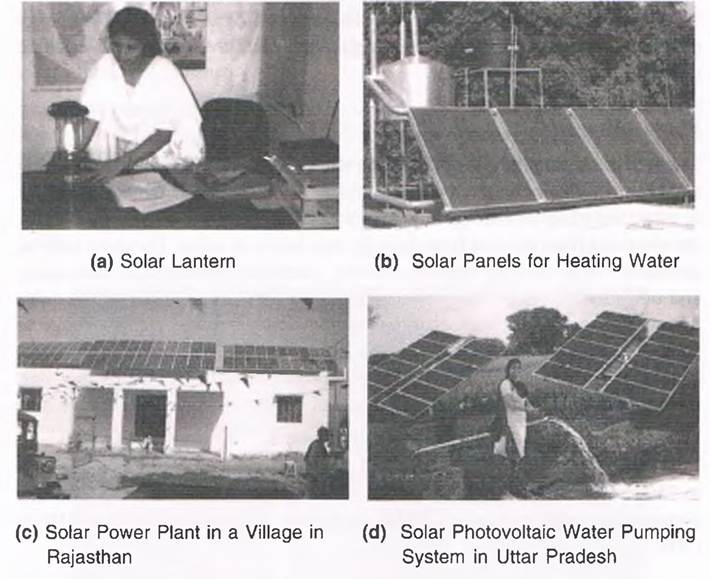
Fig 1.3 : Various uses of Solar Energy
Solar energy may be used directly through passive solar systems or active solar systems. The passive solar systems are designed to enhance the absorption of solar energy without the use of mechanical power. The active solar systems, however, use mechanical power in the form of pumps etc. for circulating air, water or other fluids from solar collectors to a heat sink meant for heat storage.
Passive solar heating uses solar energy to heat buildings directly by trapping the heat directly within the structure of the building followed by its slow release. This is similar to greenhouse effect. In active solar heating, building are heated indirectly by circulating heated water using pumps and pipes.
Solar Collectors
Since solar radiation reaching earth has fairly low temperature, its energy requires concentration which is done using solar collectors. They are usually flat panels consisting of a glass cover plate over a black background where water is circulated through tubes. They can heat water from 38o to 93oC by acting as greenhouses.
Such collectors require a lot of sunshine for efficient working. The energy produced is relatively expensive due to high capital costs involved in the installation ofheating system.
Photovoltaics
It is the technology for converting sunlight directly into electricity using solid semiconductor material such as silicon. The solar cells are made of silicon or other materials such as gallium arsenide. When sunlight strikes these cells, the electrons from the cell flow through the electrical wires. The electricity so produced can be used for lighting, running electrical appliances, in calculators and other such devices. The sector wise application of such energy includes household, agriculture, telecommunication, defence, railway etc. The range of products running on solar energy includes solar lanterns, home lighting systems, stand alone power plants, solar water pumping systems. Desalination of water, powering of remote telecommunication stations and railway signals are also done by using solar energy.
The efficiency of conversion of solar energy to electricity varies from 10% to 25% which is not very high. Its use is being encouraged and over 61,00,00 systems, aggregating to over 20 MW, have been installed according to MNES (2002).
Solar energy offers a great potential but suitable technologies are yet on the way to fully exploit this non-depleting source.
Solar Energy and Environment
As far as the environment is concerned, there is hardly any direct adverse impact of the use of solar energy. But, there are certain indirect ways by which the technology used for harnessing solar energy can have harmful effects on the environment. It involves the use of a variety of materials such as metals, plastics, fluids etc. The manufacture of these materials produces toxic wastes, and can also accidentally release these materials in the environment.
The general disadvantage of solar energy, however, is that the solar energy being relatively dispersed, requires large area. This can be taken care of by using solar collectors on the roof tops of buildings.
b. WindEnergy
Wind energy has been in use since early Chinese and Persian civilizations. It has been used for sailing, grinding grain or pumping water for irrigation. Lately, it has been also used for the generation of electricity.
It is a renewable source of energy like solar energy. There is a tremendous potential for its use but wind is highly variable in time, place and intensity which offer limitations to its use.
Wind energy can be obtained by using wind mill, wind turbines or wind farms. A wind mill, as shown in Fig 1.4, involves rotation of blades or vanes with the help of wind energy. This, then, generates mechanical energy for lifting of water from well or rivers, for grinding or for generation of electricity. The use of wind energy for the generation of electricity was first done in Denmark in 1890s.
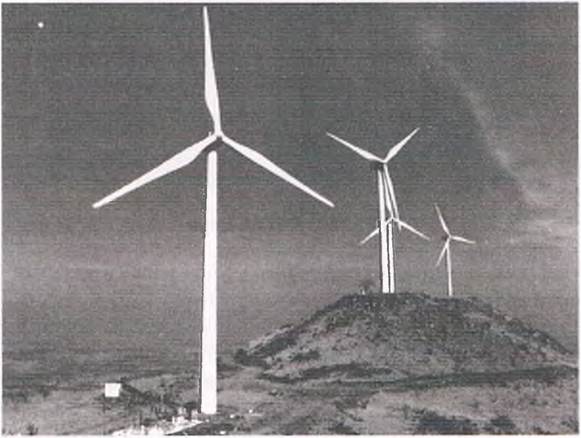
Fig 1.4 : Wind Mills and Wind Turbine at Davengere, Karnataka
The use of wind power has increased all over the world because of rising prices of fossil fuels and their fast depletion. The energy crisis in 1970s and 1980s also encouraged the use of wind energy on a large scale. This has been possible by the use of wind turbines.
Although, turbines operate on the principle of windmills, they are much sophisticated in design. They use propeller type rotors mounted on high towers. The amount of wind energy captured by a wind turbine, depends upon the size of the blades as well as the speed of the wind. The largest wind turbine is in Hawaii in the Pacific Ocean. It has two blades of 50 m length and the 20 storeyed tower.
Wind turbines can be used individually to meet the energy demand for smaller towns or villages in isolated or remote areas. They can also be grouped together or clubbed as wind farms, see Fig. 1.5.
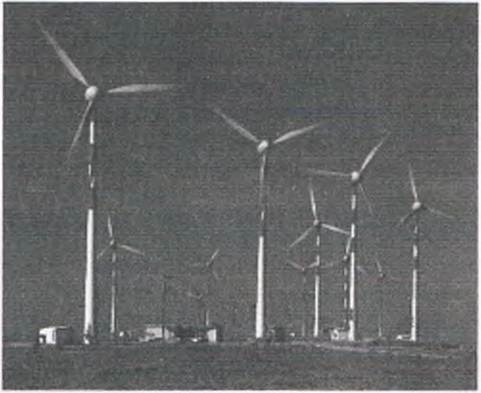
Fig 1.5 : A Wind Farm
Wind farms require a large area of land. Many wind farms (about 17000) were installed in California in 1980s and they have a capacity of about 1400 MW. The Altamont wind farm of California is one of the largest and best- known wind farms. Other than USA, other countries exploiting wind energy are France, Netherlands, Denmark, Germany and parts of Britain.
India is the fifth largest producer of wind power in the world. The wind energy potential of India is 45,000 MW. The states of Tamil Nadu, Gujarat, Andhra Pradesh, Kamataka, Kerala, Madhya Pradesh and Maharashtra have high wind potential. The state wise gross and technical potentials have been given in Table 1.4.
Table 1.4 Wind Power Potential
| State | Gross Potential (MW) | Technical (MW) |
| Andhra Pradesh | 8275 | 1750 |
| Gujarat | 9675 | 780 |
| Karnataka | 6620 | 1120 |
| Kerala | 875 | 605 |
| Madhya Pradesh | 5500 | 825 |
| Maharashtra | 3650 | 3020 |
| Orissa | 1700 | 680 |
| Rajasthan | 5400 | 895 |
| Tamil Nadu | 3050 | 1750 |
| West Bengal | 450 | 450 |
| Total | 45195 | 11875 |
Source; Annual Report 2003-2004, MNES
For 2002-2007 period, India is exceeding its target of installing 1500 MW. There are 945 water pumping wind mills, aero-generators and hybrid systems of about 370 KW capacity and wind farm projects installed with a capacity of 2483 MW. There is a good manufacturing base of 12 manufacturers of wind turbines and allied equipment.
The Centre of Wind Energy Technology (C-WET), at Chennai, is a specialised institution for developing state of the art indigenous technology for wind power utilization. It also undertakes research and development, standardization, testing and resource assessment.
It is expected that the cost of wind energy production would decrease in coming years by improving grid connections and inviting greater participation of the private sector. A new concept of mega wind farms is being initiated by the private sector.
Wind Energy and Environment
It is a very clean source, still wind energy has (relatively small) adverse impacts on the environment. The effects include the following:
(i) Vibrations in the windmill cause objectionable noise.
(ii) Windmills can kill birds.
(iii) There can be interference with radio and television broadcasts by windmills.
(iv) Windmills can degrade the scenic environment.
(v) Windmills and wind farms require a large area of land which could have been otherwise required or used for roads, housing or other public buildings.
c. Geothermal Energy
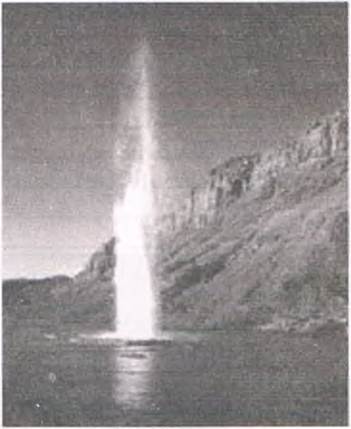
Fig 1.6 : The Geysers
Geothermal energy is the natural heat available in the interior of the earth. It was developed in Italy about 100 years back. It is used to generate electricity in Russia, Japan, New Zealand, Mexico, Hawaii and California. The Geysers (geothermal field) located north of San Francisco, California is the largest geothermal power operation in the world. It is shown below in Fig 1.6 and it produces energy directly from steam.
In India, the geothermal areas are the North Western Himalayas and Western Coast. The geothermal areas are located with the help of satellite. More than 350 hot spring sites have been identified by Geological Survey of India. They include Tattapani Geothermal fields in Chattisgarh where 300 KW power plant is planned by MNES and Puga Geothermal fields in Ladakh (J&K). In Puga valley, an experimental 1 KW generation project is being used for poultry farming, pashmina wool processing and mushroom cultivation.
Geothermal Energy and Environment
The exploitation of geothermal energy generates on-site noise, causes emission of gases and disturbance by drilling operations for laying pipes. It is also accompanied by thermal pollution resulting from hot wastewaters. These wastewaters may also be saline and hence can cause corrosion as well as disposal problems.
d. Hydropower
It is cheapest and cleanest source of energy. But, there are controversies about construction of mega dams. The small hydropower plants are, thus, emerging as alternatives for meeting the energy needs of remote and rural areas. The hydroelectric potential in India is estimated to be 600 KWh annually. The resources are mainly located in the northern and north-eastern region. In Tenth and Eleventh Plans, it is expected that 16 GWe and 19.3 GWe new capacity would be added, respectively.
The total for small hydro plants (generating upto 25 MW) is about 15000 MW. There are more than 420 such projects (MNES, 2002) spread all over the hilly regions of the country.
e. Biomass
Biomass is organic matter derived from plant materials, animal waste and the waste derived from various human activities. It is also generated from timber industry, agricultural crops, and raw materials from forests, household waste and wood.
Biomass accounts for about one-third of the fuel used in India. The usage is more than 90% by rural people and about 15% by urban people. They use wood, cow dung cakes, crop residues, sawdust etc. Firewood is the most widely used fuel and more than 1 billion people in the world still use wood as primary energy source.
Biomass can be directly burnt to produce heat or electricity. It can also be converted to gaseous fuel via gasification or can be converted to biofuels such as ethanol, methanol, methane etc. by distillation.
Biomass gasifiers convert biomass into producer gas through thermochemical gasification process. Biomass can be converted to blocks of different shapes, called briquettes, which are convenient to use. The briquettes can be used in traditional chulhas in place of coal or in the gasifiers for generation of gaseous fuel.
The efficiency ofbiomass energy generation is improving. Halfkilo of a dry plant can yield upto 1890 kcal of heat which is nearly the same amount of heat available from 250 g of coal. For improving the efficiency, gas turbine engines are being used in biomass plants. These have an efficiency of about 35%.
The biomass potential in India is enormous because of large quantities of agricultural, forestry and agro products. The power generation by biomass accounts for 14% of the total energy supply worldwide. 38% of this energy is consumed in developing countries in rural and traditional sectors. In addition to heating, pumping water and power generation (standalone or grid connected), biomass powers is also used for village electrification and industrial uses. There are 34 cogeneration plants with capacity 210 MW in operation while 26 more such units having capacity 237 MW are being installed. The total biomass based power generation capacity as per MNES, 2000 is 358 MW.
Biomass gasifier systems are being used by various industries, such as rice and textile mills, steel rolling mills, ceramic industry, brick kiln industry, tyre and tube manufacturing companies, plywood industry etc., for reducing the energy cost. India also exports gasifiers to Africa, Europe, Bangladesh, Indonesia, Sri Lanka, Maynmar and the USA. In countries like Finland, USA and Sweden, the per capita biomass energy used is higher than that in India, China or Asia.
There is a national level programme of MNES on biomass-based power generation, biomass/bagasse-based co-generation, research and development and biomass resource assessment. The potential for bagasse-based cogeneration in major sugar producing states is shown in Table 1.5.
Table. 1.5 State-by-state potential for bagasse cogeneration in
India
| State | Potential (MW) | Commissioned exportable capacity, as of 31 December 2003 |
| Maharashtra | 1,250 | 21.0 |
| Uttar Pradesh | 1,250 | 75.0 |
| Tamil Nadu | 500 | 105.0 |
| Karnataka | 500 | 125.0 |
| Andhra Pradesh | 300 | 49.3 |
| Bihar | 300 | Nil |
| Gujarat | 250 | Nil |
| Punjab | 150 | Nil |
| Other | 500 | Nil |
| Total | 5,000 | 375.9 (7.5%) |
Source : MNES, New Delhi.
Biomass Energy and Environment
Biomass fuels although plentiful can cause several environmental problems. Burning ofbiomass fuels causes air pollution by generating smoke. Also, if we keep on using wood from forests and do not replace them, it causes the problem of deforestation. Deforestation can, in turn, accelerate the process of soil erosion which can further lead to water pollution. Burning of organic urban waste releases toxins and causes air pollution. Conversion ofbiomass to alcohol also adds to air pollution and is also not a very viable option economically. The inefficient burning of such fuels in traditional chulhas is associated with the problems of indoor pollution and health hazards. Thus, there is a need for proper management of biomass resources.
There are many efforts for improving technology to make biomass a clean and affordable resource. One such technology is the use of biogas plants.
f. Biogas
Biogas is derived from cattle dung and human waste. It contains 55-70% methane which is inflammable. It bums with a blue flame. It can be used for
lighting when burnt in silk mantle lamps. It can be used in dual-fuel engines and substitutes upto 75% diesel oil.
Biogas plants involve the mixing of organic waste with water. Their decomposition in the absence of air produces biogas which can be used as fuel with the help of pipelines. The left over digested slurry is used as manure in agriculture and pisciculture.
Biogas can also be generated by using wood, straw or waterweeds like water hyacinth, hydrilla, duckweeds etc.
There are three main models used for the generation of biogas. They are as follows:
(i) Floating gasholder type - also known as Indian or Khadi and Village Industries Commission (KVIC) model.
(ii) Fixed dome model - known as Deenbandhu model
(iii) Bag type portable digester made up of rubberised nylon fabric.
There is an estimated potential of 120 lakh plants out of which 36.51 lakh plants have already been installed. During 2003-04, the target was to install 1.50 lakh plants.
The MNES is having the National Biogas and Manure Management Programme (NBMMP) which is a modified version of Ninth Plan scheme known as the National Project on Biogas Development (NPBD). KVIC and State nodal agencies are involved in the programme implementation. Several NGOs, Sustainable Development Agency (SDA) and BIOTECH are working in this area in collaboration with grass-root level voluntary agencies and self-employed trained workers. Fig 1.7 shows a biogas plant.
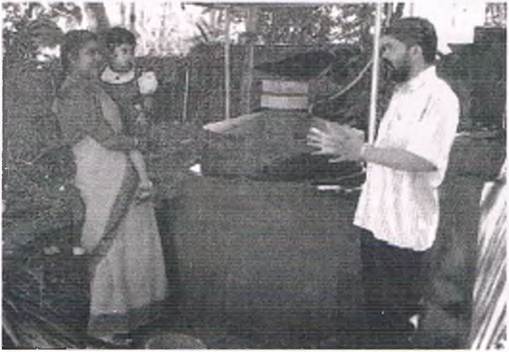
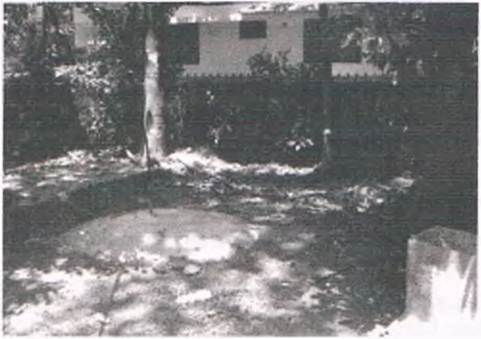
Fig 1.7: (b) A Deenbandhu Biogas Plant in Kerala
g. Tidal Energy
There are different forms of energy available from oceans. They are thermal energy, tidal energy and energy from ocean waves and currents. However, with the present technology, we are able to harness only tidal energy. The potential sites of tidal energy in India are Gulf of Kutch, Gulf of Khambat (Cambay) in Gujarat, Gurgaduani creek and delta of Ganga in sunderban area in West Bengal. Tidal energy can be harnessed for generating electricity in an area where sea water can move into a narrow cut. Such an area is naturally occurring at a point where rivers flow into the sea. Fig. 1.8 shows tidal power and its harnessing.
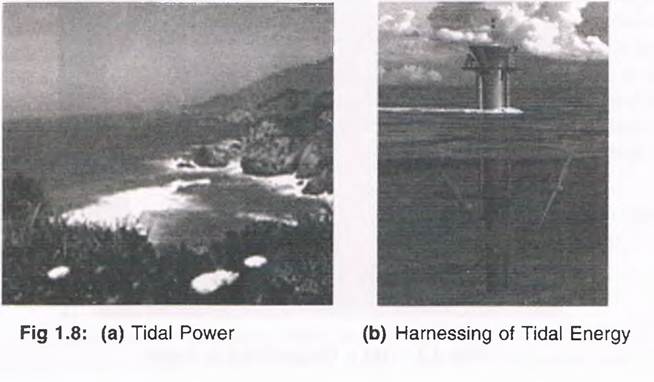
Both incoming and outgoing tides are held back by the dam. The difference in water levels generates electricity through reversible turbogenerators which can work both ways for power generation i.e. movement of water in opposite direction.
g. Energy from Waste
Worldwide, there is an increasing awareness about waste generated by human activities. Safe, efficient and scientific methods are being designed for treatment and disposal of wastes. The generation of energy from these wastes reduces the quantity of waste and also improves its quality to match with pollution control standards.
In India, the potential for generating power from urban and municipal waste is about 1700 MW whereas that from industrial waste is about 1000 MW at present.
The energy recovery from wastes is one of the thrust areas identified by MNES. The two programmes for implementing this objective are as follows:
• National Programme of Energy Recovery from Urban and Industrial Wastes.
• UNDP/GEF project on ‘Development of High Rate Bio-methanation Processes’.
India’s urban waste amounts to about 30 million tonnes of solid waste and 4400 million cubic meters of liquid waste per year. In addition to this, a large amount of industrial waste is also generated. This waste pollutes environment in a number of ways if not disposed off properly.
During the year 2003-04, five projects - two based on municipal solid waste (MSW) and one each on sewage, vegetable waste and starch industry solid waste, were commissioned with a total installed capacity of 15.65 MW.
The MSW plant is located at Lucknow. It is designed to process 500-600 tonnes of waste per day from Lucknow city. It is meant for power generation by producing biogas.
Table 1.6 shows the achievements of renewable energy programme in India (Source: MNES).
Table 1.6 Major programme of Renewable Energy sources and their cumulative achievements
| S. No | SourceZTechnology | Units | Achievement (Cumulative) | Position in the world |
| 1. | Power Generation | |||
| (i) Wind Power | MW | 2483.20 | V | |
| (ii) Small Hydropower | MW | 1603.32 | X | |
| (in) Biomass based power | MW | 681.53 | IV | |
| (iv) Biomass Gasifiers | MW | 60.480 | I | |
| (v) Solar Voltaic power | MW | 2.54 | V | |
| (vi) Urban & Industrial waste | MW | 41.43 | I | |
| 2. | Thermal Applications | |||
| (i) Biogas plants | lakhs | 36.51 | π | |
| (ii) Improved Biomass Chulha (Cook stove) | crores | 3.52 | π | |
| (iii) Solar water heating systems | 0.80 | Million sq. m collector area | ||
| (iv) Box Solar cookers (No.) | No. | 555000 | I | |
| (v) Schefler solar cookers (No.) | No. | 2000 | ||
| (vi) Solar steam cooking systems | No. | 10 | ||
| 3. | Water Pumping | |||
| (i) Wind pumps | No. | 1087 | ||
| (ii) Solar PV pumps | No. | 6452 | ||
| 4. | Solar Lighting Systems | |||
| (i) Solar street lighting systems | No. | 52102 | ||
| (ii) Home lighting systems | bgcolor=white>No.307763 | |||
| (iii) Solar lanterns | No. | 538718 | ||
| 5. | Other applications | |||
| (i) Integrated Rural Energy Programme | Distt | 253 | ||
| (ii) Energy parks | No. | 376 | ||
| (iii) Hybrid systems | KW | 370 | ||
| (iv) Solar photovoltaic power (stand alone) | kWp | 851 | ||
| (v) Aditya solar shops | No. | 59 | ||
| (vi) Battery operated vehicles | No. | 300 | ||
| yii) Village electrification | No. of villages | 1563 |
i. Hydrogen- The Future Fuel
Hydrogen is the simplest and most common element found on the earth. It has the high energy content per unit of weight (i.e. 120.7 kJ g^1). It is very light in weight. It is used as a fuel for rocket and space crafts due to its above said qualities.
Hydrogen is receiving world-wide attention because it is a clean and efficient fuel. It can be used in any of the ways in which fossils fuels are normally used. On combustion, it produces water as the by-product and hence, it is an environmentally safe fuel.
Hydrogen can be produced in a variety of ways as follows:
(i) Biological conversion of organic effluents like distillery starch, sugar processing etc.
(ii) Electrolysis of water
(iii) Thermal decomposition of water through solar or nuclear energy
(iv) Gasification of coal
(v) Steam reformation of natural gas, naphtha
(vi) Pyrolysisofbiomass
(vii) Partial oxidation of heavy hydrocarbons or coal
Hydrogen can be used for power generation and transport applications. It can be used either directly in internal combustion engines or through fuel cells.
Fuel cells produce electricity by combining fuel and oxygen by an electrochemical reaction. Hydrogen and phosphoric acid are most common fuels but fuel cells are also based on methanol, ethanol and natural gas. Fuel cells directly convert the chemical energy to electricity without involving the combustion to generate heat and then mechanical energy which is further converted to electricity as is the case with conventional fuels. Thus, it is an efficient way of generating electricity. A fuel cell is shown in Fig. 1.9.
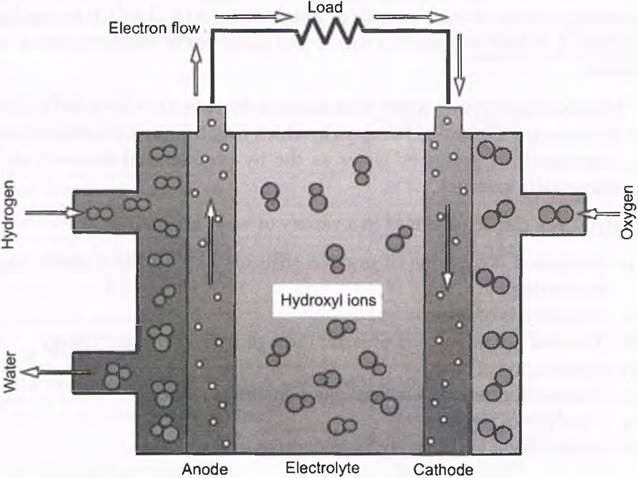
Fig.1,9: A Fuel Cell
Hydrogen (fuel) and oxygen are present in the electrolyte in the fuel cell. They remain separated from one-another. Upon ionisation, they migrate from one electrode to other through the electrolyte solution. The flow of electrons from negative to positive electrode is diverted through the electrical motor for supplying current.
Fuel cells are modular in nature construction wise and their efficiency is independent of size. A variety of fuel cells are available. They can be classified as low temperature and Medium & High temperature fuel cells. They are used for mobile, stationary and portable applications. Low temperature (upto 100oC) cells are useful for transport and small power generation applications while medium and high temperature (upto 1000oC) cells are preferred for power generation and combined heat and power applications. Fuel cells can also be used as UPS. Their applications cover domestic, industrial, transport and agricultural sectors.
j. Nuclear Energy
About 16% of the world’s electrical energy is derived from nuclear energy. Nuclear energy is the energy stored in the atomic nucleus. Nuclear energy or atomic energy can be used for constructive purposes such as power or electricity generation. The two main modes of reactions used are fission and fusion reactions.
Nuclear fission involves splitting of an atomic nucleus into smaller fragments whereas in nuclear fusion, atomic nuclei combine to form heavier nuclei. Both these processes, release an enormous amount of energy. The fission reaction is shown in Fig 1.10.
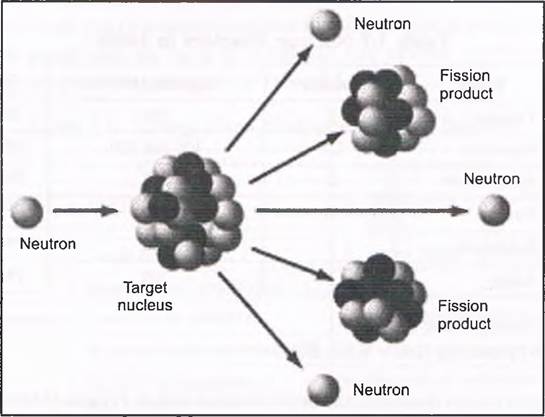
Fig 1.10: A Fission Reaction
Most nuclear power plants use light-water nuclear reactors which use ordinary water for transforming heat from reactor core to boilers. These reactors use и,’5 as fuel. The natural abundance of this isotope of uranium is only 0.7%. The process of enrichment concentrates this isotope to 3%. The fission of и using neutrons releases smaller fragments as 140Ba and 93Kr, a lot of energy and neutrons. These neutrons carry forward the chain reaction by further splitting the Uranium atoms present.
Another type of reactors called fast breeder reactors, can increase the nuclear fuel potential by 100 times. They do not require weapon-grade material and can use upto 60% of uranium in the ore.
The uranium reserves in India amount to about 95,000 tonnes of the metal. After accounting for losses due to mining (15%), milling (20%) and fabrication (5%), the amount available for power generation is 61,000 tonnes. But the thorium reserves are larger in quantity. The monazite reserves are about 8 million tonnes in which about 0.63 million tonnes of thorium is present. So far, only 17 deposits containing about 4 million tonnes of monazite have been identified as exploitable. The amount of thorium available for nuclear power is about 2,25,000 tonnes.
There are 14 operating atomic reactors in India. The power generation during 2001 -2002 was 19193 Million Units. Table 1.7 lists the number and type of reactors.
Table 1.7 Nuclear Reactors in India
| S.No | Place | Number | Capacity (Mwe) | Type |
| 1. | Tarapur | 2 | 160 | BWR |
| 2. | Rajasthan | 2,2 | 100 and 220 | PHWR |
| 3. | Kalapakkam | 2 | 220 | PHWR |
| 4. | Narora | 2 | 220 | PHWR |
| 5. | Kakrapara | 2 | 220 | PHWR |
| 6. | Kaiga | 2 | 220 | PHWR |
* BWR -Boiling Water Reactor
* PHWR-Pressurized Heavy Water Reactor
There are eight more reactors under construction at Tarapar (Maharashtra), Kaiga (Kamataka), Rawatbhata (Rajasthan) and Kudankulam (Tamilnadu). The nuclear power plants in India are owned, constructed and operated by Nuclear Power Corporation Ltd. (NPCL).
The PHWR type reactors use heavy water as moderator and coolant. They work one once-through-cycle of natural uranium. Nearly 330 GWe-yr of electricity can be produced using them. Using the same amount of uranium, the multiple recycling of the fuels by Fast Breeder Reactors (FBR) can provide about 42,200 GWe-yr assuming 60% utilization of heavy metal. However, the actual potential will be 150,000 GWe-yr. This much energy is good enough to meet our energy demands for many years to come.
The Department of Atomic Energy has worked out a three-stage nuclear power programme. The first stage involves the installation of a nuclear power plant of capacity 20GWe by 2020. The second stage involves building a chain of fast breeder reactors to enhance the capacity of fissile material and to produce power. Construction of first 500 Mwe Prototype Fast Breeder Reactor (PFBR) has been approved in September 2003, which would be completed in 2011. Four more such units would be constructed by 2020 to generate 20GWe power.
The third stage involves the exploitation of thorium reserves through fast or thermal critical reactors or accelerator driven sub-critical reactors (ADS). A 300 MWe Advanced Heavy Water Reactor (AHWR) is under development. It is designed to draw about two-third power from thorium fuel and will provide experience about the technology aspects related to thorium fuel cycle.
Energy production using nuclear fuels is relatively a clean and efficient option. Although 1 kg of uranium generates an equal amount of energy generated by 35,000 kg of coal, we have to weigh the two options in terms of their advantages or disadvantages given in Table 1.8.
Table 1.8 Energy from Coal and Nuclear Sources
| Coal | Nuclear sources | |
| Advantages | 1. Inexpensive | 1. Small amount of solid waste is there |
| 2. Large availability | 2. Large energy available | |
| 3. Small capital investment | ||
| Disadvantages | 1. Leads to air pollution | 1. Large operational costs |
| 2. Releases large amount of CO2 | 2. Large capital investment | |
| 3. Surface mining disturbs landscape | 3. Problem of radioactive waste disposal | |
| 4. Transportation-infrastructure is costly | 4. Technology- availability and updating | |
| 5. Ash-disposal | 5. Risk factors -Radiation hazards -Accidents |
In view of the disadvantages associated with nuclear power generation, it has been a controversial issue for several years.
The problems are site selection for nuclear power plants, strict safety controls, disposal of radioactive waste and effects on human health by radiation exposure, various stages of nuclear fuel cycle (discussed later) generate nuclear waste which poses a great problem as far as its disposal is concerned. This has been described under Hazardous Waste and its Management (Chapter 10).
In addition to this, weapon grade nuclear fuel is also smuggled for terrorist activities which is another kind of problem to be solved. The regulatory and safety functions of atomic energy are carried out by Atomic Energy Regulatory board. The President of India constituted it on 15,h November 1983 under Atomic Energy Act, 1962.
Thus, nuclear power, if used sensibility and carefully,can solve the future energy problems.