Chapter 3 Methodology
Multi-criteria decision-making models (MCDM) are the most widely used decision methods in the sciences, business, government and engineering worlds. They were developed by Roy, within the framework of operational research, at the beginning of the late 1960s [12, 13].
These models can help to improve the quality of decisions by rendering the decision-making process more explicit, rational and efficient [83, 86].Several evaluation approaches aiming to identify the “best” possible solution refer to the utility theory, which implies the existence of a univocal utility function. Tracing the decisional aspect back to the maximization of a utility function raises problems for decision-makers since it does not take into account the different dimensions, the various points of view and the diverse objectives [82]. The optimization paradigm had been abandoned in various areas of theoretical research and is regularly criticized in the literature. For example, according to Simon [89], the achievement of the “best” alternative (objectively, this might be impossible) is replaced by those alternatives that “satisfy” a certain number of explicitly defined requirements.
In line with the above, if one intends to analyse a problem, taking into account the various aspects of the issue and its features, it is necessary to adopt a method that replaces the “optimal solution” with a group of “efficient solutions”. According to this approach, defined as a multi-criteria approach, the final solutions depend on the initial conditions identified by the decision-maker.
The Electre III method plays a prominent role in MCDM. These models belong to the class of the partial aggregation multi-criteria approach aiming to individuate a relationship between the alternatives, called outranking relation useful for dealing with problems of choice (the best action among various alternatives), of classification (assignment of actions to more classes of which characteristics are known) and of ordering (construction of an order of preferences linked to a set of possible actions).
Starting from the alternative ai (the statistic unit; in our case the University), the criterion j (variable: in our case graduate characteristic) with the value of criterion j being gj, the Electre III method is a comprehensive evaluation approach aiming to identify many different efficient solutions using the preferences of decision-makers. The decisional problem consists in using the information together with the opinions © Springer Nature Switzerland AG 2020 7
R. Allegro and O. Giambalvo, University Performance Before and During Economic Crises, UNIPA Springer Series, https://doi.org/10.1007/978-3-030-36142-6_3 expressed by the decision-maker in order to establish a compromise or, in other words, to help the decision-maker to choose the alternative more coherent with his/her structure of preference. Thus, the final solutions depend on the preferences expressed by the decision-makers.
The preferences are included in the model by means of weights and three threshold values (for each criterion). The weight associated with each criterion represents a coefficient of relative importance given to the criterion that is the most direct and explicit expression of the preferences and can relevantly influence the results.
The thresholds, associated with each criterion, correspond to values that are introduced in order to limit two types of risk: the risk of considering two situations that are distinct but conditions and values are so close that we can consider them equivalent, and the risk of not encompassing preferential situations as different. In particular, the indifference threshold (q∙) refers to the smallest difference, among the values of criterion gj, to which a decision-maker attributes a meaning in terms of indifference. For example, if the difference between two universities is two points relating to the average graduation grade and the indifference threshold for this criterion is 3, then the two universities are, in fact, indifferent with respect to this criterion.
Only a difference beyond 3 is considered relevant.The preference threshold (sj ) expresses the minimal difference, among the values of criterion gj, to which a decision-maker attributes a meaning in terms of narrow preference. For example, if the difference between two universities is 5 points relating to the same criterion and the preference threshold established by the decision-maker for this criterion is 4, then the university with the highest degree grade will be preferred to the other one. The veto threshold (vj∙) expresses the minimal difference, among the values of criterion gj, beyond which a decision-maker considers that the gap between the scores is no longer balanceable by the performances of the other criteria. For example, if university A surpasses university B by 8 points, relating to the same criterion and the veto threshold for this criterion is established by the decision-maker at 5, then B and A cannot be compared.
Preference, indifference and veto thresholds aim at defining the relationship (S), in order to establish whether alternative (a) is preferable to alternative (a') or whether there is no difference at all. The relationship is known as outranking and is summarized as follows:
if aSa, then alternative (a) outranks alternative (a'). This means that (a) is at least as good as (a') for most of the criteria and never worse for the rest of them.
The statement aSa' is defined for each criterion j and for every pair (a, a') of alternatives in the database. Building a relation of outranking (S) as the union of elementary relations of indifference (I), light preference (Q) and heavy preference (P), this method takes into account also the lack of comparability between alternatives (N), different from the indifference solution since caused by the existence of contrasting preferences on various criteria making it impossible to establish, knowing that they are not the same, the better one.
In the Electre III model, outranking is fuzzy, so a credibility degree is computed for the outranking relationship.
The final result is a ranking of alternatives. This result can be represented by a graph where the alternatives are the nodes and the outranking relationship is represented by an arch.
The Electre III outranking method provides a structure in steps.
The first step leads to the definition of the concordance and discordance matrices, which determine whether statement aSa' is acceptable.
In details: 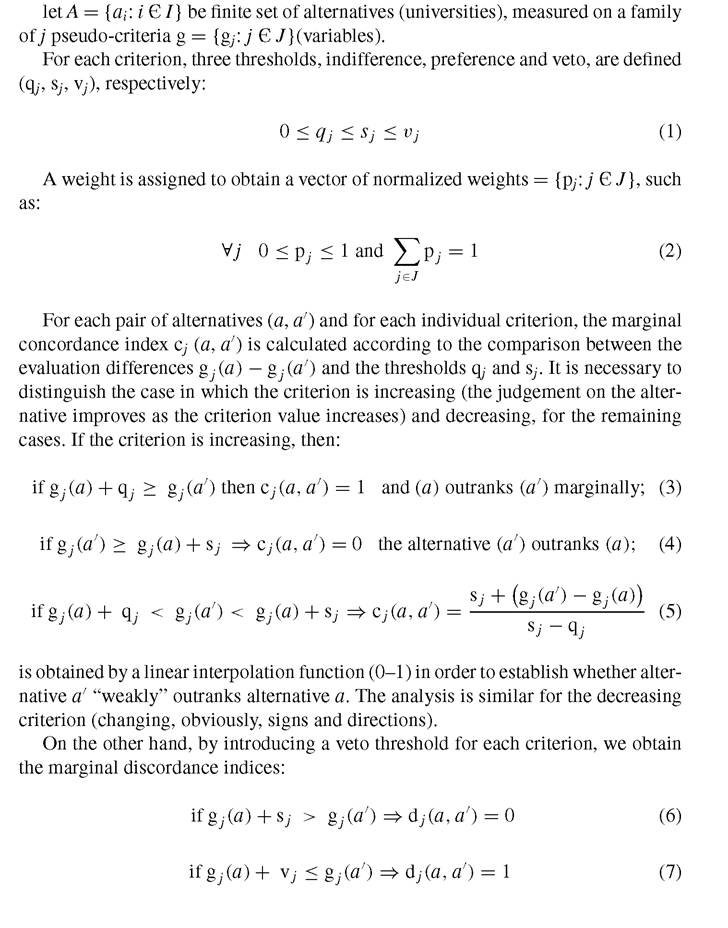

Once the J concordance matrices and the J discordance matrices are obtained (they are I ? I matrices), one proceeds with the calculation of the I ? I aggregated concordance matrix, whose elements are the weighted sum, with the weights initially assigned to each criterion, of the marginal concordance indices. Using the weights p, the concordance index c(a, a') is defined as follows[1]:

where Cj (a, a') are the marginal concordance indices.
The second step permits to classify the alternatives by combining the concordance and the marginal discordance indices, in order to produce the credibility outranking matrix, defined as follows:
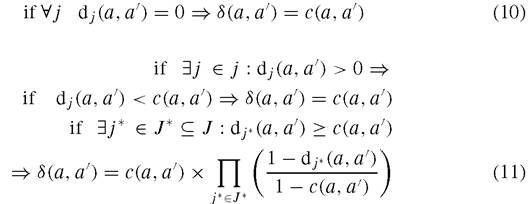
The third step leads to the final ranking of alternatives.
Alternatives are ranked through a distillation1 [2] procedure. For this purpose, two distillation algorithms are constructed, respectively, by following a descending and an ascending procedure (for details on these procedures, see, e.g., [84, 85, 87]). Descending distillation ranks the alternatives from best to worst while ascending distillation ranks them from worst to best. The discrimination threshold s,(δ) is the maximal discrepancy between two credibilities, showing when two alternatives can still be considered in the same class and with the same magnitude.
The descending distillation algorithm classifies the alternatives according to the qualification score q(a) of each alternative, i.e. the difference between the number of alternatives a' outranked by alternative a and the number of alternatives a' outranked by alternative a.Two complete pre-orders are therefore found on all the alternatives.
Within the credibility matrix, the maximum degree of credibility δ0 is established for the extraction of the alternatives, equal to:

that is the maximum among the values δ(a, a') at the к-th step (Ak is the credibility matrix at the k-th step); this determines a “value of credibility”, and only the values δ(a, a') that are close enough to δ0 will be considered. Hence, the discrimination threshold s,(δ) is subtracted, and thus, δ'0 is calculated:

the first level of separation is calculated δ1, according to the set Ak:

The qualification score qδ(a) of each action a ∈ A, where A is a finite set of
alternatives, is defined as the number of actions that are outranked by the action ai
minus the number of actions outranking it, i.e.

where

The descending distillation algorithm classifies the actions according to the
maximal classification, following the rule:

and the following Ak subset is obtained:

ι
ι
r
ι this way, a subdistillation until only one action will be left.
The procedure is repeated starting from Ak+1and finishes when all actions in A have been attributed to a class. As previously, the result is a descending distillation. In the distillation from below, the procedure is similar to the previous one, but the selection is done according to the minimal qualification rule:

In this case, D- is the first distillation unit from below and each class C- will be built from below.
After obtaining the two pre-orders P(A)+ and P(A), the procedure to define the final order suggested by Scharlig [88] is an intersection based on three rules. Firstly, an alternative cannot be ahead of another in the final order, unless it is ahead of it in one of the two preliminary orders P(A)+ or P(A)- and ahead of it or ex equo in the other one. Secondly, two alternatives cannot be ex equo in the final order unless they belong to the same class in both classifications (ascending and descending). Thirdly, two alternatives are in conflicting in the final order if one is ahead of the other one in one classification (ascending and descending) and is behind it in the other one. The results can be represented as a graph.
More on the topic Chapter 3 Methodology:
- This chapter provides a systematic overview of the multidimensional measurement methodology of Alkire and Foster (2007, 2011a), with an emphasis on the first measure of that class: the Adjusted Headcount Ratio or M0.
- Chapter 1 traced the rise of empiricism as an alternative to the rationalism of classical philosophy.
- Distribution and Dynamics
- Chapter 2 About Overeducation and Mismatching
- ANALYTICAL PROBLEMS
- Identification of the Poor: The Dual-Cutoff Approach
- Notes
- The Production Function and Changes in Productivity in the European Union
- Definition andOrigins
- ABOUT THE CONTRIBUTORS