Choosing between different environmental policy instruments
The problem of the choice of environmental policy instruments has been an issue since Pigou (1932) analysed the need for state intervention when private costs diverge from social costs, and suggested that the solution would be to internalize the externalities through taxation.
Coase (1960) criticized the proposed state intervention, and affirmed that there is no reason to suppose that governmental regulation is called for simply because the problem is not very well handled by the market or the firm. The key feature is the presence of transaction costs that make one policy better than another.The ensuing debate has been conducted along these two opposite views: on the one hand, the supporters of the idea that the choice of policy instruments to be applied following a market failure is a public matter and the state, as policy designer, should select the optimal instrument and take responsibility for its imposition in the public interest; versus, on the other, the supporters of market-based instruments, trying to fight a battle against a sort of ‘antimarket’ mentality based on a reluctance to apply market-oriented instruments (Lewis, 1996).
If we want to continue along these lines the problem would be to compare the efficiency of instruments that can be considered ‘public oriented’ and those that can be considered ‘market oriented’, where the first are characterized by a public agency with a public definition of conduct rule and a public enforcement system and the second are instruments based on market mechanisms stimulating the conduct of the firm indirectly and characterized by a private administration and enforcement system.1
Given this premise, the definition of a superior and not ideological line to be followed in the choice between different environmental policy instruments would appear to be a very difficult task.
But looking at this problem from a law and economics perspective, we can move from the theoretical definition of the efficiency of different instruments to their practical, and so direct, potential to achieve concrete objectives. In particular, three objectives emerge as relevant in judging the practical efficiency of environmental policies: the first is paying accident compensation to the victims; the second is prevention, in the sense of providing incentives for firms to improve safety standards; and the third is connected with technological change in the sense of encouraging firms to adopt lower-risk technologies.
Given these three objectives, this chapter will analyse the efficiency of environmental policies, focusing on the imperfections that can emerge in their practical applications. In particular we shall concentrate on informational problems that can characterize the activities of the agencies and private firms in relation to the efficient implementation of the different environmental policy instruments.
In order to specify and precisely define the various instruments, Figure 23.1 presents a scheme of the different environmental policy instruments that will be examined. The first choice is between liability and regulation, where the latter includes a subdivision between, on one hand, a ‘command-and- control' form of regulation based on the definition of standards and, on the other, market-based instruments as an indirect form of incentive for private firms. Another subdivision can be considered at this point: typically, com- mand-and control regulation can be either technology or performance-based standards.
Market-based instruments can also be of different kinds: taxes or tradable permits. On the other side, liability is an instrument based on the judiciary system, and can be assigned on the basis of a negligence or a strict liability
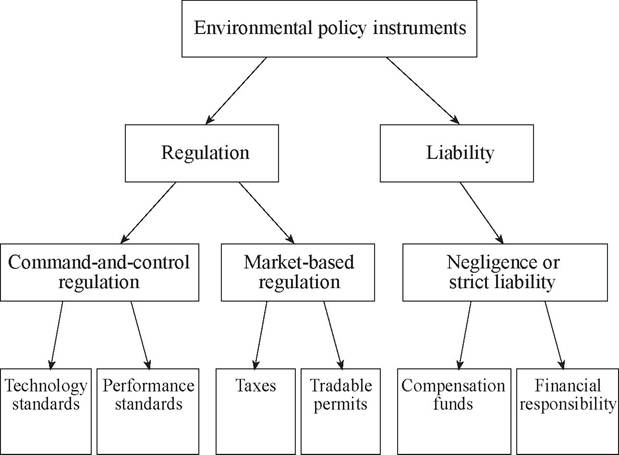
Figure 23.1 Scheme of different environmental policy instruments
regime. Finally the limit of ‘judgment proofness,, which can arise from the application of a liability system when the resources of the responsible party fall short of the damage amount, can be solved in two ways: a compensation fund and a financial responsibility system.
Before defining regulation, liability and the other instruments, it should be noted that in practice it is difficult to refer to a specific policy instrument, given that the environmental policy choice usually involves a mix of them.
More on the topic Choosing between different environmental policy instruments:
- THE PARTICIPATION PRINCIPLE
- REVIEW OF FORENSIC ASSESSMENT INSTRUMENTS
- Bovine Tuberculosis in Uganda
- Diagnosis of Bovine Tuberculosis in Zambia