CONCLUSION
The effect of democracy on redistribution and inequality is important for understanding how democracies function and use the available policy instruments. Nevertheless, our survey of the relevant literature shows that the social science literature on this topic is far from a consensus or a near-consensus on this topic.
We explained why the baseline expectation in the literature has been that democracy should increase redistribution and reduce inequality (for example, based on Meltzer and Richard’s, 1981 seminal paper), and why this expectation may not be borne out in the data because democracy may be captured or constrained; because democracy may cater to the wishes of the middle class; or because democracy may simultaneously open up new economic opportunities to the previously excluded, contributing to economic inequality. This ambiguity may be one of the reasons why the large empirical literature on this topic comes to such inconclusive findings, though the use of datasets with different qualities and different methodologies and econometric practices, many of which are far from satisfactory, are also contributing factors. It may also be that because different researchers have looked at different sets of countries in different periods, the differing results are to some extent picking up situations where one or another of the mechanisms we have identified is more dominant.
The bulk of the chapter empirically investigated the (dynamic) relationship between democracy and various economic outcomes related to redistribution and inequality. Our results, which come from panel data models controlling for the dynamics and persistence in our outcome variables, indicate that democratization does indeed increase government taxation and revenue as fractions of GDP. This confirms the basic prediction of the standard Meltzer-Richard model. In contrast, we have found no robust evidence that democracy reduces inequality, although our estimated coefficients are quite imprecise in this case.
Our results also suggest that democracy increases the share of GDP and population not in agriculture, as well as secondary school enrollment. This is consistent with democracy triggering a more rapid structural transformation, for example, because this structural transformation may have been arrested or slowed down by the nondemocratic political system. The relationship between democratic institutions and structural change is worth further investigation.These patterns suggest that the effect of democracy on redistribution and inequality may be more nuanced than often presumed and highly heterogeneous across societies. We tried to make some tentative progress on this issue by providing additional correlations pertaining to these heterogeneous effects and mechanisms on which they might be based. We found some results suggesting that democratization in the presence of powerful landed elites may increase inequality, and that structural transformation may induce an expansion of opportunities that counteract any additional redistribution, and either of these could explain the absence of an effect on inequality. This interpretation is confirmed by our finding that democracy increases inequality in places that have a lower share of population in agriculture, and at times when the global technological and organizational frontier is more inequality inducing. A natural next step for research is isolating exogenous variation in these heterogeneous effects across democracies and nondemocracies.
In addition, we also found some evidence consistent with a (modified) Director’s law, which suggests that democracy redistributes from the rich and the poor to the middle class, and therefore its effect on inequality may depend on the relative position of the middle class vis-a-vis the poor and the rich. Further research on whether and how democracies transfer from the poor to the middle class would be an important contribution.
(Overall, the evidence suggests that to the impact of democracy on inequality is limited, and these limited effects work by altering pre-redistribution market outcomes, while the fiscal mechanisms stressed by the literature play at most a small role in explaining any effect of democracy on inequality, and may in fact be inequality-increasing.
We hope that further research on these issues, tackling the first-order endogeneity concerns and exploiting within-country as well as cross-national variation, will more systematically uncover the mechanisms at work.)ACKNOWLEDGMENTS
We are grateful to the editors for their detailed comments on an earlier draft and to participants in the Handbook conference in Paris, particularly to our discussant Jose-Victor Rios-Rull.
APPENDIX A. COMPARISON TO RODRIK (1999)
This appendix replicates and extends the analysis in Rodrik (1999). At a first glance, the fact that we find no robust effect on net or gross income inequality seems at odds with Rodrik’s findings that democracies pay higher real wages in manufacturing. These opposite findings could be explained by a logic similar to the one outlined in Proposition 4. In particular, democracies may increase wages by allowing workers to reallocate to new sectors, but this may also increase inequality if there is sufficient heterogeneity in labor productivity and wages were previously compressed and reduced by labor market institutions. Besides this conceptual difference we also explore the differences between our empirical setting and Rodrik’s. We show that while the results are robust to our democracy measure, they are fragile in a number of other directions.
Rodrik’s data generating model is given by

with wit manufacturing wages from the UNIDO dataset compiled by Martin Rama. However, this model cannot be estimated because wage data comes grouped on averages for the years t, t +1, t +2, t +3, t +4 for every 5 years from 1960 onward. Thus, only the average wages between 1960 and 1964, 1965 and 1969, and so on are observed. Thus, Rodrik estimates

with all variables averaged over 5 year periods (from t to t + 4), and the model is estimated in a panel covering 1960,1965,..., 1990.
Though Rodrik presents cross-sectional and panel estimates, we focus on the latter which are the more convincing ones and are also closer to the empirical strategy adopted in this chapter.In the top panel of Table 21.A1 we present different estimates of Equation (21.A1) using a normalized polity score between 0 and 1, a normalized Freedom House index between 0 and 1 and our democracy measure separately as proxies for democracy. We always control for the log of GDP per capita, the log of worker value added in
Table 21.A1 Replication of Rodrik's results on the log of manufacturing wages
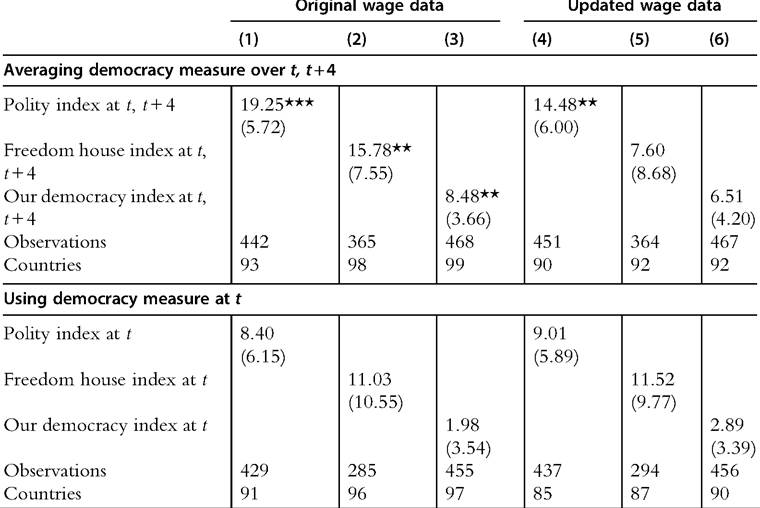
Dependent variable is log of average wages between t and t + 4.
Note: OLS estimates include a full set of country and year fixed effects. All models control for the log of GDP per capita, log of worker value added and log of the price level, but these coefficients are not reported to save space. Robust standard errors, adjusted for clustering at the country level, are in parentheses. ***: significant at 1%; **: significant at 5%; *: significant at 10%.
manufacturing and the log of the price index (from the Penn World Tables) following Rodrik’s original setup. The estimates of β are multiplied by 100 to ease their interpretation. The left panel uses Rodrik’s original wage data and the right panel uses an updated version. In all models we present robust standard errors adjusting for clustering at the country level, which are reflected in slightly higher standard errors than the ones found by Rodrik.
Our estimates show that democracy, measured by any of the indices, is associated with higher wages using the original wage data, which replicates Rodrik’s findings. There are still some small differences caused by updates to Polity and Freedom House, but qualitatively his conclusions hold. In particular, an increase in the polity score from 0 to 1 increases wages by 19.72% (s.e.
= 5.98); an increase in the Freedom House index from 0 to 1 increases wages by 20.57% (s.e. = 8.13), and a switch from nondemocracy to democracy in our measure increases wages by 8.54% (s.e. = 3.88). The results using the new wage data are less clear, smaller, and not significant for Freedom House and our democracy measure. The results suggest that the association between democracy and wages is not robust if one uses the updated wage data and the same empirical strategy as Rodrik.There are two more issues that are important to consider in weighing the importance of Rodrik’s evidence. The wage data are in the form of 5-year averages. First, this will tend to induce nontrivial serial correlation in the dependent variable, inducing error in the presence of lagged dependent variables on the right-hand side (which our estimates suggest are present). Second, by averaging the democracy index, Rodrik’s specification induces the correlation between wages at t and democracy at t + 1, t + 2, t +3 and t + 4, which of course does not reflect the effect of democracy on wages, to influence the estimate for β.
To address the second issue and get closer to the empirical strategy we used in this chapter, we can estimate the model

This model still averages the dependent variable, which cannot be undone given the wage data, but uses the baseline value of the democracy index and the controls for the years 1960,1965,..., 1990. The bottom panel in Table 21.A1 presents our results using the original wage data (left panel) and updated wage data (right panel). The estimates for β are significantly smaller and never significant. The comparison between the top panel—which uses Rodrik’s original specification—and our preferred specification in the bottom suggests that Rodrik’s results are, at least in part, driven by a correlation between wages at t and democracy at t + 1, t +2, t +3 and t + 4.
Finally, we present estimates of the model

which comes closest to the empirical specification we used throughout the paper. Table 21.A2 has the same structure as Table 21.2 in the paper and presents several estimates of the dynamic panel model in Equation (21.A1). In this case, the lagged dependent variable also controls for the nontrivial autocorrelation patterns induced by averaging the dependent variable. The results confirm that there is no effect of democracy at time t on average wages between t and t +4. Only the GMM estimates show large effects that are almost significant at conventional levels. But these estimates are unreliable because they are significantly above the fixed effect models with different imposed values of ρ (and these estimates should bracket them). Moreover, the estimated ρ is too small compared to the fixed effects estimates (it should typically be larger). We believe that this pattern may be caused by the averaging of the dependent variable, which invalidates the moment conditions of GMM estimation.
Table 21.A2 Effects of democratization on the log of manufacturing wages controlling for worker value added, prices and GDP per capita
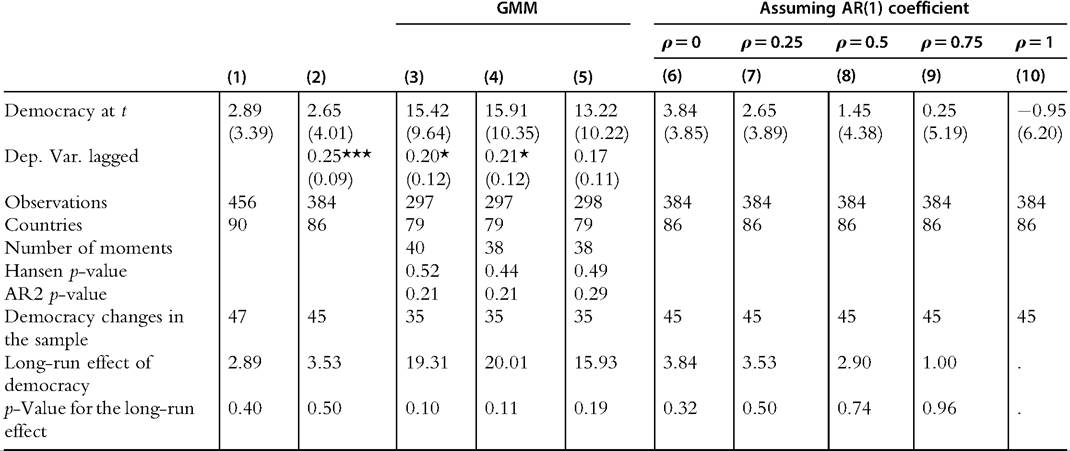
Dependent variable is log of average wages between t and t + 4.
Note: OLS estimates (Columns 1—2) include a full set of country and year fixed effects. Arellano and Bond's GMM estimators of the dynamic panel model (Columns 3—4) remove country fixed effects by taking first differences of the data, or by taking forward orthogonal differences (Column 5) and then constructing moment conditions using predeterminedlags ofthe dependent variable anddemocracy. Columns 4 and 5 use up to the Afthlagofpredeterminedvariables to create moments, restrictingthe numberof moments used. Columns 6—10 impose different values for the autocorrelation coefficient in the tax revenue as a percentage of GDP series, and estimate the effect of democracy including a full set of country and year fixed effects. All models control for the log of GDP per capita, log of worker value added and log of the price level, but these coefficients are not reportedto save space. Robust standard errors, adjustedfor clustering at the country level, are in parentheses. ***: significant at 1%; **: significant at 5%; *: significant at 10%. We do not report long-run effects and their p-values in Column 10 because they are not defined for ρ ¼ 1.
Rodrik also estimates models using wage data compiled by the Bureau of Labor Statistics for a smaller set of countries. The very small number of democratizations in this sample (only Portugal, South Korea, and Spain) makes these results less reliable. In any case, using Rodrik’s original specification, we find that our democracy measure is associated with a 37% increase in wages (standard error = 14.23), but when we estimate the specification in Equation (21.6), including the lagged dependent variable, the effect becomes smaller and no longer significant.
APPENDIX B. RESULTS USING OTHER MEASURES OF DEMOCRACY
In this section we study whether our results are driven by our new measure of democracy. Inparticularweuse Cheibub etal. (2010) Democracy-Dictatorship data (CGV) and Boix- Miller-Rosato’s Complete Dataset ofPolitical Regimes, 1800-2007 (BMR). Both datasets are different updates and revisions ofthe Przeworski et al. (2000) measure. We estimate our basic dynamic panel model using the log of tax revenue as a percentage of GDP, and the Gini coefficient for net and gross income as dependent variable. We only report fixed effects estimates and the Arellano and Bond GMM estimates for each of these variables.
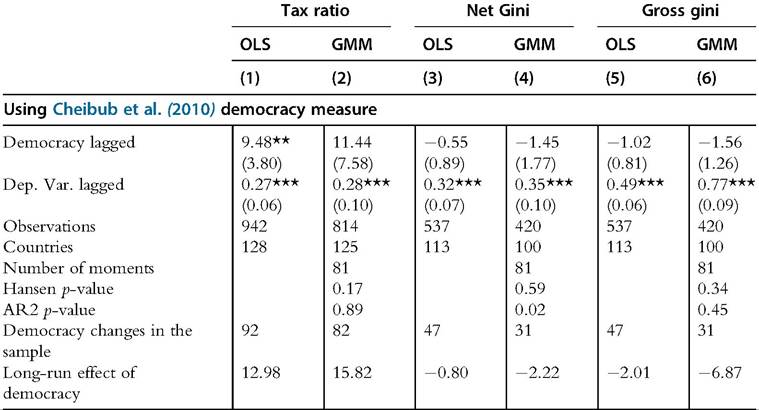
The top panel in Table 21.A3 presents the results using Cheibub et al. (2010) democracy measure; while the bottom panel presents the results using Boix et al. (2012) democracy measure. We find a similar pattern and similar magnitudes, though our GMM estimates on the tax to GDP ratio are less precise and not significant. Again, there is
Table 21.A3 Effects Ofdemocratization on the log of tax revenue as a percentage of GDP per capita, and Gini coefficient of net and gross income
Continued
Table 21.A3 Effects of democratization on the log of tax revenue as a percentage of GDP per capita, and Gini coefficient of net and gross income—cont'd
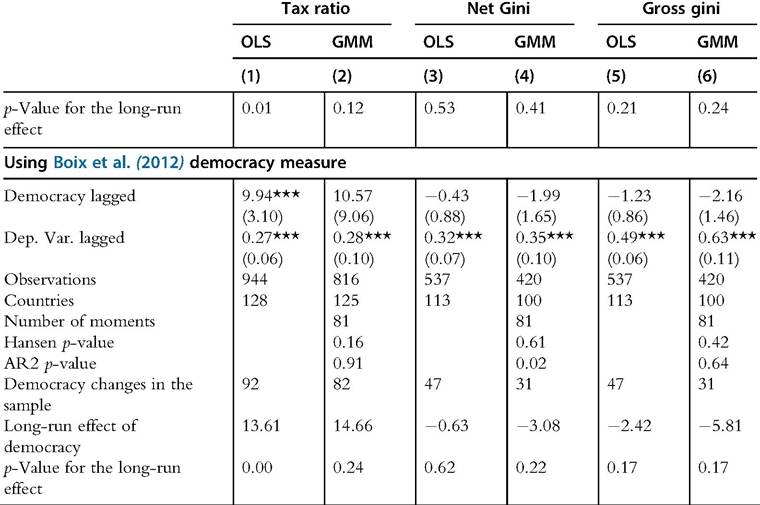
Note: Odd columns present OLS estimates with a full set of country and year fixed effects. Even columns present Arellano and Bond's GMM estimators of the dynamic panel model which remove country fixed effects by taking first differences of the data and then constructing moment conditions using predetermined lags of the dependent variable and democracy. All models control for the lag of GDP per capita but these coefficients are not reported to save space. Robust standard errors, adjusted for clustering at the country level, are in parentheses. ***: significant at 1%; **: significant at 5%; *: significant at 10%.
an effect on tax revenue as a percentage of GDP, which holds in a more robust way when we focus on specifications in levels that are not reported here to save space. We also continue to find no robust effect on inequality.
Overall, the results are broadly similar using other measures of democracy, though they are more precise and consistent with our preferred measure—as would be expected if our measure removes some of the measurement error present in other indices. This was one of the main goals for its construction.
REFERENCES
Acemoglu, D., 2006. Modeling inefficient institutions. In: Blundell, R., Newey, W., Persson, T. (Eds.), Advances in Economic Theory. Proceedings of 2005 World Congress. Cambridge University Press, New York, NY.
Acemoglu, D., Robinson, J.A., 2000. Why did the west extend the franchise? Q.J. Econ. 115, 1167-1199.
Acemoglu, D., Robinson, J.A., 2001. A theory of political transitions. Am. Econ. Rev. 91, 938—963.
Acemoglu, D., Robinson, J.A., 2006. Economic Origins of Dictatorship and Democracy. Cambridge University Press, New York, NY.
Acemoglu, D., Robinson, J.A., 2008. Persistence of power, elites and institutions. Am. Econ. Rev. 98, 267-291.
Acemoglu, D., Johnson, S., Robinson, J.A., 2001. The colonial origins of comparative development: an empirical investigation. Am. Econ. Rev. 91 (5), 1369-1401.
Acemoglu, D., Johnson, S., Robinson, J.A., 2002. Reversal of fortune: geography and institutions in the making of the modern world income distribution. Q. J. Econ. 118, 1231-1294.
Acemoglu, D., Johnson, S., Robinson, J.A., Yared, P., 2005. From education to democracy? Am. Econ. Rev. 95, 44-49.
Acemoglu, D., Johnson, S., Robinson, J.A., Yared, P., 2008. Income and democracy. Am. Econ. Rev. 98, 808-842.
Acemoglu, D., Johnson, S., Robinson, J.A., Yared, P., 2009. Reevaluating the modernization hypothesis. J. Monet. Econ. 56, 1043-1058.
Acemoglu, D., Ticchi, D., Vindigni, A., 2011. Emergence and persistence of inefficient states. J. Eur. Econ. Assoc. 9 (2), 177-208.
Acemoglu, D., Egorov, G., Sonin, K., 2012. Dynamics and stability of constitutions, coalitions and clubs. Am. Econ. Rev. 102 (4), 1446-1476.
Acemoglu, D., Naidu, S., Restrepo, P., Robinson, J.A., 2013a. Democracy does cause growth, Unpublished.
Acemoglu, D., Robinson, J.A., Santos, R.J., 2013b. The monopoly of violence: evidence from Colombia. J. Eur. Econ. Assoc. 11 (S1), 5-44.
Acemoglu, D., Robinson, J.A., Torvik, R., 2013c. Why Do voters dismantle checks and balances? Rev. Econ. Stud. 80 (3), 845-875.
Acemoglu, D., Reed, T., Robinson, J.A., 2014. Chiefs: elite control of civil society and economic development in sierra Leone. J. Polit. Econ. 122 (2), 319-368.
Aghion, P., Persson, T., Rouzet, D., 2012. Education and military rivalry. Unpublished, http://scholar. harvard.edu/files/aghion/files/education_and_military_rivalry.pdf.
Aidt, T.S., Dallal, B., 2008. Female voting power: the contribution of women’s suffrage to the growth of social spending in Western Europe (1869-1960). Public Choice 134 (3-4), 391-417.
Aidt, T.S., Jensen, P.S., 2009a. The taxman tools Up: an event history study ofthe introduction ofthe personal income Tax in western Europe, 1815-1941. J. Public Econ. 93, 160-175.
Aidt, T.S., Jensen, P.S., 2009b. Tax structure, size of government, and the extension of the voting franchise in western Europe, 1860-1938. Int. Tax Public Fin. 16 (3), 362-394.
Aidt, T.S., Jensen, P.S., 2011. Workers ofthe World Unite! Franchise Extensions and the Threat of Revolution in Europe, 1820-1938. Cambridge Working Papers in Economics 1102, Faculty of Economics, University of Cambridge.
Aidt, T.S., Jensen, P.S., 2013. Democratization and the size of government: evidence from the long 19th century. http://ideas.repec.org/p/ces/ceswps/_4132.html.
Aidt, T.S., Dutta, J., Loukoianova, E., 2006. Democracy comes to Europe: franchise expansion and fiscal outcomes 1830-1938. Eur. Econ. Rev. 50 (2), 249-283.
Aidt, T.S., Daunton, M.J., Dutta, J., 2009. The retrenchment hypothesis and the extension of the franchise in England and Wales. Econ. J 120, 990-1020.
Albertus, M., Menaldo, V., 2012. If you’re against them you are with us: the effect of expropriation of autocratic survival. Comp. Polit. Stud. 45 (8), 973-1003.
Albertus, M., Menaldo, V., 2014. Gaming democracy: elite dominance during transition and the prospects for redistribution. Br. J. of Polit. Sci. 44 (3), 575-603.
Alesina, A., Angeletos, G.-M., 2005. Fairness and redistribution. Am. Econ. Rev. 95, 960-980.
Alesina, A., Glaeser, E.L., 2004. Fighting Poverty in the US and Europe: A World of Difference. Oxford University Press, New York, NY.
Alesina, A., La Ferrara, E., 2005. Preferences for redistribution in the land of opportunities. J. Public Econ. 89, 897-931.
Alesina, A., Rodrik, D., 1994. Distributive politics and economics growth. Q. J. Econ. 109, 465—490.
Alesina, A., Tabellini, G., 1989. External debt, capitalflightandpoliticalrisk. J. Inter. Econ. 27 (3), 199—220.
Alesina, A., Baqir, R., Easterly, W., 1999. Pubic goods and ethnic divisions. Q. J. Econ. 114, 1243-1284.
Algan, Y., Cahuc, P., Sangnier, M., 2013. Efficient and Inefficient Welfare States. https://sites.google.com/ site/pierrecahuc/unpublished_papers.
Alvaredo, F., Atkinson, A.B., Piketty, T., Saez, E., 2010. The WorldTop Incomes Database. Available from http://topincomes.g-mond.parisschoolofeconomics.eu/.
Alvarez, J., Arellano, M., 2003. The time series and cross-section asymptotics of dynamic panel data estimators. Econometrica 71 (4), 1121-1159.
Anderson, S., Francois, P., Kotwal, A., 2011. Clientelism in Indian Villages. http://faculty.arts.ubc.ca/ fpatrick/documents/clientAERmay1313.pdf.
Ansell, B., 2010. From the Ballot to the Blackboard: The Redistributive Political Economy of Education. Cambridge University Press, New York, NY.
Arbetman-Rabinowitz, M., Kugler,J., Abdollahian, M., Johnson, K., Kang, K., 2011. Replication Datafor: Relative Political Capacity Dataset. http://hdl.handle.net/1902.1/16845 Transresearch Consortium.
Arellano, M., Bond, S.R., 1991. Some specification tests for panel data: Monte Carlo evidence and an application to employment equations. Rev. Econ. Stud. 58 (2), 277-298.
Atkinson, A.B., Micklewright, J., 1992. Economic Transformation in Eastern Europe and the Distribution of Income. Cambridge, Cambridge University Press.
Atkinson, A.B., Piketty, T., Saez, E., 2011. Top incomes in the long Run of history. J. Econ. Liter. 49 (1), 3-71.
Austen-Smith, D., Banks, J.S., 1999. Positive Political Theory I. University of Michigan Press, Ann Arbor, MI.
Avelino, G., Brown, D.S., Hunter, W., 2005. The effects ofcapitalmobility, trade openness, and democracy on social spending in Latin America 1980-1999. Am. J. Polit. Sci. 49 (3), 625-641.
Baland, J.-M., Robinson, J.A., 2008. Land and power: theory and evidence from Chile. Am. Econ. Rev. 98, 1737-1765.
Baland, J.-M., Robinson, J.A., 2012. The political value of land: political reform and land prices in Chile. Am. J. Polit. Sci. 56 (3), 601-619.
Bardhan, P., Bowles, S., Wallerstein, M. (Eds.), 2006. Globalization and Egalitarian Redistribution. Princeton University Press, Princeton, NJ.
Bates, R.H., Block, S.A., 2013. Revisiting African agriculture: institutional change and productivity growth. J. Polit. 75 (2), 372-384.
Battaglini, M., Coate, S.T., 2008. A dynamic theory of public spending, taxation and debt. Am. Econ. Rev. 98 (1), 201-236.
Baum, M.A., Lake, D.A., 2001. The invisible hand of democracy: political control and the provision of public services. Comp. Polit. Stud. 34, 587-621.
Baum, M.A., Lake, D.A., 2003. The political economy of growth: democracy and human capital. Am. J. Polit. Sci. 47, 333-347.
Beard, C.A., 1913. An Economic Interpretation of the US Constitution. The Free Press, New York, NY.
Benabou, R., 2001. Unequal societies: income distribution and the social contract. Am. Econ. Rev. 90, 96-129.
Benabou, R., 2008. Ideology. J. Eur. Econ. Assoc. 6, 321-352.
Benabou, R., Ok, E., 2001. Social mobility and the demand for redistribution: the POUM hypothesis. Q. J. Econ. 116, 447-487.
Benabou, R., Tirole, J., 2006. Beliefin a just world and redistributive politics. Q. J. Econ. 121, 699-746.
Berlinski, S., Dewan, T., 2011. The political consequences of franchise extension: evidence from the second reform Act. Q. J. Polit. Sci. 6 (4), 329-376.
Besley, T.F., 2007. Principled Agents: The Political Economy of Good Government. Oxford University Press, Oxford.
Besley, T.F., Kudamatsu, M., 2006. Health and democracy. Am. Econ. Rev. 96, 313-318.
Besley, T.F., Persson, T., 2011. Pillars of Prosperity. Princeton University Press, Princeton, NJ.
Besley, T.F., Persson, T., Sturm, D., 2010. Political competition, policy and growth: theory and evidence from the United States. Rev. Econ. Stud. 77, 1329-1352.
Blaydes, L.M., Kayser, M., 2011. Counting calories: democracy and distribution in the developing world. Inter. Stud. Q. 55, 887—908.
Blundell, R., Bond, S., 2000. GMM Estimation with persistent panel data: an application to production functions. Econ. Rev. 19 (3), 321—340.
Boix, C., Miller, M., Rosato, S., 2012. A complete data Set of political regimes, 1800—2007. Comp. Polit. Stud. 46 (12), 1523-1554.
Brown, D.S., 1999. Reading, writing and regime type: democracy’s impact on primary school enrollment. Polit. Res. Q. 52 (4), 681-707.
Brown, D.S., Hunter, W.A., 1999. Democracy and social spending in Latin America, 1980-92. Am. Polit. Sci. Rev. 93 (4), 779-790
Brown, D.S., Hunter, W.A., 2004. Democracy and human capital formation: educational expenditures in Latin America. Comp. Polit. Stud. 37, 842-864.
Burkhart, R.E., 1997. Comparative democracy and income distribution: shape and direction of the causal arrow. J. Polit. 59 (1), 148-164.
Campello, D., 2011. The great gap: inequality and the politics of redistribution in Latin America. In: Blofield, M. (Ed.), The Politics of Redistribution in Less Developed Democracies: Evidence from Brazil, Ecuador, and Venezuela. Penn State Press, University Park, PA.
Carter, M.R., Morrow, J., 2012. Left, Right, Left: Income Dynamics and the Evolving Political Preferences of Forward Looking Bayesian Voters. http://agecon.ucdavis.edu/people/faculty/michael-carter/docs/ nopoumECMA.pdf.
Cascio, E., Washington, E., 2012. Valuing the Vote: The Redistribution of Voting Rights and State Funds Following theVoting Rights Act of1965. NationalBureau of Economic Research, Working Paper No. 17776.
Cheibub, J.A., 1998. Political regimes and the extractive capacity of governments: taxation in democracies and dictatorships. World Polit. 50, 349-376.
Cheibub, J.A., Gandhi, J., Vreeland, J.R., 2010. Democracy and dictatorship revisited. Public Choice 143 (1), 67-101.
Daalgard, C.-J., Hansen, H., Larsen, T., 2005. Income skewness, redistribution and growth: A reconciliation, Unpublished, Department of Economics, University of Copenhagen.
Dasgupta, S., 2013. Legalizing the Revolution. Unpublished, Ph.D. Thesis, Columbia University.
De la O, A.L., Rodden,J., 2008. Does religion distract the poor? Income and issue voting around the world. Comp. Polit. Stud. 41 (4), 437-476.
Drazen, A.M., 2000. Political Economy in Macroeconomics. Princeton University Press, Princeton, NJ. Dunning, T., 2008. Crude Democracy. Cambridge University Press, New York, NY.
Einhorn, R.L., 2006. American Taxation, American Slavery. University of Chicago Press, Chicago, IL.
Elis, R., 2011. Redistribution Under Oligarchy: Trade, Regional Inequality and the Origins of Public Schooling in Argentina, 1862-1912. Unpublished, Ph.D. Dissertation, Department of Political Science, Stanford University.
Ellman, M., Wantchekon, L., 2000. Electoral competition under the threat of political unrest. Q. J. Econ. 115 (2), 499-531.
Engerman, S.L., Sokoloff, K.L., 2005. The evolution of suffrage institutions in the New World. J. Econ. Hist. 65, 891-921.
Engerman, S.L., Sokoloff, K.L., 2011. Economic Development in the Americas since 1500: Endowments and Institutions. Cambridge University Press, New York, NY.
Fernandez, R., Rogerson, R., 1995. On the political economy of education subsidies. Rev. Econ. Stud. 62, 249-262.
Flemming, J.S., Micklewright, J., 2000. Income distribution, economic systems and transition. In: Atkinson, A.B., Bourguignon, F. (Eds.), Handbook of Income Distribution, first ed. In: vol. 1. Elsevier, Cambridge, pp. 843-918, Chapter 14.
Frank, T., 2005. What’s the Matter with Kansas? How Conservatives Won the Heart of America. Holt, New York, NY.
Fujiwara, T., 2011. Voting Technology, Political Responsiveness, and Infant Health: Evidence from Brazil. http://www.princeton.edu/~fujiwara/papers/elecvote_site.pdf.
Gallego, F.A., 2010. Historical origins of schooling: the role of democracy and political decentralization. Rev. Econ. Stat. 92 (2), 228-243.
Gerring, J., Thacker, S., Alfaro, R., 2012. Democracy and human development. J. Polit. 74(1).
Gil, R., Mulligan, C.B., Sala-i-Martin, X., 2004. Do democracies have different public policies than nondemocracies? J. Econ. Perspect. 18, 51-74.
Gradstein, M., Justman, M., 1999a. The industrial revolution, political transition and the subsequent decline in inequality in nineteenth century Britain. Explor. Econ. Hist. 36, 109-127.
Gradstein, M., Justman, M., 1999b. The democratization of political elites and the decline in inequality in modern economic growth. In: Breizes, E.S., Temin, P. (Eds.), Elites, Minorities andEconomic Growth. Elsevier, Amsterdam.
Gradstein, M., Milanovic, B., 2004. Does liberte=egalite? A survey of the empirical evidence on the links between political democracy and income inequality. J. Econ. Surv. 18 (4), 515-537.
Gradstein, M.,Justman, M.,Meier,V., 2004. The PoliticalEconomy ofEducation: Implications for Growth and Inequality. MIT Press, Cambridge.
Guttsman, W.L. (Ed.), 1967. A Plea for Democracy: Ad Edited Selection from the 1867 Essays on Reform and Questions for a Reformed Parliament. Macgibbon & Kee, London.
Harding, Robin, Stasavage, David, 2013. What Democracy Does (and Doesn’t do) for Basic Services: School Fees, School Inputs, and African Elections. Unpublished, Department of Politics, New York University.
Hassler, J., Storesletten, K., Mora, J.V.R., Zilibotti, F., 2003. The survival of the welfare state. Am. Econ. Rev. 93 (1), 87-112.
Hendrix, C.S., 2010. Measuring state capacity: theoretical and empirical implications for the study of civil conflict. J. Peace Res. 47 (3), 273-285.
Holton, W., 2008. Unruly Americans and the Origins of the Constitution. Palgrave Macmillan, New York, NY.
Holtz-Eakin, D., Newey, W.K., Rosen, H.S., 1988. Estimating vector autoregressions with panel data. Econometrica 56 (6), 1371-1396.
Huber, E., Stephens, J.D., 2012. Democracy and the Left: Social Policy and Inequality in Latin America. University of Chicago Press, Chicago, IL.
Huber, E., Nielsen, F., Pribble, J., Stephens, J.D., 2006. Politics and Inequality in Latin America and the Caribbean. Am. Sociol. Rev. 71 (6), 943-963.
Husted, T.A., Kenny, L., 1997. The effect of the expansion of the voting franchise on the size of government. J. Polit. Econ. 105, 54-82.
Kaufman, R.R., Segura-Ubiergo, A., 2001. Globalization, domestic politics, and social spending in Latin America: a time-series cross-section analysis, 1973-97. World Polit. 53 (4), 553-587.
Krusell, P., Rlos-Rull,J.-V., 1999. On the size of the US government. Am. Econ. Rev. 89 (5), 1156-1181.
Krusell, P., Rios-Rull, J.-V., Quadrini, V., 1997. Politico-economic equilibrium and growth. J. Econ. Dynam. Control 21 (1), 243-272.
Kudamatsu, M., 2012. Has democratization reduced infant mortality in sub-Saharan Africa? Evidence from micro data. J. Eur. Econ. Assoc. 10 (6), 1294-1317.
Lapp, N.D., 2004. Landing Votes: Representation and Land Reform in Latin America. Palgrave Macmillan, New York, NY.
Larcinese, V., 2011. Enfranchisement and Representation: Italy 1909-1913. Unpublished, Department of Government, London School of Economics, http://personal.lse.ac.uk/LARCINES/enfranchisement_ nov11.pdf.
Lee, W., 2003. Is democracy more expropriative than dictatorship? tocquevillian wisdom revisited. J. Devel. Econ. 71, 155-198.
Lee, C.-S., 2005. Income inequality, democracy, and public sector size. Am. Sociol. Rev. 70 (1), 158-181.
Li, H., Squire, L., Zou, H.-f., 1998. Explaining international and intertemporal variations in income inequality. Econ. J. 108 (1), 26-43.
Lindert, P.H., 1994. The rise of social spending, 1880-1930. Explor. Econ. Hist. 31 (1), 1-37.
Lindert, P.H., 2004. Growing Public: Social Spending and Economic Growth since the Eighteenth Century. Cambridge University Press, New York, NY.
Lizzeri, A., Persico, N., 2004. Why Did the elites extend the suffrage? Democracy and the scope of government, with an application to Britain’s ‘age of reform. Q. J. Econ. 119, 707-765.
Llavador, H., Oxoby, R.J., 2005. Partisan competition, growth, and the franchise. Q. J. Econ. 120, 1155-1192.
Londregan, J.B., 2000. Legislative Institutions and Ideology in Chile. Cambridge University Press, New York, NY.
LottJr., J.R., Kenny, L., 1999. How dramatically did women’s suffrage change the size and scope of government? J. Polit. Econ. 107 (6), 1163-1198.
Lundahl, M., 1982. The rationale for apartheid. Am. Econ. Rev. 72, 1169-1179.
Martinez-Bravo, M., PadrT., 2013. Democratization and Power Resources 1850-2000. http://www.fsd.uta.fi/en/data/ catalogue/FSD1216/meF1216e.html#viittaaminen.
Waldstreicher, D., 2009. Slavery’s Constitution: From Revolution to Ratification. MacMillan, New York, NY.
Weede, E., 1989. Democracy and income inequality reconsidered. Am. Sociol. Rev. 54 (5), 865-868. Weyland, K., 2004. Neoliberalism and democracy in Latin America: a mixed record. Lat. Am. Polit. Soc.
46 (1), 135-157.
Whiteford, A., Van Seventer, D., 2000. Understanding contemporary household inequality in South Africa. Stud. Econ. Econ. 24 (3), 7-30.
Wigley, S., Akkoyunlu-Wigley, A., 2011. The impact of regime type on health: does redistribution explain everything? World Polit. 63 (4), 647-677.
Wilse-Samson, L., 2013. Structural Change and Democratization: Evidence from Apartheid South Africa. Unpublishedworking paper, Columbia University, http://www.columbia.edu/~lhw2110/research. html.
Wooldridge, J.M., 2002. Econometric Analysis of Cross Section and Panel Data. MIT Press, Cambridge. Wright, R.D., 1996. Taxes, redistribution and growth. J. Public Econ. 62, 327-338.