CONCLUSIONS: MAJOR FINDINGS FROM THE LITERATURE SURVEY AND IMPLICATIONS FOR FURTHER RESEARCH
19.6.1 A Summary of Findings and Propositions from the Overview of Studies Providing Multicausal Explanations
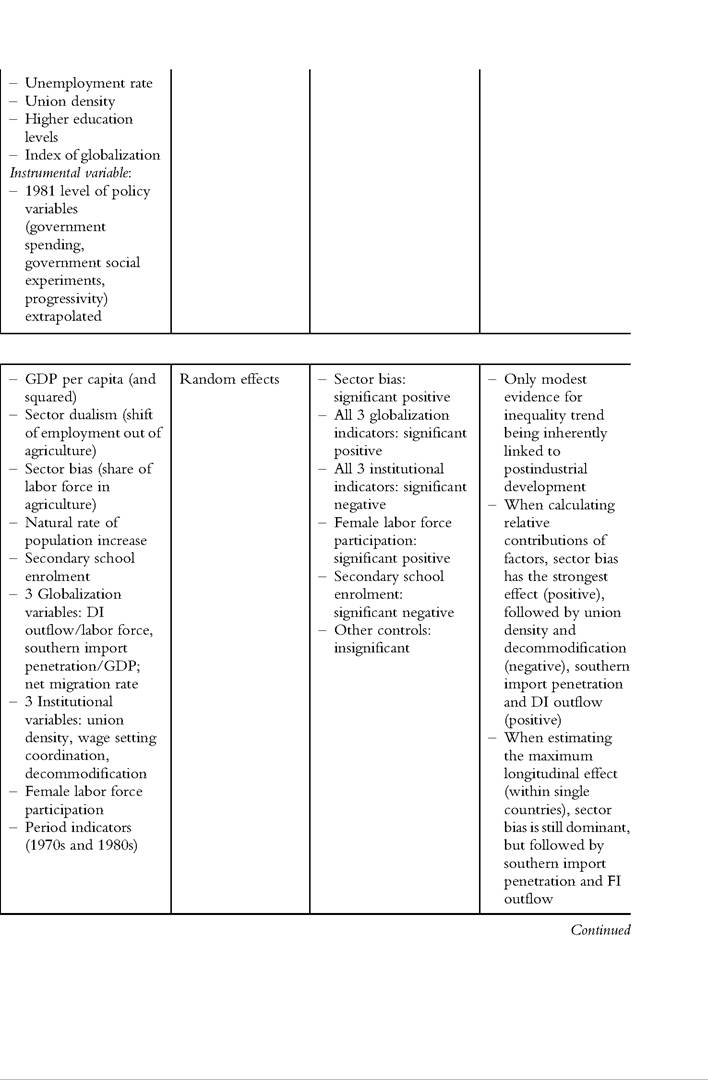
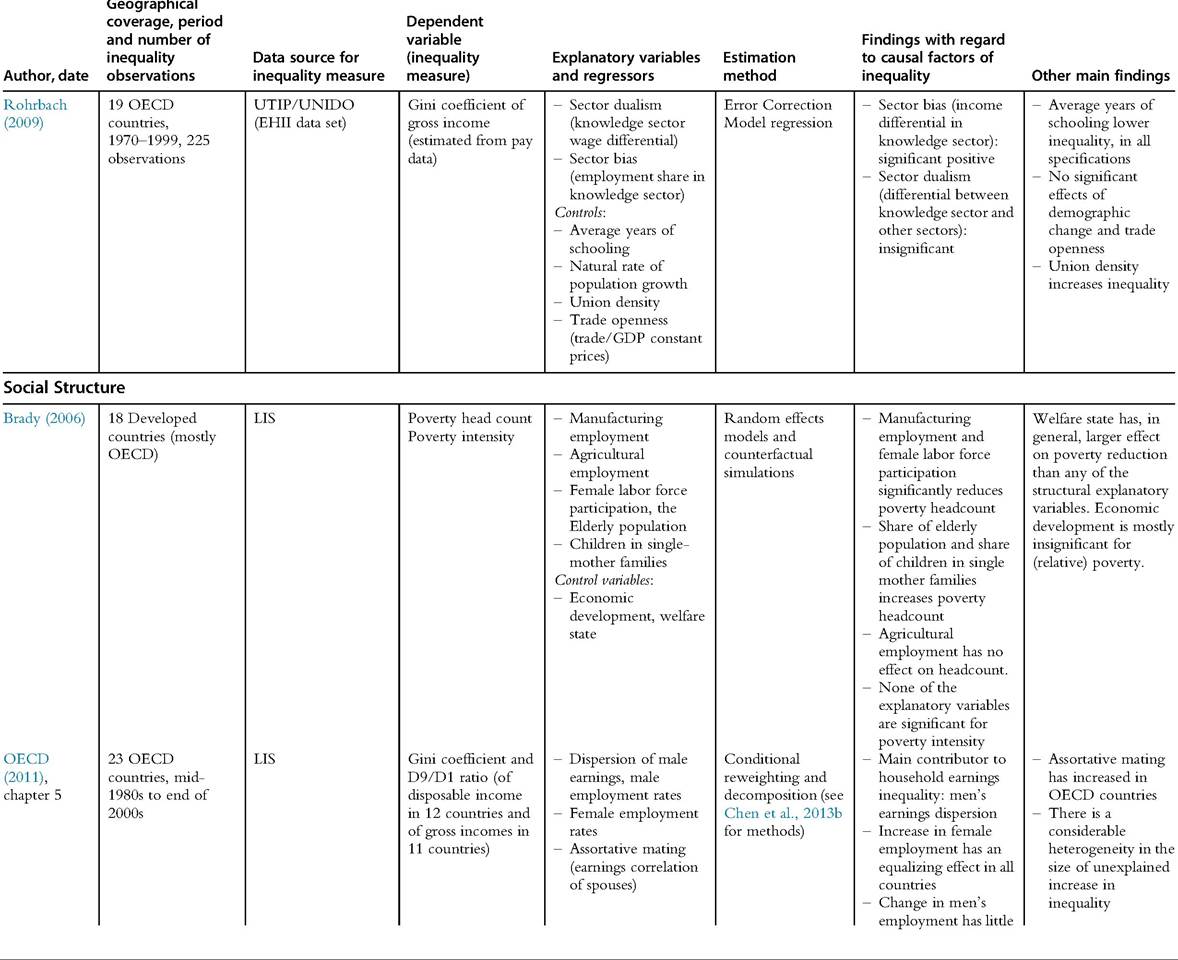
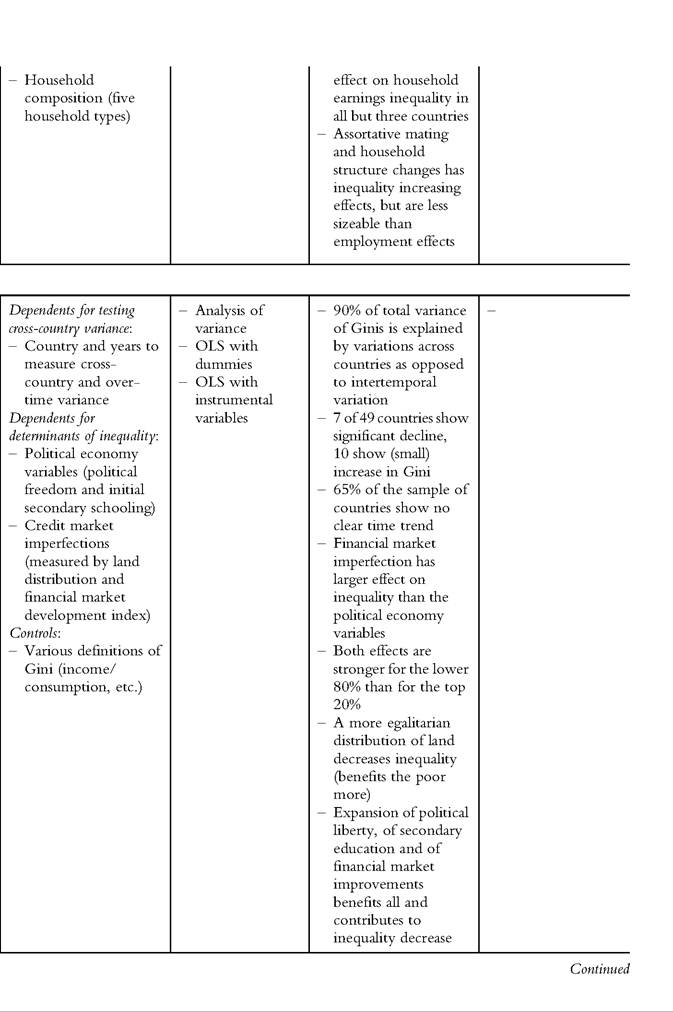
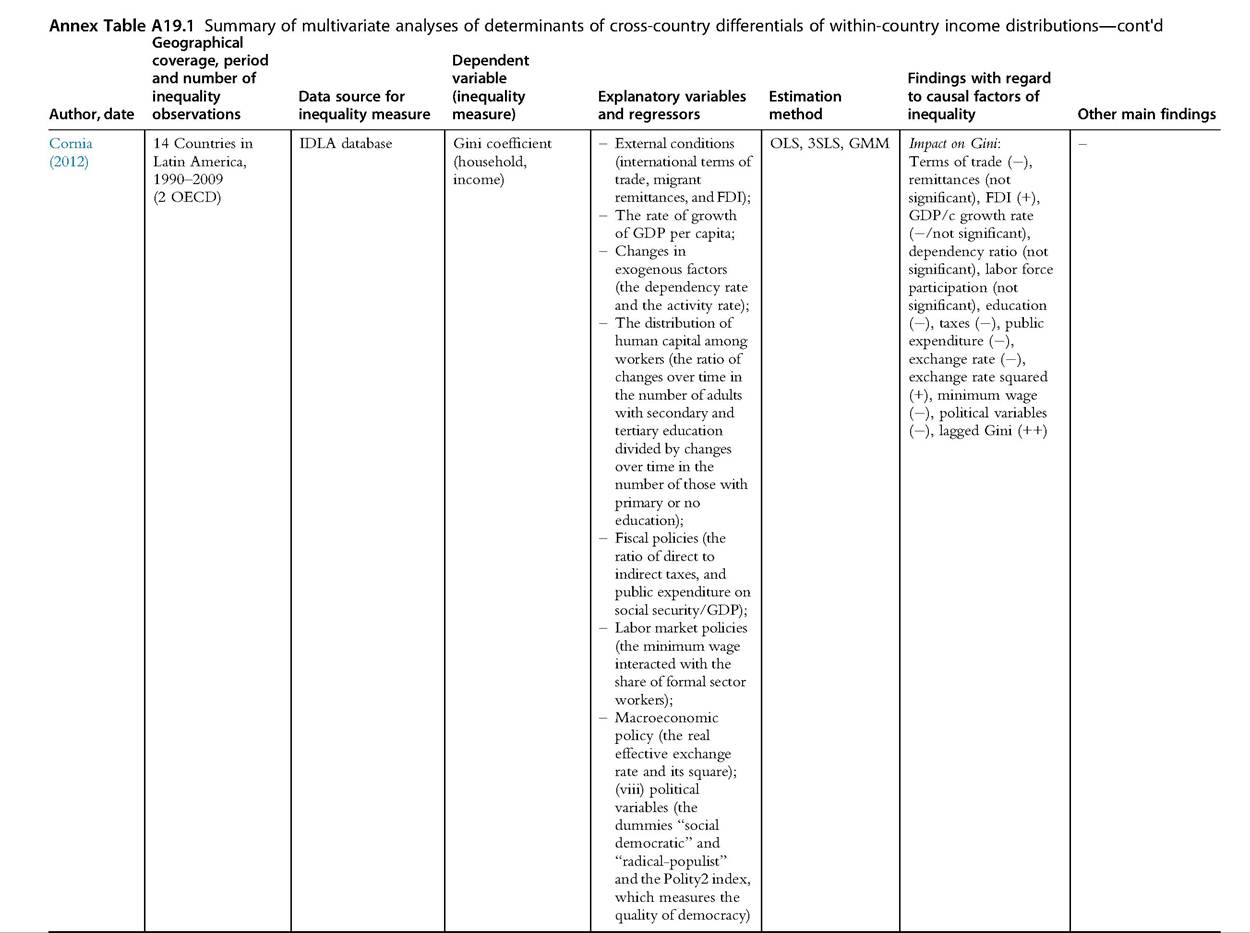
This section summarizes the main findings presented above from the most important recent studies that provide multicausal explanations and provides a combined analysis of the relative weights of the various arguments set out in Section 19.5.
For the purpose of the summary, we differentiate between three levels of explanatory factors. On the first, broadest level (represented by the diamonds in Figure 19.1), there are six different groups of factors:1. structural macroeconomic sectoral changes
2. globalization and technology change
3. labor market and other relevant institutions
4. politics and political processes
5. tax/transfer schemes
6. demographic and other microstructural changes
As indicated in Section 19.1, we may think of the above factors as “underlying” causes of inequality change. On the second level, there are elements within each of the six broad groups (such as FDI, technology, trade, etc., for globalization or such as unionization, unemployment benefits, employment protection legislation, etc., for labor market institutions). This second group could be included under the umbrella of “proximate causes” of inequality or “hints” at causes.[320] [321] Finally, there is a third level, on which the various authors operationalize their models, that is, where they chose the appropriate variables for their models, which are, in most cases, necessarily second-best proxies of the second-level factors. In what follows, we summarize the results of the level of abstraction represented by the first level. While doing that, we also report findings for the interactions between the effects of the various variable groupings as far as they are available. As for the major hypothesis of structural macroeconomic sectoral changes (i.e., sector bias and sector dualism, as proposed by Kuznets), the evidence is inconclusive. As for the debate on globalization versus technology, there has been a move away from trade-focused explanations to technology explanations during the 1990s. In the 2000s, several authors changed track from their earlier views that the effect of trade on inequality was modest at best (Krugman, 2007; Scheve and Slaughter, 2007). They now suggest that trade-induced phenomena such as outsourcing may have had a more significant effect on income distribution than formerly assumed. That said, while under the pure aspect of trade costs, off-shoring all tasks that are technically off-shorable may indeed be possible, this will not always make sense from a business point of view, especially when transaction costs and economies of scope are taken into account; the assumed effect of a surge in off-shoring may therefore be exaggerated, as argued by Lanz et al. (2011). At the same time, technological change now is more often understood as endogenous and interacting with trade. More generally, the key issue today is no longer identifying which trade or technological change was the main culprit in increasing inequality, but rather to identify the channels through which these two operate and interact in their effect on inequality (see Chusseau et al., 2008). The effect of education—human capital accumulation—on inequality is not linear and, because of different composition and wage premium effects at different times, can first be disequalizing and then equalizing, analogous with the Kuznets process. While it is widely recognized that institutions matter, the weight attached to this factor in econometric studies has long been limited. A majority of (but not all) studies finds significant negative associations, in particular with wage inequality, through direct or indirect effects of union density/coverage, wage coordination/centralization and EPL. Checchi and Garcia-Penalosa (2005) and the OECD (2011) found the weakening of employment protection and the decline in unionization increased wage dispersion, mostly having effects at the lower ends of the distribution of wages. It has, however, also been emphasized that when observed in a broader context (i.e., concentrating on combined employment and dispersion effects of institutional changes), the results were inconclusive because employment and inequality effects of institutional change tended to net each other out (OECD, 2011). Also, Checchi and Garcia-Penalosa (2008) suggested that the combined effects of institutions on factor income inequality are weak, whereas the income distribution effects of high tax wedges (which could be expected to serve larger redistribution to favor lower segments of the labor markets) also has controversial effects (high-wage workers are able to pass on tax burden to their employers, while the overall tax wedge effects can contain considerable unemployment increases). All in all, it is shown that for inequality trends, developments in political processes are of key importance. How preferences of the electorate are recognized, processed and translated into policies (which, in turn, shape labor market and welfare state institutions) do play an important role in redistributive institutions and, ultimately, in inequalities. The identification of the Left and the Right may easily turn out to be problematic, especially when representation of the various labor market segments is taken into account (Rueda, 2008). Given the fact that parties sometimes pick up interests of insiders (such as active earners) as opposed to the interests of outsiders (such as the inactive earners and the unemployed), redistributive outcomes might come about as results of sometimes contradicting tendencies of redistribution from the rich to the poor and of legislation to support the interest of the insiders of the labor markets. When analyzing actual redistribution processes, the definitions of the pre- and postredistribution inequality (in other words, the accounting framework in which the redistribution processes are understood and interpreted) has been identified as crucial to the measurement of the effects of redistribution (Whiteford, 2008; Immervoll and Richardson, 2011; Kenworthy and Pontusson, 2005). It also has been emphasized that redistribution might have a number of second-order effects. The results of redistribution analyzes have shown that redistribution reduces inequality overall in all OECD countries, although to a varying extent, depending on concrete institutional settings. The redistributive effectiveness of the two sides (taxes and benefits) has been shown to be different: cash transfers (in all countries but the United States) are estimated to have much larger first-order effects on inequality than taxes (Whiteford, 2008; Immervoll and Richardson, 2011).[323] Among public social transfers, public pension programmes achieve the largest redistribution; however, the interpretation and evaluation of these differs and is dependent on the chosen perspective of Robin Hood or piggy bank welfare states. There are second-order effects of redistribution, such as those resulting from behavioral adjustment on the contributor side (taxpayers) or the recipient side (social assistance beneficiaries). Some studies are able to show the existence of second-order responses, the magnitude of which, however, seems to be relatively small (Doerrenberg and Peichl, 2012). The measured effects of taxation on labor supply (which is clearly an important area of potential behavioral repercussions) imply that social embeddedness of institutions is noticeable. Studies by Blundell et al. (2011) highlighted that behavioral elasticities for women are larger with regard to both decisions about entering the labor markets (extensive margin) and changing work efforts on the labor markets (intensive margins). An important aspect in redistribution research is how the change in size and techniques of tax transfer schemes have contributed to changes in overall inequality. As highlighted by the OECD (2011), changes in redistribution can be seen as causal factors for increasing inequality during the period before the breakout of the economic recession in 2008. The redistributive power of the welfare state was weakened in the period between the mid-1990s to mid-2000s. The social context can also be captured by the effects of changing demographic composition (by age, household types, etc.) and ofchanging demographic behavior (household formation, assortative mating, etc.) on inequality. While the (composition) effects of ageing and of household composition are estimated to have an inequality-increasing effect (Lu et al., 2011; OECD, 2011; Peichl et al., 2010), the results of some of the discussed behavioral trends (assortative mating) are less clear-cut, but in general also are shown to have an effect on inequality change, mostly as disequalizing effects. Some scholars present the results of the “incomplete revolution” of women’s changing role in labor markets and in families as equalizing within the households (because of more equal divisions of domestic labor) but disequalizing among households (because of differential behavioral reactions of women with higher and lower status [Esping-Andersen, 2009]). Taken together, when modelling the inequality effects of changes in demographic composition and behavior on the one hand and labor market related changes on the other, the OECD (2011) concludes that the former seems to explain much less of the increase in inequality than the latter. In a nutshell, this is what we found at the first level of factors identified at the beginning of this section (and in the diamonds of Figure 19.1). To give a brief summary assessment of the results found in the studies published over the past 10-15 years, Figure 19.3 provides an idea of the direction of causal factors of inequality that were identified. This summary remains qualitative and cannot be based on quantitative assessment because the multitude of studies use various and different methodologies, estimation methods and data, as well as varying country coverage. Further, it is in part our own subjective assessment. As a convention, positive/negative association means disequalizing/equalizing. “Significance” has to be understood here (and elsewhere in the text) as a statistically significant association, notwithstanding the relative size of a coefficient. “Inconclusive” means that roughly as many studies report (significantly) positive as negative effects. Further, this assessment is based as much as possible on studies covering the restricted sample of OECD/EU countries. Figure 19.3 Drivers of inequality: a qualitative summary of results for OECD countries reported in recent studies. EPL, employment protection legislation;FDI, foreign direct investment;UB, unemployment benefit. A first glance at Figure 19.3 reveals that inconclusiveness prevails for many possible drivers of inequality, that is, the large number of recent empirical, cross-country studies report contradicting results, which can often but not always be traced back to different country samples, time periods, data and methodological specifications. In particular, for those factors for which there are more complete and fairly direct measures at hand (such as measures of trade openness or financial openness), there is little clear effect reported, whereas for factors where more proxy-type measures need to be used (such as technology), there seem to be more significant findings. One is tempted to detect some sort of Heisenberg principle: the sharper we can measure a variable, the less effect will be found. As mentioned above, the summary assessment in Figure 19.3 refers to findings on the different level-one factors separately. To show and interpret the relative strength of the various findings, one would need to refer to studies with a true multivariate design, that is, those covering not only a multitude of countries but also a sufficient number of variables representing each of the first-level factors in the models. Because of the complexity of methodological and data requirements, none of the studies attempts to cover all of the first-level factors simultaneously, but a few studies in our literature review were able to cover a multitude of the factors mentioned above. One of the few examples is OECD (2011), which makes an attempt to study the interactions between four groups of factors: (i) globalization (captured both by trade and financial openness); (ii) SBTC; (iii) institutional and regulatory reforms; and (iv) changes in employment patterns.[324] When explaining the relative weights of these factors within a common analytical framework,[325] the authors conclude that globalization (trade, FDI, financial liberalization) had little effect on wage inequality trends per se once institutional factors are accounted for. However, globalization processes put pressure on policies and institutional reforms to deregularize labor and product markets. Such institutional and regulatory reforms were primarily aimed at promoting growth and productivity, and while they had a positive effect on employment, at the same time they have been associated with increased wage inequality in many countries. What concerns the role of technology development in the period is that it was mostly beneficial for the highly skilled workers, a trend that resulted in larger wage disparities. However, increases in human capital (via mostly large-scale expansion of higher education in most OECD countries) offset much of the drive towards rising inequality. Another example is Cornia (2012), who examined the explanatory factors of the declining inequality trends in Latin American countries. Among “proximate” causes of inequality, he investigated changes in both factorial and personal distributions of income caused by endowments of unskilled labor, human capital, physical capital, land and nonrenewable assets; their rates of returns also were taken into account. State intervention was measured by taxes and transfers received by households. Household-level income components enter the equation (similar to GIRE), together with macro-level variables such as dependency rates and activity rates. Overall inequality (measured by Gini coefficients) was decomposed into a weighted average of six factors (six different types of income). Results then were put into a broader framework, and changes in proximate causes are interpreted within the frame of changes in underlying causes (these include external conditions such as exports or capital flows, macrovariables related to the balance of payments, nonpolicy endogenous factors such as fertility and activity trends, dependency ratios, etc.), educational achievements and policy factors (related to taxes and transfers policies, wages, labor markets, economic and social policies, etc.). The major conclusion of the paper is that the decline in inequality in Latin America was most importantly due to the reversal of the skill premium (resulting from a massive increase of secondary enrolment), a decrease in the supply of unskilled labor, a return to collective bargaining and an increase in minimum wages. Other factors such as the improvements in external economic conditions or the endogenous changes in dependency and activity rates played only a minor role in inequality reversal. A third noticeable example for an attempt to create a broad based modelling of inequality change is Mahler (2010), who sought to explain the determinants and effects of government redistribution on inequality, mostly focusing on the role of taxes and transfers and on the distributive effect of wage bargaining institutions and minimum wages. He tested five alternative explanations from the literature: the median voter argument, the PRT, the political institutional approach, the labor unions approach and the globalization approach. Government redistribution was found to be positively related to pregovernment inequality (as the MR argument predicts), to the level of electoral turnout, to unionization rate and to the presence of proportional electoral systems. Further, a relatively egalitarian distribution of earnings was found to be positively associated with the degree of coordination of wage bargaining. On the other hand, no significant relationship has been found for the measures of globalization in his models.[326] The study also does not find support for the government partisanship hypothesis (share of cabinet positions held by Left parties). These three examples are quoted here in more detail because they help show how far the various multivariate analyses can take us in understanding the relative weights of the various drivers of inequality. However, for a more encompassing GIRE-type specification and a proper test of it, still better data and larger country coverage are awaited. 19.6.2 Lessons on Methods and Models We started this chapter with the aim to provide a thorough survey of what international (i.e., cross-country) studies can tell us about the drivers and underlying causes of income inequality with regard to levels and, in particular, trends. In the sections above, we were able to demonstrate how much progress has been made in terms of data availability and use for the countries in the joint set of the EU and the OECD (despite all remaining deficiencies of secondary data sets). A rich literature of studies of various drivers of inequality and their results have been discussed in the chapter. Yet, for the answers to some of the most important questions formulated at the outset, the jury is still out. These relate to — the influence of the time coverage and geographical coverage of inequality data — a more precise identification of the relative weights of factors (drivers) of inequality — the comparability and accuracy of model estimates Below we discuss these three aspects in turn. The articles reviewed in this chapter reveal that there have been quite spectacular developments in data infrastructures for the research on earnings and income inequality. Elements of this development can be summarized as follows: — First and foremost, some new, large, comparative data collection exercises began. The most prominent one is the EU-SILC, produced annually for all of the member states of the EU and some non-EU countries. This data exercise encompasses a combination of ex ante and ex post harmonized data collection activities (Atkinson and Marlier, 2010). — The collection of inequality variables in secondary data sets (most recently, the OECD Income Distribution Database, for example) has been accelerated and standardized and moved to annual reporting. In addition, some new secondary data sets have been built (of which the GINI project has most recently provided a rich data set for 30 countries and 30 years; Toth, 2014). — For some of the countries, a historical data collection exercise started, which contributes to a much better understanding of long-term trends in inequality (see, e.g., Atkinson and Morelli, 2014 or the long-run data series of the World Top Incomes Database developed by Alvaredo et al.) In sum, the data situation improved greatly in the past few decades and even since the publication of Volume 1 of the Handbook of Income Distribution (Atkinson and Bourguignon, 2000). Simon Kuznets could now perhaps count on a situation where not 5% but maybe 50% of the analysis comes from data and only the other half (rather than 95% in 1955) of the analysis has to rely on speculation. Nevertheless, there are still deficiencies in the data front that impose serious limits on analysis and on a better understanding of the dynamics of inequality from a cross-country perspective. While there are some data sets covering a large number of countries, there are a few truly longitudinal data sets covering long periods but only a few countries. However, researchers wishing to analyze inequality developments using comparable long-term series of country data will have to make serious compromises.[327] These types of compromises regard coverage (N), the number of data points (t) per country and their combinations as well. The vast majority of studies reviewed is based on unbalanced panels because they cover different time periods for each country. That means that t has a variance across the cases. If this variance is nonrandom, the estimates may be biased. When missing years correlate in a systematic way with the dependent variable, estimates risk being biased. In addition, for income inequality estimates, annual time series are not available for most countries and in general not in secondary data sets. Most of the studies summarized in Annex Table A19.1 look at a time period of about 20-30 years, but the number of observations per country differs greatly, from around 3 up to 20. How serious the issue of unbalanced panels is also depends on the nature of the research question: for some tests of questions, a large N may compensate for a small t, for example, when testing the effect of institutional change (in which case the over-time variance in short periods will be negligible). In other cases, for example, when looking at the effect of macroeconomic changes (where year-to-year fluctuations may be not negligible), it may not.[328] As we have shown in Sections 19.5.1-19.5.6 (roughly corresponding to the six major “diamonds” in Figure 19.1 representing six different groups ofpotential drivers ofinequal- ities), studies of inequality identified significant effects of globalization and technical change, of political structures, of redistributive expenditures and some demographic composition changes. However, most models following the structure of Equation (19.3) (GIRE) are partial in the sense that they ask how variable group X affects inequality when controlled for variable groups Z or Q variables. This sometimes can misguide readers when interpreting the relevance of the results. All in all, in the literature there are rare attempts to provide weights to various significant factors; many leave complementary variable sets among the group of omitted variables or assume them to be absorbed by fixed effects. As an example, studies analyzing the effects of globalization on inequality typically control for sectoral composition of the economy or sometimes for institutional variables (such as unionization or employment protection) but still leave out a great number of variables that could help control for demographic or education structure, for political processes or for redistribution. Similarly, analyses focusing on, for example, politics do account for party structures, electoral systems, voter turnout patterns and the like, sometimes controlling for demographic composition of societies, and so on. However, they also remain “rough,” omitting too many variables (related to globalization, sectoral divisions, etc.) and thereby keeping a large part ofthe unexplained variance in the dark (or gray). However, when trying to enrich the variable sets on the right-hand side ofthe GIRE, we run into problems similar to those of growth regressions. This does not come as a surprise because the structure of inequality regressions and those of growth regressions is similar, with just different left-hand variables. As indicated in the literature on economic growth regressions (see Mankiw, 1995; Temple, 2000; Eberhardt and Teal, 2009), part of the problem of inconclusiveness of results stems from a very simple fact: too small a number of countries, too many competing explanations and too short a time series with not many comparable definitions. Mankiw (1995) lists three of these problems: the problem of simultaneity, the problem Ofmulticollinearity and the problem of degrees of freedom. For inequality regressions, each of these holds equally. Simultaneity refers to the fact that right-hand variables are, in many cases, not exogenous but products of the same third (sometimes unobserved) factor, which determines inequality, and the chosen right-hand-side variable as well. This problem can also be called the endogeneity problem or reverse causality. Should we find that inefficient redistribution in a country fails to produce the expected inequality reduction, it might easily be that both government inefficiency and the large market income inequality are a product of a third factor, such as bad governance and or distrust in the given country (also on this issue see Robinson, 2009). Multicollinearity has a similar origin. In many of the models the right-hand variables are correlated. A high level of taxes, for instance, will correlate with high levels of expenditures, especially in countries with higher levels ofstate employment (which in itself may have a lower level of inequality within this sector). Also, a higher share of more educated people may correlate with higher employment in education, where wage bargaining is more centralized. Inequality regressions need to face these multicollinearities, and researchers need to be innovative in trying to find proper ways to decrease the level of multicollinearity problems. The third aspect is related to the potential number of explanatory variables. The tradeoff here can be summarized as follows. For partial regressions, there may be too much unexplained variance left for the omitted variables. For more comprehensive regressions, the small number of observations limits the options. Given the fact that cross-country comparisons usually cover only a limited number of countries, the increase in the number of independent variables also is constrained. As Mankiw (1995) puts it, “there are too few degrees of freedom to answer all the questions being asked” (p. 306). For a better understanding of how inequalities evolve in a cross section of countries, more data points are needed—but for this we cannot have more countries, only time observations. Furthermore, with the current amount of information at hand, not all of the complex mechanisms and channels that affect the distribution of earnings and incomes will show up in aggregate inequality regressions. Therefore, attempts to better specify the GIRE need to be complemented with more analysis of the constituent parts of these channels. A final but important lesson relates to the disciplinary composition of inequality researchers. In our review we covered literature from economics, sociology and political science. Our most important lesson from this was that these disciplines have something to tell and to learn from each other. To share knowledge and discuss results, a common language is needed. As we have seen from scrolling though the literature, it is starting to exist. As Atkinson and Brandolini (2009) put it, “valuable lessons can be learned but that we require: an integrated approach to theory and estimation; a proper specification of the data employed; and techniques to address the deficiencies of the underlying data” (p. 442). This will help decrease the level of speculation in inequality research—what Kuznets estimated to be 95% and we estimate now to be around 50% because of the fast development of inequality research in the past few decades. Annex Table A19.1 Summary of multivariate analyses of determinants of cross-country differentials of within-country income distributions—cont'd Continued Annex Table A19.1 Summary of multivariate analyses of determinants of cross-country differentials of within-country income distributions—cont'd Continued Annex Table A19.1 Summary of multivariate analyses of determinants of crosscountry differentials of Withimcountrv income distributions—cont'd - Education level (HDR education index) — Urbanization level — Education: significant negative — Results of globalization are robust to inclusion of education and urbanization — International travel and Internet user: significant negative — Trade: significant positive — FDI: insignificant observations D9/D1, D9/D5, D5/D1 Controls: — FDI stock — Education (average years of schooling) — GDP per capita — Inflation — Technology (ICT capital/total capital stock) — Institutions (union density and concentration, bargaining level) — Trade in services: significant positive on D9/D1, D9/D5 and D5/D1 — FDI, GDP/capita: significant positive Short-run effects: — Trade in goods: significant positive on D9/D1 and D5/D1 — Trade in services: insignificant — FDI, GDP: insignificant Union density and union concentration: significant and negative 1997-2007; 230 observations GDP — FDI (net inflows/ GDP) Controls: — GDP/capita, unemployment, LTU, inflation, number of companies — GMM — Trade openness significant negative GMM: — Inward FDI insignificant — Trade openness significant negative GMM: — GDP/capita significant positive, other controls insignificant Institutions (2002) (18 OECD) Yearbook (2004) For changes in poverty: 58 developing countries with data over the period 1980 to 2000 Kray (2002), PovCal Net (iii) growth rate of the percentage of population living under 1 $ a day (and 2$ in robustness tests); (iv) growth rate of the Poverty Gap (¼weighing by distance from the 1$ level) 2. Countries with better-developed financial intermediaries experience faster declines both in poverty and income inequality (2005) observations — Unemployment benefit — Unemployment rate: significant positive (insignificant in OLS) — UB benefit: significant negative (indirectly through labor share in SLS) Reducedform equation: capital/labor ratio and education have strongest correlation with inequality, followed by union density, tax wedge and UB; minimum wage marginally significant Annex Table A19.1 Summary of multivariate analyses of determinants of cross-country differentials of within-country income distributions—cont'd 1980-1998; 61 observations in GDP — Unemployment rate — Union density rate — Public expenditure: significant negative — Unemployment: significant positive — Per capita income — Political rights — Civil liberties Controls: — Years of education; percentages of population under 15; over 64; urban; employed in industry; employed in services — Quadratic specification also included — However, if controls and fixed effects are omitted, the estimated trade-off between inequality and economic freedom disappears (2008) 82 observations Controls: — Demography: age of head of household, age of spouse — Tertiary education — Other controls: female employment, investment, openness — Institutions insignificant, except tax wedge (significant positive) Gross and disposable income inequality: — Unemployment benefit, EPL: significant negative — Tax wedge: significant positive — Weaker effect of institutions on factor income than on disposable income inequality (2009) 41 observations, 1978-2002 (LIS 5-year time periods) - Second model (market income inequality): wage inequality, stock market capitalization, percentage of population in retirement age - Third model (disposable income inequality): union density, economic coordination, government partisanship Third model (disposable income inequality): market income inequality (+), union density (—), economic coordination (—) Left government inheritance (—) 1960-2003 + — differentiation + — better (and richer) students to better universities —— returns of education differentiate — greater inequality SW, CH, UK, US); Annex Table A19.1 Summary of multivariate analyses of determinants of cross-country differentials of within-country income distributions—cont'd Muinelo- 1980—2000; around 220 observations Unbalanced panel of WIID2b (Gini (Log of) Gini — Globalization: total trade; trade with LDCs — Institutions: union density; centralization Control: — Migrants share in population; Right parties share in parliament; social insurance expenditures/GDP; unemployment rate; female labor force participation — Civil liberties bounds analysis to test robustness — OLS (pooled, — Trade, deindustrialization: positive but insignificant — Other controls: insignificant 1990s: — Trade with LDCs: positive and significant — Social insurance expenditures: negative and significant — All other regressors and controls: insignificant — Increase in civil expenditures), but in neither period is deindustrialisation significant — Data source dummy Political Processes Continued Annex Table A19.1 Summary of multivariate analyses of determinants of cross-country differentials of within-countrv income distributions—cont'd Annex Table A19.1 Summary of multivariate analyses of determinants of cross-country differentials of within-country income distributions—cont'd Mohl and 23 OECD LIS 5-Year averages of — Overall government Panel regressions — At very high levels of — Percentiles ratios — Left government — Disproportionality of the electoral system — Voter turnout Cooirolo. — Unemployment rate — Population 65 + Continued Annex Table A191 Summary of multivariate analyses of determinants of cross-country differentials of within-roιιntrv income distributions—cont'd Annex Table A19.1 Summary of multivariate analyses of determinants of cross-country differentials of within-country income distributions—cont'd ACKNOWLEDGMENTS The authors are grateful to Tony Atkinson, Francois Bourguignon and Andrea Brandolini for their useful comments and suggestions on earlier drafts of this chapter. The authors also thank Wen-Hao Chen, Tim Goedeme, Alexander Hijzen, Marton Medgyesi and Pieter Vanhuysse for comments and advice on the literature. Numerous comments at the Paris author’s conference organized in preparation of this book in April 2013 are much appreciated. The authors also thank Anna B. Kis and Eszter Rekasi for their research assistance. They have no responsibility for any remaining errors. The views expressed are not necessarily those of the institutions with which the authors are affiliated. REFERENCES Acemoglu, D., 2002. Technical change, inequality, and the labor market. J. Econ. Lit. XL, 7—72. Acemoglu, D., 2003. Labor- and capital-augmenting technical change. J. Eur. Econ. Assoc. 1 (1), 1—37, 03. Acemoglu, 1988. Why do new technologies complement skills? Directed technical change and wage inequality. Q. J. Econ. 113, 1055—1090. Adelman, I., Morris, C.T., 1973. Economic Growth and Social Equity in Developing Countries. Stanford University Press, Stanford, CA. Afonso, A., Schuknecht, L., Tanzi, V., 2010. Income distribution determinants and public spending efficiency. J. Econ. Inequal. 8 (3), 367—389. Aghion, P., Howitt, P., 1998. Endogenous Growth Theory. MIT Press, Cambridge, MA. Aghion, P., Caroli, E., Garcia-Penalosa, C., 1999. Inequality and economic growth: the perspective of the new growth theories. J. Econ. Lit. 37 (4), 1615—1660. Alderson, A.S., Doran, K., 2013. How has income inequality grown? The income distribution in LIS countries. In: Gornick, J., Jantti, M. (Eds.), 2013: Economic Disparities and the Middle Class in Affluent Countries. Stanford University Press, Stanford, CA, pp. 51—74. Alderson, A., Nielsen, F., 2002. Globalization and the great u-turn: income inequality trends in 16 OECD countries. Am. J. Sociol. 107 (5), 1244-1299. Alesina, A., Fuchs-Schtinde ln, N., 2005. GoodBye Lenin (orNot?): The Effect ofCommunism on People’s Preferences. Working Paper 11700, In: National Bureau of Economic Research (NBER), Cambridge, MA. Alesina, A., Glaeser, E.L., 2006. Fighting Poverty in the US and Europe: A World of Difference. Oxford University Press, Oxford. Alesina, A., La Ferrara, E., 2005. Preferences for redistribution in the land of opportunities. J. Public Econ. 89 (5-6), 897-931. Alesina, A., Giuliano, P., 2009. Preferences for Redistribution. Working Paper 14825, National Bureau of Economic Research (NBER), Cambridge, MA. Alfaro, L., Kalemli-Ozcan, S., Volosovych, V., 2008. Why doesn’t capital flow from rich to poor countries? An empirical investigation. Rev. Econ. Stat. 90 (2), 347-368. Anand, S., Kanbur, S.M.R., 1993. The Kuznets process and the inequality-development relationship. J. Dev. Econ. 40 (1993), 25-52. Atif, S.M., Srivastav, M., Sauytbekova, M., Arachchige, U.K., 2012. Globalization and Income Inequality: A Panel Data Analysis of 68 Countries. MPRA Paper No. 42385. Atkinson, A.B., 1975. The Economics of Inequality. Oxford University Press, Oxford. Atkinson, A.B., 2002. A critique of the transatlantic consensus on rising income inequality. World Econ. 24 (4), 433-452. Atkinson, A.B., 2007. The distribution of earnings in OECD countries. Int. Labour Rev. 146 (1-2), 41-61. Atkinson, A.B., 2008. The Changing Distribution of Earnings in OECD Countries. Oxford University Press, Oxford. Atkinson, A.B., Bourguignon, F. (Eds.), 2000. Handbook of Income Distribution. Elsevier Science B.V., Amsterdam, p. 958. Atkinson, A.B., Brandolini, A., 2001. Promise andpitfalls in the use oftsecondary, data-sets: income inequality in OECD countries. J. Econ. Lit. 39 (3), 771—799. Atkinson, A.B., Brandolini, A., 2006a. On data: a case study of the evolution of income inequality across time and across countries. Camb. J. Econ. 33 (3), 381—404. Atkinson, A.B., Brandolini, A., 2006b. From earnings dispersion to income inequality. In: Farina, F., Savaglio, E. (Eds.), Inequality and Economic Integration. Routledge, London, pp. 35—64 (chapter 2), 335 p. Atkinson, A.B., Brandolini, A., 2009. The panel-of-countries approach to explaining income inequality: an interdisciplinary research agenda. In: Morgan, S.L., Grusky, D.B., Fields, G.S. (Eds.), Mobility and Inequality: Frontiers of Research in Sociology and Economics. Stanford University Press, Stanford, pp. 400-448. Atkinson, A., Marlier, E., 2010. Income and Living Conditions in Europe. Eurostat, Luxembourg. Atkinson, A.B., Morelli, S., 2014. Chartbook of Economic Inequality, ECINEQ WP 2014 - 324. http:// ssrn.com∕abstract=2422269. Atkinson, A.B., Gordon, J.P.F., Harrison, A., 1989. Trends in the shares of top wealth-holders in Britain, 1923-1981. Oxf. Bull. Econ. Stat. 51 (3), 315-332. Atkinson, A.B., Rainwater, L., Smeeding, T., 1995. Income Distribution in OECD Countries: Evidence from the Luxembourg Income Study. OECD Publishing, Paris. Atkinson, A.B., Piketty, T., Saez, E., 2011. Top incomes in the long run of history. J. Econ. Lit. 49 (1), 3-71. Autor, D.H., Katz, L.F., Krueger, A.B., 1998. Computing inequality: have computers changed the labor market? Q.J. Econ. 113 (4), 1169-1213. Autor, D., Levy, F., Murnane, R., 2003. The skill content of recent technological change: an empirical exploration. Q. J. Econ. 118 (4), 1279-1334. Babones, S., Alvarez-Rivadulla, M.J., 2007. Standardized income inequality data for use in cross-national research. Socio. Inq. 77 (1), 3-22. Baccaro, L., 2008. Labour, Globalisation and Inequality: Are Trade Unions Still Redistributive? Discussion Paper No. 192, International Institute for Labour Studies, Geneva. Ballarino, G., Bratti, M., Filippin, A., Fiorio, C., Leonardi, M., Servini, F., 2014. Increasing educational inequalities? In: Salverda, W. et al., (Ed.), Changing Inequalities in Rich Countries: Analytical and Comparative. Oxford University Press, Oxford (Chapter 5). Barr, N., 2001. The Welfare State as Piggy Bank. Information, Risk, Uncertainty, and the Role of the State. Oxford University Press, Oxford. Bassanini, A., Duval, R., 2006. Employment Patterns in OECD Countries: Reassessing the Role of Policies and Institutions. OECD Economics Department Working Papers 486, OECD, Economics Department. Beck, T., Demirguc-Kunt, A., Levine, R., 2004. Finance, Inequality, and Poverty: Cross-Country Evidence. NBER Working Paper No. 10979, http://www.nber.org/papers/w10979. Benabou, R., Ok, E., 2001. Social Mobility and the Demand for Redistribution: The POUM Hypothesis. Q. J. Econ. 116 (2), 447-487. Beramendi, P., Cusack, T.R., 2009. Diverse disparities: the politics and economics of wage, market, and disposable income inequalities. Polit. Res. Q. 62 (2), 257-275. Bergh, A., 2005. On the counterfactual problem of welfare state research: how can we measure redistribution? Eur. Sociol. Rev. 21, 345-357. Bergh, A., Fink, G., 2008. Higher education policy, enrollment, and income inequality. Soc. Sci. Q. 89 (1), 217-235. Bergh, A., Nilson, Th., 2010. Do liberalization and globalization increase income inequality? Eur. J. Polit. Econ. 26, 488-505. Berman, E., Bound, J., Machin, S., 1998. Implications of skill-biased technological change: international evidence. Q. J. Econ. 113 (4), 1245-1279. Bertola, G., 2008. Inequality, Globalization, and Financial Development, Conference Paper Globalization and Inequality: Reflections on the Development of a Divided World, European University Institute in Florence. Biewen, M., Jenkins, S.P., 2006. Variance estimation for generalized entropy and Atkinson inequality indices: the complex survey data case. Oxf. Bull. Econ. Stat. 68 (3), 371-383. Birdsall, N., 1998. Life is unfair: inequality in the world. Foreign Policy 112, 76-83. Blackburn, M.L., Bloom, D., 1987. The Effects of Technological Change on Earnings and Income Inequality in the United States, NBER Working Paper No. 2337, Cambridge. Blanchard, O., Giavazzi, F., 2003. Macroeconomic effects of regulation and deregulation in goods and labor markets. Q. J. Econ. 118 (3), 879-907, MIT Press. Blau, F.D., Kahn, L.M., 2009. Inequality and earnings distribution. In: Nolan Salverda, W.B., Smeeding, T.M. (Eds.), pp. 177-203 (Chapter 8). Bloom, N., Draca, M., Van Reenen, J., 2011. Trade Induced Technical Change: The Impact of Chinese Imports on Innovation and Productivity. NBER Working Paper No. 16717, National Bureau of Economic Research, Cambridge, MA. Blundell, R.W., 1995. The Impact of Taxation on Labour Force Participation and Labour Supply. OECD Jobs Study Working Papers No. 8, OECD Publishing. Blundell, R., Bozio, A., Laroque, G., 2011. Labour supply and the extensive margin. Am. Econ. Rev. Pap. Proc. 101 (3), 482-486. Borck, R., 2007. Voting, inequality and redistribution. J. Econ. Surv. 21 (1), 90-109. Bourguignon, F., 2005. The effect of economic growth on social structures. In: Aghion, P., Durlauf, S. (Eds.), Handbook of Economic Growth, vol 2. Elsevier, North-Holland, Amsterdam, pp. 1702-1747 (Chapter 27). Bourguignon, F., Ferreira, F., Lustig, N., 2005. The Microeconomics of Income Distribution Dynamics in East Asia and Latin America. The World Bank and Oxford University Press, Washington, DC, 2005. Bourguignon, F., Bussolo, M., Cockburn, J., 2010. Macro-micro analytics: background, motivation, advantages and remaining challenges. Int. J. Microsimulation 3 (1), 1-7. Bradley, D., Huber, E., Moller, S., Nielsen, F., Stephens, J., 2003. Distribution and redistribution in postindustrial democracies. World Polit. 55 (January), 193-228. Brady, D., 2006. Structural theory and relative poverty in rich western democracies, 1969-2000. Res. Soc. Stratif. Mobil. 24 (2), 153-175. Brandolini, A., 2003. A bird-eye view of long-run changes in income inequality. Bank of Italy, mimeo. Brandolini, A., Smeeding, T.M., 2009. Income inequality in richer and OECD countries. In: Salverda, W., Nolan, B., Smeeding, T.M. (Eds.), The Oxford Handbook of Economic Inequality, Oxford University Press, Oxford, pp. 71-100. Bruno, G.S.F., Crino, R., Falzoni, A.M., 2004. Foreign Direct Investment, Wage Inequality, and Skilled Labor Demand in EU Accession Countries, Centro Studi Luca d’Agliano Development Studies Working Papers No. 188, October 2004. Burniaux, J.M., Padrini, F., Brandt, N., 2006. Labour Market Performance, Income Inequality and Poverty in OECD Countries, OECD Economics Department Working Papers 500. Burtless, G., 1999. Effects of growing wage disparities and changing family composition on the US income distribution. Eur. Econ. Rev. 43, 853-865. Burtless, G., 2009. Demographic transformation and economic inequality. In: Salverda, W., Nolan, B., Smeeding, T.M. (Eds.), The Oxford Handbook of Economic Inequality, Oxford University Press, Oxford, pp. 435-454 (Chapter 18). Card, D., 1996. The effect of unions on the structure of wages: a longitudinal analysis. Econometrica 64 (4), 957-979. Card, D., DiNardo, J., 2002. Skill Biased Technological Change and Rising Wage Inequality: Some Problems and Puzzles, NBER Working Paper No. 8769. Carnoy, M., 2011. As higher education expands, is it contributing to greater inequality? Natl. Inst. Econ. Rev. 215, R4. Carter, J.R., 2007. An empirical note on economic freedom and income inequality. Public Choice 130 (1-2), 163-177. Cassette, A., Fleury, N., Petit, S., 2012. Income inequalities and international trade in goods and services: short- and long-run evidence. Int. Trade J. 26 (3), 223-254. Celik, S., Basdas, U., 2010. How does globalization affect income inequality? A panel data analysis. Int. Adv. Econ. Res. 16 (4), 358-370. AccessedJune 19, 2012, http://www.springerlink.com/index/10.1007/ s11294-010-9281-0. Checchi, D., Garcia-Penalosa, C., 2005. Labour Market Institutions and the Personal Distribution of Income in the OECD, IZA Discussion Paper 1681. Checchi, D., Garcia-Penalosa, C., 2008. Labour market institutions and income inequality. Econ. Policy 23 (56), 601-649, CEPR, CES, MSH. Chen, 2013. Assessing the Possible Distributional Impact of Migration in OECD Countries—A Scoping Paper, Discussion Paper at the EU/OECD Seminar on Jobs, Wages and Inequality, Paris November 2013, mimeo. Chen, W.-H., Forster, M., Llena-Nozal, A., 2013a. Globalisation, Technological Progress and Changes in Regulations and Institutions—Which Impact on the Rise of Earnings Inequality in OECD Countries? Luxembourg Income Study Working Paper, No. 597. Chen, W.-H., Forster, M., Llena-Nozal, A., 2013b. Determinants of Households Earnings Inequality: The Role of Labour Market Trends and Changing Household Structure, Luxembourg Income Study Working Paper, No. 591. Chen, W.-H., Foorster, M., Marshalian, M., Llena-Nozal, A., 2014. Women, Work and Wages: The Gender Aspect of Earnings and Household Income Inequality. OECD Social, Employment and Migration Working Papers, OECD Publishing, Paris (forthcoming). Chusseau, N., Dumont, 2012. Growing Income Inequalities in Advanced Countries, ECINEQ Working Paper No. 2012-260. Chusseau, N., Dumont, M., Hellier, J., 2008. Explaining rising inequality: skill-biased technical change and north-south trade. J. Econ. Surv. 22 (3), 409-457. Corneo, G., Grtiner, H.P., 2002. Individual preferences for political redistribution. J. Public Econ. 83, 83-107. Cornia, G.A., 2005. Policy Reform and Income Distribution, DESA Working Paper No. 3. Cornia, G.A., 2012. Inequality Trends and their Determinants: Latin America Over 1990-2010. WIDER Working Paper No. 2012/09 appeared under the same title as Chapter 2 in Cornia, G.A. (Ed.), 2014. Falling Inequality in Latin America. Oxford University Press, pp. 23-49. Cusack, T., Fuchs, S., 2002. Ideology, Institutions, and Public Spending. Discussion Paper P 02 - 903, Social Science Research Center, Berlin. Davidson, R., Flachaire, E., 2007. Asymptotic and bootstrap inference for inequality and poverty measures. J. Econom. 141 (1), 141-166. Davis, D., Mishra, P., 2007. Stolper-Samuelson is dead: and other crimes of both theory and data. In: Harrison, A. (Ed.), Globalization and Poverty, University of Chicago Press, Chicago, pp. 87-107. De Gregorio,J., Lee,J., 2002. Education and income inequality: new evidence from cross country data. Rev. Income Wealth 48 (3), 395-417. Deininger, K., Squire, -L., 1996. A new data set measuring income inequality. World Bank Econ. Rev. 10 (3), 565-591. Deininger, K., Squire, L., 1998. New ways of looking at old issues. J. Dev. Econ. 57, 259-287. Dickens, R., Machin, S., Manning, A., 1999. The effects of minimum wages on employment: theory and evidence from Britain. J. Labor Econ. 17, 1-22. DiNardo, J., Fortin, N., Lemieux, T., 1996. Labour market institutions and the distribution of wages, 1973-1992: a semi-parametric approach. Econometrica 64, 1001-1044. DiPrete, Th., McManus, P., 2000. Family change, employment transitions, and the welfare state: household income dynamics in the United States and Germany. Am. Sociol. Rev. 65 (3), 343-370. Doerrenberg, P., Peichl, A., 2012. The Impact of Redistributive Policies on Inequality in OECD Countries, IZA DP No. 6505. Dollar, D., Kraay, A., 2002. Growth is good for the poor. J. Econ. Growth 7, 195-225. Downs, A., 1957. An Economic Theory of Democracy. Harper and Brothers, New York. Dreher, A., 2006. Does globalization affect growth? Evidence from a new index of globalization. Appl. Econ. 38 (10), 1091-1110. Dreher, A., Gaston, N., 2008. Has globalization increased inequality? Rev. Int. Econ. 16 (3), 516-536. Ebenstein, A., Harrison, A., McMillan, M., Phillips, S., 2009. Estimating the Impact of Trade and Offshoring on American Workers Using the Current Population Surveys, NBER Working Paper No. 15107. Eberhardt, M., Teal, F., 2009. Econometrics for Grumblers: A New Look at the Literature on CrossCountry Growth Empirics, CSAE WPS/2009-07. Egger, H., Kreickemeier, U., 2009. Firm heterogeneity and the labor market effects of trade liberalization. Int. Econ. Rev. 50 (1), 187—216. Egger, H., Kreickemeier, U., 2010. Worker-specific effects of globalisation. World Econ. 33 (8), 987-1005. Esping-Andersen, G., 1990. The Three Worlds of Welfare Capitalism. Princeton University Press, Princeton, NJ. Esping-Andersen, G., 2009. The Incomplete Revolution: Adapting to Women’s New Roles. Polity Press, Cambridge, UK. Esping-Andersen, G., Myles, J., 2009. Economic inequality and the welfare state. In: Salverda, W., Nolan, B., Smeeding, T. (Eds.), The Oxford Handbook of Economic Inequality. Oxford University Press, Oxford, pp. 639-664. Faustino, H., Vali, C., 2012. The Effects of Globalisation on OECD Income Inequality: A Static and Dynamic Analysis, School of Economics and Management Working Paper WP 12/2011/DE, Lisbon. Feenstra, R., Hanson, G., 1996. Globalization, outsourcing, and wage inequality. Am. Econ. Rev. 86, 240-245. Feenstra, R., Hanson, G.H., 1999. The impact of outsourcing and high-technology capital on wages: estimates for the United States, 1979-1990. Q. J. Econ. 114 (3), 907-940. Feenstra, R., Hanson, G., 2003. Global production sharing and rising inequality: a survey of trade and wage. In: Choi, E.K., Harrigan, J. (Eds.), Handbook of International Trade. Blackwell, Malden, MA, pp. 146-185. Ferreira, F.H.G., Ravallion, M., 2009. Poverty and inequality: the global context. In: Salverda, W., Nolan, B., Smeeding, T.M. (Eds.), Chapter 24, pp. 599-636. Figini, P., Gorg, H., 2006. Does Foreign Direct Investment Affect Wage Inequality? An empirical Investigation, IZA Discussion Paper No. 2336. Finseraas, H., 2008. Income inequality and demand for redistribution: a multilevel analysis of european public opinion. Scand. Polit. Stud. Nord. Polit. Sci. Assoc. 32 (1), 94-119. Fiori, G., Nicoletti, G., Scarpetta, S., Schiantarelli, F., 2007. Employment Outcomes and the Interaction between Product and Labor Market Deregulation: Are They Substitutes or Complements? IZA Discussion Papers 2770, Institute for the Study of Labor (IZA). Firpo, S., Fortin, N.M., Lemieux, T., 2009. Unconditional quantile regressions. Econometrica 77 (3), 953-973. Fong, C.M., 2001. Socialpreferences, self-interest, andthe demand for redistribution.J. Public Econ. 82 (2), 225-246. Fong, C.M., 2006. Prospective Mobility, Fairness, and the Demand for Redistribution. Department of Social and Decision Sciences Working Paper, Carnegie Mellon University, Pittsburgh, PA. Forster, M., 2013. Repartition des revenus etinegalites sociales. In: Bontout, O., Hazouard, S., Lasserre, R., Zaidman, C. (Eds.), Les Reformes de la Protection Sociale en Allemagne. CIRAC/DREES, Paris, pp. 237-258. Forster, M.F., Mira d’Ercole, M., 2012. The OECD approach to measuring income distribution and poverty. In: Besharov, D., Couch, K. (Eds.), Counting the Poor—New Thinking About European Poverty Measures and Lessons for the United States. Oxford University Press, Oxford, pp. 27-58. Forster, M.F., Verbist, G., 2012. Money or Kindergarten? Distributive Effects of Cash Versus In-Kind Family Transfers for Young Children. OECD Social, Employment and Migration Working Papers No. 135, OECD Publishing. Forster, M.F., Whiteford, P., 2009. How much redistribution do Welfare States achieve? The role ofcash transfers and household taxes. CESifo DICE REPORT J. Inst. Comp. 7 (3), 34-41, Munich. Francois, J., Nelson, D., 2003. Globalization and Relative Wages: Some Theory and Evidence. GEP Research Paper 03/15, University of Nottingham. Francois, J., Rojas-Romagosa, H., 2005. The Construction and Interpretation of Combined Cross-Section and Time-Series Inequality Datasets. CEPR Discussion Paper No. 5214. Freeman, R., 1993. How much has de-unionization contributed to the rise in male earnings inequality?” In: Danziger, S., Gottschalk, P. (Eds.), Uneven Tides: Rising Inequality in America. Russell Sage, New York, NY, pp. 133—163. Freeman, R., 2009. Globalization and inequality. In: Salverda, W., Nolan, B., Smeeding, T. (Eds.), The Oxford Handbook of Economic Inequality. Oxford University Press, Oxford, pp. 575—589. Fuest, C., Niehues, J., Peichl, A., 2009. The Redistributive Effects of Tax Benefit Systems in the Enlarged EU. IZA DP No. 4520. Galbraith, J., 2012. Inequality and Instability. A Study of the World Economy Just Before the Crisis. Oxford University Press, Oxford. Gijsberts, M., 2002. The legitimation ofincome inequality in state-socialist andmarket societies. Acta Sociol. 45 (4), 269-285. Goedeme, T., 2013. How much confidence can we have in EUSILC? Complex sample designs and the standard error of the Europe 2020 poverty indicators. Soc. Indic. Res. 110 (1), 89-110. http://dx. doi.org/10.1007/s11205-011-9918-2. Goldberg, P.K., Pavcnik, N., 2007. Distributional effects of globalisation in developing countries. J. Econ. Lit. XLV, 39-82. Golden, M.A., Wallerstein, M., 2011. Domestic and international causes for the rise of pay inequality in OECD nations between 1980 and 2000. In: Brady, D. (Ed.), Comparing European Workers Part A (Research in the Sociology of Work, Volume 22 Part 1) Emerald Group Publishing Limited, pp. 209-249. Goos, M., Manning, A., 2007. Lousy and lovely jobs: the rising polarization of work in Britain. Rev. Econ. Stat. 89 (1), 118-133, 01. Gottschalk, P., Smeeding, T.M., 2000. Empirical evidence on income inequality in industrial countries. In: Atkinson, A.B., Bourguignon, F. (Eds.), Handbook of Incomes Distribution. Elsevier, North- Holland, Amsterdam, pp. 261-307 (Chapter 5). Goudswaard, K., Caminada, K., 2010. The redistributive effect of public and private social programmes: a cross-country empirical analysis. Int. Soc. Secur. Rev. 63 (1), 1-19. Gourdon, J., Maystre, N., de Melo, J., 2008. Openness, inequality and poverty: endowments matter. J. Int. Trade Econ. Dev. 17 (3), 343-378. Greenwood, J., Guner, N., Kocharkov, G., Santos, C., 2014. Marry Your Like: Assortative Mating and Income Inequality, NBER Working Paper No. 19829. Guillaud, E., 2013. Preferences for redistribution: an empirical analysis over 33 countries. J. Econ. Inequal. 11 (1), 57-78. Hall, P.A., Soskice, D. (Eds.), 2001. Varieties of Capitalism. The Institutional Foundations of Comparative Advantage, Oxford University Press, Oxford. Haskel, J.E., Slaughter, M., 1999. Trade, Technology and UK Wage Inequality? CEPR Discussion Paper No. 2091. Haskel, J.E., Slaughter, M., 2001. Trade, technology and UK wage inequality. Econ. J. 111, 163-187. Haskel, J.E., Slaughter, M., 2002. Does the sector bias of skill-biased technical change explain changing skill premia? Eur. Econ. Rev. 46, 1757-1783. Hellier, J., Lambrecht, S., 2012. Inequality, growth and welfare: the main links. In: Hellier, J., Chusseau, N. (Eds.), Growing Income Inequalities: Economic Analyses. Palgrave Macmillan, pp. 274-311, http:// www.palgrave.com/page/detail/?sf1=id_product&st1=520792&loc=uk. Helpman, E., Itskhoki, O., Redding, S., 2009. Inequality and Unemployment in a Global Economy, NBER Working Paper No. 14478, Cambridge, MA. Heshmati, A., 2004. The Relationship Between Income Inequality, Poverty and Globalisation, IZA Discussion Paper No. 1277. Hijzen, A., 2007. International outsourcing, technological change, and wage inequality. Rev. Int. Econ. 15 (1), 188-205. Hijzen, A., Martins, P.S., Schank, T., Upward, R., 2013. Foreign-owned firms around the world: a comparative analysis of wages and employment at the micro-level. European Economic Review 60, 170-188. Hills, J., 2004. Inequality and the State. Oxford University Press, Oxford. Hox, J., 2002. Multilevel Analyses. Lawrence Erlbaum Assoc, Mahwaj, NJ. Iacovou, M., Levy, H., Kaminska, O., 2012. UsingEU-SILC Data for Cross-National Analysis: Strengths, Problems and Recommendations. ISER Working Paper No. 2012-03, University of Essex. ILO, 2008. Labour institutions and inequality. In: ILO, World of Work Report, Volume October 2008. ILO. Geneva, pp. 71—114 (Chapter 3). IMF, 2007. Globalization and inequality. In: World Economic Outlook, Volume October 2007. IMF, Washington, pp. 31—65. Immervoll, H., Richardson, L., 2011. Redistribution Policy and Inequality Reduction in OECD Countries: What Has Changed in Two Decades? LIS Working Paper No. 571. Iversen, T., Soskice, D., 2006. Electoral institutions and the politics of coalitions: why some democracies redistribute more than others. Am. Polit. Sci. Rev. 100, 165—181. Iversen, T., Soskice, D., 2009. Distribution and redistribution. The shadow of the nineteenth century. World Polit. 61 (3), 438-486. Jain, S., 1975. Size Distribution of Income. WorldBank, Washington. Janmaat, J.G., 2013. Subjective inequality: a review of international comparative studies on people’s views about inequality. Eur. J. Sociol. 54 (03), 357-389. http://dx.doi.org/10.1017/ S000397561300020. Jantti, M., 1997. The role of demographic shifts, markets, and government policies. Economica 64 (255), 415-440. Jantti, M., Jenkins, S., 2010. The impact of macroeconomic conditions on income inequality. J. Econ. Inequal. 8 (2), 221-240, Springer. Jaumotte, F., Lall, S., Papageorgiou, C., 2008. Rising Income Inequality: Technology, or Trade and Financial Globalization? IMF Working Paper No. WP/08/185. Jesuit, D.K., Mahler, V.A., 2010. Comparing government redistribution across countries: the problem of second order effects. Soc. Sci. Q. 91 (5), 1390-1404. Kahanec, M., Zimmermann, K., 2009. International migration, ethnicity, and economic inequality. In: Salverda, W., Nolan, B., Smeeding, T. (Eds.), The Oxford Handbook of Economic Inequality. Oxford University Press, Oxford, pp. 455-490. Kammer, A., Niehues, J., Peichl, A., 2012. Welfare regimes and welfare state outcomes in Europe. J. Eur. Soc. Policy 22, 455-471. Kang, B., Yun, M., 2008. Changes in Korean Wage Inequality, 1980-2005, IZA Discussion Paper No. 3780. Karoly, L., Burtless, G., 1995. Demographic change, rising earnings inequality, and the distribution of personal well-being, 1959-1989. Demography 32 (3), 379-405. Kearney, A.T., Inc., the Carnegie Endowment for International Peace, 2004. Measuring globalization: economic reversals, forward momentum. Foreign Pol. March/April 2004, 1-12. Kearney, A.T., Inc., the Carnegie Endowment for International Peace, 2007. The globalization index 2007. Foreign Pol. October/November 2007, 1-12. Keely, L.C., Tan, C.M., 2008. Understanding preferences for income redistribution. J. Public Econ. 92 (5-6), 944-961. Kelley, J., Zagorski, K., 2004. Economic change and the legitimation of inequality: the transition from socialism to the free market in Central-East Europe. In: Bills, D.B. (Ed.), Research in Social Stratification and Mobility. vol. 22, Elsevier Ltd, Oxford, pp. 319-364. Kenworthy, L., 2007. Inequality and sociology. Am. Behav. Sci. 50 (5), 584-602. http://dx.doi.org/ 10.1177/0002764206295008. Kenworthy, L., 2011. Progress for the Poor. Oxford University Press, Oxford. Kenworthy, L., McCall, L., 2007. Inequality, Public Opinion, and Redistribution. Working Paper 459, LIS, Luxembourg. Kenworthy, L., Pontusson, J., 2005. Rising inequality and the politics of redistribution in affluent countries. Perspect. Polit. 3 (3), 449-471. Koeninger, W., Leonardi, M., Nunziata, L., 2007. Labour market institutions and wage inequality. Ind. Labour Relat. Rev. 60 (3), 340-356. Korpi, W., 2006. Power resources and employer-centered approaches in explanations of welfare states and varieties of capitalism: protagonists, consenters, and antagonists. World Polit. 58 (2), 167-206. Korpi, W., Palme, J., 1998. The paradox of redistribution and strategies of equality. Am. Sociol. Rev. 63, 661-687. Korpi, W., Palme, J., 2003. New politics and class politics in the context of austerity and globalization: welfare state regress in 18 countries, 1975-95. Am. Polit. Sci. Rev. 97 (3), 425-446. Kovacevic, M.S., Binder, D.A., 1997. Variance estimation for measures of income inequality and polarization—the estimating equations approach. J. Off. Stat. 13 (1), 41-58. Kremer, M., Maskin, E., 2003. Globalization and Inequality, Harvard University, Department of Economics. Unpublished Manuscript. Kristov, L., Lindert, P., McLelland, R., 1992. Pressure groups and redistribution. J. Public Econ. 48, 135-163. Krueger, A.B., 1993. How computers have changed the wage structure: evidence from microdata, 19841989. Q.J. Econ. 108, 33-60. Krugman, P., 1995. Growing world trade: causes and consequences. Brookings Pap. Econ. Act. 1, 327-377. Krugman, P., 2000. Technology, trade and factor prices. J. Int. Econ. 50, 51-71. Krugman, P., 2007. Trade and Inequality, Revisited. http://voxeu.org/index.php?q=node/261. Kuznets, S., 1955. Economic growth and income inequality. Am. Econ. Rev. 65, 1-25. Lambert, P., Nesbakken, R., Thoresen, Th., 2010. On the Meaning and Measurement of Redistribution in Cross-Country Comparisons, LIS Working Paper No. 532. Lanz, R., Miroudot, S., Nordas, H.K., 2011. Trade in Tasks. OECD Trade PolicyWorkingPapers No. 117, OECD Publishing. Larcinese, V., 2007. Voting over redistribution and the size of the welfare state: the role of turnout. Polit. Stud. 55 (3), 568-585. Layard, R., Nickell, S., Jackman, R., 1991. Unemployment: Macroeconomic Performance and the Labour Market. Oxford University Press, Oxford. Lee, D.S., 1999. Wage inequality during the 1980s: rising dispersion or falling minimum wage? Q. J. Econ. 114, 977-1023. Lee, E., Vivarelli, M., 2006. Understanding Globalization, Employment and Poverty Reduction. Palgrave, Houndmills. Lemieux, T., 2008. The changing nature of wage inequality. J. Popul. Econ. 21 (1), 21-48. Li, H., Zou, H., Squire, 1998. Explaining international and intertemporal variations in income inequality. Econ. J. 108, 26-43. http://www.worldbank.org/research/inequality/pdf/squire.pdf. Lorentowicz, A., Marin, D., Raubold, A., 2005. Is Human Capital Losing from Outsourcing? Evidence from Austria and Poland, Governance and the Efficiency of Economic Systems, Discussion Paper No. 76. Lu, Y., Morissette, R., Schirle, T., 2011. The growth of family earnings inequality in Canada, 1980-2005. Rev. Income Wealth 57 (1), 23-39. Ltibker, M., 2007. Inequality and the demand for redistribution: are the assumptions of the new growth theory valid? Soc Econ Rev. 5 (1), 117-148. Lucas, R., 1990. Why doesn’t capital flow from rich to poor countries? Am. Econ. Rev. 80 (2), 92-96. Lupu, N., Pontusson, J., 2011. The structure of inequality and the politics of redistribution. Am. Polit. Sci. Rev. 105 (2), 316-336. Luttmer, E., Singhal, M., 2008. Culture, Context, and the Taste for Redistribution. Working Paper 14268, National Bureau of Economic Research (NBER), Cambridge, MA. Machin, S., 1997. The decline of labour market institutions and the rise of wage inequality in Britain. Eur. Econ. Rev. 41 (3-5), 647-657. Machin, S., 2009. Education and inequality. In: Salverda, W., Nolan, B., Smeeding, T.M. (Eds.), The Oxford Handbook of Economic Inequality. Oxford University Press, Oxford, pp. 261-307 (Chapter 17). Machin, S., Van Reenen, J., 1998. Technology and Changes in Skill Structure: Evidence from Seven OECD Countries. IFS Working Paper W98/04, Institute for Fiscal Studies. Mahler, V.A., 2004. Economic globalization, domestic politics, and income inequality in the developed countries: a cross-national study. Comp. Polit. Stud. 37, 1025-1053. http://cps.sagepub.com/cgi/ content/abstract/37/9/10257. Mahler, V.A., 2008. Electoral turnout and income redistribution by the state: a cross-national analysis of the developed democracies. Eur. J. Polit. Res. 47 (2), 161-183. Mahler, V.A., 2010. Government inequality reduction in comparative perspective: a cross-national study of the developed world. Polity. 42 (4), 511(31) (Report). Mahler, V., Jesuit, D., 2013. Political sources of government redistribution in high-income countries. In: Gornick, J.C., Jantti, M. (Eds.), Economic Inequality in Cross-National Perspective. Stanford University Press, Stanford, pp. 145-172. Mankiw, G., 1995. The growth of nations. Brookings Pap. Econ. Act. 1995 (1), 275-326, 25th Anniversary Issue (1995). Marx, I., Salanauskaite, L., Verbist, G., 2013. The Paradox ofRedistribution Revisited: And that itMay Rest in Peace? IZA Discussion Paper 7414 (May 2013). Available at http://www.iza.org/en/webcontent/ publications/papers/viewAbstract?dp_id=7414. McCarty, N., Pontusson, J., 2009. The political economy of inequality and redistribution. In: Salverda, W., Nolan, B., Smeeding, T.M. (Eds.), The Oxford Handbook of Economic Inequality. Oxford University Press, Oxford, pp. 665-692. Medgyesi, M., Toth, I.Gy., 2009. Economic growth and income inequalities. In: Ward, T., Lelkes, O., Sutherland, H., Toth, I.Gy. (Eds.), European Inequalities. Tarki Social Research Institute, Budapest, pp. 131-152 (Chapter 6). Melitz, M., 2003. The impact of trade on intra-industry reallocations and aggregate industry productivity. Econometrica 71 (5), 1695-1725. Meltzer,A.H.,Richard, S.F., 1981.Arationaltheoryofthe size ofgovernment.J.Polit.Econ. 89 (5),914-927. Messina, J., 2003. The Role of Product Market Regulations in the Process of Structural Change. Working Paper Series, No. 217, European Central Bank. Michaels, G., Natraj, A., Van Reenen, J., 2010. Has ICT Polarized Skill Demand? Evidence from Eleven Countries over 25 Years, CEPR Discussion Papers 7898, CEPR Discussion Papers. Milanovic, B., 2000. The median-voter hypothesis, income inequality and income redistribution. Eur. J. Polit. Econ. 16 (2-3), 367-410. Milanovic, B., 2005. Can we discern the effect of globalization on income distribution? Evidence from household surveys. World Bank Econ. Rev. 191, 21-44. Milanovic, B. (Ed.), 2012. Globalization and Inequality, Edward Elgar Publishing, Cheltenham, UK. Milanovic, B., Squire, I., 2007. Does tariff liberalization increase wage inequality. In: Harrison, A. (Ed.), Globalization and Poverty. Chicago University Press, Chicago, pp. 143-181 (chapter 4). Moene, K.O., Wallerstein, M., 2001. Inequality, social insurance, and redistribution. Am. Polit. Sci. Rev. 95 (4), 859-874. Moene, K.O., Wallerstein, M., 2003. Earnings inequality and welfare spending: a disaggregated analysis. World Polit. 55 (4), 485-516. Mohl, P., Pamp, O., 2009. Income inequality & redistributional spending: an empirical investigation of competing theories. Public Finance Manag. 9 (2), 179(56) (Report). Muinelo-Gallo, l., Roca-Sagales, O., 2011. Economic growth and inequality: the role offiscalpolicies. Aust. Econ. Pap. 50 (2-3), 74-97. Muinelo-Gallo, l., Roca-Sagalees, O., 2013. Joint determinants of fiscal policy, income inequality and economic growth. Econ. Model. 30, 814-824. Nel, P., 2005. Democratization and the dynamics of income distribution in low- and middle-income countries. Politikon 32 (1), 17-43. http://dx.doi.org/10.1080/02589340500101675. Nickell, S., 1998. Unemployment: questions and some answers. Econ. J. Roy. Econ. Soc. 108 (448), 802-816. Nicoletti, G., Scarpetta, S., 2005. Product Market Reforms and Employment in OECD Countries. OECD Economics Department Working Papers 472OECD, Economics Department. Nicoletti, G., Haffner, R., Nickell, S., Scarpetta, S., Zoega, G., 2001. European integration, liberalization and labor market performance. In: Bertola, G., Boeri, T., Nicoletti, G. (Eds.), Welfare and Employment in United Europe. MIT Press, Cambridge, MA, pp. 147-236. Niehues, J., 2010. Social Spending Generosity and Income Inequality: A Dynamic Panel Approach, IZA Discussion Paper Series. Discussion Paper No. 5178. Nielsen, F., Alderson, A., 1995. Income inequality, development, and dualism: results from an unbalanced cross-national panel. Am. Sociol. Rev. 60, 674—701. Nolan, B., Marx, I., 2009. Economic inequality, poverty, and social exclusion. In: Salverda, W., Nolan, B., Smeeding, T.M. (Eds.), The Oxford Handbook of Economic Inequality. Oxford University Press, Oxford, pp. 315—341 (Chapter 13). Nolan, B., Salverda, W., Checchi, D., Marx, I., Mcknight, A., Toth, I.Gy., van de Werfhorst, H.G. (Eds.), 2014. Changing Inequalities and Societal Impacts in Rich Countries: Thirty Countries’ Experiences. Oxford University Press, Oxford. Nollmann, G., 2006. Erhoht Globalisierung die Ungleichheit der Einkommen? Determinanten von Einkommensverteilungen in 16 OECD-Landern 1967—2000. Kolner Zeitschrift fur Soziologie und Sozialpsychologie 58 (4), 638-659. Nunziata, L., 2002. Unemployment, Labour Market Institutions and Shocks. Economics Papers 2002-W16, Economics Group, Nuffield College, University of Oxford. OECD, 2005. Measuring Globalisation. OECD Economic Globalisation Indicators. OECD Publishing, Paris. OECD, 2006. OECD Employment Outlook - BoostingJobs and Incomes. OECD Publishing, Paris. OECD, 2007. Offshoring and Employment: Trends and Impacts. OECD Publishing, Paris. OECD, 2008. Growing Unequal? Income Distribution and Poverty in OECD Countries. OECD Publishing, Paris, 308 pp. OECD, 2011. Divided We Stand: Why Inequality Keeps Rising? OECD Publishing, Paris, 386 pp. OECD, 2013a. Crisis Squeezes Income and Puts Pressure on Inequality and poverty—New Results from the OECD Income Distribution Database. OECD Publishing, Paris. OECD, 2013b. Quality Review of the OECD Database of Household Incomes and Poverty and the OECD Earnings Database. OECD Publishing, Paris. Olivera, J., 2014. Preferences for redistribution after the economic crisis. Working Papers, ECINEQ, Society for the Study of Economic Inequality 334, ECINEQ. Society for the Study of Economic Inequality. Olson, M., 1965. The Logic of Collective Action Cambridge. Cambridge University Press, Cambridge, UK. Osberg, L., Smeeding, T.M., 2006. ‘Fair’ inequality? Attitudes toward pay differentials: the united states in comparative perspective. Am. Sociol. Rev. 71 (3), 450-473. Osberg, L., Smeeding, T.M., Schwabish, J., 2004. Income distribution and public social expenditure: theories, effects, and evidence. In: Neckerman, K. (Ed.), Social Inequality. Russel Sage Foundation, New York, NY, pp. 821-859. Osier, G., Berger, Y., Goedeme, T., 2013. Standard error estimation for the EU-SILC indicators of poverty and social exclusion. Eurostat Methodologies and Working Papers, Eurostat, Luxembourg, 2013 edition. Palma, J.G., 2011. Homogeneous middles vs. heterogeneous tails, and the end of the ’inverted-U’: it’s all about the share of the rich. Dev. Change 42 (1), 87-153. Parker, S.C., 2000. Opening a can of worms: the pitfalls of time-series regression analyses of income inequality. Appl. Econ. 32 (2), 221-230. Paukert, F., 1973. Income distribution at different levels of development: a survey of evidence. Int. Labour Rev. 108, 97-125. Pavcnik, N., 2011. Globalization and within-country income inequality. In: Bacchetta, M., Jansen, M. (Eds.), Making Globalization Socially Sustainable, International Labour Organization and World Trade Organization publication, pp. 233-260 (Chapter 7). Peichl, A., Pestel, N., Schneider, H., 2010. Does Size Matter? The Impact of Changes in Household Structure on Income Distribution in Germany, IZA DP No. 4770. Piketty, T., 1995. Social mobility and redistributive politics. Q. J. Econ. 110 (3), 551-584. Piketty, T., Saez, E., 2006. The evolution of top incomes: a historical and international perspectives. Am. Econ. Rev. 96 (2), 200-205. Pissarides, C., 1990. Equilibrium Unemployment Theory. Basil Blackwell, Oxford. Pontusson, J., 2000. Wage inequality and varieties of capitalism. World Polit. 52, 350-383. Pontusson, J., Rueda, D., 2010. The politics of inequality: voter mobilization and left parties in advanced industrial states. Comp. Polit. Stud. 43 (6), 675-705. http://dx.doi.org/10.1177/0010414009358672. Pontusson,J., Rueda, D., Way, C.R., 2002. Comparative political economy ofwage distribution: the role of partisanship andlabourmarketinstitutions. Br.J. Polit. Sci. 32 (2), 281—308. http://dx.doi.org/10.1017/ S000712340200011X. Przeworski, A., Teune, H., 1970. The Logic ofComparative Social Inquiry. Wiley-Interscience, NewYork, 153 p. Pyatt, G., 2003. Development and the distribution of living standards: a critique of the evolving data base. Rev. Income Wealth 49 (3), 333—358. Ravallion, M., Loskhin, M., 2000. Who wants to redistribute? The tunnel effect in 1990s Russia. J. Public Econ. 76, 87-104. Rehme, G., 2007. Education, economic growth and measured income inequality. Economica 74 (295), 493-514. Reuveny, R., Li, Q., 2003. Economic openness, democracy, and income inequality: an empirical analysis. Comp. Polit. Stud. 36 (5), 575-601. Robinson, J.A., 2009. The Political Economy of Redistributive Policies, Research for Public Policy, Inclusive Development, ID-09-2009. RBLAC-UNDP, New York. Roemer, J.E., 1998. Why the poor do not expropriate the rich: an old argument in new grab. J. Public Econ. 70, 399-422. Rohrbach, D., 2009. Sector bias and sector dualism: the knowledge society and inequality. Int. J. Comp. Sociol. 50 (5-6), 510-536. Romer, T., 1975. Individual welfare, majority voting, and the properties of a linear income tax. J. Public Econ. 14 (May), 163-185. Rueda, D., 2008. Left government, policy, and corporatism: explaining the influence of partisanship on inequality. World Polit. 60 (3), 349-389. Rueda, D., Pontusson, J., 2000. Wage inequality and varieties of capitalism. World Polit. 52, 350-383. Sabirianova-Peter, K., Buttrick, P., Duncan, D., 2010. Global reform of personal income taxation, 1981-2005: Evidence from 189 countries. Natl. Tax J. 63 (3), 447-478. Salverda, W., Nolan, B., Smeeding, T. (Eds.), 2009. The Oxford Handbook of Economic Inequality, Oxford University Press, Oxford. Salverda, W., Nolan, B., Checchi, D., Marx, I., Mcknight, A., Toth, I.Gy., van de Werfhorst, H.G. (Eds.), 2014. Changing Inequalities and Societal Impacts in Rich Countries: Analytical and Comparative Perspectives, Oxford University Press, Oxford. Scheve, K.F., Slaughter, M.J., 2007. A new deal for globalization. Foreign Aff. 86 (4), 34-47. Schwartz, C., 2010. Earnings inequality and the changing association between spouses’ earnings. Am. J. Sociol. 115 (5), 1524-1557. Senik, C., 2009. Income Distribution and Subjective Happiness: A Survey. OECD Social, Employment and Migration Working Paper 96, OECD, Paris, France. Shorrocks, A., 1982. Inequality decomposition by factor components. Econometrica 50, 193-211. Shorrocks, A., Guanghua, W., 2008. Ungrouping Income Distributions - Synthesising Samples for Inequality and Poverty Analysis. WIDER Research Paper No. 2008/16. Slaughter, M.J., 2000. Production transfer within multinational enterprises and American wages. J. Int. Econ. 50, 449-472. Smeeding, T., 2002. Globalization, inequality, and the rich countries of the G-20: evidence from the Luxembourg Income Study (LIS). In: Gruen, J.L.D., OBrien, T. (Eds.), Globalisation, Living Standards, and Inequality, Recent Progress and Continuing Challenges. J.S. McMillian Printing Group, Lidcombe NSW, Australia, pp. 179-206. Solt, F., 2009. Standardizing the world income inequality database. Soc. Sci. Q. 90 (2), 231-242. Spector, D., 2004. Competition and the capital-labor conflict. Eur. Econ. Rev. 48 (1), 25-38, Elsevier. Spilimbergo, A., Londorio, J.L., Szekely, M., 1999. Income distribution, factor endowments, and trade openness. J. Dev. Econ. 59 (1), 77-101. Stahlberg, A.C., 2007. Redistribution across the life course in social protection systems. In: OECD (Eds.), Modernising Social Policy for the New Life Course. OECD Publishing, Paris, pp. 201216, 226 p. Suhrcke, M., 2001. Preferences for Inequality. Eastvs. West. Innocenti Working Paper 89, UNICEF International Child Development Centre, Florence, Italy. Sylwester, K., 2003. Enrolment in higher education and changes in income inequality. Bull. Econ. Res. 55, 249-262. Taylor, K., Driffield, N., 2005. Wage inequality andthe role ofmultinationals: evidence from UKpanel data. Labour Econ. 12, 223-249. Te Velde, D., Xenogiani, T., 2007. Foreign direct investment and international skill inequality. Oxf. Dev. Stud. Taylor FrancisJ. 35 (1), 83-104. Temple, J., 2000. Growth regressions and what the textbooks don’t tell you. Bull. Econ. Res. 52 (3), 0307-3378. Tepe, M., Vanhuysse, P., 2013. Parties, unions, and activation strategies: the context-dependent politics of active labor market policy spending. Polit. Stud. 61 (3), 480-504. Tepe, M., Vanhuysse, P., 2014. Taking social policy personally: the effect of personality traits and regime socialization on welfare state attitudes in Germany, R&R, European Political Science Review. Thoenig, M., Verdier, T., 2003. A theory of defensive skill-biased innovation and globalization. Am. Econ. Rev. 93 (3), 709-728. Tinbergen, J., 1975. Income Distribution: Analysis and Policies. American Elsevier (New York), North- Holland (Amsterdam). Toth, I.Gy., 2014. Revisiting grand narratives ofgrowing income inequalities: lessons from 30 country studies. In: Nolan, B., Salverda, W., Checchi, D., Marx, I., Mcknight, A., Toth, I.Gy., van de Werfhorst, H. G. (Eds.), Changing Inequalities and Societal Impacts in Rich Countries: Thirty Countries’ Experiences. Oxford University Press, Oxford, pp. 11-47. Toth, I.Gy., Keller, T., 2013. Income distribution, inequality perception and redistributive preferences in European countries. In: Gornick, J.C., Jantti, M. (Eds.), Economic Inequality in Cross-National Perspective. Stanford University Press, Stanford, pp. 173-220. Toth, I. Gy, Medgyesi, M., 2011. Income distribution in new (and old) EU member states in Corvinus. J. Sociol. Soc. Policy 2 (1), 3-31. Toth, I.Gy., Horn, D., Medgyesi, M., 2014. Rising inequalities: will electorates go for higher redistribution? In: Salverda, W., Nolan, B., Checchi, D., Marx, I., Mcknight, A., Toth, I.Gy., van de Werfhorst, H.G. (Eds.), Changing Inequalities and Societal Impacts in Rich Countries: Analytical and Comparative Perspectives. Oxford University Press, Oxford, pp. 195-217 (Chapter 8). Tsai, P.L., Huangy, C.H., Yang, C.Y., 2012. Impact of globalization on income distribution inequality in 60 countries: comments. Global Econ. J. 12 (3), 1-10. Article 7, http://www.bepress.com/gej/vol12/ iss3∕7. Van Kerm, P., 2007. Extreme Incomes and the Estimation of Poverty and Inequality Indicators from EUSILC. IRISS Working Paper Series, CEPS-Instead, Luxembourg, p. 51. Van Kerm, P., Pi Alperin, M.N., 2013. 2013: inequality, growth and mobility: the intertemporal distribution of income in European countries 2003-2007. Econ. Model. 35, 931-939. Van Reenen, J., 2011. Wage Inequality, Technology and Trade: 21st Century Evidence. CEP Occasional Paper No. 28, London. Vanhuysse, P., 2002. Efficiency in politics: competing economic approaches. Polit. Stud. 50 (1), 136-149. Vecernik, J., 2010. Earnings disparities and income inequality in CEE countries: an analysis of development and relationships. Luxemburg Working Paper, Luxemburg. Retrieved from, http://papers.ssrn.com/ sol3/papers.cfm?abstract_id= 1806991. Verhoogen, E., 2008. Trade, quality upgrading and wage inequality in the Mexican manufacturing sector” Q.J. Econ. 123 (2), 489-530. Ward, T., Lelkes, O., Sutherland, H., Toth, I.Gy. (Eds.), 2009. European Inequalities: Social Inclusion and Income Distribution in the European Union, Tarki, Budapest, 214 pp. Weeks, J., 2005. Inequality Trends in Some Developed OECD Countries, DESA Working Paper No. 6, UN. Wheeler, C.H., 2005. Evidence on wage inequality, worker education, and technology. Fed. Reserve Bank St. Louis Rev. 87 (3), 375-393. Whiteford, P., 2008. How much redistribution do governments achieve? The role of cash transfers and household taxes. In: OECD, Growing Unequal? OECD Publishing, Paris, pp. 97—121 (Chapter 4). Wood, A., 1994. North-South Trade, Employment and Inequality: Changing Fortunes in a Skill-Driven World. Clarendon Press, Oxford. Wood, A., 1998. Globalisation and the rise in labour market inequalities. Econ. J. 108 (450), 1463-1482. Zhou, L., Biswasy, B., Bowlesz, B., Saunders, P., 2011. Impact of globalization on income distribution inequality in 60 countries. Global Econ. J. 11 (1), 1-16, Article 1.
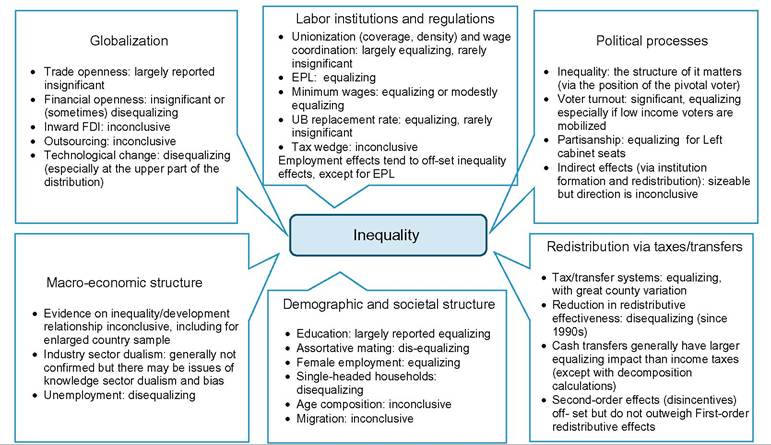
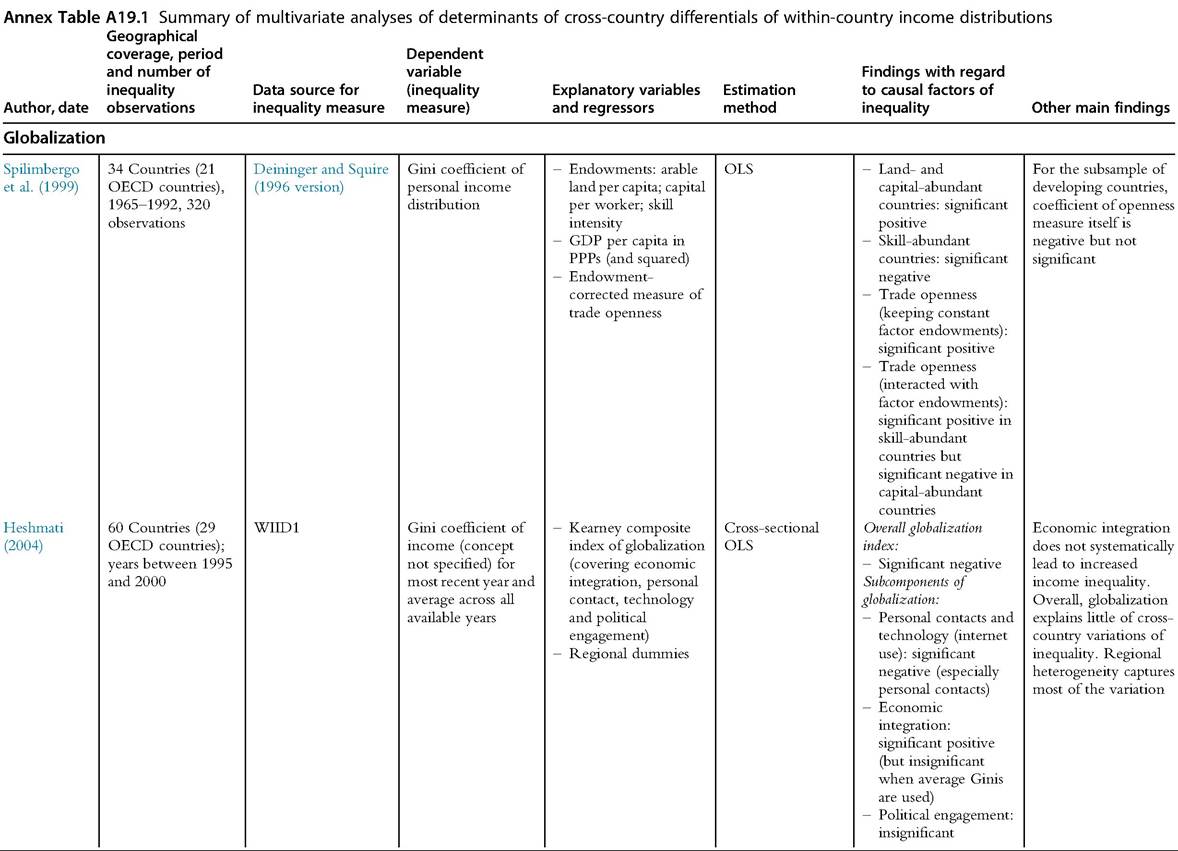
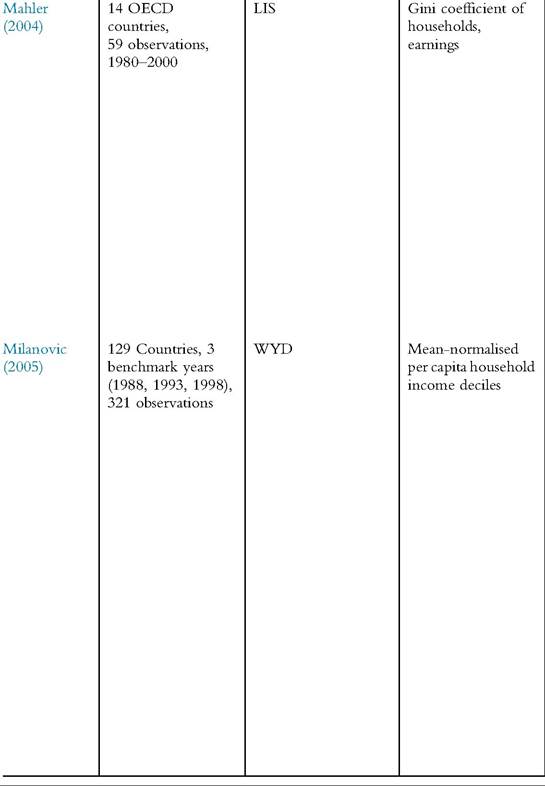
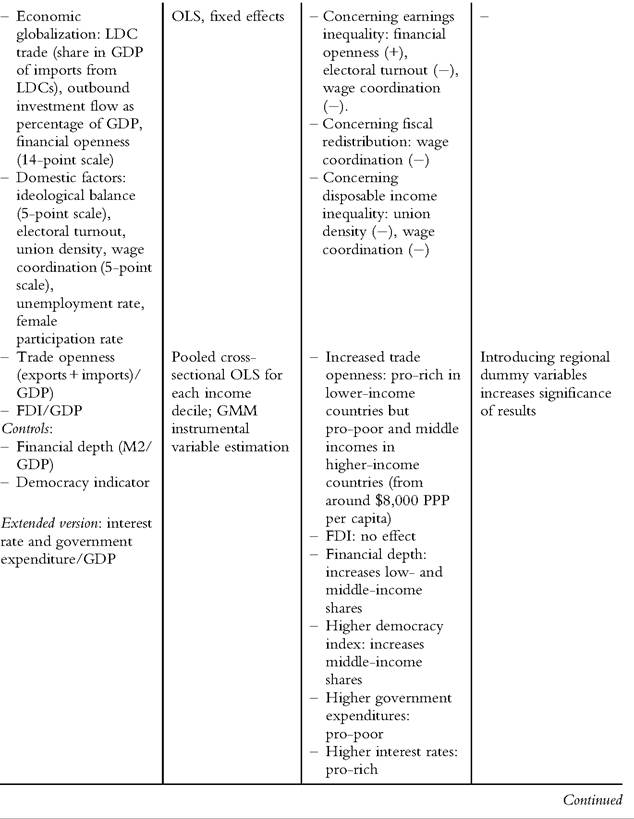
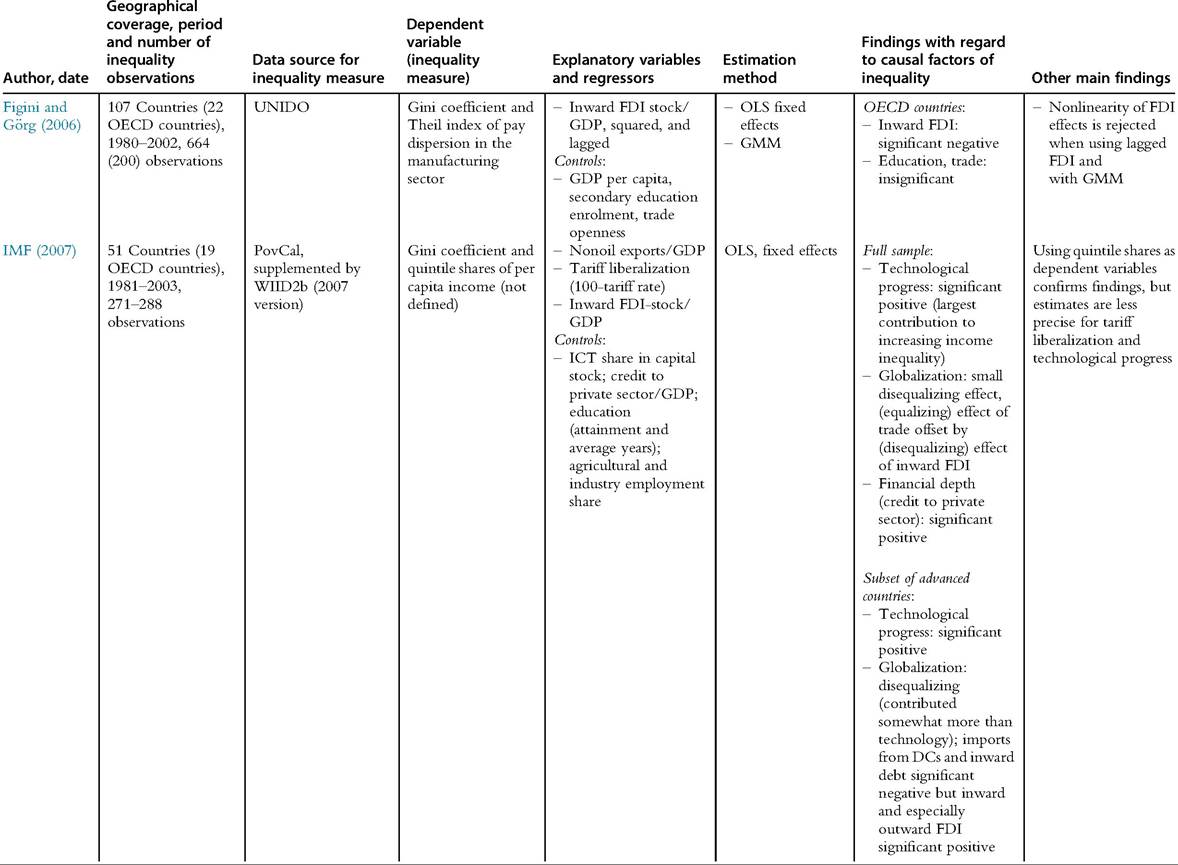
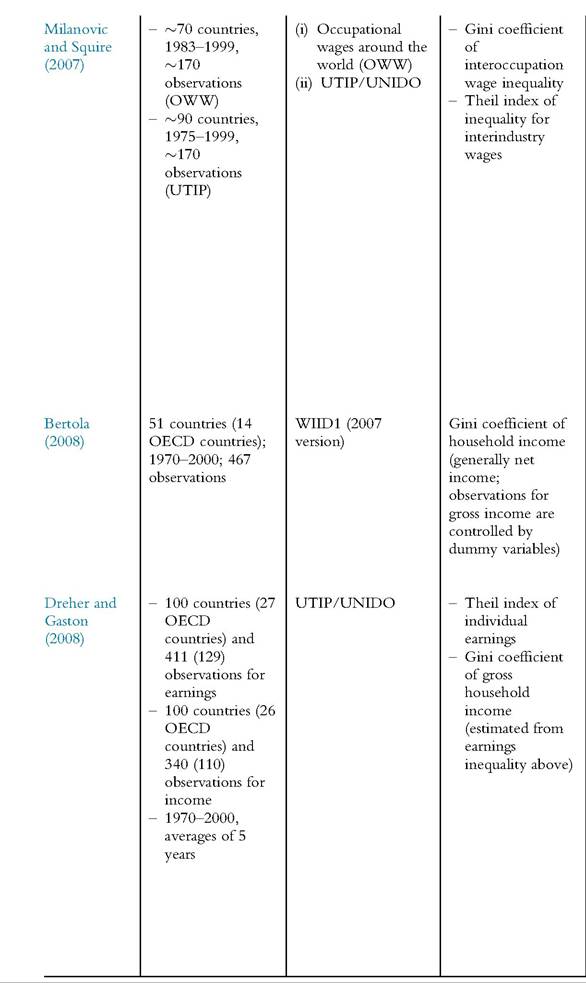
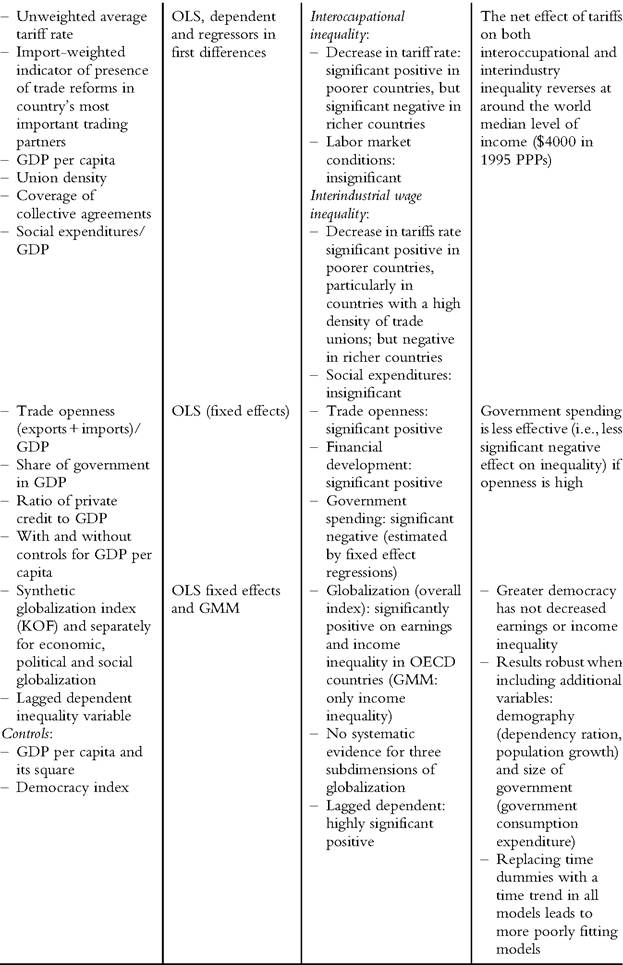
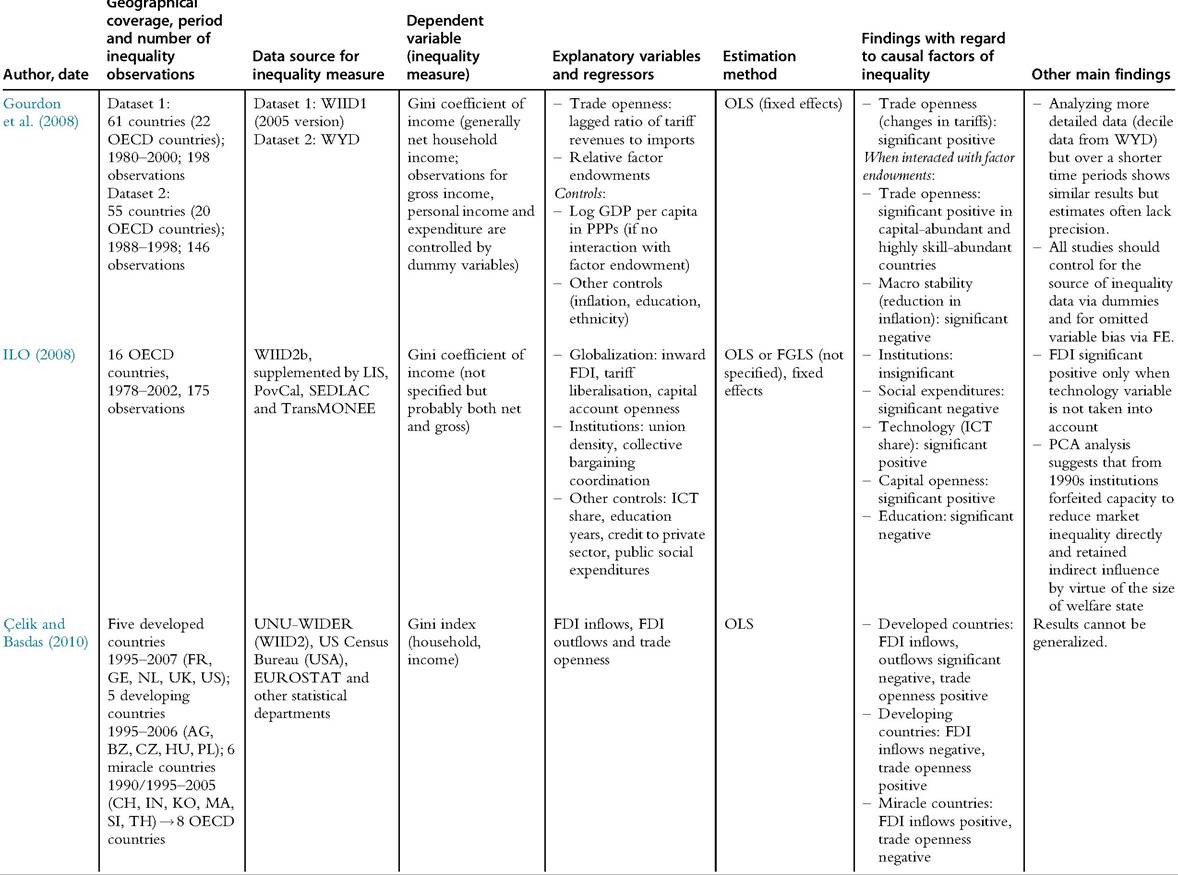
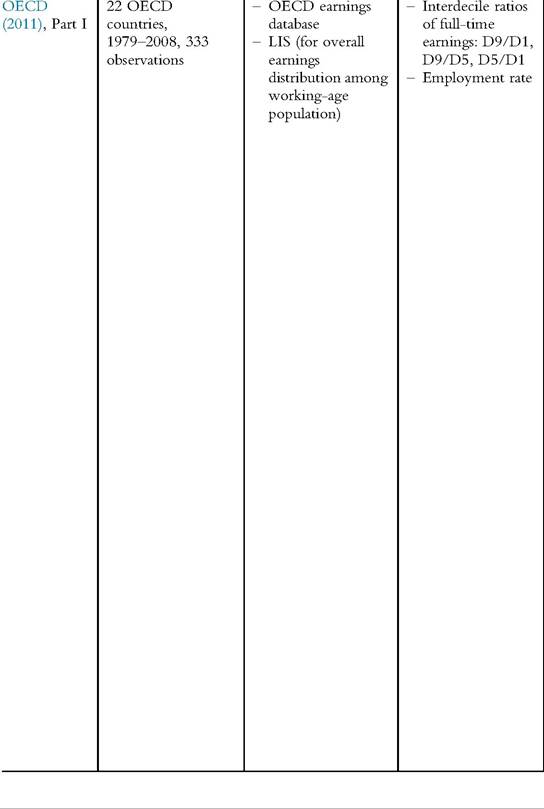
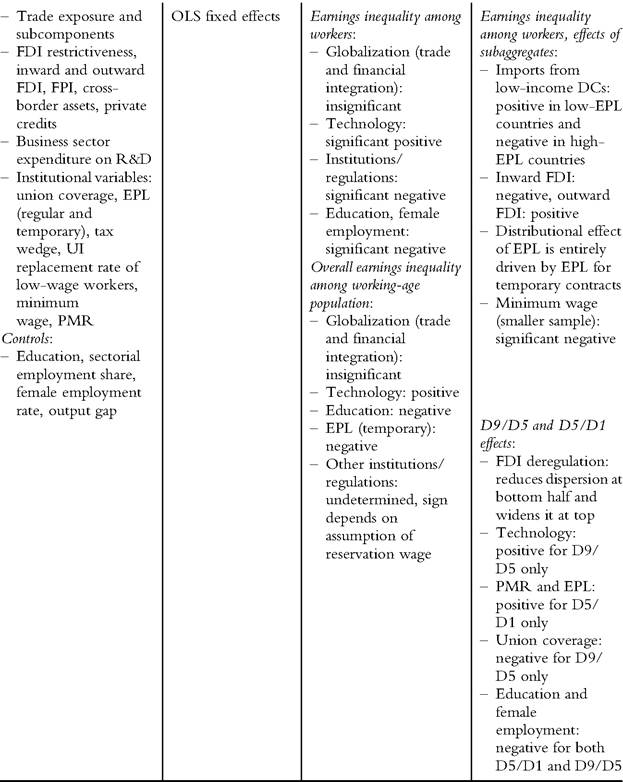
Author, date Geographical coverage, period and number of inequality observations Data source for inequality measure Dependent variable (inequality measure) Explanatory variables and regressors Estimation method Findings with regard to causal factors of inequality Other main findings Zhou et al. 62 countries (24 WIID2b (2004 Gini coefficient of — Globalization: equally Cross-sectional — Both overall Subcomponents of (2011) OECD countries), benchmark year 2000 version) net income (observations on expenditures were increased by 5 points, on gross income decreased by 7.5 points) weighted Kearney index and principal component index OLS globalization indices: significant negative globalization-. Cassette et al. 10 OECD countries OECD earnings Interdecile ratios of — Tradeopenness:total, Error correction Long-run effects: Education has a (2012) (AS, DK, FI, FR, GE, JP, NE, SW, UK, US), balanced panel; 1980—2005; 220-240 database individual earnings: goods and “other” services model regression — Trade in goods: significant positive on D9/D1 and D5/D1 negative effect on inequality (but coefficient not always significant) Faustino and 24 OECD WIID2 (2008 Gini coefficient of — Trade openness: — OLS fixed OLS: OLS: Vali (2012) countries; version) (missing values imputed) income (exports + imports)/ effects — Inward FDI significant positive — GDP/capita, unemployment and inflation significant positive, other controls insignificant
De Gregorio 22 countries (1965), IMF Government Gini coefficient and Educational inequality, OLS Nonlinear relationship - bgcolor=white>and Lee 49 countries (1990) Finance Statistics quintile shares (household, income) educational attainment, log of GDP/capita, square of log of GDP per capita, social expenditure/GDP, regional dummies between educational attainment and educational inequality (inverted U-shape) Beck et al. For changes in the distribution of income: 52 developing and developed economies with data averaged over the period 1960 to 1999; World Development Indicators, Dollar and Changes in 4 separate dependent variables: (i) changes in poverty (change in income of each economy's poorest 20%); (ii) changes in income distribution (Gini coefficient); GDP % of private credit by financial intermediaries to private firms + GDP growth; Instrumental variables: legal origin of the country, latitude of the capital city, natural resource endowments; plus for inequality models: initial (1960) avg schooling, inflation, trade openness; plus for poverty models: initial poverty level OLS, 2SLS 1. Financial development alleviates poverty and reduces income inequality Checchi and 16 OECD Deininger and Squire Gini coefficient of - Labor share OLS and IV, fixed — Labor share: Labor market Garcia- countries, (1998 version) personal incomes - Wage dispersion effects significant negative institutions (union Penalosa 1960-1996, 210 Brandolini (2003) — Unemployment rate SLS regressions — P9/P1 ratio: significant positive density, minimum wage, unemployment benefit) are essential determinants of labor market outcomes: labor share, wage differentials, unemployment rates
Geographical coverage, period Dependent and number of variable Findings with regard inequality Data source for (inequality Explanatory variables Estimation to causal factors of Author, date observations inequality measure measure) and regressors method inequality Other main findings Weeks 7 OECD countries WIID1 Gini coefficient of - Current public OLS (fixed — Union density: Applying the model to (2005) (AS, CN, GE, JP, SW, UK, US); gross personal income expenditure share country effects) significant negative two countries with annual time series (UK, US) yield the same strong significance for union density but unemployment and government expenditure (UK only) become insignificant Carter (2007) 39 countries (20 OECD), 104 observations at all levels of economic development WIID2b Gini coefficient — Economic freedom OLS with robust standard errors Economic freedom lowers equality by reducing income distribution towards the poor Checchi and Garcia- Penalosa 16 OECD countries, 1969-2004, LIS Gini coefficient of 3 equivalized income definitions for the working-age population: factor income, gross income, disposable income — Institutions: union density, unemployment benefit, EPL, wage coordination, minimum wage, tax wedge OLS, fixed effects Factor income inequality: — Trade-off of unemployment benefit and EPL: both lower inequality but increase unemployment (EPL only without fixed effects) Beramendi 13 countries LIS Gini coefficient for - First model (wage OLS (robust First model (effects on — and Cusack (all OECD), market income inequality, wage inequality and disposable income inequality inequality): number of manufacturing workers, imports from the Third World (percentage of GDP), female labor force participation rate, proportion of at least college education, union density, government partisanship, economic coordination, interaction of the last two standard errors and panel-estimated standard errors) wage inequality): female participation (+), percentage of college education (+), union density (—), economic coordination (—), interaction of economic coordination and partisanship (—) Second model (marketbased income inequality): stock market capitalization (+), pension-age population (+) Carnoy 20 countries WDI Gini coefficient of Trends of inequality, Trend analysis (no Higher education: Logical chain: higher (2011) (3 OCED); household, income, highest 20%, lowest 20% distribution of education, private and social returns to education, ratio of public spending regression) greater inequality education Golden and 16 OECD countries OECD earnings Interdecile ratio of First differences over 5-year Weighted OLS; 1980s: Determinants of Wallerstein (AS, AT, BE, CN, database individual earnings: peιeo0s: separate regression - Union density and earnings inequality are (2011) DK, FI, FR, GE, IT, JP, NE, NO, D9/D1 - Deindustrialization: share of industrial employment models for 1980s and 1990s; IV (independent variables); extreme centralisation: negative and highly significant different in 1980s (institutions) and 1990s (trade with LDCs and social
Author, date Geographical coverage, period and number of inequality observations Data source for inequality measure Dependent variable (inequality measure) Explanatory variables and regressors Estimation method Findings with regard to causal factors of inequality Other main findings Gallo and 43 upper-middle- coefficients) coefficient (5-year — Education inequality one-way liberties index reduce is significant on Gini Roca-Sagales and high-income averages) of income — Growth random effects income inequality — Public current (2011) countries for — Public investment models with — Increase in expenditures and 1972-2006 — Current public temporal educational direct taxation expense dummies) inequality increase robust in sensitivity — Direct taxes inequality estimates — Indirect taxes — Current public — Disposable income expenditure has (dummy) significant and Control: sizeable negative — Dummy for various effect on inequality data sources — The direct effect of public investment is not significant (though indirect effects are shown) — Direct taxes have negative and significant (though small) effect — economic growth has a significant negative effect on inequality 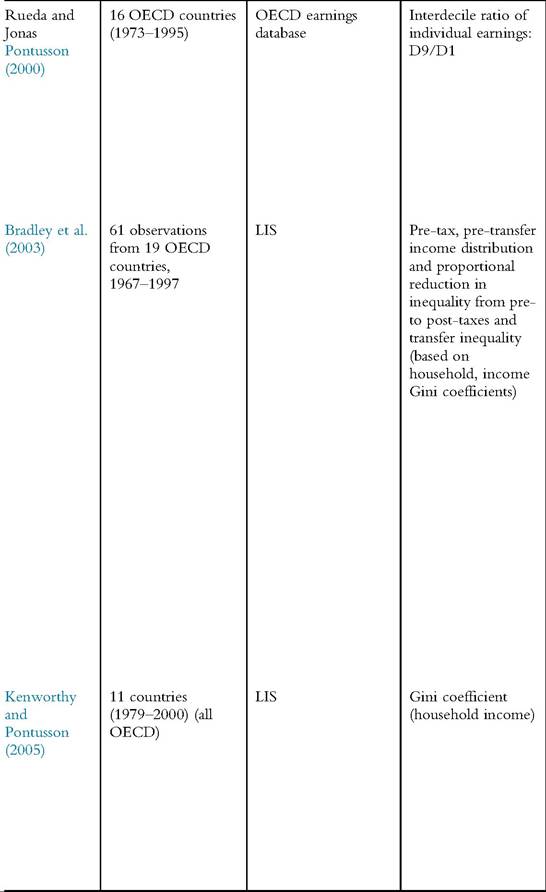
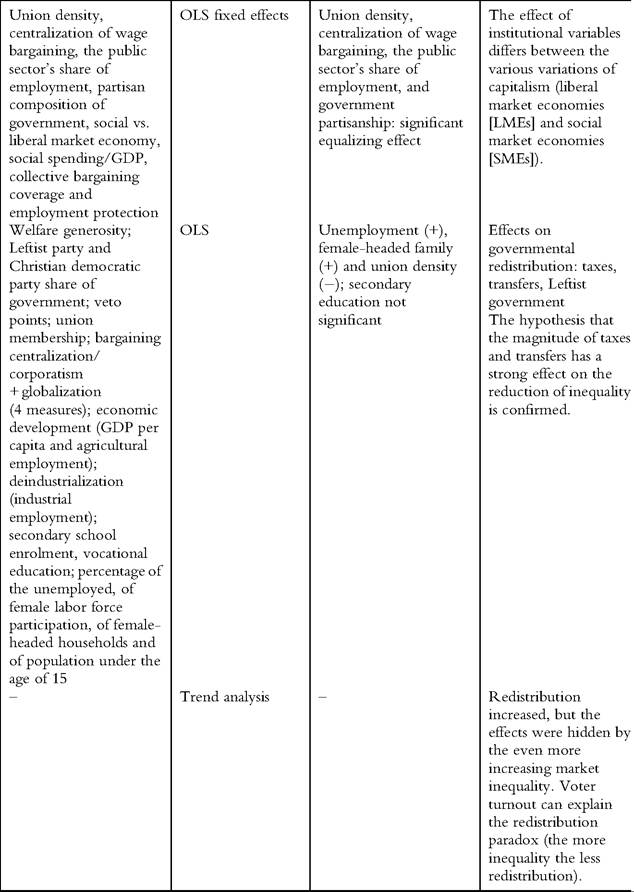
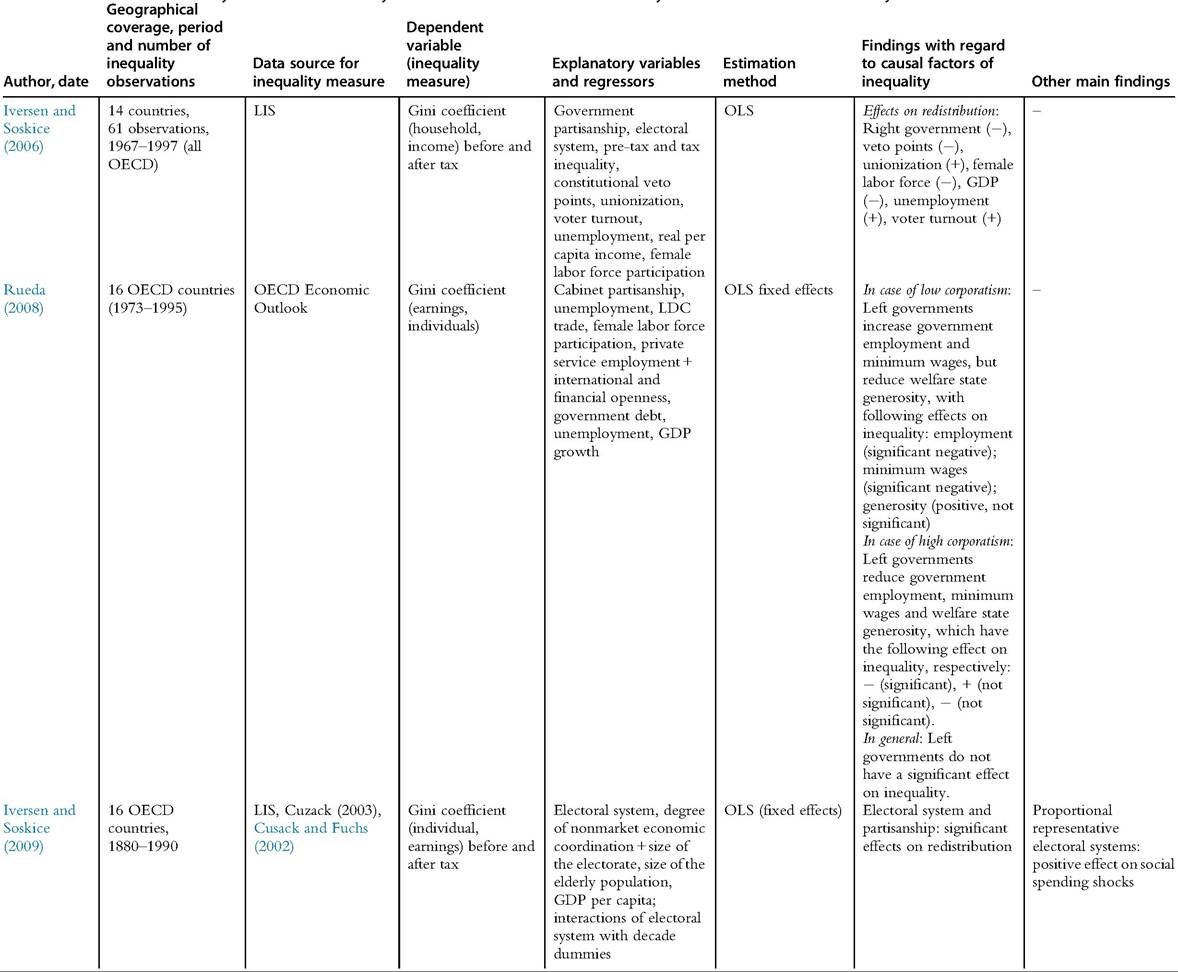
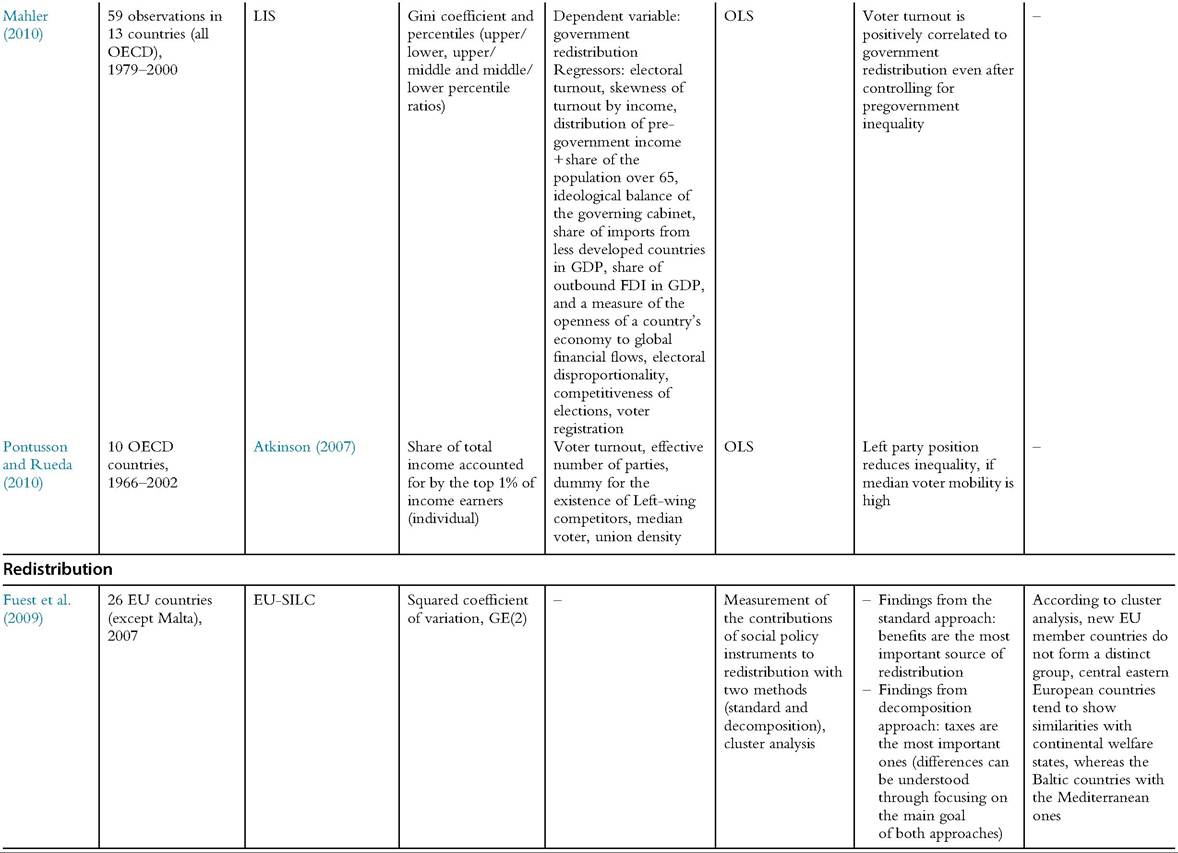
Author, date Geographical coverage, period and number of inequality observations Data source for inequality measure Dependent variable (inequality measure) Explanatory variables and regressors Estimation method Findings with regard to causal factors of inequality Other main findings Pamp (2009) countries, cumulative share- expenditures (t ¼ 7, N¼ 23) inequality the 1971-2005 gains of the first, the — Government social with various positive relationship first to second and expenditures robustness checks, between inequality the first to fifth — Social transfers ratio two-step system and redistribution is deciles and share- (average transfers per GMM reversed (nonlinear gain of second to total disposable relationship) eighth deciles income) — Redistribution is — Unemployment driven by the P90/ expenditures P50 ratio and targeted — Health expenditures at the middle class — Gini (Director’s law) (P90/P50, P50/P10, median-to-mean ratio) — GDP growth Afonso et al. 26 OECD WIID, supplemented — Gini coefficient — Redistributive social — Cross-sectional — Redistributive social — DEA suggests low (2010) countries; year by OECD and LIS of household spending (transfers, OLS spending: highly efficiency of public around 2000 and disposable subsidies) — DEA for significant equalizing spending with average for period income — PIT assessing the distribution (all regard to inequality 1995-2000 — Income share of — Education efficiency of three inequality in some southern bottom 40% achievement (PISA) public spending indicators) and continental — Per capita income — Education spending — Tobit — Education European and high of bottom 20% — Unemployment regressions to achievement (in efficiency in some in PPPs — GDP per capita capture particular maths): Nordic countries in PPPs exogenous significantly — Tobit analysis nondiscretionary equalizing suggests strong factors in — Education spending indirect role of explaining and PIT: not institutions on spending significant distribution, being efficiency — Only high social significantly spending coupled correlated with with good education reduces inequality (Gini) spending efficiency