DRIVERS OF INEQUALITY: MAIN EXPLANATIONS
This section sets out the main arguments of inequality drivers in OECD countries put forward in cross-country studies and reports the results from recent empirical work supporting or not supporting these arguments.
We focus our review of the literature including studies undertaken in the past 10—15 years, with no pretention of exhaustiveness. In particular, this review updates Atkinson and Brandolini (2009) and extends the literature review by Chen et al. (2013a).The section introduces the main factors put forward to explain international differences in levels and trends of income inequality. The discussion is structured along six main headings: structural macroeconomic sectorial changes; globalization and technical change; changes in institutions and regulations; political processes; redistribution via taxes and transfers; and structural societal changes. Annex Table A19.1 gives an account of the wealth of findings for a subset of 48 selected studies that are considered to be the most pertinent ones undertaken in the past 10—15 years. The selection criteria relate to coverage (i.e., the studies should include a critical mass of countries and should focus on the joint OECD and EU areas); multivariate explanations (i.e., monocausal studies were excluded); and timeliness (i.e., preference was given to more recent studies not yet included in literature surveys available elsewhere).
When talking about “main drivers,” it is useful first to make a distinction between direct, or proximate, drivers and indirect, or underlying, factors resp. causes behind changes in income distribution (see Cornia, 2012 for the same distinction). Direct drivers can be gauged, for instance, by decomposing summary income inequality measures by income components or by calculating the first-order effect of changing household structures on income distribution, for example, by using shift-share analyses.
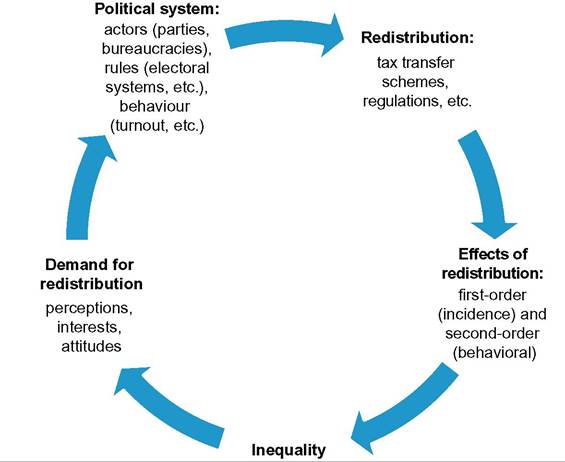
A variety of such direct factors for growing inequality in OECD countries has been identified by the OECD (2008). While usually analyzed in isolation, such identification of factors— especially if as exhaustive as possible—provides a useful checklist of “hints” (Cornia, 2012) at indirect factors or causes that lie behind inequality changes. In the following subsections, we classify the main underlying factors into six overall headings, following the presentation in Figure 19.1.The subsections below resume the arguments put forward in the literature and report the results from empirical analyses. The main “culprits” tested in the literature have been subsumed under the different subheadings enumerated above, each observing single sets of drivers of inequality and inequality changes, thus defining more monocausal explanations of inequality. Of course, none of the studies reviewed is monocausal in nature, and all test the significance and relative importance of several drivers, but the point of departure is often related to one particular area, for example, the impact of globalization versus technology or versus institutions.
Our review focuses on OECD and EU countries. The country coverage in some studies is limited to only a subset of OECD countries, whereas many other studies include a larger sample of countries, including notably middle-income and developing countries. Given the focus of this chapter, we review below results pertaining to the OECD area, also when obtained from the second strand of studies insofar as results for OECD countries are reported separately.
Though our preferred explanatory variable is dispersion of household disposable income, we also report findings that explain changes in the distribution of earnings. While the use of one or the other of these two income concepts may alter the findings (net income estimates also are affected by household structure and tax/transfer changes), and definitions within these two aggregates differ (full-time wages or annual earnings; gross or net incomes), a number of studies refer exclusively to the effect on earnings, especially those looking at the causal role of trade and technology.
Findings referring to income and earnings are presented separately below.19.5.1 Structural Macroeconomic Sectoral Changes
For a long time, the quest to identify driving factors of inequality looked primarily at the association between economic development and inequality and was focused on testing the hypothesis that Kuznets (1955) put forward. According to this hypothesis, inequality follows an inverted U-shaped relationship with increased development. This is linked to a sectoral move from a “traditional” sector (agriculture) to a “modern” sector (industry). Insofar as the traditional sector is less productive, it will provide lower wages than the modern sector (sector dualism); it also is expected that the traditional sector has lower inequality within it (sector bias). Consequently, it is expected that development first increases and subsequently decreases inequality.
Usually, economic development is proxied by real income or GDP per capita (y). To capture the parabolic shape of the relationship, the quadratic form of y is added. Following Hellier and Lambrecht (2012), in the frame of a panel of country studies, the relationship can be written as:
INEQi, t = α + βiyι, t + β2yi, t2 + Aχi, t+ εi, t (19.3)
where i and t are country and time, y is per-capita real income (or GDP) and Xit = {xj∙it} a vector of variables j that affect the inequality measure INEQ. These variables seek to control for shocks as well as institutional and regulatory differences across countries. Equation (19.1) is a specific variant of the general regression equation GIRE described earlier in Section 19.2.1. The Kuznets hypothesis then is confirmed if the estimated values β1 and β2 are such that β1 > 0 and β2 < 0.
The turning point, where inequality attains its highest value and begins to decrease, can then be estimated to correspond to the period Ω, such that )∙,ω = y0 — β1∕2β2 (for a start of the estimation at time t = 0 with the income per capital y0).[270]Evidence from studies of the inequality/development relationship remains broadly inconclusive. Around half of the studies reviewed by Atkinson and Brandolini (2009) estimate such relationship, with or without other controls. Some of these studies support the Kuznets hypothesis but others reject it. Hellier and Lambrecht (2012) undertake a review of studies testing the Kuznets hypothesis. Studies based on cross-sectional analysis of countries in their majority tended to support the Kuzents hypothesis (although some clearly reject it), whereas the evidence from panel data estimations is more mixed. In a study of the EU member states between 2000 and 2005, Medgyesi and Toth (2009) suggest absence of a clear relationship between the economic growth rate and inequality within EU member states in the first half of the 2000s. Bourguignon (2005) concludes that, overall, the analyses of the available data at hand “do not suggest any strong and systematic relationship between inequality and the level of development of an economy” (p. 1733).
Empirically, the past 20-30 years were characterized by a considerable increase in earnings and income inequality in a large majority of OECD countries (OECD 2008, 2011), a development that is sometimes called “the great U-turn” (but see Section 19.4.2 on variability of inequality measures). Even if one considers the inequality/development relationship to be accurately described as an inverted U-shaped curve, this picture needs to be amended and replaced by an N-shaped (Alderson and Nielsen, 2002) or tilde-shaped (Hellier and Lambrecht, 2012) curve.
Alderson and Nielsen (2002) test the Kuznets hypothesis by applying a measure of sector dualism (shift of employment out of agriculture) for 16 OECD countries for the period 1967—1992.
They find that sector dualism has no significant effect on income inequality unless none of the globalization variables are controlled for. At the same time, sector bias (measured as the share of the labor force in agriculture) has a strong and positive effect. The latter surprising positive sign is explained by Alderson and Nielsen by the fact that dualism in agriculture has become less relevant for OECD countries for overall inequality, and its meaning now is more likely to be a measure of agrarian traditionalism than a component of the dualism model.The “great U-turn” may then better be explained by other phenomena such as globalization or institutional change (see the next section). Still, issues of sector dualism and sector bias can be expected to play an important role when analyzed in terms of a sectoral change from a postindustrialized to a knowledge society. Nollmann (2006) and Rohrbach (2009) propose a model similar to that of Alderson and Nielsen (2002) but focus on sector dualism in terms of the wage differential between the knowledge sector and the remainder of the economy and on sector bias in terms of employment shares in the knowledge sector. For a panel of 19 OECD countries for 1970—2000, Rohrbach finds support for the sector bias hypothesis but no support for sector dualism. Moreover, and in contrast to Alderson and Nielsen (2002), Rohrbach (2009) finds no significant effect of globalization (in terms of trade openness), concluding that factor effects remain central determinants for understanding inequality. This traces back to the original argument by Kuznets that through the segmentation of factor markets sectorial changes can be important drivers of inequality changes. However, while there is some segmentation of the labor market in OECD countries, it does not appear across large sectors of activity. The high-tech/low-tech distinction seems more important but less easy to implement analytically.
19.5.2 Globalization and Technical Change
Since the 1990s, economic globalization has been intensively analyzed as one of the main potential drivers of increased earnings and income inequality in the OECD area.
“Globalization” is, however, a multifaceted phenomenon and cannot be reduced to a single variable.[271] There are different aspects of it and they are likely to affect trends in earnings and income inequalities in different ways and in possibly opposing directions:— trade integration (goods and services mobility)
— financial integration (capital mobility)
— production relocation (firm mobility)
— technology transfers (information mobility)
— political aspects of globalization
The following subsections consider these aspects in turn.[272]
19.5.2.1 Trade
Increased trade integration is often taken as a main sign and sometimes as the sole proxy for the degree of economic globalization. The share of world trade in world GDP has grown from about one third to over half in the past 30 years (IMF, 2007). In most OECD countries, the extent of trade integration has doubled or tripled during this period, and the increase was especially stark during the 1990s (OECD, 2011).[273]
The standard reading of traditional international trade theory is that increased trade integration is associated with higher relative wages of skilled workers in advanced countries, thus contributing to increased inequality in those countries and higher relative wages of unskilled workers in developing countries with an associated decrease in inequality (for a discussion of the relationship between skill differentials and globalization, see, for instance, Krugman, 1995, 2000 and Kremer and Maskin, 2003). This is based on predictions of the Heckscher-Ohlin (HO) model, or variants of it. This model expects that countries export goods that use intensively the factor with which they are most abundantly endowed and import those that intensively use their scarce factors. Advanced countries with abundant highly skilled labor will therefore import products from countries with lower endowments of skills and export products made by skilled workers. Combined with the Stolper- Samuelson theorem, which predicts that trade increases the real returns to relatively abundant factors, increased trade integration should then reduce the demand for less-skilled workers and increase the demand for skilled workers in advanced countries and the inverse in developing countries Heckscher-Ohlin-Samuelson (HOS) model. Second, less-skilled workers are predicted to migrate to advanced countries. Third, capital would flow from advanced countries with large capital-to-labor ratios to developing countries with small capital-to-labor ratios. All three processes are predicted to lead to increased inequality in advanced countries and to decreased inequality in developing countries.
However, most studies found it difficult to reconcile the empirical evidence on earnings and income inequality trends with the traditional HOS model, which typically does not capture technology diffusion. A number of cross-country studies find trade globalization to have increased income inequalities in high-wage and low-wage countries alike, which is at odds with traditional trade theory (for a review, see Milanovic and Squire, 2007). Furthermore, all sectors tended to become more skill intensive (as already reported by Krugman, 1995). Chusseau et al. (2008) relate this to the fact that trade between advanced and developing countries still accounts for a lower share than trade between advanced countries, thereby playing a lesser role in the shift of factor demand (Chusseau et al., 2008).
Some ofthe shortcomings ofthe traditional HOS model have been put forward by, for instance, Davis and Mishra (2007). The particular assumption of growing capital flows from developed to developing countries and their equalizing impact (in developing countries) has been challenged, notably on the grounds of capital market imperfections (Lucas, 1990; Alfaro et al., 2008). During the past 15-20 years, new approaches in trade models have been developed to overcome analytical shortcomings of the HOS model in several areas. The first one is to take account of heterogeneity of firms within industries in both developed and developing countries based on the development of dynamic industry models, as in the work of Melitz (2003). The coexistence of more productive firms that are expanding and entering the export market and contracting less productive firms within the same industry has an effect on how trade influences the wage and income distribution (Pavcnik, 2011). Exporting firms can employ more productive workers and offer higher wages, with a possible sizeable effect on increased wage inequality within sectors.
This calls into question the assumption of competitive labor markets underlying the HOS model, which expects an equalizing wage distribution in developing countries through higher unskilled wages. Newer trade theories therefore accounted for labor market imperfections by including efficiency wage models or models of fair wages in their framework (e.g., Verhoogen, 2008; Egger and Kreickemeier, 2009, 2010). In a next and complementary step, attempts were made to relate the exporting firms’ wage premium to search frictions as a source of labor market imperfection, introducing search and matching models (Helpman et al., 2009). In both streams of work, trade liberalization can be consistent with increasing residual wage inequality, that is, inequality between workers with the same skills and other characteristics.
Empirically, however, both these channels, which are related to the recognition of heterogeneity of firms, can only be observed and analyzed at the micro level, going beyond models based on “representative firms.” A number of studies reporting results for particular countries, mainly Latin American countries and Indonesia, were published in the later 2000s. Most of these studies (reviewed by Pavcnik, 2011) suggest that increased export market access was associated with greater wage inequality in a given country. But there are no cross-country studies available so far.
There are channels other than the HOS model through which trade can affect income inequality. One is increased competition, which tends to reduce the relative prices of consumption goods and can also diminish the monopoly position enjoyed by the upper class—both processes would reduce income inequality (Birdsall, 1998). A more indirect argument refers to the second-order effects of decreases in the relative wages of unskilled workers; this may lead to incentives for workers to up-skill and for employers to hire more unskilled labor, leading to lower inequality (Blanchard and Giavazzi, 2003). There are also other theories and models that predict that inequality would decrease in both advanced and developing countries, namely through the effect of specialization; such division of labor could generate increasing returns to scale, whereby labor has a higher marginal productivity (Francois and Nelson, 2003).
In the following, the empirical results of selected pooled cross-country studies are summarized, distinguishing effects of trade globalization on wage dispersion on the one hand and on income inequality on the other. When discussing the effect on wage dispersion, the notions of “wage differential” and “wage distribution” need to be distinguished. The models described above (in particular the HOS theory) yield predictions about the wage differential (i.e., on wage ratios between various skill or occupation groups), but the effect on the distribution of wages also depends on quantities (i.e., the number of people earning these wages). If quantities are fixed (as assumed in a static trade theory), one can read the distribution of wages directly from the wage differential. But if people migrate and change across sectors, one cannot predict distributional effects directly from changing wage differentials. Most of the empirical studies reviewed below test the potential effect of trade integration on wage distribution.
19.5.2.1.1 Wage Dispersion Effects
For a set of 23 OECD countries 1980-2008, OECD (2011) suggests that trade integration[274] has no significant effect on trends in wage dispersion at the aggregate level within countries once the effects of technological change and institutions are controlled for. This result holds for both top and bottom sensitive indicators of earnings (interdecile ratios) and when imports and exports are examined separately. An insignificant distributive effect of trade integration is also estimated for the overall earnings distribution among the entire working-age population (i.e., including the unemployed), insofar as trade had neither a significant positive or negative effect on employment.
On the other hand, Cassette et al. (2012) suggest a positive relationship between trade and wage dispersion for a subsample of 10 OECD countries between 1980 and 2005, which, however, differs between goods and services as well as in short- and long-run estimates. In the short run, wage dispersion is widened by increased trade in goods, whereas trade in services has no effect. That differs from long-run effects, where trade in services increases inequality, in particular at the top of the earnings distribution (i.e., between top and median earnings).
For OECD countries, a subaggregate of total trade may be a more pertinent indicator, namely the share of imports from low-income developing countries (LDCs). However, Rueda and Pontusson (2000) suggest that its increasing share had no effect on wage dispersion, at least for the period up to 1995. Similarly, Mahler (2004) shows that, for a subset of 14 OECD countries for the period 1980—2000, imports from LDCs had no significant distributive effects on either earnings or disposable incomes. For the more recent period up to 2008, OECD (2011) reports similar findings, although with nuances: overall the effect of LDC imports is distribution neutral, but considering the institutional context, such imports tend to compress the wage dispersion in countries with stronger employment protection legislation (EPL) but widen it in countries with weaker EPL. For Golden and Wallerstein (2011), however, trade with LDCs is one of the key drivers of increased wage dispersion within 16 OECD countries during the 1990s.[275] Their results distinguish the period of the 1990s from the decade of the 1980s, when trade played no role but institutions did (see Section 19.5.3). Among those finding a moderate disequalizing role of imports from LDCs are Alderson and Nielsen (2002), although their results refer to income rather than earnings inequality.[276] [277] 26 19.5.2.1.2 Income Distribution Effects Few studies estimate the effect of trade openness for the group of OECD countries on the distribution of income directly. For the subgroup of advanced countries analyzed by the IMF (2007), economic globalization overall (trade and financial globalization taken together) contributed to increasing income inequality, but this was entirely because of foreign direct investment (FDI) trends, which more than outweighed the equalizing effects of trade: both exports and, in particular, imports from LDCs (but not trends in tariffs) were associated with decreasing income inequality in advanced countries. Similarly, for 24 OECD countries for the period 1997-2007, Faustino and Vali (2012) found that trade liberalization decreases income inequality, making use of both static and dynamic regression estimates. In a study of 16 OECD countries, the ILO (2008) included tariff liberalization as only a proxy for trade openness, finding no significance for an effect on income inequality. 19.5.2.2 Trade Openness and Inequality in an Enlarged Country Sample There are somewhat more findings attributing distributive effects to increased trade integration when the country sample is enlarged from the group of OECD countries.2 Evidence is mixed, and for a full sample of 129 countries for three points in time in the 1980s and 1990s, Milanovic (2005) suggests that as national income increases, the inequality effects of globalization reverse, enhancing inequality at poorer income levels but dampening inequality at higher levels.[278] This runs counter to the hypotheses of the classical HOS model. Milanovic and Squire (2007) investigated the effect of trade (measured with the unweighted average tariff rate) on interoccupational and interindustry wage differentials for the period between 1980 and 1999. For both indicators, a decrease in tariff rates tended to have a positive association with wage dispersion in poorer countries but a negative association in richer ones. Institutions (union density and coverage) do not play a role in interoccupational wage disparity but reinforce the disequalizing effect on interindustry wage differentials. For a panel of 51 countries, Bertola (2008) found that trade openness is positively associated with inequality of both gross income and disposable income (for a smaller set of countries) and that government expenditure is less redistributive in countries with a higher degree of trade openness. Spilimbergo et al. (1999) suggested that the effects of trade openness on inequality depend on factor endowments, increasing income inequality in skill-abundant countries but reducing it in capital-abundant countries. Based on newer data and a larger country sample, Gourdon et al. (2008) nuanced this finding. Measured as a lagged ratio of tariff revenues to imports, they found that trade openness is associated with increases in income inequality in both high skill-abundant and capital- abundant countries. By contrast, IMF (2007) suggests that the role of trade globalization in the last two decades of the twentieth century was insignificant overall, but some elements actually contributed to decreasing income inequality, in particular lower tariffs and higher agricultural exports. For the specific country group of Latin American countries, Cornia (2012) found, perhaps contrary to expectations, that the gains in terms of trade realized during the 1990s and 2000s contributed significantly, albeit modestly, to the recent decline in income inequality. This is explained by relaxed external constraints on growth and consequently increased incomes, employment, and revenue collection.[279] 19.5.2.3 Financial Openness There are mechanisms other than trade through which economic globalization can accelerate earnings and income inequality. One such mechanism is cross-border movement of capital, a factor that is overlooked in the basic trade model, which assumes that labor and capital are mobile within a country but not internationally. Factors such as deregulation, privatization and advances in technology all contributed to the rapid growth of capital movement, in particular FDI, over the past decades. If the utilization of capital as well as embodied technology requires the use of skilled workers, and capital and skilled labor are complementary, the increase in inward capital will increase demand for skilled workers (Acemoglu, 2002). Much like HOS models of trade, models of FDI usually predict different effects in advanced and developing countries. IfFDI flows are directed to countries with relative abundance of low-skilled labor, this should a priori increase the demand for the abundant factor and hence have an equalizing effect in developing but a disequalizing effect in developed countries. However, less skill-intensive outward FDI from advanced countries can appear as relatively high skill-intensive inward FDI in developing countries. In that case, even when the transferred technology is “neutral,” an increase in FDI from advanced to developed countries can increase the demand for skilled labor and contribute to increasing inequality in both advanced and developing countries (Feenstra and Hanson, 2003; Lee and Vivarelli, 2006). Further, there may be indirect disequalizing effects, even if FDI is mainly attracted by low skill-intensive countries and sectors; to attract FDI, countries may relax regulations in the field of employment protection or fiscal parameters, which otherwise would have an equalizing effect (Cornia, 2005). Endogenous growth models such as those proposed by Aghion and Howitt (1998) or Aghion et al. (1999) assume two stages of development and inequality when new technologies are introduced: in the transition phase skilled labor demand and hence wage inequality increase before decreasing in a second stage. Such models can be adapted in terms of effects of FDI on the availability of new technologies. Figini and Gorg (2006), for instance, view FDI as a vehicle for introducing new technologies. They expect that in a first step more FDI will lead to increased inequality between skilled and unskilled workers, with a reversed trend in the second step as domestic firms follow up imitating advance technologies. 19.5.2.3.1 WageDispersionEffects Figini and Gorg (2006) wrote one of two articles in our review that use FDI as the main explanatory factor for distributional changes. Their model specifies only the inward component of FDI. For the subsample of 22 OECD countries, they found that higher inward FDI is significantly (at the 5% level) related to lower earnings inequality in the manufacturing sector for the period 1980—2002. Further, this effect seems to be linear. This is in contrast to the results for non-OECD countries, where the inward FDI has a positive though nonlinear association with earnings inequality. Similar findings are also suggested in the results of OECD (2011) for 23 OECD countries between 1980 and 2008. Although overall FDI turns out to be insignificant, inward FDI has a significant equalizing effect on wage distribution and outward FDI has a dis- equalizing effect, although the latter effect is rather modest (see the next section). Inward FDI, however, seems to be correlated with trends in trade integration. Other indicators of financial openness were reported to be insignificant in this study; this concerns crossborder assets and liabilities, foreign portfolio investment, and a de jure measure of FDI restrictiveness, which was the preferred measure of financial openness in this study.[280] Among more country-specific studies, Taylor and Driffield (2005) found that inward FDI flow can explain, on average, 11% of the increase in wage inequality in United Kingdom between 1983 and 1992. Bruno et al. (2004) examined the effects of inward FDI on relative skilled labor demand and wage differentials in manufacturing in the Czech Republic, Hungary and Poland for the years 1993-2000. They found that FDI did not contribute to increasing wage dispersion in the three countries, although it did contribute to increasing the skill premium in the Czech Republic and in Hungary (but not in Poland). Hijzen et al. (2013) analyzed microeconomic (firm-level) data for three developed and two emerging economies and found that wage premium effects following foreign ownership are larger in developing countries, that the largest effect on wages comes from workers who move from domestic to foreign firms and that employment growth after foreign takeover is concentrated in high-skill jobs. 19.5.2.3.2 Income Distribution Effects Most studies reviewed found only modest or no significant effects of overall FDI in OECD countries, but there are more significant results when inward and outward FDI are analyzed separately. Using time series data for the period 1960-1996, Reuveny and Li (2003) showed that inward FDI flow for 69 countries is significantly and positively associated with income inequality for both OECD and less developed countries, which were sampled separately. The IMF (2007) reached the same conclusion: for the subsample of advanced countries in the study of trends over 1980-2003, they identified both inward and, in particular, outward FDI as the elements of globalization that most increased income inequality, slightly more than outweighing the equalizing effect of increased trade. For a more recent period, 1997-2007, increased inward FDI was also found to be significantly positively related to income inequality for a sample of 24 OECD countries by Faustino and Vali (201 2).[281] This seems to back up the observation that FDI occurs in more skill- and technology-intensive sectors. The opposite was found by Celik and Basdas (2010). Their article is the second of the two studies in our review that uses FDI as the main explanatory factor for distributional changes. For a subsample of five developed countries, their analysis suggests that both FDI inflows and FDI outflows are associated with decreased income inequality for the period of the mid-1990s to mid-2000s. The working hypothesis is that this is attributable to greater redistribution permitted by higher tax revenues from increased employment in the case of FDI inflows and changes in the economic structure with low-skilled labor being pushed to up-skill in the case of FDI outflows. The small number of observations (5 countries for 11 time observations), however, casts some doubts on the robustness ofthe results. On the other hand, the ILO (2008) estimates that the inward FDI share in GDP had no effect on income inequality in a sample of 16 OECD countries for the period 1978—2002, as long as the analysis controls for technology (information and communications technology [ICT] share)—otherwise FDI comes out as a significant predictor, suggesting that FDI could act as a proxy for that omitted factor and actually lead to greater demand for skilled labor. Somewhat more clear-cut results were found for the region of Latin America. Cornia (2012) examined a subsample of 19 Latin American countries for the period from 1990 to 2009. Given the boom in capital inflow, Cornia expects deteriorating effects on income inequality via an appreciation ofthe real exchange rate and a dampened growth in the labor intensive noncommodity traded sector. Indeed, the FDI stock had a significant and strongly disequalizing effect in all specifications, and the effect is most pronounced among the group of Andean countries (where FDI is particularly important in the mining sector). That said, in this analysis FDI—such as other external economic and demographic variables considered— had a more limited average effect on income inequality than the policy variables. A more disequalizing effect of FDI also often is found in studies with the broadest possible country coverage. Broadening the analysis to 42 advanced and developing countries, the ILO (2008) found inward FDI to be the only variable among eight economic controls to be robustly positively associated with increased income inequality. This positive association was confirmed by the IMF (2007) for 51 countries, although technology played an even stronger role in the latter study. Higher inward FDI benefits solely the top quintile, whereas income effects for the three bottom quintiles are significantly negative. For a panel for 111 countries from 1970 to 2000, TeVelde and Xenogiani (2007) showed that FDI positively affects skill formation not only within countries but also across countries, especially in countries that are relatively well endowed with skills to start with. On the other hand, in his analysis of 129 countries for three benchmark years (late 1980s, early 1990s, late 1990s), Milanovic (2005) found that FDI has no effect on the income distribution, whether alone or when interacting with income. However, results from analyses that pool developed and developing countries are difficult to interpret because this blurs the channels through which financial openness affects the distribution of incomes, especially when inward and outward FDI are netted out. 19.5.2.4 Outsourcing Most of the evidence that relates increasing earnings or income inequality on increased trade openness focuses on trade in final goods. As shown earlier, a larger part of the literature suggests that trade, measured in these terms, has not been the major driving factor (if at all) of increased inequalities in the OECD area. Such findings, however, neglect that the production of goods itself has become globalized, and outsourcing in terms of increasing trade in intermediate products may play a decisive role. It has been estimated that the potential of off-shoring of tasks concerns between 20% and 30% of all jobs in a number of OECD countries, including medium- and high-skilled jobs; however, tradability is determined not only by the technical feasibility of unbundling and digitization but also by transaction costs and the economies of scope of keeping tasks together (Lanz et al., 2011). Among the first to put forward the outsourcing hypothesis, Feenstra and Hanson (1996) suggested that the rapid development of international production sharing[282] [283] (from home companies to their foreign affiliates) may distort the wage distribution in home countries by moving some of domestic non-skill-intensive activities abroad. Such a move concerns potentially all firms (not only traded industries) as long as business owners find the fragmentation of production more cost-effective. Firms in advanced countries may “outsource” particular stages of production to less developed countries; these stages seem less skill-intensive in the advanced country but relatively skill-intensive in the receiving country. As a result, trade—the outsourcing aspect of it—may reduce the relative demand for unskilled workers and increase employment toward skilled work within industries in both countries. This also offers an explanation of why trade could lead to increased relative demand for skilled workers within industries, rather than across industries, as predicted by the traditional HOS theory. Chusseau et al. (2008) and Pavcnik (2011) provide a summary of recent approaches of theoretical outsourcing models. Various studies have tested the outsourcing hypothesis for single countries. Feenstra and Hanson (1996) found that outsourcing can account for a sizeable share of the increase in the relative demand for skilled workers in manufacturing sectors and for a notable amount of the increase in the relative wage of nonproduction workers in the United States during the 1980s.35 Using updated data for the United States and measuring outsourcing by intermediate inputs in total materials purchase, Feenstra and Hanson (2003) found that outsourcing can account for half or more of the observed skill upgrading; the other half is contributed by technological change. For the United Kingdom, Hijzen (2007) also found international outsourcing contributing to the increase in wage inequality during the 1990s, although not to the same extent as technological change. Kang and Yun (2008) identified deindustrialization and outsourcing to China as two of the factors of rapidly increasing wage inequality in Korea since the mid-1990s, in addition to human capital factors and technological change. On the other hand, Slaughter (2000) suggested that outsourcing activities of US multinational enterprises tend to have small, imprecisely estimated effects on US relative labor demand. Similarly, using industrial data for a group of OECD countries, the OECD (2007) also concluded that outsourcing in general has only a rather moderate effect on shifting relative demand away from low-skill workers within the same industry. Lorentowicz et al. (2005), on the other extreme, discovered that outsourcing actually lowered the skill premium in Austria, a skill-abundant country, whereas it increased the wage gap in Poland, a relatively labor-abundant country.[284] There are, however, few larger cross-county studies that explicitly test the outsourcing hypothesis. Taking outward FDI as a partial proxy for outsourcing, the OECD (2011) found this effect to be only modestly significant for explaining increased wage inequality in a sample of 23 OECD countries and distribution neutral in terms of overall earnings inequality (i.e., when employment effects are included).[285] This result is consistent with the fact that outsourcing activities to developing economies account for a small portion of total outward FDI stock in most OECD countries.[286] Analyzing 16 OECD countries over 1980-2000, Mahler (2004) also found that outward FDI is not significantly related to both household earnings and income inequality in either direction. 19.5.2.5 Technological Change Next to trade and financial globalization, there are other equally plausible and competing explanations for income distributional changes. One that is often portrayed as an alternative to trade-related explanations is technological progress (e.g., Autor et al., 1998; Berman et al., 1998). Technological change, often described as advances in information and communication technology, is considered skill-biased insofar as it increases the total relative demand for skills for given prices of skilled and unskilled labor. Whether factor- or sector-biased (or indirectly biased via other factors of production), skill-biased technological change (SBTC) tends to increase the wage premium and/or increase unemployment among low-skilled workers and is therefore expected to increase inequality.[287] The wage premium will not increase only if the increase in the relative demand for skilled labor is offset by a corresponding increase in the endowment with skilled labor. In most studies, skill bias is identified by looking at changes in the share of skilled workers in sectoral wage bills or employment, and an increase in these shares within selected and defined research and development (R&D) industries or firms often is interpreted as evidence for SBTC.[288] Research that uses direct measures for technological progress such as computer usage or total factor productivity also reaches similar conclusions, although there is still debate over whether it is sector bias or skill bias that determines changes in the wage distribution.[289] The impact of technology seemed to be robust even when broader levels of aggregation were analyzed. One reason why technological change often has been privileged over trade as the main explanation for increased inequality is the observation that employment shifts toward skilled work happening within rather than between sectors (although newer trade theories take this phenomenon into account in the frame of heterogeneity of firms models; see Section 19.5.2.1). Although this finding was confirmed for a sample of 12 OECD countries by the OECD (2011, p. 139), the analysis also highlights the growing wage inequality among workers with similar skills. Even after accounting for observable differences across workers, the dispersion of wages has risen, that is, there has been an increase in residual wage variation. The simple distinction between skilled and unskilled workers may not be detailed enough, and technological change, in particular ICT developments, can be accompanied by shifts away from routine and toward nonroutine labor (Autor et al., 2003; Michaels et al., 2010; Goos and Manning, 2007). Many studies that have put technological change in the forefront of their explanation refer to one single country. Over the years, considerable evidence has been collected for the United Kingdom (e.g., Haskel and Slaughter, 1999; Hijzen, 2007) or for the United States (e.g., Blackburn and Bloom, 1987; Acemoglu, 1988; Card and DiNardo, 2002; Autor et al., 2003; Wheeler, 2005). Larger cross-country studies including measures of technological progress (usually among the controls) became available more recently. Some studies identified this process as a key driver for inequality: the IMF (2007) finds that, overall (i.e., for the total sample of 51 countries), “technological progress has had a greater impact than globalization on (income) inequality within countries” (p. 31). Looking at the subsample of advanced countries, it turns out that globalization in terms of FDI contributed as much as, if not somewhat more than, technological change to increasing overall income inequality. A higher share of ICT investment also is identified as being strongly and significantly associated with higher inequality in 16 advanced countries by the ILO (2008). The OECD (2011) also shows a strong and positive effect of technological change (captured by R&D business sector expenditures) on both wage dispersion among workers and overall earnings inequality among the whole working-age population. The second effect arises because technological change had no significant effect on employment rates, and the overall effect was therefore driven by the increased wage dispersion effect. Technological change is further shown to affect mostly the upper part of the distribution (OECD, 2011). It is, however, in practice extremely difficult to disentangle technological change from other aspects of globalization that increase skill premia.[290] [291] [292] Advances in technology are, for instance, at the origin of the fragmentation of economic activities, outsourcing and off-shoring, or, as Freeman (2009) put it, “offshoring and digitalization go together.” 19.5.2.6 Trade-Induced Technological Change or Technology-Induced Trade? In most studies, technological change is treated as an exogenous variable (e.g., IMF, 2007; ILO, 2008; OECD, 2011). However, developments of technology and trade are not independent. Increased trade openness has contributed to the spread of technology, whereas technological progress has helped widen trade integration. Therefore, the three studies mentioned above recognize that technological change can also be seen as an additional channel through which economic globalization operates.43,44 Chusseau et al. (2008) reviewed four studies from the early 2000s, all of which found indications of trade-induced technological change in advanced countries. More recent studies confirm this picture. Bloom et al. (2011) showed that trade with low-wage countries (in particular China) had large effects on technical change in 20 European countries and the United States; it led to within-firm technology upgrading as well as between-firm reallocation of jobs towards more technology-intensive enterprises. Equally, Goldberg and Pavcnik (2007), Verhoogen (2008), and van Reenen (2011) emphasized in their studies that increased trade integration leads to faster technology upgrading. Another approach to the interaction between globalization and technology has been called “defensive innovation” and goes back to Wood (1994). Firms that faced intensified import competition from developing countries have incentives to engage in more R&D efforts to develop new ways of production to remain competitive. While testing this hypothesis is complex because it requires the availability of innovation data at the firm level, there are some studies confirming such an effect.[293] The hypotheses of trade-induced skill-biased technological change SBTC and endogenous SBTC through capital deepening is also backed up by the OECD (2011), which suggested a positive correlation between SBTC, trade and capital flows, pointing to an interplay between globalization and technological change. 19.5.2.7 Education Access to education and human capital accumulation are important factors that are expected to have an impact on income distribution. A higher average level of education is often expected ceteris paribus to reduce income inequality because it allows a greater share of the population to benefit from higher-skill activities (see, e.g., results from Sylwester, 2003 for OECD countries and an enlarged country sample for the period 1970—1990). However, while there is agreement on the existence of positive economic returns on education in terms of earnings levels, the theoretical predictions of the inequality effect of changes in education enrolment are not straightforward. Increases in education levels entail both a composition and a wage effect, which can move in different directions: the composition effect increases the share of higher education and initially tends to increase inequality before eventually decreasing it when higher education becomes the majority choice. The wage effect lowers the wage premium as the supply of more highly educated workers increases and thereby decreases inequality (for a discussion, see Bergh and Fink, 2008 or De Gregorio and Lee, 2002). The important point to retain here is that the education-inequality relationship is neither monotonic nor linear, and the education effect can first be disequalizing and then equalizing, in analogy with the Kuznets process (see also Rehme, 2007). Further, there remains the issue of lagged reversed causality, with inequality levels at time t affecting education enrolment at time t + 1. Human capital can be seen as a complement to technology. Increases in human capital and in the supply of skills are necessary to decrease and eventually reverse the pressure to higher inequality that stems from technological change. The underlying logic is that technological change in the economy drives up the demand for higher-skilled workers, while the overall effect on inequality by and large depends on how elastic the higher education output is in relation to the increased demand. If the response is slow or inadequate, the skill premium of the more highly educated (the incumbent and the inflow as well) increase, implying, by definition, an increase in inequality in a dimension (education) that plays a large role in explaining overall inequality (on this latter relationship see Ballarino et al., 2014). Such a view refers to the model of a “race between technology and education” going back to Tinbergen (1975).[294] In many of the studies reviewed here, some education variable (e.g., share of adults with secondary or higher education, average school years) is introduced, most often as a control variable to capture human capital development. None of these studies suggest a positive association with inequality, that is, a disequalizing effect of education on earnings or income inequality but in their majority rather an equalizing one. This is particularly the case when the country sample is restricted to the OECD/EU area, and significant coefficients are reported, for instance, by the ILO (2008), OECD (2011), Afonso et al. (2010) and Cassette et al. (2012), as well as Cornia (2012) for Latin American countries. In terms of magnitude, according to the OECD (2011), the growth in average educational attainment over the 1980-2008 period offset to a great extent the disequalizing effect brought on by other factors, in particular SBTC. De Gregorio and Lee (2002), in one of the studies that specify educational factors—attainment and distribution of education—as the main explanatory variable in their models, suggest that these explain some but by no means all of the variation in income inequality across countries and over time. Nonetheless, their analysis confirms a negative relationship between income inequality and higher educational attainment (and a positive one with educational inequality) for a larger sample of around 60 countries. On the other hand, the IMF (2007) suggests that there is an insignificant association between education and income inequality for both the OECD and an enlarged country sample. Carter (2007) and Bergh and Nilson (2010) even report a positive association, but their studies pool a subset of OECD with a larger number of mostly low-income countries. The point that a more highly educated labor force can contribute to greater income inequality in developing and emerging economies is also made by Carnoy (2011). This is related to increasing returns to university relative to secondary and lower education; decreasing public spending differences between higher and lower education; and increasing differentiation of spending among higher education institutions, with declining spending towards mass universities relative to elite universities.[295] For the sample of OECD/EU countries, however, it is fair to say that most empirical evidence points to an equalizing effect of educational expansion. These results are also important for policy considerations drawn from cross-country studies of the multiple causes of inequality. If “up-skilling” of the population can indeed provide a most powerful element for countering the trend towards increasing inequality, policy responses that focus on increased access to education will be more promising than those that concentrate on limiting economic globalization (and technological progress). They potentially have a double dividend by contributing to capturing benefits from increased economic integration and by keeping inequality levels lower or actually lowering them (see also Machin, 2009). 19.5.2.8 Going Beyond the Economic Notion of Globalization Some authors have argued that the pure economic aspects of increased openness—trade, capital flows, foreign investment and so on—do not reflect the whole reality of globalization. Other more social, political and cultural aspects would also merit consideration (e.g., Dreher and Gaston, 2008; Zhou et al., 2011; Atif et al., 2012; Heshmati, 2004). These authors typically construct synthetic measures of globalization along the lines of the Kearney globalization indexes[296] and test their significance and that of their subcomponents for explaining earnings and income inequality. Interestingly, some of these studies—in particular Heshmati (2004) and Zhou et al. (2011)—find overall globalization to have a negative relationship with income inequal- ity.[297] In these cases, investigation of the subcomponents of globalization reveals that the economic aspects (such as trade) tend to have a significant positive relationship, which is, however, more than outweighed by factors such as increased personal contacts/travel and information/Internet use. While the above two studies ofthe impact of “overall” globalization are based on a broad country sample of advanced and developing countries (60 and 62, respectively), the Dreher and Gaston (2008) study allows the OECD area to be separated out in their analysis of 100 countries. For the OECD sample, they found overall globalization to have a significant positive relationship with inequality, whereby this association is much larger for earnings than for income inequality.[298] Different than the studies mentioned above, the three subdimensions of globalization (economic, political, social) seem to have no systematic relationship with inequality except that none of them have a negative sign in any of the specifications. Bergh and Nilson (2010) are another example of an analysis of the effect of an overall indicator of globalization and its element on net income inequality trends over the past 35 years in around 80 countries. Their results reveal a positive and strong association[299] that is largely driven by the social dimension of globalization. Although the sign and size of the economic and the political dimensions of globalization are similar, their coefficient is not significant. 19.5.3 Changes in Institutions and Regulations Until 30 years ago, the quest for identifying driving factors of income inequality focused on testing the Kuznet hypothesis (see Section 19.5.1). However, since the 1990s a range of other factors has increasingly been considered. In the context of OECD countries, globalization and technological change became prime candidates for research (many other variables show little variability in the OECD). It is, however, important to also consider the role of institutions, in particular labor market institutions, and changes in regulations (Checchi and Garcia-Penalosa, 2005; Piketty and Saez, 2006; Lemieux, 2008). The increase in wage inequality since the 1980s in several countries coincided with changes in labor market institutions, such as a decline in the importance of unions in setting wages. That labor market institutions and policies have lost redistributive potential in recent times also has been put forward; in particular, trade union density, collective bargaining coverage and centralized collective bargaining were estimated to have become less effective in reducing inequality (Baccaro, 2008). Chapter 18 provides a detailed discussion of the theory and literature that relates labor market institutions to the dispersion of wage earnings and proposes an empirical approach for analysis. While it is widely recognized that institutions are an important factor for identifying the multiple causes of inequality (e.g., Acemoglu, 2003; Smeeding, 2002), the weight attached to this factor in econometric studies has long been limited. Some papers have argued that, given the relative stability of institutional patterns across countries, including country fixed effects in the analysis would capture a larger part of this factor, at least its time invariant components (e.g., Figini and Gorg, 2006). This does not, however, fully reflect development over the past decades, during which some institutions such as union density and coverage or EPL considerably weakened in many countries. In the earlier studies, the degree of unionization was the main factor used to measure labor market institutions (e.g., Freeman, 1993); union density (share of employees who are members of a trade union) or union coverage (share of employees covered by wage bargaining agreements) are probably more precise indicators. Union density and coverage often are expected to have an equalizing effect on the earnings distribution, not only because unions strive for wage standardization and seek to increase the earnings of their members[300] but also through indirect effects, such as promotion of social expenditures that benefit low-income groups as a whole (Mahler, 2004), creation of an institutional environment in which workers care more about wage dispersion because of some shared norm of fairness (Golden and Wallerstein, 2011) or employers following certain pay norms where workers are paid a fraction of their productivity plus a uniform amount (for a discussion of this reputational approach see Atkinson, 2002). Another factor increasingly analyzed is the impact of wage-setting centralization and coordination. Again, this factor may have both direct and indirect effects on the distribution of earnings: centralized bargaining improves the bargaining position of workers; it may help broaden norms of distributive justice; and it is expected to be economically more efficient, resulting in more resources to be distributed (Mahler, 2004; see also the discussion in sub-section below). A third factor that is expected to have an important effect on wage dispersion is EPL. EPL is likely to affect employers’ costs to hire/dismiss workers. Such policies would compress the wage differential if they are relatively more important for unskilled workers. There may, however, be considerable differences for the effects of changes in EPL for regular versus temporary workers. Further, there are a number of regulative factors that affect the distribution of earnings, such as minimum wages, unemployment benefits and tax wedges. The working hypothesis here is that minimum wages compress the wage differential, and a decrease in minimum wages contributes to an increase in wage inequality. Higher unemployment benefit replacement rates would increase the reservation wage, with a possible equalizing effect on wage inequality. The distributive effect of tax wedges is a priori ambiguous. Finally, not only labor market institutions and regulations affect the earnings distribution; the observed trend of a large decline in product market regulation (PMR), which precedes the larger trends weakening labor market institutions, also is expected to have a major role (OECD, 2011). Many of the above aspects of labor market institutions and regulations are, in general, expected to have a more or less equalizing effect on the distribution of wages. This is, however, not necessarily the case when it comes to household earnings or income inequality; the latter also is influenced by trends in employment and unemployment at the household level. Rising employment, for instance, may attenuate growing wage inequality, and the net effect of institutions on household income inequality also depends on their effect on employment. A vast body of empirical evidence points to a significant effect of both institutions and regulations on employment levels (for an overview, see OECD, 2006).[301] Theoretically, the overall impact of institutions and regulations remains ambiguous (Checchi and Garcia-Penalosa, 2008). The majority of studies reviewed (with the major exception of ILO, 2008) point to a negative association between various aspects of institutional and regulatory change and earnings as well as income inequality. Weakening of institutions has often been identified as a key driver of increasing inequalities. 19.5.3.1 Wage Dispersion Effects Earlier studies of single OECD countries found that the decline in unionization increased wage inequality (Card, 1996; Machin, 1997). Looking at trends in a crosscountry setting up to 1995, Rueda and Pontusson (2000) suggested higher union density is associated with a more compressed wage dispersion independent of the policy “regime” of a country (social, liberal, mixed). For the same set of OECD countries, Golden and Wallerstein (2011) provide newer estimates but make a distinction between the 1980s and the 1990s: in the former decade, decreasing union density and centralization were identified as key factors of increasing wage dispersion, whereas these factors were no longer significant in the 1990s and were replaced by trade and social expenditures as explanatory factors. Cassette et al. (2012) found union density and union concentration to be significantly negatively associated with earnings inequality for a set of 10 countries for a period of 25 years (up to 2005). Such a finding is also reported by Burniaux et al. (2006), although it is limited to particular inequality indexes. On the other hand, Mahler (2004) founds no effect of union density but a significant and negative effect of wage coordination on earnings inequality for a set of 13 OECD countries over the two decades 1980-2000. Koeninger et al. (2007) found changes in a set of labor market institutions explained as much as trade and technology: EPL, levels and duration of benefit replacement rates, union density and the minimum wage were shown to negatively affect the wage differential. Checchi and Garcia-Penalosa (2005) identified three types of labor market institutions as essential determinants of wage differentials: union density, the unemployment benefit and the minimum wage. Declining minimum wages also have been found to increase wage dispersion, mainly at the lower end of the distribution (Dickens et al., 1999; DiNardo et al., 1996; Lee, 1999). The OECD (2011) considers a range of labor market institutions and regulations as possible explanatory factors for increased earnings inequality in 23 OECD countries up to 2008. The weakening in these institutions and regulations since the 1980s was shown to widen the wage dispersion among workers: (i) the effect of EPL is entirely driven by weakening EPL for temporary workers, whereas EPL for regular workers had no significant effect. Furthermore, EPL had more of an impact on the lower than the upper half of the earnings distribution; (ii) lower unemployment benefit replacement rates for low- wage workers (but not for average-wage workers); (iii) decreases in union coverage, which predominantly affected the upper half of the earnings distribution; and (iv) and lower taxation of earnings (tax wedge). Effects of changes in product market regulation are generally not included in analyses of inequality but rather are considered in studies of employment effects (e.g., Nicoletti and Scarpetta 2005; Bassanini and Duval, 2006; Fiori et al., 2007). However, it can be expected that these regulations had a larger role in wage dispersion. The OECD (2011) showed that declining PMR contributed significantly to a wider wage dispersion, in particular at the lower half of it. This is consistent with the view that PMR tends to reduce market rents available for unions to capture through collective bargaining (Nicoletti et al., 2001); this leads to a decline in union power (or more decentralized bargaining), which in turn results in greater wage dispersion. Combining the results of the effect of institutions on wage dispersion with additional ones on employment, the OECD (2011) estimated the overall effects on earnings distribution among the entire working-age population. It turns out that wage dispersion and employment effects often were off-setting and led to undetermined estimates of the effects of institutions and regulations on overall earnings inequality, with one exception: weaker employment protection among temporary workers, which is estimated to have an overall disequalizing effect. 19.5.3.2 IncomeInequalityEffects Some studies provide estimates of the direct effect of institutions on (gross or net) income inequality, in particular Checchi and Garcia-Penalosa (2005, 2008) and the ILO (2008). All three studies cover a set of 16 OECD countries for a period up to the early 2000s. Checchi and Garcia-Penalosa (2005) identify union density, the tax wedge and unemployment benefits as major determinants of higher income inequality, whereas the effect of minimum wages is only marginally significant. The overall effect of stronger institutions is estimated to reduce income inequality, partly through wage compression and partly through a reduction in the rewards for capital. For a smaller sample of seven OECD countries, Weeks (2005) estimated decreasing union density as a strong predictor of increased gross income inequality. Based on a different set of data that allows several income concepts to be investigated, Checchi and Garcia-Penalosa (2008) suggested only a weak role for institutions in determining factor income inequality. A stronger effect occurs when considering disposable income inequality, particularly for unemployment benefits and EPL (negative) as well as tax wedge (positive), whereas union density, wage coordination and minimum wage remain insignificant. The fact that the tax wedge is estimated to increase income inequality (including factor income inequality) runs counter to some of the evidence summarized earlier. Checchi and Garcia-Penalosa (2008) put forward that high-wage workers may be better able to pass tax increases onto their employers than low-wage workers and that a high tax wedge can increase unemployment. Results reported by the ILO (2008), based on Baccaro (2008), show that trade unionism and collective bargaining are not significantly associated with within-country inequality, except in the central and eastern European countries.[302] Rather, economic factors such as technology-induced shifts in the demand for skilled labor and increases in FDI shares seem better predictors if increasing inequality. This nonsignificance ofinsti- tutional factors also holds for the enlarged sample of 51 countries going beyond the subsample of the 16 OECD countries. Evidence for 14 OECD countries, presented by Mahler (2004), is quite the opposite: union density and wage coordination were found to have the strongest negative relationship with disposable income inequality, whereas indicators of economic globalization (imports, outbound investment, financial openness) were found to be insignificant. 19.5.4 Political Processes A great deal of the political science and of the policy literature is concerned with the effects of inequalities and how they can be mitigated in various societies. For this chapter, however, it is the other direction that is interesting: mechanisms of how various political arrangements (voting, electoral institutions and representation in political parties, interest reconciliation and employer-employee relationships) affect inequality. The core question is, therefore, How and to what extent can political factors account for the variability of inequalities across countries and over time? How much of the cross-country and overtime variance of inequality can be explained by political determinants (agency,[303] institutions or policies)? The explanation of inequalities by political institutions has to start from the actual level and structure of inequality itself (initial or t1 distribution). Then the degree of change achieved by institutions and policies—how they modify the social setting and transform it into a new system of inequality (end result or t2 distribution)—is subject to study here. The assumption is that the objective position in the income distribution defines preferences over redistribution, which is aggregated in the political process, the end of which, in turn, is a change in income distribution. This is, no question, a loop in the line of reasoning, indicating a circularity in the arguments. This is a difficult issue for empirical research and, although recognized by many, few have offered convincing solutions to it. We classify the channels of this transformation into three groups: (i) democratic representation and partisan politics, (ii) interest groups and lobby organizations and (iii) redistributive policies of the state (governments). From a different angle, we are concerned with the demand for and the supply of policies, mediated by the political process itself.Below we turn to these in detail. 19.5.4.1 Preference Formation and Partisanship 19.5.4.1.1 General Frame of Understanding The most commonly used general frame for understanding the politics of redistribution in democratic societies is offered by Meltzer and Richard (1981), originating from a Downsian definition ofpolitical competition and democracy (Downs, 1957; see also Romer, 1975). In this setting politics is about redistribution only, and the extent of redistribution is defined by electoral politics only. The aim of parties is to win elections. It is assumed that in majority voting systems (where the winner takes all) the party that is able to attract the vote of the median voter—the median being defined in terms of the dimension in which the political agenda stretches the political spectrum (incomes, political opinions, etc.)—wins. Forvoting on taxes and redistribution, the spectrum is, by definition, defined by the level of incomes/ wealth. Voters, who by their material wealth/incomes occupy the full continuum of the income distribution, vote over the general tax rate, which provides resources (public funds) for redistribution. If the pivotal voter is the same as the person with a median income (which is not necessarily the case), on the assumption of self-interest he or she would prefer more redistribution (higher taxes) than a person with an income above the median. An increase in inequality can be gauged by the increased distance between the median and the average income. The demand for redistribution in period t2, therefore, is assumed to be linked to the extent of inequalities in period t1. Under the Meltzer and Richard (hereafter MR) paradigm, greater inequality leads to higher social spending and results in larger redistribution. This would imply a higher level of redistribution in countries with greater inequalities to start with. To put it differently, multiparty democracy, as described above, would produce an equalizing self-correction mechanism, leading to larger redistribution in those countries where inequalities are larger. The prediction, therefore, is that the variance of inequalities are, at least to some extent, dependent upon the essential features of democracy. There have been many tests of this proposition, contrasting levels of inequality with levels of redistribution, with varying results. As an empirical test, for example, Milanovic (2000) found that there is a consistent association between gross household income inequality and more tax/transfer redistribution in a set of 24 democracies in the period of the mid-1970s to the mid-1990s. Also, Mahler (2008) found support for the MR propositions after refining definitions of original inequality and redistribution.5 Mahler (2010) found a positive relationship between pregovernment inequality and government redistribution on the basis of observations of 13 OECD countries. Mohl and Pamp (2009) stated that there is a nonlinear relationship between the two. They concluded that at very high levels the positive relationship between inequality and redistribution is reversed. The argument for the reversal stresses the role of Director’s law, that is, that redistribution 56 When, however, it is not the status (democratic preference aggregation via representative democracy) but the process itself (say, transition from nondemocracy into democracy) that is observed, Nel (2005) did not find support for the median voter hypotheses (despite careful definitions of the variables used). may go from the ends to the broadly defined middle class (ranging from the 20th to the 80th percentile).[304] Contrary to the above findings, and partly because of lack of appropriate data or improper specifications, many of the tests of the link between initial inequality and redistribution could not reach conclusive results. (For reviews of various aspects of the MR model and its propositions, see Alesina and Giuliano, 2009; Borck, 2007; Guillaud, 2013; Keely and Tan, 2008; Kenworthy and McCall, 2007; Ltibker, 2007; Lupu and Pontusson, 2011; McCarty and Pontusson, 2009; Mohl and Pamp, 2009; Olivera, 2014; Osberg et al., 2004; Senik, 2009.) A potential reason for the inconclusiveness of the literature may be that, as Robinson (2009) put it, “The model does not predict a simple positive relationship between inequality and redistribution across countries since there are many differences between countries which may be correlated with either the demand or supply of redistribution at a particular level of inequality” (p. 28). Also, it can be expected that in high-inequality countries with badly performing institutions, any income that is taxed away is likely to be wasted by corruption or diverted by elites, and this will reduce the demand for redistribution. Also, in general, MR would mean that extension of the franchise will increase redistribution, that is, democratization of the political regimes brings about lower levels of inequalities. However, while the equalizing effects of democratization seem to be shown in many cases, they might not be automatic (see Galbraith, 2012; Nel, 2005; Robinson, 2009).[305] In what follows we go through some relevant assumptions and predictions and use the MR proposition to structure the line of reasoning here, acknowledging the fact that some alternative suggested theoretical papers (most notably Iversen and Soskice, 2006 and to some extent Moene and Wallerstein, 2001) suggest different frames and sometimes diametrically different conclusions. We start from the micro (assumptions on the motivational base of voters) and move to the macro level (such as features of electoral systems). A simple presentation of the potential links between inequality, redistribution and intermediate processes is shown in Figure 19.2 (following Toth et al., 2014). As indicated in Figure 19.2, there are potential mediating mechanisms on both the micro and the macro levels. On the one hand, personal attributes and perceptions might have an effect on individual redistributive preferences and, on the other, the institutional mechanisms that translate preferences to policy actions. Determinants of political participation shape the ratio and the composition of voters, and the activity of the civil society matters a lot in policy decisions. Finally, it is clear that the ways in which (and to what extent) attitudes of voters will, via the machinery of politics, shape policies depend to a large extent on various institutions (political and executive alike). 19.5.4.1.2 Motivations, Expectations and Values of Voters To understand the mechanisms of the micro determinants of votes over redistribution is crucial and has to be linked more closely to the political science literature. However, a large number of empirical studies are already available and provide more understanding of the characteristics and motivations (from the redistribution perspective) of citizens belonging to various parts of the income distribution. Various studies show that although it exists, the correlation linking material position and attitudes regarding the welfare interventions of the state is far from perfect. Some attempts to identify reasons for the Figure 19.2 Theoretical links of the political processes involved in the determination of income distribution. Source: Toth et al. (2014) “deviations” (i.e., the observation that some of the relatively richer voters will be proredistribution while others with below-median incomes may not be supportive) stress that it is not only the current economic position but also the expectations concerning economic prospects that matter (see Benabou and Ok, 2001 and Ravallion and Loskhin, 2000 for prospect for upward mobility; see Alesina and Fuchs-Schiindeln, 2005, 2005, Piketty, 1995 or Guillaud, 2013 for social mobility experiences and expectations based on these[306] [307]). Others stress the role of socialization into general value systems either in the frame of the overall sociopolitical environment, such as a socialist past, or simply ideological systems or family traditions (Kelley and Zagorski, 2004; Corneo and Gruner, 2002; Fong, 2001, 2006; Alesina and Fuchs-Schiundeln, 2005; Gijsberts, 2002; Suhrcke, 2001). These are, in many cases, not temporary but long-lasting cultural differences, sometimes transmitted over generations (Alesina and Fuchs-Schilndeln, 2005; Luttmer and Singhal, 2008). Also, the beliefs about the fairness of the economic system and about the rules of the game of “getting ahead” in society seem to be important determinants of the acceptance the actual level of redistribution or a demand for more of it (Fong, 2001, 2006; Alesina and La Ferrara, 2005; Alesina and Glaeser, 2006; Osberg and Smeeding, 2006; for a recent review of the literature on inequality and justice perceptions see Janmaat, 2013). Finally, it is not simply general views and attitudes but also personality traits that can matter. A hypothesis of how these attitudes come about is presented by Tepe and Vanhuysse (2014). They found that personality traits in some cases strongly determine welfare attitudes, even after controlling for class, sociodemographic variables and even social- ization.6 Moreover, they show that some traits such as conscientiousness, openness and extraversion are conditioned by communist regime socialization (when comparing the Eastern and Western Lander of Germany, similar to Alesina and Fuchs-SchiAndeln, 2005). 19.5.4.1.2 Reference Groups and Heterogeneity of Voters Inequality is often measured by various indices reflecting the whole income distribution (most commonly by the Gini coefficient but also by various other variance-based measures). Putting these into the right-hand side of regressions is, however, problematic in political economy models. It cannot be reasonably assumed that voters have the same image of inequality that is provided by any of these rather complicated measures. It is a much more plausible assumption that voters think of social distances, define proximity to other voters, etc. The idea of social affinity (an acknowledgement of those groups who are the closest to the assumed decision makers) was raised by Kristov et al. (1992). For political economy models of redistribution the idea has been applied by Osberg et al. (2004), Lupuand Pontusson (2011), Finseraas (2008) and Toth and Keller (2013). Empirical tests show that that the actual level of inequality (and, more importantly, the structure of inequality as measured by the distance between the middle classes and the poor) also drives attitudes towards redistribution. There seem to be convincing examples that the relative position of the middle—which might cover also the pivotal voter in elections— influences public spending priorities (and coalition formation). As Lupu and Pontusson (2011) showed, a greater dispersion in the lower half of the earnings distribution (as measured by the P50/P10 ratios) is consistently associated with less redistribution in a sample of 15 advanced democracies. A more prominent skew of the redistribution (meaning middle classes being positioned closer to the poor) would result in more redistribution in their sample. Osberg et al. (2004) also showed that the structure of redistribution matters, but in a different way: they found that inequality between the top and the middle of the distribution (measured by the 90/50 ratio) has a large and negative effect on social spending, implying that the top may have more room for opting out of public services in the case of larger inequalities. 19.5.4.2 The Issues at Stake: Different Forms of Redistribution The assumption of the basic MR model is that there is only one type of redistribution (vertically transferring money from the rich to the poor). The original model is even more simplistic: it specifies a uniform tax rate levied on the above-average-income voters on the one hand and a lump sum amount handed over to the lower segments of the distribution. Actual redistribution programs are, however, more sophisticated. As Moene and Wallerstein (2001, 2003) pointed out, distinction between insurance-type programs (in which participants seek provisions against income losses at bad times) and redistribution programs involving taxes on the rich to benefit the poor has to be made. They suggest (and offer empirical evidence to support the suggestion) that while the demand for vertical redistribution is negatively correlated with income, the demand for insurance is positively correlated (and in some situations these two effects might even cancel out each other). This might indeed have a sizeable effect on the actual distributive outcomes. In his review of the literature, Borck (2007) summarized various types of redistribution and classified the literature according to this differentiation. The first and most obvious direction is redistribution from the rich to the poor; models underlying social preferences, upward mobility and voter mobilization (see above) point to the direction of causation from increased inequality to increased vertical redistribution. There are, however, other types of redistributive mechanisms, such as spending programs, that entail transfers from the poor to the rich. This might be the case when there is public provision of private goods, education or insurance. In these cases the state/public budgets may effectively be subsidized by the poorer income groups. Finally, the public provision of private goods or the operations of public pension schemes might represent a case for the so-called Director’s law: when the tails of the distribution are expropriated by the middle (for other reviews, see Mohl and Pamp, 2009; Mahler, 2010; Alesina and Giuliano, 2009). Another issue regarding the definition of redistribution relates to the income concepts used for measurement. Obviously, simply associating Gini coefficients after taxes and benefits with the size of the public social budgets is erroneous because it conflates the right- and the left-hand sides of the equation. Based on LIS data, Kenworthy and Pontusson (2005) refined the definition of redistribution. They proxy redistribution by a difference between the Gini of disposable household incomes (after taxes and benefits) and the Gini for market incomes (before taxes and benefits). This helps them show (on both cross section and on country time series data) that an increase in market income inequality correlates with an increase in redistribution (see similar results from Immervoll and Richardson, 2011).61 This finding about the over-time, within-country variation of redistribution as a response to inequality is in broad agreement with what is suggested by the MR proposition. What makes a difference between countries, however, is the elasticity with which the welfare states react during the period they observe (varying spells in the 1980s and 1990s) an inequality increase.[308] [309] An additional empirical characteristic of electoral politics is that sometimes parties do not simply play the cards of (vertical or insurance-type) redistribution in elections. They often try to make political space multidimensional, sometimes introducing issues that create divisions orthogonal to the vertical income differentiation. Campaigns often are about complex packages, and “issue bundling” might easily place the median voter at a part of the income distribution different from the median income (Roemer, 1998). This might, in concrete circumstances, be a strategy to target parties on the Right of the political spectrum (because they are interested in diverting the electorate away from issues that motivate the lower- income groups), but issue bundling may sometimes also be in the interest of Left parties.[310] 19.5.4.3 Political Inequality: Unequal Participation in Elections The prediction of higher redistribution in the case of higher inequality also assumes full (or at least uniform across income groups) participation in elections. This, however, generally does not hold empirically.[311] Therefore, differential voter participation might alter aggregate redistributive preferences. If the middle classes participate more than the poor, then parties may seek to represent the interests of relatively higher-income voters. In another dimension, greater participation of older voters can induce more party promises for pension expenditures compared with family-related expenditures. Therefore, empirics of the actual redistribution might differ from predictions based on uniform participation. (See more on participation in Kenworthy and Pontusson, 2005; Larcinese, 2007; Pontusson and Rueda, 2010.) An important note by Kenworthy and Pontusson (2005) and, especially, by Pontusson and Rueda (2010) is that the mobilization of voters is a crucial issue in how inequality translates into politics of redistribution. Political inequality (at least in terms of participation in elections) may play a major role in policy formation. Because the low-income voters who might be motivated in larger redistribution may not be sufficiently activated during elections, redistribution might be lower than predicted by “objective” inequality. Pontusson and Rueda (2010) also point out that there is a need to differentiate between core constituencies of the Left (and Right) parties, in addition to the positions of the median voters who, in proportional representative (PR) systems at least, can be considered swing voters. Their major finding is that the extent to which Left parties take up the issue of redistribution also depends on the general mobilization of low-income citizens. To put it differently: if the “demand” for redistribution is represented by a larger appearance of the low-income segments in the polls, the Left will react to it by offering more redistributive policies. This, of course, cannot fully be treated as exogenous; therefore, party politics for differential mobilization of their core constituencies (especially on the Left) might have an important effect on redistribution. This issue is discussed further in the next section (Section 19.5.4.4) on political institutions. Mahler (2008) introduces two factors into the analysis: the level of electoral turnout and the degree to which turnout is skewed by income. When these factors are taken into account, the predictive power of the MR model is significantly improved. He found the link to be especially strong for the lower and the middle parts of the income distribution and when social transfer policies are at stake as opposed to tax policies. In a later and more refined formulation, Mahler and Jesuit (2013) showed that political participation (most notably union density) is positively related to redistribution, especially when the share gains of the lower middle classes are considered. 19.5.4.4 Political Regimes and Partisanship For a broader understanding ofthe effect ofpolitical dynamics on income distributions, it is worth starting with a consideration of the effect of general political regimes—most notably democracy—on inequality. As stated by Galbraith (2012) in a review of many propositions, it is difficult to establish clear conclusions. Classifying political regimes into democracies and nondemocracies does not help much. Some nondemocratic (communist or Islamic) regimes can have more egalitarian distributions than others. Of course, long-serving, established social democratic regimes of the twentieth century are associated with lower-level inequality, but causality may run in either direction. Finally, there are numerous examples when the transition to a more democratic regime is paralleled by an increase rather than a decrease of inequality (consider the case of central and eastern European countries experiencing post-communist transitions) (Galbraith, 2012; Toth and Medgyesi, 2011; Tas defined by Hall and Soskice (2001). The former setting is characterized by comprehensive, publicly funded welfare systems, heavily regulated labor markets and institutionalized wage bargaining systems. They find that these two distinctive general settings do have an effect on wage formation and distribution. Except for unionization, for which the above broader institutional settings are not significant (higher unionization has an equalizing effect in both regimes), the effect of the other observed institutional variables differs in the various variations of capitalism (i.e., between SMEs and LMEs). The finding that the effect of a partisan composition of government varies among sociopolitical regimes (it matters in LMEs but not in SMEs) is also important in understanding the working of the median voter theorem, as specified in the previous section. 65 In a subsequent study Pontusson et al. (2002) also found that higher levels of unionization and wage bargaining and larger shares of public sector employment reach their equalizing effects primarily by improving the relative position of unskilled workers (who constitute the lower tail of the distribution), but partisanship (most notably the participation of the Left in government) has an equalizing effect on the upper end of the distribution by constraining the wage growth of the highly skilled. In centralized wage bargaining systems the Left governments seem to be successful in controlling changes at both the upper (taxation, etc.) and the lower (minimum wages, etc.) tails of the wage distribution. Reflecting the fact that parties traditionally considered “Left-wing” became increasingly heterogeneous in their ideological beliefs and policies throughout the last decades, Tepe and Vanhuysse (2013) reclassify them by reweighting their nominal positions with their ideological stances/declarations in their party manifestos (data taken from the Comparative Manifesto Project). Also, the same authors aimed to identify strategies of Leftist parties and of trade unions with regard to their effect on EPL (assumed to favor insiders) and active labor market policies (ALMP; assumed to favor outsiders). Analyzing data from a sample of 20 OECD countries between 1986 and 2005, they found (inline with Rueda, 2008) that the Left party power variable has no effect on outsider-favoring ALMP spending in general and a negative effect on job creation programs (which contradicts what PRT theorists suggest). However, as they emphasize, larger and more strike-prone unions tend to increase ALMP spending overall, specifically in those dimensions that help their members: employment assistance and labor market training (Tepe and Vanhuysse, 2013). 19.5.5 Redistribution Via Taxes and Transfers: Technical and Efficiency Aspects The question of why and in what direction redistribution changes the pre-tax and pretransfer income distribution depends largely on the interplay of various political forces that are able to influence the political process. The question of how and with what effectiveness it happens is more of a technical nature. This section describes some aspects of effectiveness, many of which are not straightforward right from the outset. The identification and measurement of redistribution presupposes a counterfactual that exists before the redistributive action of transferring money from taxpayers to benefit recipients takes effect. However, the pretransfer distribution already is influenced by regulatory acts (relating to interhousehold transfers such as alimony and others such payments, to employer-employee relationships such as regulations of wages or working conditions, to supply and demand in various markets such as rent control in housing markets, etc.), the operation of which contributes to the shape taking place before conventionally defined income distribution starts to be measured.[313] Further, the features of “pre-redistribution” are embedded into a broader context such as informal norms of responsibility over the welfare of others (younger or older family or local community members, the poor or the handicapped, etc.); the actual role of such forms of informal solidarity varies across countries. These caveats need to be mentioned at the outset, although no extensive coverage can be given to them in what follows. Broad forms of redistribution (and of welfare states) can be classified into two categories: the “piggy banks” and the “Robin Hoods” (Barr, 2001). The piggy bank approach puts the focus on smoothing consumption and on insurance against risks prevalent in various stages of the life cycle. In its ideal form it has an effect on life cycle distribution of incomes but does not lead to interpersonal redistribution. The other type (the Robin Hood approach) focuses is on redistribution between various social strata (most commonly from the rich to the poor). Our image (and, even more, our evaluation) of the extent of redistribution is greatly affected by the perspective from which we see incomes and benefits. Consider the largest item—pensions—as an example. In actuarially fair pension insurance systems there is no interpersonal redistribution involved. Under given parametric regimes of accrual rates, retirement ages, compensation rates, etc., people save for income security during their old age. But putting this income transfer into a cross-sectional frame produces a false impression of the extent of redistribution between richer and poorer segments of the society at a given point in time. In the same vein, the perspective has to be clear when evaluating the redistributive role of sickness insurance, education finance (especially at a higher level), and many other fields. Furthermore, for cross-country comparisons of income distribution, it should be made clear that countries differ in the mix of the characteristics described above (systems such as the Danish tax-financed welfare states are more the Robin Hood type, whereas Bismarckian systems and to a lesser extent the Beveridgean systems are more piggy bank types), although no really ideal types exist. However, changing the perspective also changes our images of the redistributive effects of the various welfare state arrangements. (See Whiteford, 2008 for more on this.) The extent to which welfare states focus on redistribution among versus between people in a lifetime perspective varies considerably (roughly half in Australia but two-thirds in the United Kingdom and four-fifths in Sweden, taken from a lifetime perspective; see Hills, 2004; Stahlberg, 2007). This also hints to what extent we can expect welfare states to modify income distribution in a long-term perspective. 66 For explaining the distribution of current incomes (our focus in this chapter) it is mostly the Robin Hood-type welfare state activity that matters.[314] Among the many related issues (mostly treated in Chapters 23 and 24 on antipoverty policies and microsimulation, respectively), our focus remains on the effect of redistribution on incomes. We focus on the following questions. - What overall first-order effect does redistribution have on (initial, cross-sectional, “virgin”) income distribution? - What feedback/secondary effects of redistribution can be identified? To measure redistribution, setting up a proper income accounting framework is crucial. The commonly used framework (see OECD, 2008, for example, but earlier in Atkinson, 1975) starts from (1) factor incomes (i.e., gross wages, salaries, self-employment and property incomes, adding private occupational pensions to arrive at (2) market incomes, which are supplemented by social benefits, private transfers and miscellaneous cash incomes, resulting in (3) gross income, from which the deduction of various taxes (on wages and/or incomes, by employees and/or employers) results in (4) disposable cash incomes (see Forster and Whiteford, 2009 for more on this framework). Attempts to measure redistribution compare various elements of the above to assess the immediate (direct, first-order) effects of redistribution.[315] 19.5.5.1 Overall, First-Order Effects of Redistribution After comparing pre-redistribution (market income) inequality to post-redistribution (net disposable income) inequality, Whiteford (2008) concluded that redistribution reduces inequality by roughly one-third of the “original” inequality (ranging between 45% in Denmark, Sweden and Belgium and some 8% in Korea [Whiteford, 2008]). These results refer to the entire population and thus include the effect of public pension transfers, which, as argued earlier, blurs the picture. The OECD (2011, 2013) showed that the redistributive effect of public transfers and taxes for the working-age population—thereby excluding public pensions to a large extent—amounted to, on average, little over a quarter across OECD countries in the late 2000s, reaching close to 40% in some Nordic and continental European countries. Immervoll and Richardson (2011) showed that redistribution (as measured by the difference between Gini coefficients before and after redistributive measures, whichever is appropriate) increased between the 1980s and the mid-2000s in general across the OECD. However, the pace of increase of market income inequality to a large extent exceeded the increase of redistribution during the period. Especially during the periods between the mid-1990s and mid-2000s, the redistributive strength of tax benefit systems decreased in many countries (in the latter period the weakening redistribution contributing to inequality increased more than market income inequality increased in itself). Regarding the redistributive effectiveness of the two sides (taxes on the one hand and expenditures on the other), the OECD (2008) and Whiteford (2008) found redistribution achieved by public cash transfers was twice as large as redistribution achieved by income taxes (except, among the whole OECD country range, the case of the United States, where taxes play a greater role). Immervoll and Richardson (2011) found that the effect of benefits on inequality was much stronger than social contributions or income taxes,[316] despite the fact that taxes and contributions were larger compared with household incomes.[317] Partly relating to this, the overall effect of the tax/benefit system on the various parts of the income distribution was found to be more prevalent in the bottom tail than in the top of the income distribution (Immervoll and Richardson, 2011). Nevertheless, Fuest et al. (2009) highlighted that the differential effect of taxes and transfers on redistributive outcomes is sensitive to the methods applied. In their study of 25 EU countries on the basis of the 2007 wave of the EU-SILC survey, their analysis, following the traditional redistribution accounting framework (see Forster and Whiteford, 2009), confirms that benefits are the most important inequality-reducing factors. However, when applying factor decompositions described by Shorrocks (1982) (i.e., when determining what roles various factor components play in determining overall inequality), they concluded that benefits play a minor role (if any) in redistribution. This later procedure results in a much larger role for taxes and contributions in inequality reduction in almost all countries (Fuest et al., 2009). Among the explanations, they argue that while in a traditional accounting framework an equally distributed social transfer tends to have a positive effect on final inequality, to achieve a redistributive effect in a decomposition framework requires a definite negative correlation of transfers with incomes. There has, however, been criticism with regard to policy interpretation of results based on the decomposition framework, which estimates the contribution of equally distributed income sources to overall inequality, by definition, as zero. This is regarded as not being intuitive because a flat-rate benefit that is “added” to unequally distributed pre-transfer income would normally be expected to decrease inequality.[318] Based on LIS data comparisons, Lambert et al. (2010) suggested at the outset that empirical literature on the relationship between income inequality and redistribution is inconclusive. Given the fact that pre-redistribution (i.e., pre-tax and pre-transfer) income inequality can, by definition, be counterfactual only, they suggest a method called “transplant and compare” for measuring the “true” effect of redistribution, independent of the starting level of inequality of the observed countries. When income tax systems are evaluated according to their own pre-tax/-transfer inequality baseline, redistributive effects of personal income taxes seem to be stronger in more unequal countries for most of the measures they applied. When harmonizing the baselines across countries, they found a weaker relationship. Based on an analysis of an unbalanced panel of 43 upper-middle- and high- income countries for the period 1972-2006, Muinelo et al. (2011) put the issue of redistribution and inequality into a broader context. After estimating structural equations to model the role of fiscal policies in economic growth and inequality, they found that increasing the size of the public sector (defined as direct taxes and expenditures), while decreasing inequality, harms growth. However, the effect of indirect taxes on both growth and inequality was found to be insignificant. Public investment of general government as a share of GDP, however, is shown to have an equalizing effect without harming economic growth. For a more restricted data set (an unbalanced panel of 21 high-income OECD countries for the period 1972-2006) and with a different variables structure for fiscal policies, Muinelo et al. (2013) found a positive correlation between lower levels of inequality and the size of the public sector (defined in terms of expenditures and taxes per the GDP). They also found that an increase of distributive expenditures (public spending on social protection, health, housing and education) to reduce income inequality in high- income welfare states had no a clear harmful effect on growth. At the same time, they found that an increase in nondistributive expenditure (general public services, defence, public order, economic services) decreases economic growth while increasing income inequality, irrespective of the financing sources (direct or indirect taxes) of expenditures. Afonso et al. (2010) attempted to estimate how effectiveness (success in achieving program objectives) and efficiency (the degree to which the use of available resources maximize their objectives) of public spending programs is achieved in various countries. According to their propositions, higher social spending is associated with a more equal distribution of incomes across the OECD countries. Southern countries are shown to perform less well in terms of efficiency than Nordic countries. For the Anglo-Saxon countries, output efficiency (the degree to which outputs can be maximized with given inputs) tends to be low, whereas input efficiency (the degree to which a given output can be maintained with decreasing inputs) tends to be high. On the basis of an analysis of 25 OECD countries, Goudswaard and Caminada (2010) found that total public social expenditures have a strong positive effect on redistribution (and inequality reduction). At the same time, countries with higher private social expenditures have lower levels of redistribution. When excluding services (health expenditures in their analysis), social expenditures (public and private) were shown to make a somewhat smaller contribution to inequality reduction. However, the effect of spending on services did not seem to have a strong effect on their results. The various elements of social expenditures have different contributions; public pensions have larger effects and unemployment benefits and labor market programs have smaller but still positive effects. The sign for private pensions was shown to be positive, implying an inequality-increasing effect. 19.5.5.2 Back to Politics: The Paradox of Redistribution With regard to the effect of welfare spending on poverty and income distribution, an influential article by Korpi and Palme (1998) pointed out an apparent paradox: they found that targeted benefit systems may have achieved less redistribution than more universal ones, based on available data for the 1980s. Kenworthy (2011) confirmed this finding for the original 10 OECD countries Korpi and Palme analyzed for the 1985—1990 time span. However, Kentworthy showed that that this inverse relationship between targeting and redistribution has weakened by the mid-1990s and then disappeared by 2000—2005. With refinements of the measures, extensions of the country coverage and robust checks of sensitivity to alternative income definitions, Marx et al. (2013) argued that the claimed empirical relationship as such no longer holds. On the methodological side they indicated that the outcomes are not only sensitive to operationalization (i.e., definitions ofthe counterfactual) and data sources (such as differences between LIS and EU-SILC data) but also to the country selection (inclusion of southern and eastern European countries reveals patterns that are different from each other and also from the previously involved country groupings). On the policy side, they argued that the nature and effects of targeted programs also substantially changed as the decades elapsed (with more emphasis on incentives and changed focus targeting in-work groups started to enjoy more support from middle class electorates as well). With better data, more refined analytics and broader coverage, Marx et al. argued that it is the differential efficiency of various targeted programs and of different country experiences that has to be explained in future research. Identifying and measuring inequality-reducing effects of redistribution may become prohibitively difficult in the frame of understanding of welfare regimes (Esping-Andersen and Myles, 2009). A full analysis should involve an analysis of taxes and transfer schemes and services, all analyzed simultaneously in a complex setting where state activities are embedded into general societal functioning, producing welfare outcomes jointly with the market and the family. Under these circumstances, the same egalitarian commitments of two different states may produce different results (Esping-Andersen and Myles, 2009). This makes systematic accounts very difficult, calling rather for analysis in a case study fashion. It is therefore important to understand the nature and operation of welfare state interventions at a program level before generalizing to the level of welfare regimes. 19.5.5.3 Second-Order Effects of Redistribution: Labor Market Responses The above findings may, however, misguide us in the understanding of redistribution if we do not pay attention to the fact that there are second-order effects that also have to be specified and analyzed. The immediate effects (as above) are “overnight” hypothetical gains to recipients (say, of social assistance) and costs to contributors (say, taxpayers). Groups on both sides may vary (according to what type of redistribution is at stake). However, redistribution can also induce second-order effects as actors when noticing changes in costs and benefits their actions will adopt (rich people may change the way they receive their incomes to lower their effective tax rates, whereas poor people might change their labor supply, etc.). Regarding second-order effects, there are many assumptions and fewer tests (except, perhaps, tests of the Laffer curve, assuming high elasticity of labor supply to changes in marginal tax rates). When modelling second-order effects, Doerrenberg and Peichl (2012) found no significance for the progressivity of income taxes, concluding that, for tax variables, the second-order (behavioral) effects might be larger than they are for expenditures. Niehues (2010) concluded that increased specific targeting of low-income groups is not associated with lower postgovernment levels of inequality. From this, her indirect conclusion is that there might be second-order (potential disincentive) effects in the case of means-tested benefits. However, her analysis of the overall effect of social transfers shows strong equalizing effects that largely outweigh second-order effects. Blundell (1995; and Blundell et al., 2011) examined potential effects of income taxation on labor supply (extensive margin [decisions to enter labor market from the outside] and intensive margin [work effort decisions of those already in the labor market]). They found that labor supply elasticities for women at both margins are larger than elasticities for men. The overview by Blundell (1995) lists a number of factors why individual labor supply responses to changes in marginal tax rates is very complex (fixed costs of work, life cycles aspects of savings, demographics and wealth accumulation, on-the-job human capital and seniority, the role of unions and collective bargaining, as well as benefit usage and effective tax rates). All these elements characterize the actual operation of the redistribution, making generalized judgements of the secondary effects of redistribution almost impossible. It is even more difficult to draw any further conclusions with respect to inequality effects, given the large number of corresponding assumptions in addition to the above (the interplay of behaviors/demographics and of the labor market effects and income effects, etc.). Starting from the assumptions that labor supply elasticity is higher at the bottom than at the top and that higher redistribution may shift employers away from social responsibility, Doerrenberg and Peichl (2012) expect negative second-round effects of redistribution on inequality, that is, increasing inequality. However, in an unspecified panel of OECD countries for the period of 1981-2005, they found that redistributive policies’ first-order effects (we might call it “overnight incidence”) remain dominant when taking into account the offsetting second-order effects (i.e., behavioral repercussions). They concluded that a 1% increase in public social spending reduces inequality in the order of 0.3% in magnitude overall. Care must be taken when interpreting the magnitude of second-order effects when they are attempted to be put into a conventional redistribution framework. Consider for example the case when market income inequality is contrasted with disposable income inequalities. The differences of the Gini coefficients calculated for these two elements may already entail behavioral reactions from the past and they may also provoke reactions in the future. Therefore, introducing the time dimension is important, especially for the understanding of the second-order effects. 19.5.6 Structural Societal Changes There are a number of reasons why changes in social structure have direct (via changing composition and the changing relative sizes of various societal subgroups) or indirect (via changing behaviors) effects on income distribution. Below is a list of examples of both direct and indirect effects, in the order of the demographic groups in question. In ageing societies, depending on the concrete institutional arrangements of the pension systems, the growth of the elderly population may contribute to lower aggregate income inequality, given the fact that in most pension systems the inequality between pensioners is smaller than inequality among the active-age population, but it may also contribute to higher inequality because pensioners, on average, have lower relative incomes. Also, the growing imbalance between social insurance recipients and social insurance contributors (or taxpayers) induces shifts in retirement ages—a fact that also has a direct consequence on pensions-to-wages ratios and, through this, on income distribution. Furthermore, the shifting of the age balance of the electorate affects the political power of the elderly who, in elections, may have a stronger voice on public expenditure preferences; this points towards the direction of the relatively better situation of the elderly compared with the income situation of the younger generations. Another example is that changes in family structures can also have direct and indirect effects. The long-term trend of the breakup process of traditional large families results in a larger number of societal units with a smaller average size. The unit of analysis for income inequality (as opposed to wage inequality) is the household. The changing household structure in a country (decline in household size, breakup of traditional family forms such as the breadwinner model, etc.) affects the unit of measurement, and this may have an immediate effect on household inequality, even if there is no change at all in wage distribution. The same holds for changes in household composition by labor market attachment; for example, an expansion of female participation in the labor force, depending on the distribution of it, will itself alter distribution. In addition, and parallel to the breakup of larger units, an additional strain on the welfare state may arise, given the duties of modern states in taking care of vulnerable citizens (should the breakup take the form of the increase of single-parent families and/or the share of elderly single households). Further, a general education expansion (which was massive in the past 50 years in the OECD area) not only changes the structure of subgroups with higher and lower skills but also contributes to deeper societal trends: more educated voters might become more interested in politics, with stronger opinions on economic or social policies, etc. Related to this, the emergence of a broader or shrinking middle class not only has a measurement consequence but the middle class change might also induce behavioral and attitudinal consequences. Finally, the change of the composition of the population by origin of birth as a result of international migration can lead to income distribution changes, depending, of course, on which parts of the income distribution of the recipient country the migrants enter. Also, changes in the attitudes or ethnic composition of societies might urge politicians to reflect these attitudes in changes in their policies. While there are a large number of studies of some particular aspects of these trends, relatively few systematic accounts of the effects of social structures in income distributions are available. When assessing the role of population structure changes on summary measures of inequality, the OECD (2008) emphasizes that income inequality exists between and within demographic groups (of various ages or by sex, for example). That study presented simulation results, considering population demography as “frozen” at the start of the observation period (mid-1980s or mid-1990s, depending on the country) to show the independent effect of changing population composition on income inequality. This highlights that changes in demography (ageing and household structure change combined) contributed to higher income inequality in most countries. It also showed that the effect of the change of household structure seems to be larger than the effects of ageing. Changes in population structure were driven by the increase of single-parent households, a key trend in determining the overall demographic effects. The effect of demographic trends on income inequality has been studied by a number of papers in the past two decades (see Burtless, 2009 and OECD, 2011 for an overview), but the number of systematic cross-national accounts is small. It has been shown for the United States (see Karoly andBurtless, 1995; Burtless, 1999) that the increase in the share of single households was an important contributor to the increase of inequality. Similar trends were shown for Germany (Peichl et al., 2010) and Canada (Lu et al., 2011), although the latter was not confirmed by another study of five OECD countries (including Canada) by Jantti (1997). Marital sorting or “assortative mating,” that is, the growing tendency that people are married to spouses with similar earning levels, can also contribute to higher inequality, which has been documented in a number of country-specific studies. Schwartz (2010), for instance, found that, for the United States, assortative mating contributed one-quarter to one-third to higher earnings inequality among married couples, with the main contribution occurring at the top of the distribution. A review of some other country-specific articles by the OECD (2011) lists a number of studies showing that an increased similarity of spouses’ earnings in households contributes to widened inequality (OECD, 2011) Cross-country evidence, however, is rare. The role of assortative mating can be illustrated by counterfactual simulations (Burtless, 2009; Chen et al., 2013b). As these simulations show, assortative mating may have nontrivial effects on inequality. The OECD (2011) provides an overview of the literature, which indicates that a number of studies show that increased resemblance of spouses’ earnings had an inequality-increasing effect, although there is a wide range of estimates as to the relative weight of this effect. OECD (2011, chapter 5) looks into this issue from a broader perspective, analyzing the transmission of earnings inequality from individuals to households in 23 countries. Results drawn from primary-order decompositions show that labor market factors outweigh demographic factors for determining increased household earnings inequality by far; the major driver behind household earnings inequality is the increase of male wage dispersion (this contributes one-third to one-half to the overall increase of household earnings inequality). A second major factor, but one that works in the opposite direction, is the increase in women’s employment in most of the countries under scrutiny. This had an off-setting, that is, equalizing, effect everywhere. Finally, demographic factors also are shown to contribute to inequality. Both the effects of the more widespread assortative mating and the change of household structure played a role, directing towards a larger inequality, though this effect was assessed (OECD, 2011) to be much more modest than labor market-related changes.[319] In their recent article, Greenwood et al. (2014) concluded that assortative mating increased between 1960 and 2005 in the United States, with an increasing effect on inequality; comparing inequality figures based on assortative mating with inequality figures based on random matching, the estimated difference increased considerably, implying that part of the inequality increase in the United States can be accounted for by increased marital sorting. In his LIS-based analysis of 18 rich (mostly OECD) countries, Brady (2006) tested the effect of various structural factors on the lower tail of the income distribution. He found that an increase in employment in general, and female employment in particular, reduces income poverty. After controlling for institutional factors (welfare state variables) and economic factors, this was found to be the largest single item with the largest poverty-reducing impact. On the other hand, the growth in the share of the elderly population and the increase in the share of children in single-mother families had an effect on increasing the poverty headcount. When concluding, however, he stressed that the welfare state has a larger effect than structural factors. 72 The equalizing effect of women’s participation in employment also is documented in other recent cross-country studies. On the basis of a counterfactual analysis of 20 OECD countries, Chen et al. (2014) found that if female labor force participation had not increased in the past 20 years, household income inequality would have increased by 1 point more on average than it actually did. Esping-Andersen (2009) pointed to the importance of demographic shifts in society, sometimes even counterbalancing the effects of large trends such as globalization and technology. The changing role of women in terms of increased labor market participation, domestic work, marriage and education has a large role in the formation of inequalities. As he argues, the process, characterized by women’s commitment to longer work careers and to their increased participation in (higher) education, via more equal division of domestic work between spouses and a greater degree of assortative mating, leads to a lower level of inequality within the family (i.e., among men and women), but it also leads to higher level of overall inequality in the society. The latter trend is induced primarily by the fact that it is the higher-educated and higher-income women among whom the process runs first, leading to widening inequalities between women with higher and lower social status. From this it follows that observed cross-country differentials in income inequality also reflect the state of what he terms the “incomplete revolution” of changing gender roles (Esping-Andersen, 2009). A next step in this reasoning could be that because societies differ according to their dominant family patterns (the two extremes being the male breadwinner model/nuclear family on the one hand and a model characterized by dual earner models and shared domestic work on the other), so too do their inequality patterns differ. This conclusion remains to be proven by further empirical comparisons. The effect of demographic and household formation changes in households have, in turn, different consequences for inequality and income dynamics, depending on the differential institutional structures in various countries. As DiPrete and McManus (2000) concluded in their US-Germany comparisons, the chances of individuals and households responding to “trigger events” (such as partner losses, unemployment, etc.) are different in institutional settings relying more on the market than in countries having more elaborate welfare arrangements. The effect of shifts in income and material well-being, triggered by household employment and household composition changes, is mediated by tax/transfer schemes as well as by private responses to these events. As DiPrete and McManus highlight, the relative role of labor market events, family change and welfare state policies in income dynamics also depends on gender. The effect of migration on inequality in donor and in recipient countries depends on the skill composition of migrants and native populations, on the process and speed of integration of migrants into the host labor markets, on differential household composition of migrants and of natives, among other factors. Also, the balance of inward and outward migration and the institutional structure is of major importance. Not only the share but also the skill composition of migrants varies substantially across countries. This makes drawing general conclusions on the effect of migration on income distribution very difficult (if not impossible). The effect—if it exists—is thus very much country and context dependent. The vast empirical migration analysis literature focuses on these elements on various target variables such as labor market outcomes, poverty and tax/benefit systems, but they very rarely have the ambition of modelling the full impact of migration on overall income inequality (Chen, 2013). A few models, however, are formulated to reach some broad general conclusions. Kahanec and Zimmermann (2009) introduced a model with heterogeneous labor markets. Their prediction is that highly skilled immigration can contribute to a decrease in inequality in the receiving countries. The argument (although with many caveats about complementarities between skilled and unskilled labor and about institutional and social histories of the various country contexts) stresses that, in OECD countries where skilled labor is abundant, the degree of the labor market assimilation of immigrants into the host country is key in determining the true long-term effect of migration on inequality. There is a much less general conclusion that can be offered for unskilled migration. Kahanec and Zimmermann (2009) concluded that the effects can be expected to be ambiguous. As a conclusion of a thorough literature review, Chen (2013) identified a number of challenges for the assessment of the effect of migration on inequality. As he concludes, most assessments are partial (focus on relative wages rather than on the full distribution) and mostly cross sectional (and, as such, overlook the earnings potential and lifetime earnings of migrants). The review suggests building integrated micro-/macrosimulation models to assess the full effects of migration on income inequality. 19.6.