Connections with law and society research
Jurgen G. Backhaus
This entry will point to some connections between law and society research, on the one hand, and law and economics work, on the other. In emphasizing general similarities, we are trying to connect different bodies of literature that stem from different disciplinary backgrounds but which, in complementing each other, might be fruitfully combined in interdisciplinary law and economics-law and society projects.
‘The study of legal change can be considered to be at the heart of sociology of law as an enterprise’ (Cotterrell, 1995, p. 351). As a matter of fact, the same holds for a substantial body of literature in law and economics. Although most law and economics work discusses the end point of legal change as the outcome of purposeful interaction (of legislatures, courts, plaintiffs and defendants, and so on), prominent scholars in particular in the field of economic history have interpreted the course of economic history in terms of a change of structures (of property rights assignments) in order to capture externalities and thereby more fully facilitate economic growth. A leading proponent of this approach is Douglass North (see North, 1981). Specifically, since economics is a social science (Frey, 1992) devoted to any circumstance in which alternatives have to be weighed against each other from the point of view of an identifiable agent with sufficiently clear objectives (Buchanan, 1969), law and economics research is not confined to the sphere of the purely economic. In this respect as well, the difference between law and economics and law and society research does not lie in the demarcation of the subjects to be studied. What can be said about legal sociology is equally applicable to law and economics research:
[M]any of these social relationships (and the institutions, practices, doctrines and understanding that is around them) are centred on or grounded in economic relationships (for example trade, employment, property, fiduciary relationships involving economic risk and corporate organisation).
But many are not, or at least not obviously: for example, many social relationships protected by civil rights of free speech, freedom of assembly or freedom of religion. Political, civil and human rights that are the direct concern of law are generally assumed to go beyond the sphere of economic relationships and to have a wider significance than the economic. (Cotterrell, 1995, pp. 347-60)Despite this wider significance, all the topics mentioned are the subject of current law and economics research (for a survey, see Posner, 1987). The difference lies, not in the demarcation of subject areas, but in the specific approach offered by the emphasis on choices and opportunity cost.
As for legal development, it is correct to state that ‘studies of legal evolution by Henry Maine, Friedrich Karl von Savigny and other historical jurists helped to set in train a development of classical sociological theory brought to fruition by Ferdinand Tonnies, Emile Durkheim and Max Weber, and in which legal development remained an important focus for wider studies of social change’ (Cotterrell, 1995, pp. 347-60). Yet, when we discuss Weber, we also have to look at Werner Sombart who, in his modern capitalism, (Figure 32.1), gave a detailed analysis of the institutional prerequisites of modern capitalist organization. (See Sombart, 1916 [1927]; Backhaus, 1989.) Even the connection between the protestant ethic and the spirit of capitalism (Weber, 1930) is a subject first discussed by Sombart as one of the prerequisites of capitalist development. If we look at the organization of Book 2 of his first volume on proto-capitalism, the evolution of entrepreneurship is shown to have substantially benefited on the one hand from agents with good access to the means of production such as the princes, the landed gentry and the townsmen, but in addition from agents who had only in common that they shared substantially different ideas and
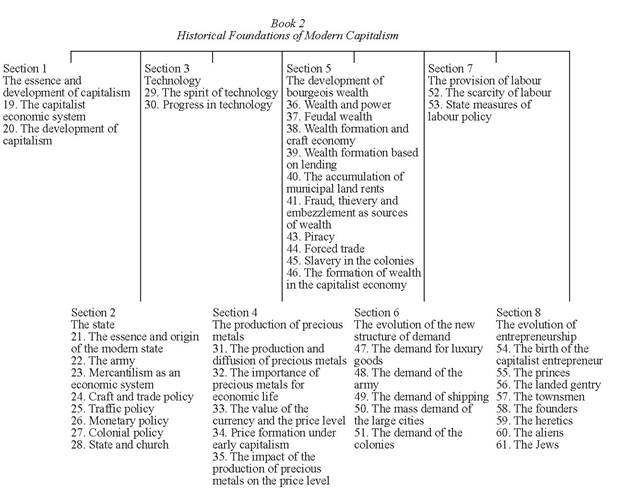
Figure 32.1 Sombart's modern capitalism
beliefs from those of the general population, that is the founders, the heretics, the aliens and the Jews, where the protestants obviously form part of the heretics.
Finally, modern sociological theory emphasizes the function of law as a communication system. Niklas Luhmann and Gunter Teubner have made important contributions in this area. Again, a tradition of economic thought should not be overlooked. Friedrich von Hayek, in his articles during the 1930s, culminating in his ‘The use of knowledge in society’ (1945), had already emphasized the market, as facilitated by legal institutions, as being the means through which economic agents effectively communicate in a modern economy.
References
Backhaus, Jurgen (1989), ‘Sombart’s modern capitalism’, Kjyklos, 42 (4), 599-611. Buchanan, James M. (1969), Cost and Choice, Chicago: Markham.
Cotterrell, Roger (1995), ‘Sociological interpretation of legal development’, European Journal of Law and Economics, 2, Norwell, MA: Kluwer.
Frey, Bruno S. (1992), Economics is a Science of Human Behavior: Towards a New Social Science Paradigm, Boston, MA: Kluwer.
Hayek, F. von (1945), ‘The use of knowledge in society’, American Economic Review, 35, 51930.
North, Douglass (1981), Structure and Change in Economics History, New York: W.W. Norton. Posner, Richard A. (1987), ‘The law and economics movement’, American Economic Review, 77 (2), May, 1-13.
Sombart, Werner (1916, [1927]), Der moderne Kapitalismus: historisch systematische Dastellung des gesamteuropaischen Wirtschaftlebens von seinen Anjfangen bis zur Gegenwart [The Modern Capitalism: A Systematic Study of European Economic History], Vols I-III, Leipzig and Munich: Duncker & Humblot.
Weber, Max (1930), The Protestant Ethic and the Spirit of Capitalism, trans. Talcott Parsons; reprinted, London: Unwin Reprint, 1985.
More on the topic Connections with law and society research:
- FINAL WORDS
- Bano Samia (ed.). The Sharia Inquiry, Religious Practice and Muslim Family Law in Britain. Routledge,2023. — 143 p., 2023
- Legal Maxims
- FIVE COMPONENTS OF LEGAL COMPETENCIES
- REVIEW OF FORENSIC ASSESSMENT INSTRUMENTS
- Taboos
- BACKGROUND AND DEFINITIONS
- 3 SELECTED SOCIO-ECONOMICALLY IMPORTANT WILDLIFE RELATED PATHOGENS AND DISEASES IN EUROPE
- Conclusion
- The Danish colonial project on the Gold Coast