CORE ELEMENTS OF AN INTERNET BUSINESS STRATEGY
In the quest for identifying an adequate Internet business strategy, both established and dot-com firms have to consider how the Internet’s specific properties can be best leveraged for their business models and how the Internet affects a particular industry’s structure.
Many firms erroneously thought that defining a business model solely includes the question of how to provide customers value. However, it is important that firms also think of how to generate revenues and which core capabilities and resources are necessary and how they can be protected from imitation.Therefore, defining an Internet business strategy that leverages the Internet to gain competitive advantage requires a thorough analysis of the Internet’s effect on industry structures. While some industries are affected to a lesser extent, some sectors have been heavily shaken up. In the latter case, entire value chains were impacted and firms were forced to adapt their business models and strategies accordingly. Although the Internet affects each industry in particular ways, some general observations can be made. Employing Porter’s (2008) five forces of competition, we outline the Internet’s influence on industry structures in general.
17.5.1 Internet’s Impact on Industry Structure
According to Porter (2001), industry structures are characterized by five competitive forces: the intensity of rivalry among existing competitors, the barriers to entry for new competitors, the threat of substitute products or services, the bargaining power of suppliers, and the bargaining power of buyers. It is suggested that these five forces determine the profitability of an average competitor.
While the Internet has created some new markets, its largest impact has been on old industries where it pushed the reconfiguration of value chains. In particular, industries that once were constrained by high costs for gathering information, communication, or bargaining have been affected.
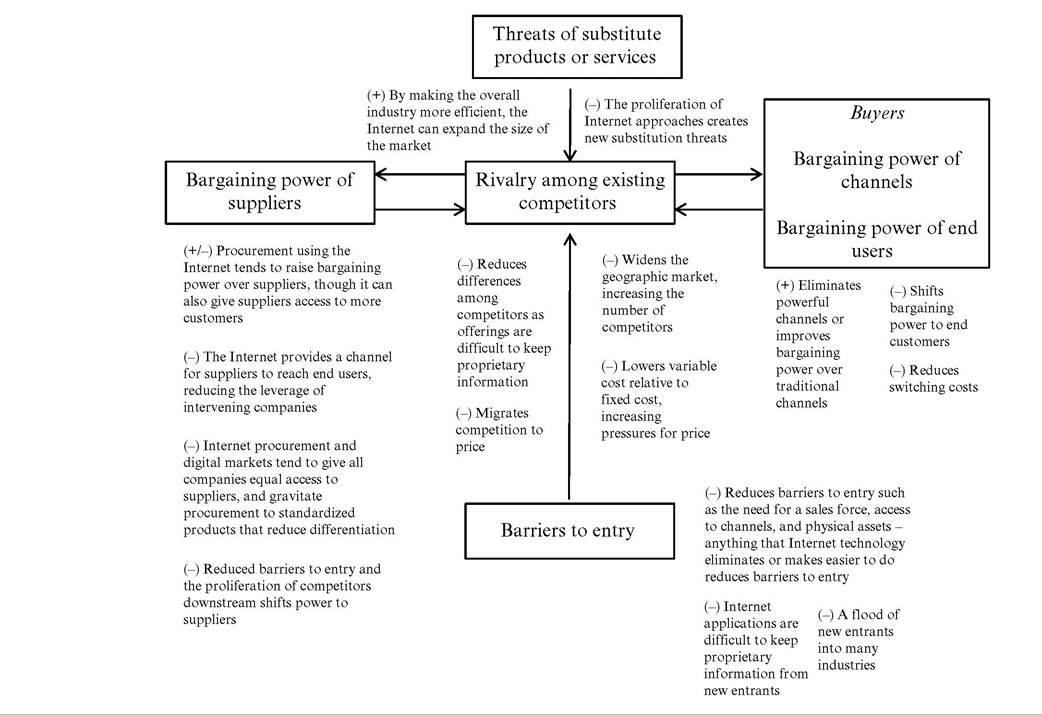
Take, for instance, the market for insurance. Hitherto, consumers had to gather information and obtain customized offers by contacting a local salesperson. Depending on the effort consumers were willing to make they had more or less offers from different insurance companies. However, gaining a complete market overview was almost impossible even with the help of brokers. Today, consumers have the opportunity to check and compare diverse offerings directly and obtain customized offers instantly over the Internet. As a result, buyers of insurance have more bargaining power as the Internet reduces information asymmetries and transaction costs. Established insurance companies have created extensive branch networks with mostly self-employed branch managers over the years. With the advent of direct insurance companies that exclusively offered insurance over the Internet, established firms had to adjust their strategies and business models by, for example, capitalizing on customer relationships, an asset that direct insurers did not have. Matching their business models with competitive strategies in an innovative way was a necessary response to the new industry structure resulting from amplified price competition and greater power of consumers.No matter which industry, the five forces determine how the economic value of a product, technology, or service is shared between competitors in this market on the one hand, and buyers, suppliers, substitutes and potential new market entrants on the other hand. As mentioned, the Internet affects industries in different ways, but some trends are generalizable for several markets, as depicted in Figure 17.3.
Many established industries have been changed significantly by Internet technology and the unique properties of the Internet. Above all, the Internet decreased the overall profitability as Internet technology allowed more competitors to enter markets in a cost-efficient way. Such market entry is facilitated first because the Internet is a low-cost standard and second because once obligatory complementary capabilities or resources have become irrelevant or easier to replicate, they lose their entry-deterring effect.
For instance, many businesses required a local sales force. With the Internet, new market entrants could easily offer products and services globally and interact with customers without having to rely on local channels. The competition further increased as once geographically confined markets were directly accessible for new competitors. Moreover, keeping offerings and business models proprietary is more complicated on the Internet, which reduces opportunities for differentiation. In addition to more competitors entering markets, the power of buyers has increased. Through the Internet, information asymmetries between vendors and consumers are reduced, which negatively affects the potential for price discrimination (Acquisti and Varian, 2005; Hinz et al., 2011). However, as ever more data on consumers’ online behavior are collected and data analytical methods (e.g., in-memory computing, MapReduce algorithm) rapidly improve, both price and search discrimination may become more prevalent (Mikians et al., 2012).However, the Internet also has some positive impacts on industries’ profitability as it improves market efficiency in diverse ways. For example, by augmenting distribution areas and the overall markets’ size, making value chains more efficient and enabling new opportunities in the competition with emerging substitutes. Moreover, the power of intermediaries has declined as the Internet facilitates direct customer access. As the Internet decreases transaction costs it also allows firms to outsource particular tasks to specialized service providers at lower prices and lower risk. Hence, the Internet has
Source: Porter (2001).
Figure 17.3 Internet’s influence on industry structure
facilitated firms to concentrate on their core competencies and to deliver value to consumers in a more cost-efficient way.
To summarize, in many established industries the Internet has increased consumers’ power, meaning that they can capture many the Internet’s benefits, such as lower transaction, marketing, distribution, and purchasing costs (Porter, 2001).
17.5.2 Sources of Competitive Advantage on the Internet
While the previous section focused on the Internet’s impact on established industries’ structures, we now examine how established and dot-com firms can create economically sustainable competitive advantages on the Internet.
Sustainable competitive advantage is referred to as a firm’s capability to outperform the market, capitalizing on valuable and rare resources that facilitate creating value for consumers in a unique and superior fashion that is hard to imitate by current and future competitors (Simon, 1988). According to the resource-based view of the firm, the ability to protect special corporate resources from imitation is crucial in achieving and sustaining competitive advantage (Rumelt, 1984; Mahoney and Pandian, 1992). In general, firms can pursue three generic strategies: operating excellence, product leadership, and customer intimacy (Treacy and Wiersema, 1993). To achieve or maintain competitive advantage firms will have to outperform competitors in one or more of those areas.
The viability of each strategy depends on the extent to which a firm is able to protect its technology or business model from being replicated by rivals. Imitability refers to the ease of copying, substituting, or leapfrogging a technology or business model innovation (Teece, 1986). On the Internet, the risk of imitation is high as protecting intellectual property is intricate in most cases. When imitability is high, continuous innovations and improvements are requisite to keep ahead of competitors. By the time rivals equalize the advantage, a firm has to push its technology or innovation a step further. As this race is both risky and cost intensive, firms should seek to gain competitive advantage by leveraging other capabilities. These complementary assets are not directly associated to a particular technology or innovation but are required to profit from them (ibid.). These capabilities can include assets as diverse as company reputation, supply chain excellence, customer service, usability, installed user base, or access to distribution channels.
Therefore, if the risk of being imitated is high, corporations need to identify complementary assets that are both mandatory for offering superior value to the targeted consumer segment and are hard to copy. Building assets of this kind strengthens a firm’s position relative to competitors, consumers, and suppliers and allows it to claim a larger share of the generated value. For example, Groupon’s offering of local discounted gift certificates requires a local sales force. As Groupon rolled out its local offering at a great pace all over the world to offer customers attractive deals, competitors were forced to set up similar organizational structures that were costly and time-consuming to develop.If the development of complementary assets is not possible internally, firms have to ally with holders of those in partnerships ranging from strategic alliances to acquisitions. But how can firms identify complementary assets that are crucial sources for competitive advantage? First, the assets have to correspond to one of the generic strategies - operating excellence, product leadership, or customer intimacy - a firm wants to pursue. It is important to note that these specific capabilities can involve each stage of the value chain. The decisive criterion for a complementary asset is its ability to substantially enhance value from a customer’s point of view. Second, investing in the deployment of complementary assets only makes sense if they cannot be replicated or substituted quickly and/or at modest costs. They should enable a lasting advantage with regard to competitors before they are able to develop similar or substituting capabilities.
To be successful the strategy of building complementary assets has to create substantial switching costs for consumers. Shapiro and Varian (1999, p. 133) state that ‘you just cannot compete effectively... unless you know how to identify, measure, and understand switching costs and map strategy accordingly’. Creating or exploiting switching costs means lessening price competition and earning higher profits than rivals.
Generally, at least three types of switching costs can be distinguished (Klemperer, 1987): transaction costs, learning costs, and artificial or contractual costs. Transaction costs occur when consumers engage in a new relationship with another firm potentially including termination costs for the existing relationship. Learning costs comprise the efforts necessary to make oneself familiar with a new product, service, or technology. Firms intentionally create artificial switching costs, such as bonus programs, proprietary standards, or repeatpurchase discounts. In the Internet business, switching costs related to direct or indirect network effects have proven to be highly effective, which is why many companies initially aim to grow quickly, no matter the cost - often not charging customers for their products or services at all - to create ‘lock-in’ effects (Anderson, 2009).However, due to the enormous technological and competitive dynamics of the Internet, sustaining competitive advantage requires fast and continuous innovation. Often Internet technologies, applications, and business models are in a ‘perpetual beta mode’, meaning that they are continuously being further developed and adapted, never reaching a final status. Thus, companies need to have the ‘sensing, seizing, and reconfiguring skills that the business enterprise needs if it is to stay in synch with changing markets and which enable it not just to stay alive, but to adapt to and itself shape’ (Teece, 2010, p. 190), typically referred to as ‘dynamic capabilities’ (Teece, 2009). Having these capabilities is particularly important in an environment such as the Internet where competition is intense and fast moving. The key to preserving competitive advantage is to offer consumers a superior performance. As business models and technologies can often be imitated quickly on the Internet, competitive advantages are often not more than a snapshot. All the more important are dynamic capabilities that help sense emerging customer needs and the identification of future technological trends. Understanding the fundamentals of consumer demand and how these demands can be met using the potential of technological innovations and organizational arrangements requires indepth knowledge about consumers, rivals, suppliers, technologies, and the industry as a whole. In markets like the Internet, which is especially affected by globalization, rapid technological changes and convergence, and new business models, companies tap into external sources of knowledge. Thereby they seek to accelerate internal innovation as internal research and development is no longer sufficient to keep pace with the rapid growth of global knowledge (Chesbrough, 2003; Gassmann, 2006; Chesbrough and Crowther, 2006).
However, many examples show that this is not enough. To find a viable business model comprising a compelling value proposition, dependable revenue sources, and key resources that are hard to duplicate, a firm needs to experiment. Business models are often provisional, meaning that they are permanently refined or superseded by new models that capitalize on new technological trends or complementary assets (Shirky, 2008). The prerequisite to innovate at high speed demands an organizational culture that encourages experimenting with new ideas and refining elements of their business model. This also requires the willingness of the entire organization to change established internal and external routines and to learn persistently. Knowing about consumer desires before the marketplace is an important asset. In this respect Web 2.0 technologies, like social networks, blogs, wikis, or media-sharing sites, play an essential role as they give both consumers and companies the chance to interact in new ways with each other. Embracing the dialogue with consumers gives firms the opportunity to build consumer intimacy, an asset that is hard to imitate. Moreover, it enables firms to react faster to changing demands and strengthen customer relations. Many firms also seek to leverage the collective intelligence of the Internet community by initiating crowdsourcing competitions (Howe, 2006). However, engaging in Web 2.0 also gives rise to challenges. The way firms communicate with customers has to be authentic in the sense that the conversations have to consider individual concerns and avoid giving ‘prefabricated’ statements. Furthermore, firms need to develop capabilities to exploit the information gathered from consumers strategically by ‘translating’ it into manageable change suggestions or requests. Thus, interacting with consumers is a prerequisite to gain or sustain competitive advantage, or as the manager of an Internet company puts it:
It has never been more important [for Internet firms] to take user interests at heart and to be available for receiving and responding to customer feedback and inquiries 24/7. With customers getting used to significantly increasing service levels, firms not able to effectively manage the customer touch-points will ultimately fail. (Wirtz et al., 2010, p. 282)
17.6