INTRODUCTION
16.1.1 Inequality Between Individuals
Consider an economy with identical couples, each of whom has a total income of 100. Individuals privately consume a unique, perfectly divisible commodity; there exist neither externalities nor economies of scale, so that, in each couple, the sum of individual consumptions equals the couple’s total income.
Inequality, as measured in a standard way, is nil. Assume, now, that some of these couples divorce, and that after divorce husbands each receive an income of 75, while each wife gets 25. The new income distribution, again by standard criteria, is now unequal; in particular, the presence of lower-income singles (the divorced wives) increases both inequality and poverty.From a deeper perspective, however, the conclusion just stated is far from granted. It entirely relies on an implicit assumption—namely, that the predivorce distribution of income within households was equal. Most of the time, such an assumption has little or no empirical justification; and from a theoretical viewpoint, it is actually quite unlikely to hold—few serious models of household behavior would predict an equal distribution of income while married if the post-divorce allocation is highly skewed. Still, it is crucial. Assume, for the sake of the argument, that the distribution of resources within married couples simply mimics what it would be in case of divorce (he gets 75, she gets 25)—not an unreasonable assumption, given that in our (admittedly simplistic) structure this is the only individually rational allocation. Then the claim that inequality increased after the wave of divorces is simply wrong. Inequality, at least across individuals, has not changed; each agent has exactly the same income, consumption and welfare than before. And the surge in measured poverty is just as spurious. There are exactly as many poor women after than there were before; it is just that, in the predivorce situation, the standard measures missed them.
The previous example, extreme as it may be, illustrates a basic point that this chapter will try to emphasize—namely, that any attempt at measuring inequality (or its evolution
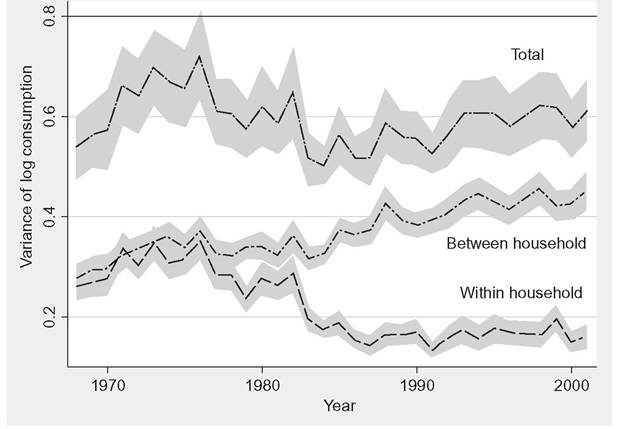
Figure 16.1 Trends in the variance of log consumption, UK. Source: Lise and Seitz (2011).
over time) that ignores allocation of resources within the family is unreliable at best, and deeply flawed at worst, especially when the basic demographics regarding family composition evolve over the period under consideration. This point had already been emphasized in the literature; for instance, Haddad and Kanbur (1990) have showed, on Philippine data, that standard measures of inequality in calorie adequacy would be understated by 30-40% if intrahousehold inequality was ignored. As a more recent illustration, consider the graph in Figure 16.1, due to Lise and Seitz (2011), that plots the evolution of inequality across households, within households, and across individuals in the United Kingdom over the last decades, as estimated from a collective model of labor supply. The main conclusion is that the standard approach, based on adult equivalence scales, underestimates the initial level of cross-sectional consumption inequality by 50%. Moreover, it gives a deeply flawed picture of the evolution of inequality over the last decades. While the usual story—a large surge in inequality between 1970 and 2000—applies to inequality across households, it is compensated by a considerable reduction of intrahousehold inequality, so that total inequality (across individuals) remains more or less constant over the period.[50]
All this strongly suggests, at the very least, that much more attention should be paid to intrahousehold inequality, from both a theoretical and an empirical viewpoint. Analyzing intrahousehold inequality, however, raises a host of specific problems. Some are ofa conceptual nature.
A large fraction of household expenditures relate to public commodities, that is, goods that are jointly consumed by the household, without exclusion restrictions; moreover, in many cases these public commodities are internally produced within the household. Spouses may have different preferences regarding public goods; therefore, the fraction of household expenditures devoted to public consumption has a potentially important impact on intrahousehold inequality, that cannot be disregarded. Similar questions arise for intrahousehold production, with the additional twist that time spent by each spouse should also be taken into account. How should such public productions and consumptions be taken into account in our inequality measures? Although the impact of public goods on inequality is by no means a new problem, it is particularly stringent in our context, if only because public goods and domestic production are among the main (economic) reasons for the existence of the household.As we shall see, these conceptual issues affect the standard notion of inequality in two ways. Besides shedding a new light on its measurement, they also revive some old discussions about its foundations. In particular, the role of public goods raises questions about which type on inequality we should concentrate on: income? (private) consumption? utility? The problem is far from innocuous: in the presence of public goods, it is relatively easy to generate examples in which a change in prices and incomes results in a decrease in a person’s private consumption and an increase in the spouse’s, whereas utilities evolve in the opposite way (welfare declines for the person whose private consumption increases and conversely). In such a context, the impact of the change on intrahousehold inequality is not clearly defined: It all depends on what exactly we are interested in.
Empirical problems are equally challenging. As always in economics, preferences are not directly observed and have to be recovered from observable data (demand, labor supply).
But, in addition, the allocation of resources within the household cannot (in general) be directly observed; it has to be recovered from the household’s (aggregate) behavior. It follows that when deciding which aspect of inequality should be considered, one cannot abstract from identification issues: there is little interest in concentrating on a notion that is not identifiable in practice. An interesting paradox, in this respect, is provided by a standard result of household economics, namely, that in some circumstances, a continuum of different models generate the same observable behavior (so they are observationally indistinguishable). In some cases, these models correspond to different intrahousehold allocations of resources, but to the same allocation of utility (in the language of the theory, the indeterminacy is welfare-irrelevant). In other words, the main justification for concentrating on inequality in income or consumption rather than in utility—namely, the fact that the former are observed, but not the latter—is sometimes partially reversed.These questions obviously arise whenever inequality is assessed on a utilitarian basis. However, even an alternative approach in terms of capabilities could hardly disregard them. Issues related to individual preferences for public goods would be less problematic in that case; what matters, from a capabilities perspective, is more an individual’s potential access to the public goods than the utility the individual actually derives from their consumption. But the difficulties in recovering individual private consumptions (especially when it comes to nutrition or other fundamental needs) would become all the more crucial. All in all, the problems raised by intrahousehold allocation should be central to any analysis of inequality, even though specific aspects may be more damaging for some approaches than for others.
What recent developments in the literature clearly indicate, however, is that while these problems are serious, they are by no means insuperable.
Although intrahousehold allocation is not (fully) observable, it can be recovered using specific, identifying assumptions that will be discussed later; that is the path followed by Lise and Seitz, but also by Chiappori et al. (2002), Dunbar et al. (2013), Browning et al. (2013), and many others in the literature. Clear progress has been made on this front over the last decades. One goal of this chapter is to briefly review these advances.A first step is to adopt an explicit model of household decision making that clarifies the notion of inequality within the household. Obviously, such models must explicitly recognize that household members each have their own preferences—if only because omitting individuals does not seem a promising way of analyzing inequality between them. An additional requirement is empirical tractability. To be usable, a model of household behavior should fulfill a double requirement: testability (i.e., it should generate a set of empirically testable restrictions that fully characterize the model, in the sense that any given behavior is compatible with the model if and only if these conditions are satisfied) and identifiability (it should be feasible, possibly under additional assumption, to recover the structure of the model—in our case, individual preferences and the decision process—from the sole observation of household behavior). Lastly, the model should provide (or be compatible with) an “upstream” theory of the generation of intrahousehold inequality; that is, we need to explain, and ideally predict, how the intrahousehold distribution of resources—and ultimately of power—responds to changes in the household’s socioeconomic environment.
Most of the recent advances use one particular class of models, based on the collective approach (see Chiappori, 1988, 1992).[51] Although other (nonunitary) perspectives have been adopted in the literature, none of the alternatives has (so far) convincingly addressed the double requirement of testability and identifiability just evoked.
16.1.2 Modeling Household Decision Making: The Collective Model
The basic axiom of the collective approach is Pareto efficiency: Whatever decision the household is making, no alternative choice would have been preferred by all members. Whereas this assumption is undoubtedly restrictive, its scope remains quite large. It encompasses as particular cases many models that have been proposed in the literature, including:
• “Unitary” models, which posit that the household behaves like a single decision maker; this includes simple dictatorship (possibly by a “benevolent patriarch,” as in Becker, 1974) to the existence of some household welfare function (as in Samuelson, 1956).
• Models based on cooperative game theory, and particularly bargaining theory (at least in a context of symmetric information), as pioneered by Manser and Brown (1980) and McElroy and Horney (1981).
• Model based on market equilibrium, as analyzed by Grossbard-Shechtman (1993), Gersbach and Haller (2001), Edlund and Korn (2002), and others.
• More specific models, such as Lundberg and Pollak’s “separate spheres” (1993) framework.
On the other hand, the collective framework excludes models based on noncooperative game theory (at least in the presence of public good), such as those considered by Ulph (2006), Browning et al. (2010), Lechene and Preston (2011), and many others, as well as models of inefficient bargaining a la Basu (2006).
The efficiency assumption is standard in many economic contexts and has often been applied to household behavior. Still, it needs careful justification. Within a static context, this assumption amounts to the requirement that married partners will find a way to take advantage of opportunities that make both of them better off. Because of proximity and durability of the relation, both partners are in general aware of the preferences and actions of each other. They can act cooperatively by reaching some binding agreement. Enforcement of such agreements can be achieved through mutual care and trust, by social norms and by formal legal contracts. Alternatively, the agreement can be supported by repeated interactions, including the possibility of punishment. A large literature in game theory, based on several “folk theorems,” suggests that in such situations, efficiency should prevail.[52] At the very least, efficiency can be considered as a natural benchmark.
Another potential issue with a collective approach to inequality issues is of a more conceptual nature. By definition, the collective approach is axiomatic; it assumes specific properties of the outcome (efficiency), and leaves aside the specific process by which this outcome has been generated. It has sometimes been argued that one should judge differently situations that generate the same allocations (and the same utility levels) but which are reached by different processes. In that case, the collective approach has to be further specialized, and this may be (and has been) done in several directions.4
Finally, an obvious but crucial advantage of the collective model is that it has been by now fully characterized. We have a set of necessary and sufficient conditions for a demand function to stem from a collective framework (Chiappori and Ekeland 2006); exclusion restrictions have been derived under which individual preferences and the decision process (as summarized by the Pareto weights) can be recovered from the sole observation of household behavior (Chiappori and Ekeland, 2009a,b). To the best of our knowledge, this is the only model of the household for which similar results have been derived.5
The next section describes the basic model. We then discuss the conceptual issues linked with intrahousehold inequality, first in the case where all commodities are privately consumed, then in the presence of public goods, finally for the case of domestic production. We then discuss the determinants of intrahousehold allocations followed by a section on identification of preferences and the sharing rule. Finally, we discuss issues related to identification. In the following section we give an overview of empirical findings and then we conclude with a brief discussion of future directions of research.
16.2.