INTRODUCTION
While it is undisputable that the economic status of men and women has greatly converged in the second half of the twentieth century, it is also well documented that it is still not equal: women receive, on average, lower employment incomes than men, they more often work part-time or not at all, and they carry out the lion’s share of unpaid work in the home.
But while there are so many clues suggesting that women’s overall income is lower than that of men, there is no straightforward measure that would allow the size of such an overall gender gap in income or in economic well-being to be assessed. The main limitation is that, in most income data sets, only some components of income, essentially related to work, are received and available at an individual level; the others are either received by households or measured as if received at the household level. The rationale for this household-level conceptualization is that multiperson households are assumed to benefit equally from shared resources within the household. This strong assumption about the distribution of income is made in the absence of reliable indications of the actual extent of intrahousehold sharing, so indicators of gender inequality in income or living standards are limited, if not biased. Then, as long as it is not possible to measure individual income—that is, being able to distribute the household income between the household members—gender inequalities are best assessed by various outcomes such as wages, pensions, or time spent in unpaid work than on the basis of a synthetic indicator assuming that all individuals who live together necessarily achieve an equal level of economic well-being.The household is not only a measurement issue: many men and women live together in couple households, and many decisions are made in the context of the household. Then, what happens within the household, especially regarding the allocation of time to paid and unpaid work, is central to the understanding of the gender gap in economic outcomes, particularly gender differentials in earnings, pensions, and wealth accumulation.
So it is not surprising that the issues of childcare and housework are repeatedly put forward in the analysis of various facets of gender inequality. Labor market institutions,firms’ management, public policies, and social norms, however, also play a major role in shaping male and female behavior, constraints, and opportunities. Conversely, labor market status, earnings, and career perspectives influence the allocation of time and relative bargaining power within the household.
In other words, studying gender inequality entails considering the interaction of several influences relating to the family as well as the public sphere, as tentatively depicted in Figure 12.1. It also brings together research questions otherwise mostly addressed in separate strands of literature.
The aim of this chapter is to provide an up-to-date review of what is known and what we do not know, at least not well, about gender economic inequalities. The review is centered on “Western”/industrialized countries. This is not because other countries would be less interesting or less prone to gender inequality—it may even take more radical forms—but because it would lead to include other (too) vast issues, especially those of economic development and economic transition.
The chapter is organized as follows: Section 12.2 provides a brief overview of the current standard approach to income and living standards in statistical information, in
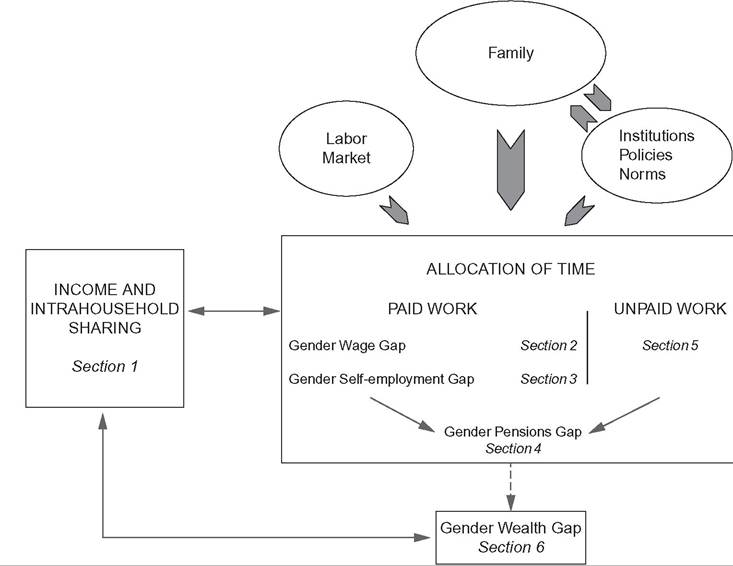
Figure 12.1 Main dimensions of gender economic inequality.
which the basic unit is the household, and its consequences for the measurement and analysis of income inequality between men and women. Sections 12.3—12.5 present an overview of the gender earnings gap. Section 12.3 is devoted to the central issue of the gender gap in wages, which has been and remains abundantly researched. Section 12.4 turns to self-employment, focusing on the question of the underrepresentation of women in this status. The gender gap in pensions, a result of past career and family trajectories, is examined in Section 12.5. Section 12.6 addresses the questions of “time and money” in the household, focusing on the unbalanced distribution of paid and unpaid work between men and women. Section 12.7 reviews the relatively small but growing literature on gender inequality in wealth.
12.2.