INTRODUCTION
Virtual economies refer to the systems of production, distribution, and trade that have emerged in online spaces, especially virtual worlds. Their origins can be traced to the 1970s, when videogame developers first gave players the ability to play and trade with one another in the same virtual world.
As the number of people with Internet connections increased, and as computer power advanced, the populations of virtual worlds rose along with the size and complexity of the economies in those worlds (Figure 24.1).Virtual economies began to receive substantial academic and media attention in the early 2000s after Castronova (2001) valued the economy of Norrath in the game EverQuest at $135 million. In the last five years, the proliferation of free-to-play games on mobile, Facebook, and other platforms has vastly increased the number of environments in which players purchase and trade virtual goods and services.1 Trade in virtual assets like virtual currencies and items has become a commonplace activity in games, as has the exchange of these assets for real-world currency.
In this chapter we review the development of and the research surrounding these economies. We examine how the real and virtual economies interact with one another and the issues such interactions create for virtual world operators. We discuss why the industry has evolved new business models in order to deal with the ‘real money trade’, that is, the market in which players trade real money with each other and with third parties in exchange for virtual goods and services. We also look at the economic research resulting from the study of virtual economies.
Academic work in the area of virtual economies began in the early 2000s. The key takeaway from this work is not that virtual economies and real economies behave in the same way - for that is debatable (Williams, 2010).
Instead, what economic research in virtual worlds has taught us is that economic agents behave similarly, whether the economy they act in is real or virtual. That said, the economics of games and virtual worlds remains a niche area of study. Scholars have not had an easy time drawing the links between real and virtual economic behavior in a way that makes the phenomenon of virtual economies interesting to the broader economics profession. However, as production begins to move out of the real world and into the virtual one, it seems inevitable to us that economists and policy-makers will need to have a better understanding of the economic motivations for entering and exiting virtual economies and their associated virtual worlds.The line between work and play can become rather fuzzy inside of virtual words, and this highlights the complexity of their motivations for production and consumption. Other interesting, more practical questions remain unanswered as well. For example, how might virtual world and video game operators compete with one another by setting
495
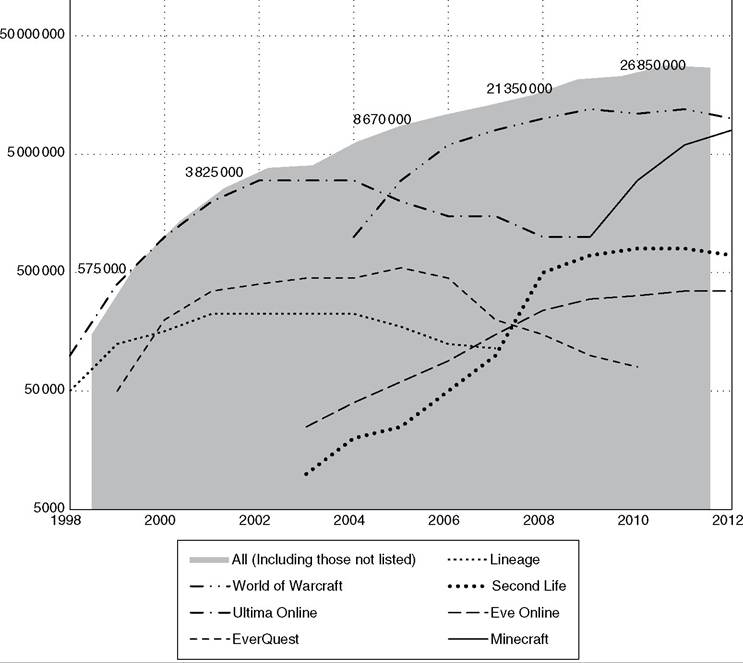
Sources: Mmodata.net, Mmo-sheet.com.
Figure 24.1 Number of residents in selected virtual worlds, 1998-2012
policies inside their virtual economies? What makes virtual assets attractive to players, beyond their real-world value? Untangling those knotty issues remains a preoccupation of so-called ‘virtual economists’.
The phrase ‘virtual economy’ has become an overloaded term in a world where goods, services, and the means to trade them are increasingly virtual. One particularly important development has been the rise of virtual currencies such as Bitcoin and Litecoin - so-called ‘crypto-currencies’, which are not backed by any government. Users trade crypto-currencies on peer-to-peer networks in exchange for goods and services. Although this is an important development in its own right, in this chapter we will focus exclusively on economies inside and surrounding video games and virtual worlds (for more information on the proliferation of non-state-controlled currencies see Castronova, 2014).
This chapter is organized as follows. In the next section, we review the origins of virtual economies, the development of which eventually led to the fundamental edifice of virtual economic design: the faucet-drain system. In section 24.3, we look at how virtual economies and real economies interact with one another. We describe the real money trade and discuss how it led to the creation of the free-to-play business model. We also discuss the issue of virtual property. Section 24.4 discusses the available research on virtual economies, and section 24.5 concludes.
24.2