Novel coronavirus hurts the Middle East and North Africa through many channels
Rabah Arezki and Ha Nguyen
World Bank
The novel coronavirus (COVID-19) was first alerted to the World Health Organization (WHO) by the Chinese authorities on 31 December 2019.
This new virus can cause flulike symptoms which often are more severe and more likely to result in death than other known coronaviruses. The virus has spread to more than 65 countries and territories, with about 87,600 cases and close to 3,000 deaths (as of 26 February 2019).1 It has the potential to severely disrupt global economic activities. In this chapter, I examine the channels through which COVID-19 may affect the Middle East and North Africa (MENA) region.COVID-19 infections
Travellers from China, Korea, Italy, and other affected countries could spread COVID-19 to the MENA region. The virus has already spread to Iran and other MENA countries. As of 29 February, Iran had reported 593 infections and at least 43 deaths.2 The rapid rise in infections there is likely to disrupt the country’s production and trade. As the virus spread in Iran, authorities closed schools and cancelled art and film events, and neighbouring countries closed their land borders with Iran.3 Other MENA countries have also reported infections. As of 29 February, the United Arab Emirates had reported 19 cases, Iraq had reported 8 cases, Bahrain had reported 38 cases and Kuwait had reported 45 cases. Egypt, Qatar and Lebanon have also reported their first cases.4
1 https://www.worldometers.info/coronavirus/
2 https://www.worldometers.info/coronavirus/
3 https://www.aljazeera.com/news/2020/02/neighbours-close-borders-iran-virus-concerns-rise-200223160135283.html
4 https://www.worldometers.info/coronavirus/
The ability to contain the virus depends on the strength of the public health systems of the MENA countries. WHO ranks most MENA countries relatively high among the world’s 191 health systems - with a few exceptions, such as Yemen (ranked 120th) and Djibouti (ranked 157th) (Tandon et al.
2000). However, some MENA countries might face difficulties in fighting the spread of the virus. Wars in Syria and Yemen will almost certainly impede the proper functioning of the health systems in the two countries. According to Abdinasir Abubakar of WHO’s Regional Office for the Eastern Mediterranean, the US embargo on Iran may hurt Iran’s ability to buy the technology required to produce essential equipment and medicine.[27]Oil prices
Because of their exposure to oil and gas exports, a decline in the prices of petroleum- related products is expected to be the most significant channel through which effects of the COVID-19 are felt in MENA countries. Since the discovery of the new virus and infections in China at the beginning of 2020, oil prices have declined sharply. The price of Brent oil dropped from $68.90 a barrel on 1 January to $50.5 a barrel as of 28 February (see Figure 1). Crude oil futures tumbled by about $20 a barrel during January and February in anticipation of the negative impact on oil demand from COVID-19 (see Figure 2).
Although other factors might have contributed to this drop, COVID-19 was probably the most important factor, largely because of the significant drop in demand from China as authorities shuttered production facilities as part of their efforts to contain the spread of the virus. According to the Oil Market Report for February from the International Energy Agency (IEA), China’s oil demand currently accounts for 14% of global demand, and China’s growth in oil demand currently accounts for more than 75% of the global growth in demand (International Energy Agency 2020). In addition, with an increasingly important role in the global economy, any setbacks to the Chinese economy are expected to have significant negative spillovers to the global economy (Arezki and Yang 2018). In addition, the global fear and uncertainty regarding the spread of virus will likely hurt investment decisions in China and in other countries, which further lowers oil prices.
The IEA expects global demand for oil to fall by 435,000 barrels per day year-on-year in the first quarter of 2020 - the first quarterly contraction in more than a decade. The global demand for all of 2020 is also expected to fall by 365,000 barrels per day - the worst performance of demand since 2011. The risk posed by the COVID-19 crisis has prompted the OPEC+ countries to consider an additional cut in oil production of 600,000 barrels a day as an emergency measure on top of the 1.7 million barrels a day already pledged (International Energy Agency 2020).The recovery of oil prices will depend on how successfully China and other countries control the spread of the virus, the effects of which are becoming increasingly global. Although the vast majority of cases have been in China, Korea, Italy, and Iran have seen a surge in infections and many other countries have recorded some cases.
Figure 1 Brent oil price and future curves
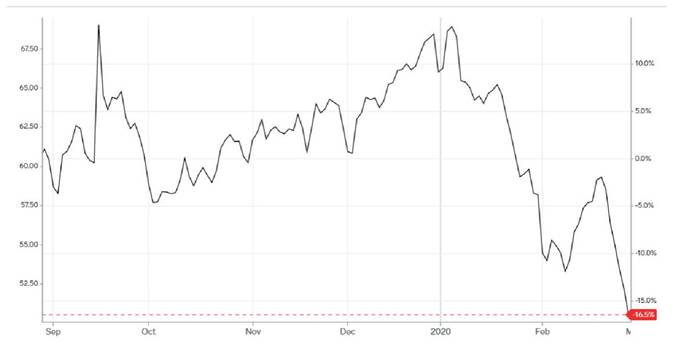
Note: Data end on 28 February 2020
Figure 2 Oil price futures (US dollars per barrel)
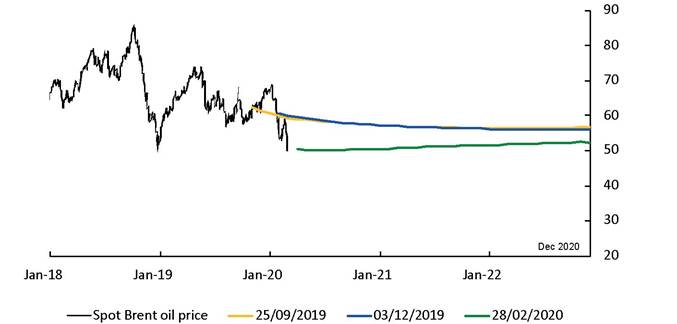
Note: Expiration dates on horizontal axis. The colour lines show the future prices of Brent crude oil on 25 September 2019, 3 December 2019 and 28 February 2020.
Source: Bloomberg, L.P.
Value chains
When China’s production is disrupted, countries with strong value chain connections with China will likely also be affected. This is a special concern for many Asian countries, which have important value chain connections with China, but less likely to be a concern for MENA countries, which have limited participation in global value chains. However, disruptions to global value chains might exacerbate the depression of oil prices caused by China’s weakening demand.
Tourism and travel
COVID-19 will likely reduce tourism from China to MENA in two ways.
The first is the pull factor: many MENA countries are now imposing travel restrictions to Chinese. In addition, Saudi Arabia suspended entry of pilgrims to the holy sites, further reducing tourism to the Middle East.6 The second is the push factor: economic slowdown in China implies less tourists travelling to other countries, including MENA. East Asia and Pacific is likely see the sharpest drop in Chinese tourists. The effect of economic slowdown in China on tourist arrivals to MENA is expected to be more limited (see Figure 3). However, the reduction of global travel will further depress oil prices.Figure 3 Estimated impact of a decline in China’s per capita GDP on Chinese arrivals to MENA and the rest of the world
Decline in Chinese tourist arrivals after a 0.3% fall in China's GDP pc
(As percent of all tourist arrivals from the World)
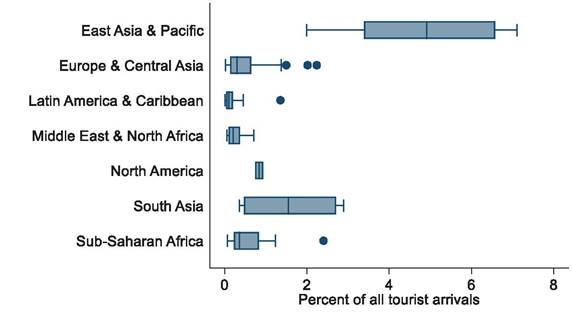
Note: Excludes Hong Kong.
Source: Lopez-Cordova (2020a, 2020b).
6 See https://www.bbc.com/news/world-middle-east-51658061
References
Arezki, R and L Yang (2018), “On the Asymmetry of Global Spillovers : Emerging Markets Versus Advanced Economies”, World Bank Policy Research Working Paper WPS8662.
International Energy Agency (2020), Oil Market Report February 2020.
Lopez-Cordova, E (2020a), “A Slowdown of China’s Economy and its Impact on the Demand for Tourism Services”, Brief.
Lopez-Cordova, E (2020b), “Digital Platforms and the Demand for International Tourism Services”, World Bank Policy Research Working Paper WPS9147.
Tandon A, C J Murray, J A Lauer and D Evans (2000), “Measuring overall health system performance for 191 countries”, World Health Organization, Geneva.
About the authors
Rabah Arezki is the Chief Economist for Middle East and North Africa Region at the World Bank and a senior fellow at Harvard University’s John F. Kennedy School of GovernmentPreviously, he was the Chief of the Commodities Unit in the Research Department at the International Monetary Fund and a non-resident fellow at the Brookings Institution.
He is also an external research associate at the University of Oxford, research fellow at the CESifo and the Economic Research Forum, and a resource person for the African Economic Research Consortium.Mr. Arezki is the author and co-author of numerous academic journal publications and other publications, including the Quarterly Journal of Economics, the Economic Journal, the European Economic Review, the Journal of International Economics, the Journal of Development Economics and Economic Policy. Mr. Arezki’s research covers a wide array of topics energy and commodities markets, the macro-development resource rich countries, the economics of the Middle East and Africa, institutions, human capital, innovation and economic growth. He received his M.S. from the Ecole Nationale de la Statistique et de TAdministration Economique in Paris, M.A. from the University of Paris-1 Pantheon-Sorbonne and Ph.D. in economics from the European University Institute.
Ha Nguyen is an Economist in the World Bank’s chief economist office for the Middle East and North Africa region. His research interests include international finance and macroeconomics. He holds a Ph.D. in economics from the University of Maryland, College Park and a M.A. and B. A. in economics from the University of Adelaide, Australia.
5