Some Implementations of the AF Methodology
As mentioned in Chapter 1, since its development, the Alkire-Foster approach to multidimensional poverty has generated practical interest. Examples include the global MPI, estimated for over 100 developing countries,17 as well as official national multidimensional poverty measures in Mexico, Colombia, Bhutan, Chile, and the Philippines, with many other regional, national, and subnational measures in progress.18 Adaptations of the methodology include the Gross National Happiness Index of the Royal Government of Bhutan (Ura et al.
2012) and the Women's Empowerment in Agriculture Index (Alkire, Meinzen-Dick, et al. 2013). Several academic studies have implemented the AF approach for different poverty measurement purposes and in different parts of the world. These are summarized in Table 5.8.Other papers do not directly implement the AF methodology but engage with it in various ways. These include Ferreira (2011), Ravallion (2011b) and others in the Journal of Economic Inequality, vol. 9 (2011), Ferreira and Lugo (2013), Foster et al. (2010), Betti et al. (2012), Cardenas and Carpenter (2013), Larochelle (2014), Berenger et al. (2013), Siminski and Yerokhin (2012), and Smith (2012).
Chapter 6, which follows, explains the normative decisions required to apply the AF framework of multidimensional poverty measurement empirically. It identifies the different decisions required, delineates their normative content and key considerations, and presents alternative courses of action.
17 UNDP (2010a); Alkire and Santos (2010,2014); Alkire, Roche, Santos, and Seth (2011); Alkire, Conconi, and Roche (2013); Alkire, Conconi, and Seth (2014a).
18 These experiences are documented on the often-updated site.
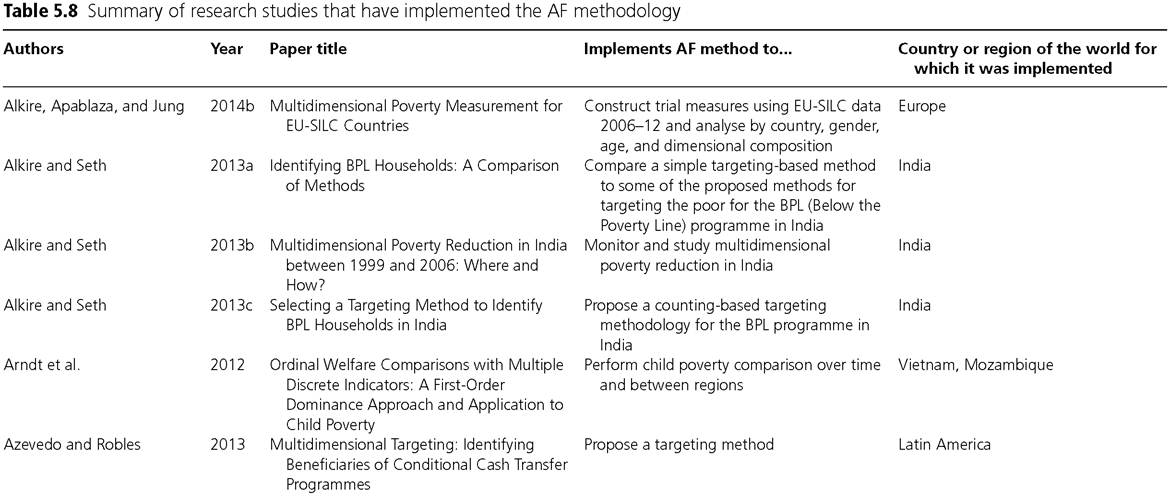
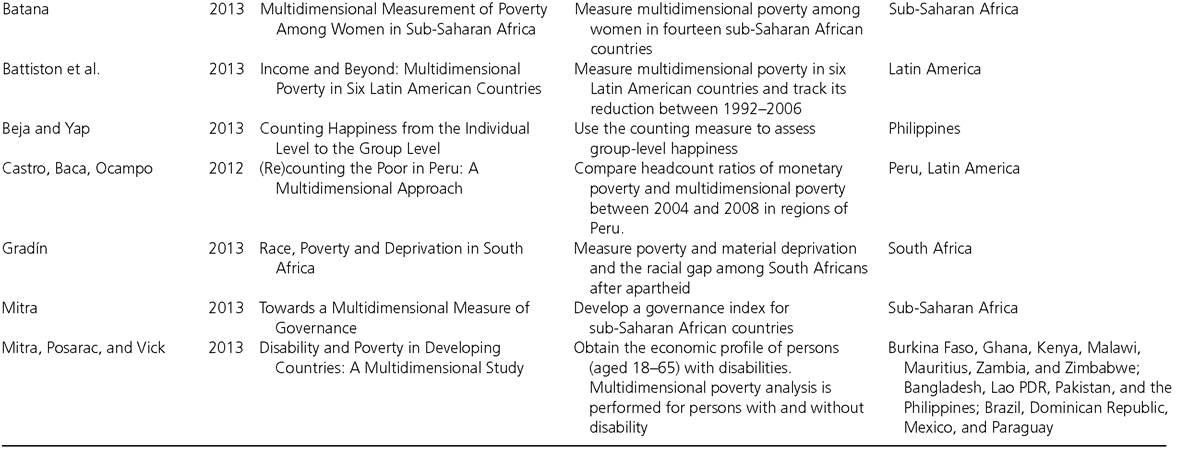
Table 5.8 (cont.)
| Authors | Year | Paper title | Implements AF method to... | Region of the world for which it was implemented | |||
| Mitra, Jones, et al. | 2013 | Implementing a Multidimensional Poverty Measure Using Mixed Methods and a Participatory Framework | Measure multidimensional poverty among people with psychiatric diagnoses | USA | |||
| Nicholas and Ray | 2011 | Duration and Persistence in Multidimensional Deprivation: Methodology and Australian Application | Construct dynamic deprivation measures and assess the duration of deprivation across multiple dimensions | Australia | |||
| Notten and Roelen | 2012 | A New Tool for Monitoring (Child) Poverty: Measures of Cumulative Deprivation | Measure material deprivation, cumulative deprivation, and child poverty | UK, Germany, France, the Netherlands | |||
| Nussbaumer et al. | 2012 | Measuring Energy Poverty: Focusing on What Matters | Derive the Multidimensional Energy Poverty Index(MEPI) | Angola, Benin, Burkina Faso, Cameroon, Congo Brazzaville, Congo Democratic Republic, Egypt, Ethiopia, Ghana, Guinea, Kenya, Lesotho, Liberia, Madagascar, Malawi, Mali, Morocco, Mozambique, Namibia, Niger, Nigeria, Rwanda, Senegal, Sierra Leone, Swaziland, Tanzania, Uganda, Zambia, Zimbabwe | |||
| Peichl and Pestel | 2013a | Multidimensional Affluence: Theory and Applications to Germany and the US | Construct an index of affluence instead of poverty to study affluence in Germany and the US | Germany, USA | |||
| Peichl and Pestel | 2013b | Multidimensional Well-Being at the Top: Evidence for Germany | Construct an index of well-being to study well-being in Germany | Germany | |||
| Roche | 2013 | Monitoring Progress in Child Poverty Reduction: Methodological Insights and Illustration to the Case Study of Bangladesh | Measure multidimensional poverty among children in Bangladesh and analyse the patterns of poverty reduction | Bangladesh, South Asia | |||
| Santos | 2013 | Tracking Poverty Reduction in Bhutan: Income Deprivation Alongside Deprivation in Other Sources of Happiness | Measure multidimensional poverty in Bhutan and track its trend between 2003 and 2007 | Bhutan, South Asia | |||
| Siegel and Waidler | 2012 | Migration and Multidimensional Poverty in Moldovan Communities | Examine multidimensional poverty in 180 Moldovian communities in 2011 | Moldova, Eastern Europe | |||
| Siani Tchouametieu | 2013 | Has Poverty Decreased in Cameroon between 2001 and 2007? An Analysis Based on Multidimensional Poverty Measures | Analyse changes in multidimensional poverty in Cameroon between 2001 and 2007 | Cameroon, sub-Saharan Africa | |||
| Tonmoy | 2014 | An Exercise to Evaluate an Anti-Poverty Program with Multiple Outcomes Using Program Evaluation | Evaluate a programme using multidimensional poverty measures with difference-in-difference matching estimators | Bangladesh | |||
| Trani and Cannings | 2013 | Child Poverty in an Emergency and Conflict Context: A Multidimensional Profile and an Identification of the Poorest Children in Western Darfur | Measure child poverty | Darfur, Sudan | |||
| Trani, Biggeri, and Mauro | 2013 | The Multidimensionalityof Child Poverty: Evidence from Afghanistan | Measure poverty among children in Afghanistan | Afghanistan | |||
| Yu | 2013 | Multidimensional Poverty in China: Findings Based on the CHNS | Measure multidimensional poverty in China and tracks its progress between 2000 and 2009 | China | |||
| Wagle | 2014 | The Counting-Based Measurement of Multidimensional Poverty: The Focus on Economic Resources, Inner Capabilities, and Relational Resources in the United States | Compare a two-step process of the dimensional approach to AF method | USA | |||
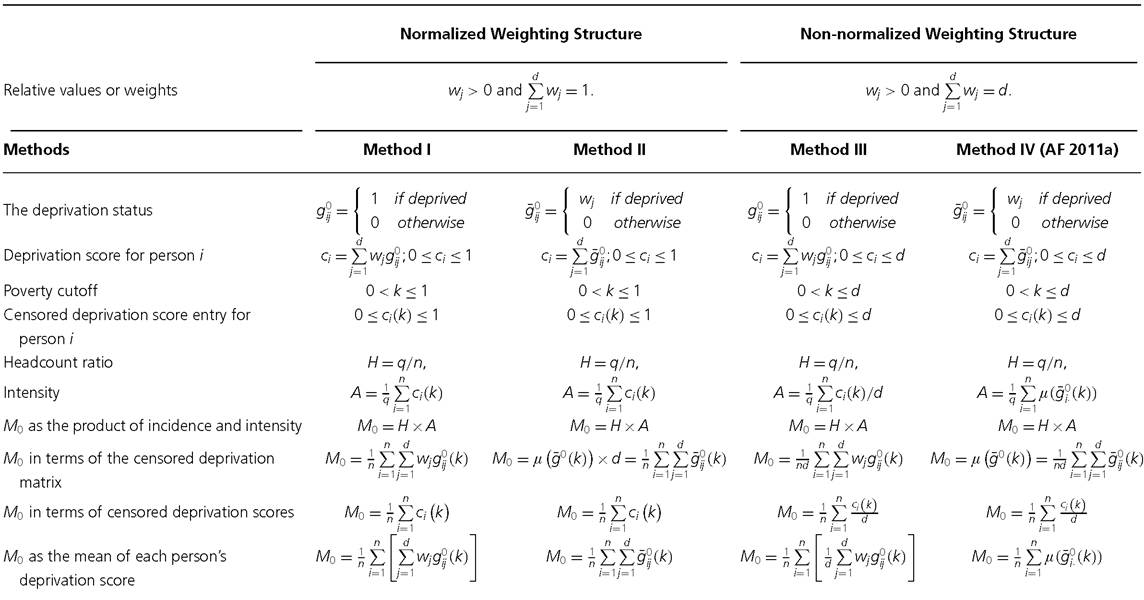
BOX 5.7 ALTERNATIVE NOTATIONS FOR THE AF METHOD
BOX 5.7 (cont.)
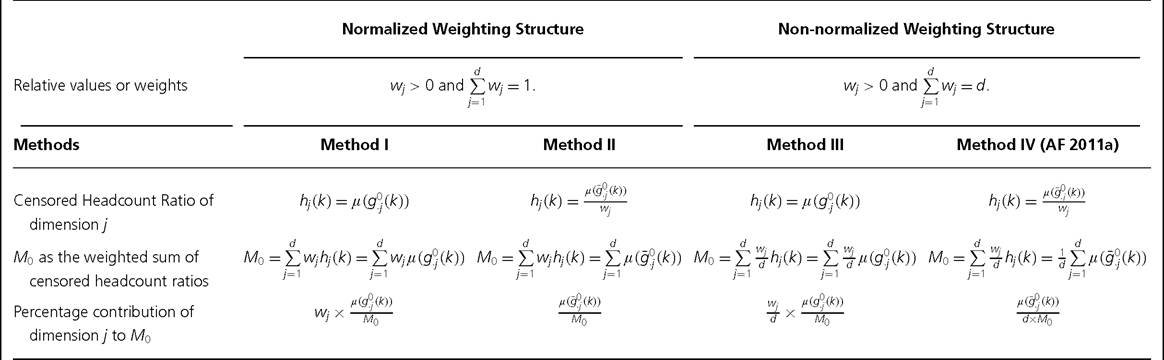
Note: Method I is the one mainly used throughout this chapter. Method IV is described in Box 5.3 and Box 5.6 and follows the notation used in Alkire and Foster (2011a).
Method II is a variant of Method I, equivalent to Method IV in that weights are incorporated into the entries of the matrix, creating the weighted deprivation matrix, and thus do not explicitly appear in formulas. Method III is a minor variant of Method IV, equivalent to Method I in the sense that weights are kept outside the deprivation matrix and thus explicitly appear in formulas.