THE ECOSYSTEM AND VALUE CHAIN OF CONVERGED VIDEO SERVICES
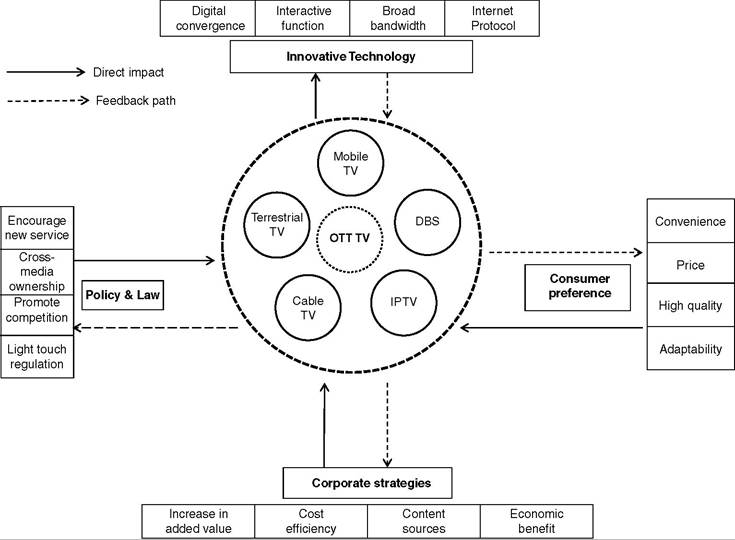
The relationship between different players in the converged media ecosystem is depicted in Figure 23.1. In this system, consumers can access video content via terrestrial TV, cable TV, direct broadcast satellite (DBS), IPTV, mobile TV or OTT TV platforms.
Four dimensions are needed to understand the converged media ecosystem. A first necessary component is innovative technology. Digital convergence, interactivity, sufficient bandwidth and the use of the Internet Protocol (IP) all have expanded the scope of feasible technological innovation. A second component is public policy. Technology and policy co-evolve, each shaping and constraining the other (Bauer, 2014). The development of new media platforms and services is influenced by government policies and regulations affecting convergence such as measures encouraging new services, allowing cross-media ownership, promoting competition, and the design of light touch regulation.A third component comprises corporate strategies, which are contingent on the potential added value that can be generated, cost efficiencies achievable by convergence services, the availability and cost of content sources and expected economic benefits. The fourth component consists of consumer preferences and choices, which are affected by attributes such as the convenience of services, their price and quality, as well as their adaptability across various platforms. In the long run, stakeholders in the market will interact both competitively and cooperatively with one another in the ecosystem (Brandenburger and Nalebuff, 1996). In Figure 23.1 OTT video is the most recent service to compete or cooperate with the incumbent media. TV media such as terrestrial TV, DBS, IPTV and cable TV might offer OTT TV service as well. Mobile TV, which is transmitted via broadcasting or satellite, has technical limitations in terms of providing OTT video service, because OTT needs to be accessed via broadband.
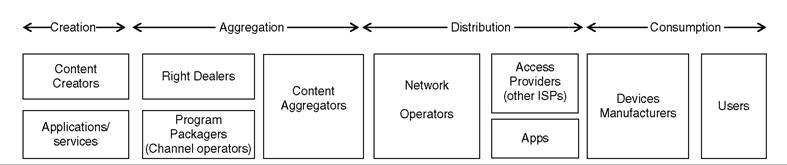
As an effect of convergence, value generation in the media market also has changed. The new value chain can be broken down into several segments (Figure 23.2). Each of them, from creation, content aggregation, distribution to consumption, is populated
Note: DBS = direct broadcast satellite; IPTV = Internet Protocol TV; OTT = over-the-top.
Source: Adapted from Bauer et al. (2003).
Figure 23.1 Converged media ecosystem
Source: Adapted from Venturini (2011).
Figure 23.2 Converged video service value chain
with key actors. Content creators, application and service providers mainly take part in creation; rights dealers, program packagers and content aggregators provide content aggregation. Network operators and access providers as well as apps are involved in the distribution of content to consumers. Furthermore, device manufacturers and users contribute to the consumption of content from the converged media platforms. In fact, in a digital economy, value is co-created when various players in the market join forces and engage in cooperative activities to innovate or increase their competitive advantage (Evens, 2010).
23.4
More on the topic THE ECOSYSTEM AND VALUE CHAIN OF CONVERGED VIDEO SERVICES:
- CONTENTS
- Bauer J., Latzer M. (Eds.). Handbook on the Economics of the Internet. Edward Elgar,2016. — 603 p., 2016