Is there too much litigation?
Given the high cost of the legal system for resolving disputes, an important normative question is whether there is too much litigation from a social perspective. This section addresses this question by examining two issues: the social versus private incentive to bring suit, and economic explanations for the success of frivolous suits.
It concludes by discussing alternative approaches to dispute resolution as a response to the high cost of litigation.The social versus private incentive to sue
The private incentive to sue is based on a plaintiff’s comparison of her cost of bringing suit and the expected settlement amount or award of damages at trial. In contrast, the social value of suit is based on a comparison of the social cost of litigation, including the defendant’s costs plus any public costs, and the social value of a suit, which consists of the incentives it creates for injurers to take reasonable care to reduce the risk of harm. In general, these comparisons will differ, resulting in an actual level of litigation that diverges from the socially optimal level. The amount and direction of the divergence depends on the interaction of two effects. First, plaintiffs ignore the cost of a suit to others; this effect will tend to cause too much litigation. Second, plaintiffs ignore the impact of litigation on the incentives of injurers to take cost-justified precaution against risk.12 This effect can lead to too little or too much litigation. On net, therefore, it is impossible to determine theoretically whether there is too much or too little litigation (Shavell, 1982b, 1997).13
Frivolous suits
Although the previous section noted that lawsuits can provide a social benefit by deterring unreasonably risky behaviour, there is a common perception that a significant fraction of lawsuits have little or no social merit and are filed solely in the hopes of obtaining a settlement. Since these so-called ‘frivolous’ suits impose a significant burden on the legal system, an analysis of how they succeed and how they can be discouraged is an important topic in the economic analysis of litigation.
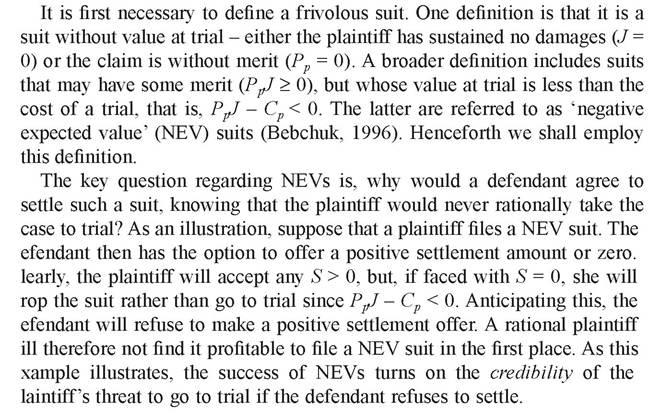
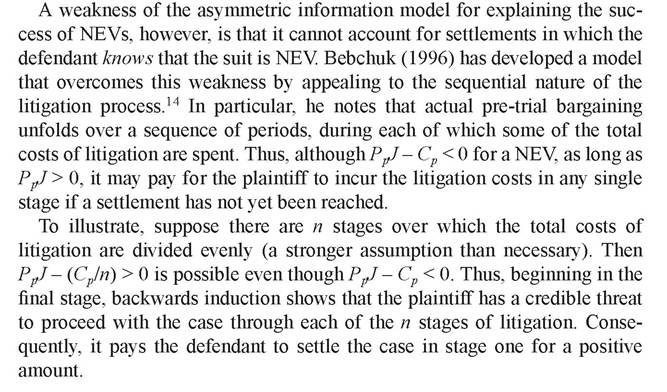
One explanation for the success of NEVs is based on the asymmetric information model described above (Bebchuk, 1988; Katz, 1990). Suppose that there are two types of potential plaintiff: those who are truly injured and those who are not. Perhaps both types of plaintiff were involved in accidents, but only the former suffered injuries. Though defendants know the fraction of uninjured plaintiffs in the population of accident victims, they cannot distinguish the injured from the uninjured in individual cases. In this setting, uninjured victims can succeed in obtaining positive settlement amounts if the fraction of uninjured plaintiffs in the population is small enough. Intuitively, defendants are willing to pay a small number of meritless claims in order to avoid the cost of taking those cases with merit to trial. The success of NEVs in this case therefore results from their ability to masquerade as truly injured plaintiffs.
Alternative dispute resolution
The high cost of litigation has caused disputants to rely increasingly on alternative methods of dispute resolution, such as arbitration and mediation. The principal advantage of these alternatives is the cost savings resulting from the reduced complexity and length of proceedings compared to fulllength trials. However, an evaluation of the social desirability of these methods must also consider the accuracy of their results and the incentive effects that they create for parties to avoid disputes in the first place (Shavell, 1995).