Implications of the model for the cost of litigation
The preceding model yields several implications regarding the structure of various procedural and cost-shifting rules aimed at promoting settlement and reducing the cost of litigation.
This section examines pre-trial discovery and cost shifting under the English Rule and Rule 68.Pre-trial discovery
The practice of pre-trial discovery allows the parties to a legal dispute to obtain information about their opponent’s case prior to trial.7 Condition (26.1) shows that discovery, if it is truly informative, will indeed increase the likelihood of settlement by reducing differences in the parties’ perceptions about the outcome of a trial. In particular, discovery will tend to cause Pp and Pd to converge, thereby increasing the size of the settlement range.
In addition to promoting settlement, which lowers the cost of dispute resolution, discovery can also increase the fairness and accuracy of dispute resolution by causing settlements to better reflect the merits of a case, and it can reduce the likelihood that meritless claims will succeed (Cooter and Rubinfeld, 1994). At the same time, however, discovery can be abused by parties to a dispute merely to gain a strategic advantage in bargaining. For example, one of the parties can make excessive information requests in an effort to impose heavy compliance costs on the other party, thereby inducing the latter to drop the claim or settle for a lesser amount.
The English Rule for allocating legal costs
The above model assumes that parties to a legal dispute bear their own litigation costs. This is referred to as the ‘American Rule’. Several researchers have argued that the costs of litigation may be lowered by imposing different cost allocation rules. The most commonly mentioned alternative is the ‘English Rule’, which requires that the loser pay the winner’s litigation costs.
Advocates of the English Rule argue that it saves on litigation costs by discouraging plaintiffs from filing claims with little merit.8id="Picutre 18" class="lazyload" data-src="/files/uch_group77/uch_pgroup315/uch_uch7352/image/image018.jpg">
Note that the right-hand side of (26.2) is larger than the right-hand side of (26.1), while the left-hand sides are the same. Thus a settlement is less likely under the English Rule than under the American Rule. The reason is that the English Rule increases the stakes of a trial relative to the American Rule since, in addition to J, the assignment of legal costs hinges on the outcome of the trial.9 Counteracting this conclusion is the fact that risk-averse litigants will be more likely to settle under the English Rule because it makes trials riskier affairs (Coursey and Stanley, 1988; Donohue, 1991).
The preceding analysis implies that the English Rule may lead to higher litigation costs than the American Rule if it results in a higher trial rate among those cases that are filed. As noted, however, the purported advantage of the English Rule is that it discourages claims with little merit from being filed in the first place. The above model implies that a suit has a lower

Thus plaintiffs with low assessments of their probability of victory will indeed be less likely to file suit under the English Rule.10 Empirical comparisons of the English and American rules have generally supported the above theoretical predictions (Snyder and Hughes, 1990; Hughes and Snyder, 1995).
Cost shifting under Rule 68
Another rule aimed at reducing the cost of litigation is Rule 68 of the Federal Rules of Civil Procedure, which requires a plaintiff who refuses a settlement offer to pay the defendant’s post-offer legal costs if the plaintiff receives a 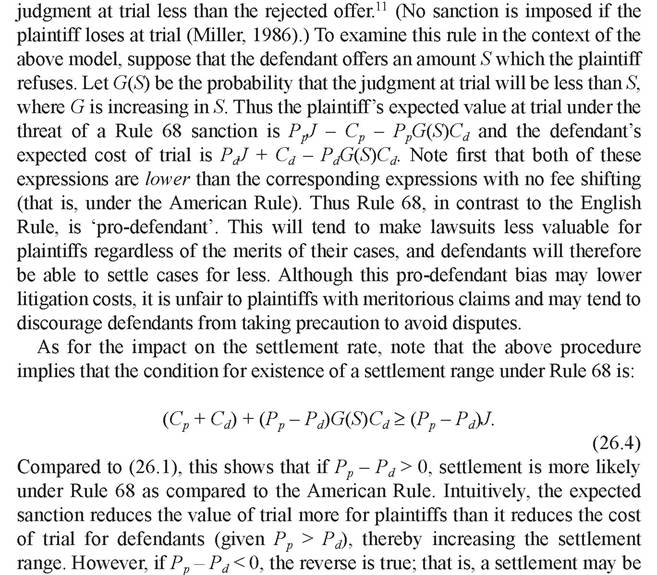 less likely under Rule 68 because the settlement range contracts. Thus the model does not provide a clear prediction about whether Rule 68 promotes settlement of legal disputes.
More on the topic Implications of the model for the cost of litigation:
- Implications of the model for the cost of litigation
- Managing conflict is time-consuming and inevitable.
- Fact Finding
- The prima facie benefits of legal accountability
- 30 Intervention and Amicus Curiae
- Potential Conflict of Interest Situations and the Codes
- Hicks’s Non-welfarist Manifesto: Its Depth and Reach
- Chapter 4 Legal framework for care in obstetrics and gynaecology
- Other Dimensions of Collective Action and Liability
- The System of Checks and Balances and the Promise of an “Armed Truce”