TRANSPOSING COPYRIGHTS TO THE INTERNET
How do the above trade-offs and the potential costs and benefits of the copyright system change in an online environment? At the outset, it can be said that the basic trade-offs and associated questions behind the copyright system remain unchanged.
The basic tenets of the economics of copyright, and hence the motivation for copyright laws and regulations, remain valid in an Internet age. Yet, there are a few important factors brought about by the development of digital technologies that fundamentally change (1) how content is created, (2) how it is accessed, and (3), potentially, how copyrights are administered. The empirical economic evaluation of the associated trade-offs induced by copyright law is affected.First, the increased availability of digital technologies, and the Internet in particular, have arguably and at first sight significantly lowered the costs to create, copy and distribute creative works on a global scale in a quasi-instantaneous fashion (Varian, 2010; Gurry, 2011). Undoubtedly, this paradigm shift has the potential to stimulate access and creativity. By many accounts, a promise of ubiquitous and more universal access to content and creativity should materialize. Lower content creation and distribution costs should eventually also lead to wider distribution of creative works or higher profit margins for creators and associated industries. Arguably, it has never been easier to create and reuse or adapt content. Amateur content creators are certainly now recognized as a new creative force (OECD, 2007). All in all, a wider range of potential authors and creators stands to be incentivized by the copyright system.
These above points need to be put into perspective, however, when looking at professionally produced content (see Wager, 2008).8 Many content sectors have actually experienced increased costs of production in a digital context.
For example, online video and computer games and new digitally shot cinema movies are multiple times more expensive than their offline equivalents. Similarly, creating a professional news report based on field research in a natural disaster zone still entails significant costs. Essentially, it is the distribution costs of content - and thus a relatively minor share of overall costs9 - that have plummeted thanks to digitization and the Internet. Novel digital distribution costs have also arisen, as discussed later in this chapter.At the same time, these developments also facilitate the piracy of creative works, as the cost of copying and disseminating unauthorized copies is reduced to nearly zero. Authors of creative works and associated content industries might benefit less as their revenues from paid copies could effectively be reduced. Costly policing of copyright infringements will ensue, and copyright holders will seek enforcement of their rights via private means and public courts to restore the original trade-off intended by the copyright system. Rampant unauthorized copying and the inability to enforce private copyrights might thus reduce the incentive effect of copyright.
Second, the rise of the Internet as a new distribution channel has introduced a change in how works are made accessible and how revenues are generated and shared. Digital content markets have experienced double-digit growth rates and increasing shares of total revenues. Many offline transactions have moved online. To illustrate, Figure 11.1 depicts the online share and growth of content sectors such as games, music, film and newspapers. The online share of computer games is greatest, whereas the share of revenues generated online by films and newspapers is still relatively
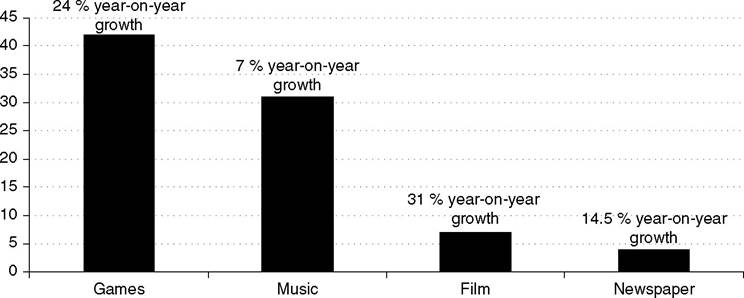
Source: Author, based on data from PricewaterhouseCoopers, updated from OECD (2008, 2010); see also OECD (2012).
Figure 11.1 Revenues generated online as a share of total revenues (%)
modest. The generation of online revenues is growing fastest for films, followed by games. In addition, new forms of content, new content producers and new ways of manipulating and modifying (‘meshing’) digital content are emerging that are not tracked by publicly available data.
Value chains and business models - and associated revenue opportunities and incentives - have changed in the face of uncertain impacts on the supply of and access to creative works. Initially it was expected that content creators could largely ‘disintermediate’ intermediaries, potentially generating more profits from themselves. The instant migration from a restricted offline model to a more liberated online model with access to content ‘everywhere, on every device and at ever time of day’ was not foreseen. In the process, additional incentives for creators and the content industry to cultivate and finance creativity would see the light of day.
Developments since have proven experts of these early days wrong. The development of workable online content business models has been slower than expected. Ten years ago nobody imagined the complexity of putting these online distribution and business models together. Roadblocks have included technological issues, the legitimate fear of online piracy and - amongst others - the difficulty of agreement on adequate revenue sharing and business models.
Direct relations between content creators and consumers, and thus full disintermediation, are still the exception rather than the norm (e.g., musicians offering music for free to obtain revenue from donations and film writers offering short or feature films on video-sharing platforms for sale). Instead, the role of intermediaries and aggregators for digital content seems to be growing. The notions that the costs of content production will drop to zero, that creators can do away with the content industry or that user-created content will supplant professional content are now also largely discarded.
A co-existence of mutually enriching professional and amateur content now seems to be the more likely scenario.The position of creators, rights holders and cultural industries in this new configuration has changed following changes in their expected revenues and the economic function of copyright. Transformed digital content values and distribution chains exist, with new important intermediaries,10 online platforms and, potentially, hardware devices required to access content;11 in fact, reintermediation rather than disintermediation is now taking place. It is currently unclear who is extracting most value from commercial digital content transactions and where the bargaining power lies: does it lie with the creators, the content industry (i.e., the content), infrastructure providers (i.e., the ‘pipes’), online intermediaries and aggregators (e.g., online content store-fronts, search engines, social networks), or device manufacturers that are able to tie content to their particular device? Rights holders still exercise distribution and price control. Yet, while hard to demonstrate with available numbers and economic analysis, this control is diminished by new distribution models and certainly also by the interest in luring consumers to legal content offerings. The power to extract revenues from copyright is thus affected, and new intermediaries and device manufacturers start having significant clout in the content value and distribution chain.
At the same, time we are witnessing the proliferation of new revenue models (Box 11.1), which potentially also impact the expected economic benefit from copyright; the control of creators in how content revenue is generated and shared is challenged. More
BOX 11.1 DIGITAL BROADBAND CONTENT REVENUE MODELS
1. Voluntary donations and contributions.
2.Digital content sales (pay-per-view, pay-per-track, pay-per-game etc.)
3.Subscription-based revenues.
4.Advertising-based revenues.
5.Selling goods and services (including virtual items) to the audience.
6.Selling of user data and customized market research.
7 Licensing content and technology to other providers.
Source: Author, based on OECD (2008).
information about new forms of content revenue distribution models would be helpful. It is increasingly known how Apple’s App Store, for instance, pays the creators of smartphone applications. According to data released by Apple, of the roughly US$19 billion generated by the App Store in 2012, roughly 70 percent was paid to the software developers.12 Similar breakdowns, however, are hard to obtain for other existing or novel digital content services.
Indeed, often the direct link between a consumer’s payment and their access to a given work by an artist is severed, with uncertain outcomes for artists and the content industry’s revenue structure. In many advertising-, donation- or subscription-based models consumers no longer purchase one particular creative work.13 For example, online music subscription services that are available for a few dollars or euros per month deliver unlimited music across a wide range of musicians.
An unbundling of content that has only been sold in bundled form for the last three decades is also taking place. The fact that consumers can now purchase individual newspaper articles rather than a whole newspaper, selected scientific articles rather than a full journal subscription, or individual songs rather than a full album has had an impact on expected copyright-based and other revenues. This is not to say that the revenues of content creators, the content industry or others need be negatively affected. If the overall price of revenues increases, potentially original creators, both amateurs and professionals, stand to benefit. It is again an empirical question whether revenues for creators - and hence, in part, the financial incentive triggered by copyright - have increased or decreased.
On the one hand, incentives for creation might increase as costs are lower. New revenue sources and mechanisms (e.g., micropayment) can be discovered, and niche artists and genres can reach a more receptive audience. On the other hand, the redistribution of bargaining power along the value chain and the rise of different business models might also bring into question the sustainability of creative supply in the future. In other words: is copyright still a guarantee of generating sufficient revenue for artists and the associated content industries in this new context?At the moment, the scarce information available regarding online digital business models does not convincingly demonstrate that copyright holders definitely benefit from new digital content value chains and business models. In OECD (2005), the authors tried to assess the revenue implications for artists from pay-per-track and other new subscription schemes, showing that the profits that go to the creators might be lower, but generally concluding that the data situation is too unsatisfactory to produce a conclusive finding on this point. Press articles have also surfaced with more anecdotal but revealing insights that streaming services do not generate much income for musicians.14
Looking at indirect revenue streams via collective management, a clear-cut assessment of what the online future holds for creators’ revenues is also difficult. The annual reports of the International Confederation of Authors and Composers Societies (CISAC) show that in 2011 only 2.2 percent of revenues generated globally by public performance were collected via digital sources and the underlying rights (CISAC, 2012). At the same time, digital rights are the second most important driver of public performance revenues after television and radio. Despite the migration from offline to online channels CISAC’s global collections have continuously increased throughout the last decade.
Finally, one could have expected that technology will make the administration of copyrights (i.e., the identification of a rights holder, the clearing of rights, the redistribution of revenue, etc.) easier, more efficient and more transparent. This is because it is generally assumed that digital transactions make it much simpler to gather detailed records on content consumption and to pay out a corresponding, and fair, remuneration.
So far, however, the administration of copyrights has not yet been significantly affected by the digital revolution. As Gurry (2011, p. 2) put it, ‘important pressures for the copyright system are trapped in a territorial cage, whereas economic and technological behavior burst out of that cage some time ago’. The costs involved in managing legitimate transactions of copyrighted material are continuing to pose entry barriers, in particular for the international development of new creators or creative works worldwide or for new Internet-based, borderless distribution platforms (Varian, 2010). The scarcity of reliable information on copyright status and licensing conditions remains (Lanteri, 2012, 2013). Finding out whether the direct or indirect (i.e., via collective rights management) remuneration of artists has been made more efficient or precise is a challenge. This holds true despite the improvements in data work by CMOs. The latter necessarily cover their collection revenue only, and hence are biased towards certain sectors and indirect revenue sources. Also, in many countries several CMOs exist and not all of their data are equally accessible, making the compilation of meaningful national or international databases impossible.
Changes to the technical and institutional copyright infrastructure might thus be needed to reinstate the financial function of copyright, which is to allow the generation of revenue in return for authorized consumption (Gurry, 2011).
The enforcement of copyrights, a necessary condition to ensure the incentive effect of copyright law, has also become significantly more challenging in the online context (ibid.). Many years have passed, and still the legal certainty about digital consumption on the Internet has not improved. Knowing what is legal and what is not remains challenging for consumers and courts alike (e.g., unauthorized streaming versus downloading, uploading of unauthorized material versus the downloading). If one introduces the country-specific and case-specific heterogeneity of the matter, things become even more difficult.15 To simplify research of this area, in their studies economists often lump together things that should not be grouped in such a manner, for example, treating all activity or files on peer-to-peer networks as illegal.
Finally, in response to the opportunities offered by the digital environment and responding to some challenges generated by new models such as Creative Commons, open source licenses and open distribution models for publishing that build on copyright have emerged. Research now needs to be undertaken to assess the economics of these new models and their impacts on content access and creation.
11.4