16.0 Ethnological Perspective
Ethno-geographically the region around Chhota Udepur of Gujarat is recognised as Rath Vistar1, the hilly area of the south-eastern part of Gujarat state. Physically, it falls in the centre of the larger Bhil Pradesh encompassing the present-day states of Rajasthan, Gujarat, Madhya Pradesh, and Maharashtra of western and central India inhabited by various subgroups of the Bhil tribe.
Rathwa2, Naik, Tadvi, Dhanak, Dungra Bhil, Bhilala, Vasava, Chaudhari, etc. are offshoots of the main Bhil tribe. The Rathwas of Gujarat, resemble the Bhilalas of Alirajpur (in the state of Madhya Pradesh) and have matrimonial relations in the bordering areas. Thus, they are sometime recognised as Rathwa-Bhilala.The undocumented archaeological sites in the Rath region lying mainly in the forests show evidences of prehistoric men dating back 15,000 to 20,000 years. One such site in the Koraj hills of Vindhyachal range has rich drawings of hunting scenes. During the medieval period small sovereign states of the Khichi Chauhan (Rajput) kingdom ruled in this region (Panchmahals3) as they were forced to survive in the interior forests by the powerful Sultanate, Maratha, and Mughal invaders. Champaner being in its proximity was ruled by the Sultanate in the 15th century AD. Thus, the Rajput rulers established alliances with the Adivasis4 of the region for political reasons. Maratha rule, which was established in Champaner was harsh and noted for killings, displacement, and migrations (Ratnagar 2010:27). From 1817 the British started applying pressure in central India forcing the local rulers to accept their authority. The Adivasis were affected when the forest rights were taken away during the 1870s by the British, and trees were cut to lay railway lines, and build bridges and buildings. There was a great depletion of the forest during the 19th century across central India.
The first half way railway line up to Bodeli from Baroda was laid in 1865 AD. This was further extended to Chhota Udepur in 1910 AD during the period of Fatehsinh Chauhan (1895-1923), the ruler of Chhota Udepur. These elements of development also find their representation in the religious Pithora paintings of the Rathwa (see Figure 16.1)5.The alliance with the Rajput rulers and assimilation of their cultural practices seems to have laid the earliest foundations of Hinduism among the Rathwa, in particular in the
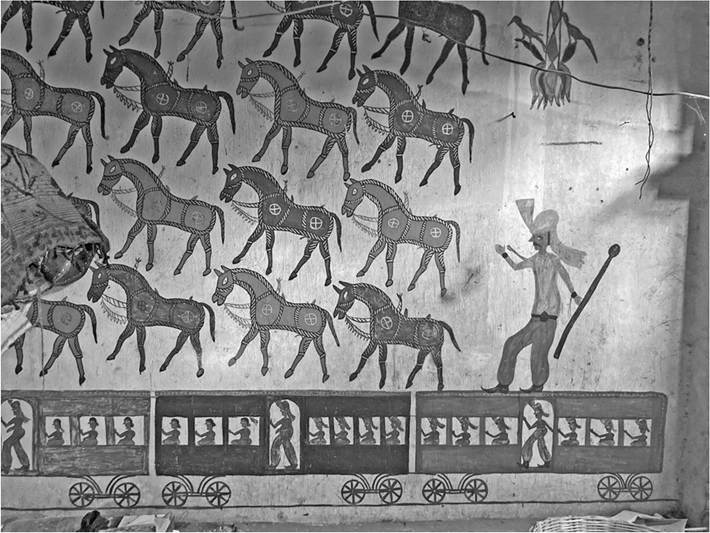
Figure 16.1 Pithora Paintings Showing Train with Passengers and Guard
Source: Author
Chhota Udepur, but also among the other Bhil Adivasis in adjoining regions. Thus, the fascination of the Aryans (Rajputs) for horses slowly became an integral part of the Rathwa’s cultural tradition6. While studying the iconography of the Pithora paintings of the Rathwa we find the prominence of the horse as a symbolic representation of their own deities and ancestors.
Post-Independence and even prior to that, the Hindu Nationalist forces have tried to integrate the social, cultural, religious, and linguistic diversities into mainstream Hinduism. Though it evolved out of the demand for unification and nationalisation of diversities, it has resulted in further complexities of identity and development among the Adivasis, leading to conflict, hierarchy, fragmentation, and diverse aspirations.
Presently, the Rathwa population is spread in all the talukas of Chhota Udepur district, and the Baria, Halol, Godhra, Jambugoda, and Kalol talukas of the adjoining Dahod and Panchmahal districts. Their population as per the census of 2011 stands at around six lakh 42,000 persons in the state of Gujarat; and their literacy rate was estimated at 35 per cent, the lowest as compared to other tribes in the state. Their language is recognised as Rathvi- Bhili7, though presently due to their constant migrations in search of livelihood they are also well conversant in Gujarati and Hindi. The livelihood of the Rathwa is dependent on rain fed crops, having small land holdings on an average between one to two acres. Due to the shrinkage of the land holding in successive generations and strict forest laws combined with the decrease in the number of mahuwa trees8, they are compelled to migrate to cities. There is little sustainable subsistence opportunity in the villages giving rise to distress migration which has harshly exposed them to the outside world. The trauma of leaving the native land and merging with the developed urban societies has exposed them to the complexities of socio-cultural, economic, religious, and political parameters. This switch over has robbed them of their identity and language, and has compelled them to adopt culture and customs of the ‘outside world’9.
16.1