Chronology of Religious Divisions
Religion is one of the major contributions of human civilisation. Around 30,000 to 40,000 years ago, the beginning of religion and painting is usually seen as indicative of spirituality and aesthetics amongst the most advanced species of humans i.e.
Homo sapiens (Mitra 2015:9). Speech as a mode of expression is also said to have developed during the same period. It was during this time that the modern human or Homo sapiens10 discovered new sources of livelihood such as fishing and fowling; and their tools became more sophisticated i.e. microliths. They spread to the Ganga valley from the south and gradually further moved to present day Rajasthan, Madhya Pradesh, and Uttar Pradesh. Among them the practice of burial of dead started which emerged as the first ritual (Mitra 2015:9). Slowly agriculture practices developed for sustenance of life. While observing religious practices among the Adivasis it is clear that their faith is set in local settings and natural elements. It is of an animistic nature as compared to philosophical Hinduism and ‘humane’ Christianity (see Dave 2004:9). Also it is of a participatory and communal nature rather than based on individual faith or creed (Figure 16.2).Throughout history there has been a gradual shift of the Rathwa towards adopting Hindu practices. As stated above this has happened due to their initial association with the Rajput clans (Khichi Chauhans)11 who came into contact with them when Mohd. Begada (1459-1511) took over the kingdom of Champaner. Later during the British rule, in the late 19th century, the missionaries started social work, along with education and health, and simultaneously converted them to Christianity in their effort to civilise them. The missionaries targeted the practices which were seen as ‘primitive’ and inhuman, thus, preparing the ground for socio-cultural and religious conversion (see Figure 16.2, the practice which for missionaries are primitive).
The religious leaders of various sects also termed many of the ‘primitive’ practices as uncultured and uncivilised, forcing Adivasis to convert to the newly established Hindu religious beliefs. During the early 20th century, on the border of present day Gujarat and Rajasthan, Guru Govindgiri12 (1858-1931) initiated a movement to demand an autonomous Bhil Raj (kingdom) (Nilsen 2015). At the root of it were various reformatory measures, such as to give up consumption of meat and liquor. Many Bhils became followers. The main medium of its propagation was dhunis13 and night time bhajan (singing the name of god in chorus) known as jagarans, in honour of Hindu deities. Later, the social reform and nationalist movement initiated by Mahatma Gandhi in the 1920s installed values of vegetarianism and liquor prohibition which were alien to the Adivasi culture. Alice Tilche in her thesis writes, “In north Gujarat Amritlal Thakkar set up the Bhil Seva Mandal in 1923 AD, a welfare organisation modelled on those of Christian missionaries, which also combined social work with the project of reform. This included the introduction of stories from the Ramayana and other (Hindu) religious books” (Tilche 2011:93). Thus, the reformatory movements led to Sanskritisation marginalising Adivasi culture, rituals, and languages.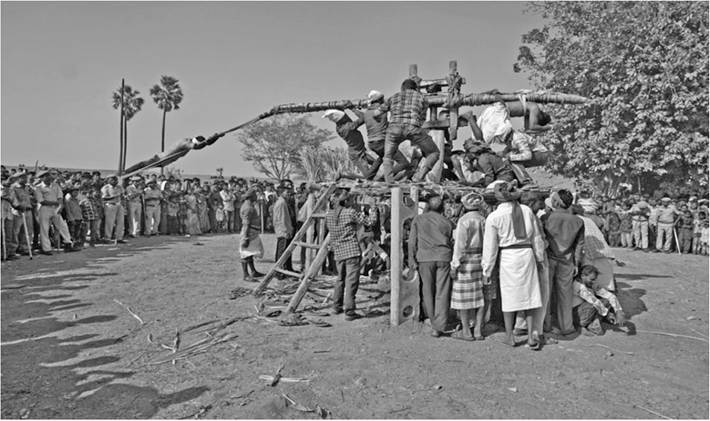
Figure 16.2 Primitive Practice during the Bhanguriya Fair in Which the Badvo is Nailed and Swung over the Pole to Test his Piousness
Source: Author
Pre-independence education policy of the ruling Gaekwad dynasty was instrumental in establishing residential schools called Ashrams in tribal belts of Gujarat. These Ashrams spread the Hindu values among the Adivasi school children. Post-Independence Ashramshalas14 were opened based on the Gandhian school model. Presently, these residential schools are spread across the tribal belt of Gujarat, even in remote locations.
They have a strict curriculum and schedule, in which one has to get up early for prabhat feri (a procession march during early morning), say prayers three times a day, and also recite Sanskrit verses before having breakfast, lunch, and dinner. This prepared the ground for the adoption of Hindu values from an early age. Most of the Ashramshalas are run by non-Adivasi trustees. There are a few which have Adivasis on the Board, but the practice and model remains the same. These schools played a significant role in erasing Adivasi identity. Thus, fertile ground was prepared for Hindu forces to sow their seeds in the form of various sects which are now active in the region.When the first generation of educated tribals came out of the schools they joined hands with the reformatory ‘Bhagat’ movement primarily aimed to promote Hindu values of purity. This was idealised by the Adivasi population as the ‘civilised class’. Thus, a mass of Adivasi in Rath Pradesh converted to bhagats who had to abandon liquor, animal sacrifice, and give up primitive religious practices including the practice of Pithora painting (ritual) which requires offering of liquor and sacrifice of animals. During the same period, the Devi (goddess) movement took place in south Gujarat. Purity of spirit was at the heart of the Devi movement. With these various movements the religion of the Adivasis has been institutionalised under various sects which had previously been nature and spirit oriented. With this institutionalisation, the distinction between the pure and impure (i.e. bhagat and jagat) has been created. Similarly, there is also gender discrimination found in the practice of various sects, particularly in Swaminarain where men and women have to sit and dine separately. This distinction has divided the community at many levels. In tribal society gender division while eating food is not a practice.
Over the past seven to eight decades, and as early as the mid-19th century AD, there has been a religious shift happening across the nation, particularly in tribal pockets.
In Gujarat for example, there was a wave of Christianity followed by the Bhagat reformatory movements and Gandhian nationalist thoughts (pre-Independence) which later prepared ground for evolution of the various Hindu sects, now predominant across the state. The beginning of religious conversion has one common root, i.e. to elevate from ‘primitive to civilised’ stage which was propagated by most of the spiritual and religious leaders. This conversion was coined as ‘bhagat’ in the Adivasi Bhil belts of Rajasthan, Madhya Pradesh, Maharashtra, and Gujarat to differentiate from the ‘jagats’ who lived an archaic life. The bhagats perceived themselves to be a civilised class entitled to jump higher in the social order of society. This has affected the ethos of the community, leading to social fragmentation. Today, many Hindu sects have impregnated the Adivasi societies, constructing various temples, organising community jagarans, festivities, which are presided over by the panth gurus, and so on. It is leading to friction between the various religious and philosophical sects within a tribe.Many Chhota Udepur Adivasis have found a middle path balancing the traditional practices while simultaneously following the teachings of the Bhagat movement. The Bhagat movement prepared the ground for various Hindu oriented sects to follow. First came Pragat Purshottam, followed by Sat Kaival, Swaminarain, Kabeer Panth, Mataji, Rai Muni (Rathwa Guru), and finally the Jains, who have also established themselves.
Migration has been the other key factor for Sanskritisation among the Adivasis in the post-independence industrial era. In Chhota Udepur the land holdings are small, particularly in the case of Nayak, Dhanak, and Tadvi Adivasis; thus, they have to migrate seasonally. When they return to their villages they bring back different values and customs. These are then adopted by the masses. At the same time their lifestyle, food pattern, and language also change. In modern times one may see food stalls of Chinese and Punjabi dishes in various parts of Chhota Udepur, and boys and girls dressed in modern outfits such as jeans and tops.
The traditional kasotas or dhotis (loin cloth) are now considered to be signs of ‘backwardness’.Migration has also contributed to gender, class and intergenerational division within the Adivasi communities (Tilche 2011:99). At the same time the political aspirations among the Adivasis have created factions. Various political parties, the prominent ones being the Congress, Bhartiya Janta Party (BJP), Aam Admi Party (AAP), and Bhartiya Tribal Party (BTP), have contributed in fracturing the unity, which they already had, instead of fostering unity among them in the changing context. During the political processions the Rathwas seem to be restating their identities being clad in traditional costumes with drums, bow and arrows, but within society they are fractured due to the differences of their religious faiths and political affiliation.
The Godhra Hindu-Muslim riots in 2002 in Gujarat affected the Adivasi areas by creating religious polarity and separating Hindus from Muslims and other minorities. This has paved the way for gradual acceptance of Hindu norms by the Adivasis with the propagation of one strong ideology ‘fear to Hindu religion from the Muslims’. Since then the right forces became more active in the Adivasi region to establish Hindu faith and practices.
16.2