Abraham
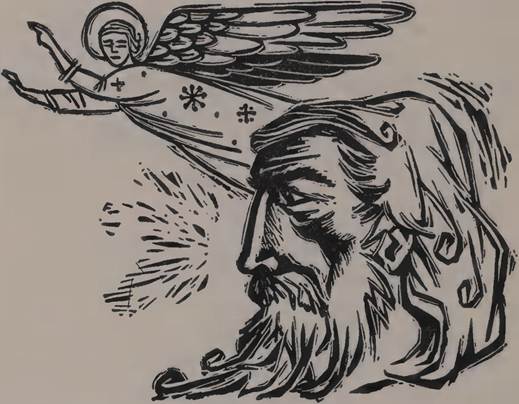
At the end of the eleventh chapter of Genesis, the name of the native city of Abram’s family is given:
11:28.
And Haran died be]ore his father Terah in the land of his nativity, in Ur of the Chaldees.Ur was a Sumerian city located near the mouth of the
ABRAHAM /107 Euphrates River. (Its remains are now well inland, for the Euphrates has built up a hundred miles of delta in the four thousand years since Abram’s time.) Ur was about a thousand years old at the time of Abram and was still in existence as late as the time of Alexander the Great (323 b.c.). However, it was not “of the Chaldees” in Abram’s time.
The Chaldeans were a tribe to the northwest of Babylonia who began to spread down the Euphrates about 1100 b.c., a thousand years after Abram. In 625 b.c. they helped overthrow the Assyrian Empire and their kings ruled in Babylon. They formed the “Chaldean Empire” (often called the New Babylonian Empire). Their greatest king was Nebuchadrezzar, who destroyed Jerusalem and carried the Jews off to their Babylonian exile. The book of Genesis was written down after the exile, and to identify Ur, a city that was strange to the Jews of the time, it was called “Ur of the Chaldees” (that is, Ur in Chaldea) as I might call it “Ur, a city in southeastern Iraq.”
Because of this verse, however, whenever Ur is spoken of in books of history or archaeology, it is almost always referred to as “Ur of the Chaldees.”
But Terah and his family leave Ur.
11:31. And Terah took Abram his son, and Lot the son of Haran his son’s son... and they went forth...to go into the land of Canaan; and they came unto Haran, and dwelt there.
This is the first mention in the Bible of the land of Canaan. It was the area between the Jordan River and the Mediterranean and even in Abram’s time it had already been occupied by a city-dwelling people of a high civilization.
They spoke a Semitic language, but through most of their history they were dominated by the powerful kingdom of Egypt. In Abram’s time, however, Egypt was in a period of weakness and Canaan was left to itself.The straightest route from Ur to Canaan would have been directly westward, but that would have meant crossing the Arabian Desert. It was more practical to go up the Euphrates to the Mediterranean coast and then down the coast to Canaan.
The city of Haran was located at the northernmost point of this route, in what is now southeastern Turkey, and there they remained until Terah died. The similarity in names between the city and Terah’s dead son is not a real one. In Hebrew the city is “Kharan,” while Terah’s son is “Haran.” In the New Testament, in fact, the city is referred to as Charran. The Douay Version distinguishes between the two by referring to Terah’s son as “Aran.”
Haran was an important city throughout ancient
ABRAHAM / 109 times. By the Romans, it was called “Carrhae” and was the scene of two important Roman defeats.
The twelfth chapter of Genesis opens with a statement that God ordered Abram to continue the migration to Canaan which had been interrupted at Haran. Abram, with his wife, Sarai, and his nephew, Lot, at once left Haran and, eventually, arrived in Canaan.
12:6. And Abram passed through the land unto the place of Sichem...
12:7. And the Lord appeared unto Abram, and said, Unto thy seed will 1 give this land...
The Hebrew historians were very careful to state as often as they could the exact places visited by Abram and his immediate descendants. It explained for them the religious importance of some of these sites and, besides, it was an important honor for the people living in those places. (It is like our own habit of saying “George Washington slept here” in connection with old houses in which he stayed during the Revolutionary War.)
Sichem, referred to later in the Bible as Shechem, was an important city in early Hebrew history, and was located just about in the center of Canaan.
It declined after the time of King Solomon, but theRomans rebuilt it and called it Neapolis. From that comes the present Arab name for it, Nablus.
God’s promise to Abram that Canaan would belong to his descendants is first mentioned in the seventh verse of this chapter, but it is repeated later. This promise was considered vitally important by the Jews later, as justifying their conquest of Canaan. Canaan became the “Land of Promise” or the “Promised Land,” a phrase which is still used.
In fact, because the descendants of Abram did not receive their Promised Land until centuries of hardship had passed, the phrase has been used to mean any vague Utopia that is hoped for in the far future after long, hard times.
Abram continued traveling southward through Canaan. Then, during a period of famine, caused, no doubt, by the periodic drought that affects that semidesert land, he left for Egypt, where food was to be had. The annual flooding of the Nile meant a constant food supply for the Egyptians and Egypt was a natural refuge in times of famine.
In Egypt, the beauty of Abram’s wife, Sarai, was noticed:
12:15. The princes also of Pharaoh saw her, and commended her before Pharaoh...
This is the first mention of the ruler of Egypt in the Bible. “Pharaoh” is not, of course, the ruler’s real
ABRAHAM / 111 name but is merely a title used by all Egyptian rulers in Biblical times, just as all American chiefs of state can be referred to as “President.” There is no way of telling which Pharaoh is meant here or in later places in the early books of the Bible, though many have made guesses. I won’t try.
The Egyptian word from which “Pharaoh” is derived is “pr’o” which means “great house,” in reference to the ruler’s palace. This is not surprising. It is quite common to refer to a ruler or to some government official by the building he lives or works in. The building, after all, is much more likely to be familiar to the average man than the ruler or official himself.
Nowadays, for instance, instead of referring to the Secretary of Defense or the Joint Chiefs of Staff directly, we will simply say “the Pentagon.” We will refer to something said by the President of the United States as having come from the ‘White House,” while a decision made by the rulers of the Soviet Union is a ruling of the “Kremlin.”
A queer intrusion of the word “Pharaoh” into modern language is in a card game known as “faro,” which is supposed to be so called because one of the picture cards represented the Egyptian Pharaoh.
After some personal danger in Egypt because of
his wife’s beauty, Abram (with Sarai) returned to Canaan. With the famine over, Abram grew well- to-do and it became a problem to find pasture for both his own herds and those of his nephew, Lot. Abram suggested they separate and offered Lot first choice:
13:10. And Lot lifted up bis eyes, and beheld all the plain of Jordan, that it was well watered everywhere...
13:11. Then Lot chose him all the plain of Jordan...
This is the first mention of the Jordan River in the Bible. As a river it is not much, for it is only about 200 miles long and is not navigable. It is the most important river in Canaan, however, and because of its associations with the Bible, it has become one of the most famous rivers in the world. It is the boundary of Canaan and to reach the “Promised Land” one must cross over the Jordan, if one approaches from the east, as the Hebrews themselves did in their invasion centuries after Abram.
For this reason, to ‘"cross over Jordan” means to complete a long and difficult journey, with success at the end. In fact, it usually means “to die,” because the hard journey of life ends, with, it is hoped, the bliss of Heaven following. For that reason, Jordan is
ABRAHAM / 113 frequently mentioned in the Negro spirituals, which grew out of the sufferings of an enslaved people to whom death and Heaven must have looked particularly attractive.
Since the plains of the Jordan were well watered, important cities and centers of Canaanite civilization were to be found there.
The Hebrews, who did not approve of the religious rites, considered those cities wicked and one of them, Sodom, was singled out for comment:13:13. But the men of Sodom 'were 'wicked and sinners before the Lord exceedingly.
A superstitious person might think it looked pretty bad for Sodom to be mentioned in this way in the thirteenth verse of the thirteenth chapter of Genesis and, to be sure, Sodom suffered a great disaster shortly thereafter. Meanwhile, because of this verse, and of others later, Sodom has come to be used as the name for any wicked place. Almost every large city in the world today has been called a “modern Sodom” at one time or another.
As for Abram, he remained in the less-developed areas, and received God’s promise, once again, that the land of Canaan would belong to his descendants.
The cities of the Jordan valley, shortly after this, 114 / WORDS IN GENESIS were engaged in a war with an invading army from Sumeria:
14:1. And it came to pass in the days of Amraphel king of Shinar, Arioch king of Ellasar, Chedorlaomer king of Elam, and Tidal king of nations;
14:2. That these made war...
Shinar, of course, referred to Sumeria; Ellasar probably means Larsa, a city near Ur; while Elam is a region east of the Tigris. By “king of nations” the Bible may mean a group of confederates from several cities.
The kings mentioned have not been identified in ancient Babylonian records, but as usual in such cases, there have been guesses. The most dramatic one is that Amraphel is identical with Hammurabi. He was the first great king of the Babylonians after the decline of the Sumerians, and he ruled about 1950 b.c. at the earliest. A very famous legal code, engraved in stone, has been recovered from his time and is called the “Code of Hammurabi.” However, he reigned several centuries after the time traditionally set for Abram and so it seems very unlikely that he is Amraphel.
A battle took place.
ABRAHAM / 115
14:3. All these were joined together in the vale of Siddim, which is the salt sea.
The “salt sea” is the lake into which the Jordan River flows. It has no outlet to the sea, so through evaporation of water, it has become very salty. It is, in fact, the saltiest body of water in the world, containing up to 25 per cent dissolved material as compared with 3 x/z per cent for the ocean. Because it is the largest lake in the area, it is sometimes referred to in the Bible as simply “the sea.” (The use of “Siddim” as its name occurs only in this chapter.)
The Greeks called it the “Dead Sea” because it is so salty no living things are found in it, and that is the name by which we know it. It is only a small lake, 46 miles long and not quite 10 miles wide, only a sixth as large as our own, almost as salty, Great Salt Lake. However, the Dead Sea occupies a great rift in the earth’s crust that extends all the way down into east central Africa. Its surface is 1286 feet below sea level (the lowest surface on our planet) and even so it is up to 1300 feet deep in spots. The Great Salt Lake is only 60 feet deep at most so that there is more water in the Dead Sea even though the Great Salt Lake covers the larger area.
The cities of the Jordan valley were defeated, and the Babylonian army took off all the loot they could carry. They also took with them prisoners whom they intended to use as slaves. Among the prisoners was Lot, whose choice of Sodom as a dwelling place had thus proven unfortunate.
Abram discovered the fate of his nephew at once: 14:13. And there came one that had escaped, and told Abram the Hebrew...
This is the first use of the word “Hebrew” in the Bible, and hereafter it is used to refer to Abram’s descendants. In later times, the Hebrews came to be called Jews for reasons I will explain later, but the word is used to the present time for the ancient language used by the Hebrews in Biblical times.
Abram led a band of men in pursuit and rescued
Lot. On his return he passed the city of Salem:
14:18. And Melchizedek king of Salem brought forth bread and wine: and he was the priest of the most high God.
Salem is the Hebrew word (Shalem) for “peace” and is still used as a greeting among Jews and among Arabs. The Arabic gesture of greeting, a low bow with a hand placed to the forehead, is called a “salaam,” from the same word spelled according to the Arabic pronunciation.
Because of the meaning of the word, and because of
ABRAHAM / 117 this verse in Genesis, Salem is a popular name for towns in the United States. Salem is the name of the capital city of Oregon, for instance. The oldest Salem in America, however, is the town in northeastern Massachusetts (population 41,000) which is chiefly famous for the witch trials that took place there in colonial times.
The Biblical Salem has been identified by most people with Jerusalem, the eventual capital city of the Hebrew Kingdom.
As for Melchizedek, nothing is known of him outside this verse and the next two. However, in later religious thought, he was considered quite important, for he was both a king and a priest; and what’s more, he was a priest of God even before the Hebrews had become a nation.
This is the first mention of a priest in the Bible. A priest is someone who officiates at sacrifices and at other rituals involving man’s relationship with God. It has always been important to men of all religions that religious rituals be followed exactly according to tradition, so that a priest is valued as a kind of caretaker of tradition.
The word “priest” comes from the Greek presby- teros, meaning “an old man.” Naturally, old men would be better acquainted with tradition, and they would make the best priests. It is for this reason, also, that “elders” is a common term for the leading officials in various religious bodies, and “aidermen” are the officials of certain town governments. In fact, old people were generally considered most trustworthy in governing the ordinary affairs of a government as well, and from the Latin word senex, meaning an “old man,” we get the word “senator. So you see, there is a connection between senators and priests, though perhaps this is not always easy to see.
In its longer form, as “presbyter,” the word remains with us, too. There are Protestant denominations in which authority is not held by bishops (as in the case of the Catholic Church and in such Protestant sects as the Episcopalians and Methodists) but by a group of elders all of equal rank. These are the Presbyterian churches.
Naturally, since one of the priest’s chief duties is to deal with the sacred things dedicated to God, he must himself be made sacred. Indeed, a Latin word for priest is sacerdos (“to give sacredness,” because sacredness is given to him when he becomes a priest). Therefore, anything pertaining to priests is “sacerdotal.”
The clothing and utensils used in ritual are, in modern times, usually stored in a room in the place of worship, which is therefore called the “sacristy.” The official in charge, a sort of general caretaker, is
ABRAHAM / 119 the “sacristan,” a word which is more often heard in the simpler form of “sexton.”
The Hebrew word for priest is kohen, and this accounts for the popularity of Cohen as a surname among modern Jews.
The “most high God” mentioned in this verse, by the way, is El Ely on in Hebrew. It may possibly have been one of the many different varieties of El or “god” worshiped by the individual Canaanite cities. However, it is accepted by both Jews and Christians to refer to God Himself and, as a result of this verse, “the Most High” has come to be a synonym for God.
Now Melchizedek blesses Abram, and Abram makes a suitable return:
14:20.... And he gave him tithes of all.
The word “tithe” is another form of the word “tenth,” so the verse means that Abram gave one tenth of the spoils he had won from the Babylonian invaders to Melchizedek. One tenth was the standard “income tax” in ancient times, but in the Middle Ages, starting with Charlemagne, this verse was taken to show that God had ordained a 10 per cent tax specifically for the support of the Church. “Tithe” has come to mean any assessed contribution to the support of a religious body.
The most personal part o£ Abram’s story is his concern about the fact that he had no children. He was growing old and he was childless, yet Canaan had been promised to his descendants. How could that be? God, however, assured him he would indeed have children and Abram accepted that. Or, as the Bible puts it:
15:6. And he believed in the Lord; and he counted it to him for righteousness.
The word “believe” can also be replaced by “trust” or by “have faith.” “Believe” is the customary word in the Old Testament and “have faith” in the New. “Faith,” from a Latin word, fides, meaning “trust,” means “belief” generally, but in a religious sense means, particularly, “belief in God.” This refers not only to the fact that He exists, but to the goodness of all He does and intends to do.
The importance of faith, which is here “counted... for righteousness” to religion, is shown by the fact that it has come to mean “religion” as in the question, “What is your faith?” Someone who is not of your faith is then an “infidel,” which in Latin is “not faithful.”
Nevertheless, at Sarai’s insistence, Abram takes Hagar, Sarai’s maid, as a second wife. (Polygamy
ABRAHAM / 121 was customary in those days.) However, when Hagar soon finds herself expecting a child, Sarai grows jealous and drives her away. Hagar, however, is not left abandoned.
16:7. And the angel of the Lord found her by a fountain of 'water in the 'wilderness...
This is the first time in the Bible that an angel is mentioned. The word is a translation of the Hebrew mal'akh, meaning “messenger,” and comes from a Greek term meaning “messenger.”
In the early books of the Bible, the “angel of God” seems to be taken for God Himself. For instance, a few verses later on, Hagar speaks as though it is God she has seen. Perhaps His invisible presence is the “Spirit of God” and His visible presence in manlike form is the “Angel of God.” However, it soon became a part of the belief of the Hebrews that God could not be seen directly. If a man saw His glory, he would die. Therefore an angel came to be considered a messenger of lesser glory, sort of halfway between God and man, and a being who could be seen with safety.
In later times, the Jews worked out more and more elaborate theories about the angels. They were supposed to have been created out of fire before Adam came on the scene. Some of the angels under Satan led a rebellion and were cast out of heaven. They are the “fallen angels.”
God began to be pictured as a ruler surrounded by hosts of angels of all degrees. The chief angels were the “archangels,” the prefix “arch-” coming from a Greek word meaning “chief.” There were also cherubim and seraphim, both of which are heavenly creatures of some sort mentioned in the Bible. Most of this was carried on into Christianity. In Milton’s Paradise Lost, in fact, these groups and others, too, all appear in as complicated a pattern as the ranks of nobles at court or officers in an army.
In some of the apocalyptic books (particularly the apocryphal ones) angels are important characters. The book of Daniel speaks of various nations as having special angels (“princes” they are there called) in charge, guarding them. They are the “guardian angels.” The guardian angel of Israel is given the name Michael.
People even came to think each individual person had a “guardian angel” of his own and perhaps even an “evil spirit” as well. This is a development of Greek and Roman notions of this sort. The guardian angel makes its appearance in folk tales as the “fairy godmother” — the most famous of these being in the story “Cinderella.”
Another important archangel is Raphael, a leading character in the apocryphal book of Tobit (which appears as canonical, however, in the Douay Bible, under the name Tobias). Still another, Gabriel, appears in the book of Daniel and in some of the New Testament stories concerning the birth of Jesus. However, Gabriel is best known to us as the archangel whose duty it is to blow the horn that will announce the Day of Judgment (“the last trump”).
All these names are masculine and, in fact, angels are always referred to in the Bible as masculine. For instance, the verse after the one in which the angel of the Lord finds Hagar begins:
16:8. And he said...
the “he” referring to the angel.
Nevertheless, when angels became an important element in religious art, they were painted as such beautiful beings that people began to think of them as female. At any rate, a good and beautiful girl is very likely to be called “an angel” by people who admire her, and the term is not as likely to be used for a man.
One exception to this rule is the slang term “angel” for a backer of a Broadway play. Perhaps this is because to the writers, actors, and producers looking for financial support, a backer seems as welcome as an angel from heaven.
But, to get back to Genesis, the angel orders Hagar to return to Abram predicting that she will bear a son:
16:11.... thou... shalt bear a son, and shalt call his name Ishmael...
16:12. And he will be a wild man', his hand will be against every man, and every man’s hand against him...
This describes Ishmael (and his descendants) as being warlike men without settled homes — nomads, in other words, at war with each other and with any settled farming communities in the neighborhood. For this reason, a rover or bandit or even just someone who doesn’t seem to fit into the society in which he lives may sometimes be called “an Ishmael.”
In the famous novel Moby Dick, the person who tells the story is himself a wanderer and he begins abruptly with: “Call me Ishmael.”
After this, with a child on the way for Abram, God repeats a covenant He had already made with him. He promises once again that Abram’s descendants by his first wife, Sarai, will inherit Canaan, and this time the covenant is more formal and impressive than ever before:
17:1. And when Abram was ninety years old and nine, the Lord appeared to Abram, and said unto him, I am the Almighty God; walk before me, and be thou perfect.
17:2. And I will make my covenant between me and thee...
The term “Almighty God” is a translation of the Hebrew El Shaddai. Again, as in the case of El Ely on, this may be one of the numerous El's of Canaan. However, again, Jews and Christians alike agree in accepting it as being God Himself. As a result of this verse and a few others like it, “the Almighty” has also come to be a synonym for God.
As a sign of the importance of this covenant, God changes Abram’s name:
17:5. Neither shall thy name any more be called Abram, but thy name shall be Abraham; for a father of many nations have 1 made thee.
Names were important in early ages and a new relationship with God required a new name. The Revised Standard Version, in a footnote, explains that “Abram” means “exalted father,” while ‘ Abraham” means “father of a multitude.”
In any case, it is as Abraham that the son of Terah is known forever after. He is usually referred to as Abraham even when events prior to this covenant are discussed. For instance, I have named this chapter “Abraham” even though it is only now, almost at the chapter’s end, that he received the name.
Both names occur in modern times. We all know that our sixteenth president was Abraham Lincoln. Perhaps not so many know that Abram was also represented in the White House, for the twentieth president was James Abram Garfield. Both presidents, by a strange coincidence, were assassinated.
As Abraham’s part of the covenant, something was required of him and his descendants:
17:10. This is my covenant, which ye shall keep, between me and you and thy seed after thee; Every man child among you shall be circumcised.
The Hebrew word for covenant is b'rith and that is the name still given to the rite of circumcision performed on Jewish male infants. A well-known Jewish social and philanthropic organization founded in New York in 1843 is called “B’nai B’rith” meaning, in Hebrew, “sons of the covenant.”
Sarai, too, was part of the covenant, as she was to be the mother of the descendants of Abraham to whom the promise was made. Her name was consequently changed to Sarah, and that, too, is the name
ABRAHAM / 127 she has been known by ever since. (Both names mean “princess.”)
Before the birth of Sarah’s child is described, there is a pause in the narrative to tell the manner in which God destroyed the wicked cities of Sodom and Gomorrah, on the shores of the Dead Sea. God announced His plan to Abraham and, as described in the eighteenth chapter of Genesis, Abraham pleaded with Him not to destroy the cities if they happened to contain some virtuous men. (In this chapter, God’s testing reveals Abraham at his noblest, and he even dares to lecture God):
18:25. That be jar from thee to... slay the righteous with the wicked... Shall not the Judge of all the earth do right?
This is the first specific mention of God as the Judge who decides on the merits of men and determines what their fate shall be. Later on, the notion of a Judgment Day was developed in much greater detail.
God agreed not to destroy any city if as few as ten good men could be found in it. However, the angels sent by God to examine the situation in Sodom found (as described in the nineteenth chapter) only one good man in it, Abraham’s nephew, Lot. He 128 / WORDS IN GENESIS offered them hospitality, while all the other inhabitants wished to harm them.
Lot was ordered by the angels to flee the city, and he did so, taking his two daughters and his wife. Once they were out of the city, God rained fire and brimstone (that is, burning sulfur) upon them and destroyed them. Lot and his family had been ordered not to look back upon Sodom as they were leaving, but Lot’s wife could not resist:
19:26. But his wife looked back from behind him, and she became a pillar of salt.
The story of Lot’s wife, even though it is contained in this one verse, and even though she isn’t so much as given a name, has always been a dramatic one. It has been used to point the moral that one must not look back longingly upon evil after one has given it up.
There are heaps of salt on the shores of the Dead Sea (which the Arabs call Bahr Lut — that is, “The Sea of Lot,” because of this story) and occasionally this heap or that is identified as Lot’s wife.
In fact, through the Middle Ages, most Europeans, as a result of this story (at a time when few of them had a chance to see the region itself) imagined that the Dead Sea must still be a region of volcanoes, with
ABRAHAM / 129 smoke and fire issuing from the ground, with ashes all about, with the sea itself black and smelling of burning sulfur. Actually, the Dead Sea is blue and peaceful and is an important asset to the modern nation of Israel, for from its salt-laden shores all kinds of important minerals can be obtained.
No trace of the old cities has been discovered by modern archaeologists, and they may be beneath the waters of the Dead Sea, which is quite shallow at the southern end.
One of the myths about the Dead Sea was that there were trees on its shore that grew beautiful apples, but inside the lovely skins were nothing but ashes. These were called “Apples of Sodom” or “Dead Sea Fruit.” Although such fruit does not exist, the term can be used for anything that seems very desirable but turns out to be worthless in the end.
Abraham had a final adventure of his own prior to the birth of Sarah’s son. He and Sarah traveled to Gerar, a city near the southern edge of Canaan’s seacoast. There, Sarah was temporarily placed in the king’s harem. The king of Gerar was, however, warned by God, who said:
20:7. Now therefore restore the man his wife; for he is a prophet...
Sarah was consequently returned and Abraham went his way.
This is the first use of the word “prophet” in the Bible. It comes from Greek words meaning “to speak for” and so a prophet is, actually, an interpreter. The Greeks applied the word to those people who explained the various oracles in which they believed, since in this fashion the wills of their various gods were interpreted. In the Bible, the word is used for an interpreter of the will of God. However, it is recognized that “false prophets” can exist also.
God’s will might be made clear by a prophet through a description of His past acts, or an explanation of His present acts, or a warning of His future acts. Naturally, the most dramatic possibility was the last and it was the predictions (usually of doom but sometimes of gladness) that attracted most attention.
For that reason, a “prophet” in ordinary speech has come to mean anyone who can foretell (or who claims he can foretell) the future, whether such foretelling has any religious significance or not.