The Flood
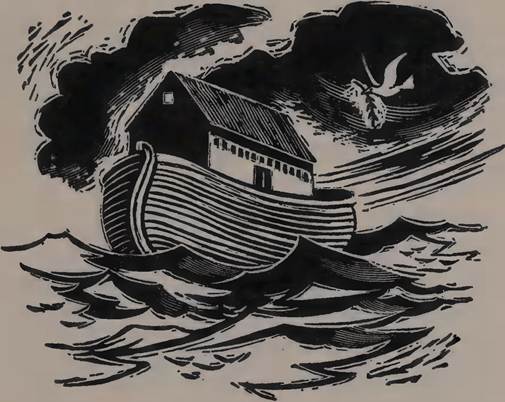
The beginning of the sixth chapter of Genesis describes the growth of wickedness among men.
God decides to destroy mankind and start all over with the one family (that of Noah) who are virtuous. Noah is therefore warned of the coming destruction and is instructed how to go about surviving:6:13. And God said unto Noah, The end of all flesh is come before me; for the earth is filled with violence through them; and, behold, 1 will destroy them with the earth.
6:14. Make thee an ark of gopher wood...
There are three unusual words in this passage. “Flesh” here means life in general. The word “ark” is not the word we would ordinarily think of for what Noah was told to build. We would call it a “ship.” The word “ark” comes from a Latin term meaning “to enclose.” Noah’s ship, you see, wasn’t just something to float on water with. God instructed Noah to build it with a roof so that it had a protection against the rain from above as well. Noah and his family were completely enclosed and the ship was, for that reason, called an ark.
As for “gopher wood,” nobody knows what kind of wood that can be. The Hebrew word for it is used nowhere else in the Bible. The Douay Version translates the phrase, “Make thee an ark of timber planks...”
God’s instructions give the ark’s measurements in “cubits.” This translation of the Hebrew word used in this chapter is derived from the Latin word for “elbow” and is taken to be the distance from the elbow to the fingertips, or about 18 inches. The
THE FLOOD /83 Hebrew measure which is translated as cubit is supposed to be equal to about 17.6 inches so that the floor area of the ark as described in this chapter comes to about 100,000 square feet. (The ark is 300 cubits long, 50 cubits wide, 30 cubits high and built with three stories.)
With the instructions complete, God for the first time describes the manner in which mankind will be destroyed:
6:17.
And behold, I, even 1, do bring a flood of waters upon the earth, to destroy all flesh...The word “flood” is from the same Teutonic source as the words “flow” and “float” and can refer to any flowing water, such as a river or stream, even when the flow is gentle and harmless. It can even refer to the rising tide so that we speak of “flood tide” when the tide comes in. We can say that “affairs are at the flood,” meaning that things are moving in the desired direction, because a rising tide means that ships will be able to float and move out of the harbor.
Because of this chapter of the Bible, however, the word “flood” has become most familiar to us as a disastrous incoming of water in which men die. An example is the sudden water flow that resulted when a dam near the city of Johnstown, Pennsylvania, burst after heavy rains in the year 1889. Over 2200 people were drowned in what has been known ever since as the “Johnstown flood.”
To distinguish the Noachian flood from ordinary floods, the word is capitalized. The word “Flood ’ can only mean the one described in the Bible. An alternate word, which does not occur in the Bible, however, is “the Deluge,” from a Latin word meaning “to wash away.”
It was necessary to save some of the various creatures of the land and air, for man could not Eve on the earth alone. The ark was to be a refuge for all species (so that in these days any place of refuge is sometimes called an ark):
6:19. And of every living thing of all flesh, two of every sort shalt thou bring into the ark, to keep them alive with thee; they shall be male and female.
The picture of all the animals slowly entering the ark, two by two, lions and sheep, bears and mice, has always been a most dramatic one. For that reason, perhaps, a little “Noah’s ark” with animals in it has always been a favorite toy of youngsters. In such toys, two of the prominent animals are the giraffes for whom special holes have to be made at the top to allow the long necks to stick through.
That isTHE FLOOD / 85 quite a modern innovation, though, for Europeans did not discover the giraffe till about 1800.
God’s instructions concerning the animals in the ark are repeated at the beginning of the seventh chapter, with a slight change:
7:2. Of every clean beast thou shalt take to thee by sevens, the male and his female: and of beasts that are not clean by two, the male and his female.
Here and elsewhere in the Bible, the words “clean” and “not clean” (or “unclean”) do not mean what we commonly think of them as meaning nowadays. The words have a spiritual meaning here. Something is “unclean” which cannot, for some reason, be made holy. Certain animals, for instance, must not be sacrificed because they are considered “unclean.” The list of such unclean animals comes later in the Bible, and the most familiar of those listed is the pig. Clean animals, which can be sacrificed, include cattle, sheep, and goats.
Naturally, something which cannot be made holy is looked upon with distaste; and, on the other hand, anything which is unpleasant ought not to be offered to God and is therefore unclean. Dead bodies are unclean and animal wastes and so on. A man must keep himself clean as much as he can so that he can always 86 / WORDS IN GENESIS approach places of worship and present himself before God. Therefore, he mustn’t use unclean animals for food or come into contact with anything unclean. If he does, he must go through certain purification rituals.
All this gives rise to the notion that being dirty in any way is to be unclean; and to be free of dirt is to be clean. Nowadays, we use the words almost always without religious significance. If we are not dirty, then we are clean. If a pig is scrubbed down for appearance in an animal show, even a Jew, if he is English-speaking, will say that the pig is clean, although from a ritualistic standpoint it is unclean. (Jews and Mohammedans still consider the pig unfit to eat because it is unclean in the ritualistic sense, but Christians have abandoned that notion.)
Into the Ark, then, went Noah and his wife; Noah’s three sons, Shem, Ham, and Japheth, and their wives; and all the animals.
The rains came, the waters rose, and the Flood killed all land life outside the ark. After that happened, the waters slowly abated and the ark came to ground again:8:4. And the ark rested in the seventh month... upon the mountains of Ararat.
Notice that the verse says “mountains of Ararat.”
THE FLOOD / 87 Ararat is not the name of a particular mountain but of a land. In fact, in the book of Jeremiah (51:27), Ararat is spoken of as a “kingdom.” Apparently, it is the ancient land of Urartu, located in what is now the eastern edge of Turkey, and which flourished from 1250 b.c. to 750 b.c. The Douay Version says “the mountains of Armenia,” that being a later name for the same region.
Nevertheless, tradition has identified Mount Ararat as a particular mountain in Turkey just at the place where the boundaries of Turkey, Iran, and the Soviet Union meet. It was first climbed by man in 1829 and in very recent years it was climbed again. There was supposed to be some hope that the remnants of the Ark might still be there, but nothing was found.
Even after coming to rest, there was no question of leaving, for only the mountaintops were exposed. Noah waited, then sent out scouts to view the terrain, using the animal kingdom for the purpose.
8:7. And he sent forth a raven, which 'went forth to and fro, until the waters were dried up from off the earth.
8:8. Also he sent forth a dove from him, to see if the waters were abated from off the face of the ground.
When the dove finally returned with an olive leaf,
this meant the ground was reasonably bare and Noah and his family could leave.
The story of Noah and the Ark was so dramatic that there was actually some attempt in the Middle Ages to set the characters among the constellations. The names of some of the constellations are very old and the Greeks had worked them into their own myths (see Words from the Myths}. The constellations were thus a continual reminder of the heathen gods and this was offensive in Christian times.
(“Heathen,” by the way, comes from heath, of Teutonic origin, meaning “open country.” The people inhabiting the land away from the cities kept to their old traditions longest and were the last to accept Christianity. Similarly, “pagan” comes from the Latin pagus, meaning “village.” Again the smalltown people were late in accepting the new religion coming to them from the big cities.)
The attempt to substitute Bible stories for the Greek myths in the sky did not succeed. Noah and his Ark, however, came closest.
The constellation of Argo, for instance, which is supposed to represent the large ship that carried Jason and his men to the land of Colchis in search of the Golden Fleece, was renamed “Noah’s Ark.” (Perhaps the coincidental similarity in sound between “Argo” and “Ark” helped.) The small con-
THE FLOOD /89 stellations of Corvus (the Crow) and Columba (the Dove) were very naturally called “Noah’s Raven” and “Noah’s Dove.” Even these names, however, did not really stick.
Once Noah, his family, and the other living creatures in the Ark emerged onto dry land once more, Noah’s first act was to sacrifice to God.
8:20. And Noah builded an altar unto the Lord; and took of every clean beast, and of every clean fowl, and offered burnt offerings on the altar.
The Douay Version uses the word “holocaust” in this verse in place of “burnt offerings.” Ordinarily in sacrificing an animal, only certain parts were burnt, the remainder being for the use of those officiating on the occasion. Sometimes, however, all the animal might be burnt and then it is a holocaust, from Greek words meaning “wholly burnt.”
After that, God made a covenant (that is, an agreement) with Noah:
9:9. And I, behold, I establish my covenant with you, and with your seed after you.
In this covenant God agrees never to destroy life by means of a flood again and sets the rainbow in the sky as a witness. The word “seed” in this verse is an old-fashioned term for “descendants” and, in fact, the Revised Standard Version makes the verse read “with you and your descendants after you.”
There are other covenants between God and man later in the Old Testament but those covenants are with the Hebrews in particular.
This one is with all men, for since Noah and his family are the only ones left alive after the Flood, all men who were to live thereafter would be of Noah’s “seed.”One more item in Noah’s life history is then told. He was the first to cultivate the vine and, unaware of the effects of wine, he became its first victim:
9:20. And Noah began to be an husbandman, and he planted a vineyard:
9:21. And he drank of the wine, and was drunken...
A “husband” is the head of a household, and it comes from an old Teutonic phrase meaning “dweller in a house.” In the old days, when farming was by far the most important occupation, a “husband” or “husbandman” was automatically a farmer and that’s what it means in verse 9:20. The Revised Standard Version says, “Noah was the first tiller of the soil.” To be “tiller of the soil” means to do the work necessary to raise crops. In fact, “till” in this sense and “toil” come from the same ancient Teutonic expression.
Because of Noah’s drunkenness, the popular plays
THE FLOOD /91 written about Noah’s Flood during the Middle Ages always showed Noah to be fond of liquor. The modern play and movie Green Pastures shows the same thing. In fact, when various parts of the Noah story were placed among the constellations, the constellation Crater (the Cup) was named ‘‘Noah’s winecup.”
During the time when Noah lay in his tent in a drunken sleep, Noah’s son Ham was disrespectful, and Noah, upon recovering, was angry over this. For some reason that the Bible does not make clear, he cursed Ham’s son Canaan for it:
9:25. And he said, Cursed be Canaan; a servant of servants shall he be unto his brethren.
This is worse than it sounds to us, since we are used to servants who can give notice when they wish and who lead comfortable lives. The Revised Standard Version has it read “a slave of slaves,” which is closer to what is really meant.
Now Canaan was considered the ancestor of the people who lived in the land later occupied by the Hebrews. When the Hebrews first arrived, the land itself was known to them as “Canaan” and the native inhabitants were “Canaanites.
It frequently happens in ancient genealogies, you see, that the person who is described as the ancestor of the inhabitants of a certain region has himself the name of that region. Such a man is an “eponymous” ancestor, from Greek words meaning “name upon.” He had placed his name upon the land, so to speak.
In later years, the Hebrews fought the Canaanites and occupied their land, reducing them to slavery, and this verse was used to explain why that happened. In modern times, the verse was used in another way, which I will come to shortly.
Noah meant a new start for mankind. Once again, as in the time of Adam, there was only one ancestor. Because of this and because Noah, like Adam and Enoch, was described as having a personal connection with God, he, too, was felt to have been in the possession of secret information from God. A book called the “Apocalypse of Noah” was at one time circulated among the Jews, but it is now lost. Parts of it are probably to be found in the apocryphal book of Enoch.
The repeopling of the earth, from this one ancestor, proceeded rapidly. The tenth chapter of Genesis describes how different nations arose from Noah’s three sons, Shem, Ham, and Japheth. This is done by means of a rapid genealogy and a listing of chil-
THE FLOOD /93 dren. For instance:
10:2. The sons of Japheth; Gomer, and Magog, and Madai, and Javan, and Tubal, and Meshech, and Tiras.
These are thought to represent the eponymous ancestors of various nations. We can’t be absolutely sure in every case what nations are meant, but scholars have made guesses. For instance, Gomer is supposed to represent the people north of the Black Sea, who were called “Kimmerians” by the Greeks. Madai represents the Medes, who lived in what is now northwestern Iran. Javan represents the lonians, the Greeks who lived in western Asia Minor. Certain smaller groups have been guessed at for T ubal, Meshech, and Tiras, but Magog remains a complete mystery.
After running through the descendants of Japheth, the fifth verse of the chapter goes on to say:
10:5. By these were the isles of the Gentiles divided in their lands...
The word “Gentiles” is the translation of the Hebrew goyim, which means “nations,” or “peoples.” In fact, the Revised Standard Version uses the phrase “coastland peoples” in place of “isles of the Gentiles.” “Gentile” comes from the Latin gens, meaning “clan”; that is, any group of individuals descended from a common ancestor. This is not such a bad translation, since clans and nations were much the same thing in early times.
Of course, the Romans considered themselves as being born of one or another of the various “gens” which they knew about and considered important. Foreigners were descended of people of whom the Romans had never heard. Naturally, every group of human beings considers itself superior to other groups, so a descendant of one of the “gens” was better than anyone of outside descent.
For that reason, a person considered of “superior birth,” someone of “family,” is of “gentle” birth. He is a “gentleman,” a man of one of the “gens,” in other words. Naturally, a gentleman would have manners that were superior to those of “common birth” so that we have such words as “gentle,” “genteel,” and even “jaunty” to describe such pleasant manners. And when an author speaks of the “gentle reader,” he isn’t calling him mild and soft; he is flattering him by praising his birth and family.
Most people tend to divide all mankind into two groups — their, own on one side and all others on the other side. We ourselves speak of “Americans” and “foreigners”; the Greeks spoke of “Hellenes” (them-
THE FLOOD / 9S selves) and “barbarians” (all others). The Hebrews considered themselves as one group and all others (the goyim or “Gentiles”) on the other. Because of the influence of the Bible, we have accepted the classification, and the word “Gentile” is now taken to mean any non-Jew.
Oddly enough, the Mormons (a Christian sect established mainly in Utah) use the term “Gentile” to mean any non-Mormon, so that to a Mormon, a Jew is a Gentile.
In general, the sons of Japheth represent peoples and lands to the north of the Black Sea and the Mediterranean. The Bible goes on to describe the sons of Ham as representing people and lands in northern Africa and near-by regions in Asia. For instance:
10:6. And the sons of Ham; Cush, and Mizraim, and Phut, and Canaan.
Mizraim is the Hebrew name for Egypt, and Cush is the Hebrew name for Ethiopia, the land to the south of Egypt. Phut is not surely identified, and Canaan I have already mentioned.
There is one scrap of personal history in the genealogy of Ham:
10.8. And Cush begat Nimrod: he began to be a mighty one in the earth.
10:9. He was a mighty hunter before the Lord: wherefore it is said, Even as Nimrod the mighty hunter before the Lord.
10:10. And the beginning of his kingdom was Babel, and Ere ch, and Ac cad, and Calneh, in the land of Shinar.
Now Nimrod was clearly someone connected with Babylonian history, though exactly who he was is not known. The “land of Shinar” is almost certainly an ancient region between the Tigris and Euphrates, the name of which has come down to us as “Sumer.” There was a high civilization in Sumer as old as that of Egypt, if not older, and as long ago as 2600 b.c. a ruler named Sargon was conquering neighboring islands and establishing an empire.
The cities mentioned in verse 10 were connected with Sumer. Accad (or Akkad) was a city and region to the north of Sumer, and it was conquered by Sargon. Erech (or Uruk) was a Sumerian city on the Euphrates. The whereabouts of Calneh is uncertain, but Babel is, of all the Sumerian cities, the most famous. It grew to be the largest and for long periods it ruled the entire area. It is better known by the Greek version of its name, “Babylon.”
There is some puzzlement as to why Nimrod should be considered a son of Cush, since Ethiopia had no connection with Sumeria. One guess is that Cush, in
THE FLOOD / 97 this verse, refers to the Kassites, or Kossaeans, who conquered Babylonia about 1600 b.c. and remained as rulers until about 1150 b.c.
The expression “mighty one” is a translation of the Hebrew word gib b or, meaning a person of exceptional size, strength, and valor. Such a person would have been described as a “hero” by the Greeks. Since a “mighty one” uses his strength in combat also, he might also be described as a “warrior.”
For that reason, Jewish legends clustered about Nimrod as the first great warrior and empire-builder, as a despotic and tyrannical ruler. The word “Nimrod” was formerly used to mean a tyrant for that reason.
It is not surprising that he should be considered a great hunter. The kings of Assyria (who lived thousands of years after the great days of Sumer, but who ruled over the same region and were well known to the Jews of the time) were merciless warriors as was the Nimrod of Hebrew legend and, in addition, one of their favorite amusements was hunting.
In any case, Nimrod, whoever he was, was sufficiently known for his hunting to become the basis of a popular figure of speech: “He’s as good a hunter as Nimrod.” Thanks to this verse, the notion of Nimrod as tyrant was replaced by the notion of Nimrod as hunter. Any hunter can be called a “Nimrod.”
In fact, this expression almost entered English literature in an important way. In 1836, it seems, a certain London publisher hit upon the idea of having a book of essays written about a group of amateur sportsmen interested chiefly in hunting and fishing and calling themselves the “Nimrod Club.” They were to be very clumsy and the book was to be a humorous one describing the scrapes they got into.
The publisher approached a young newspaperwriter (only twenty-four at the time) and asked if he would do it. The writer, however, said he was no sportsman and would write the book only if he could do as he pleased. He went on to write the book and it was an enormous and smashing success. There were some hunting scenes in it and one character was a clumsy sportsman always getting into scrapes, but that was all that was left of the original idea.
The name of “Nimrod Club” had to be dropped and the club was named instead after its president, Samuel Pickwick. The writer, you see, was Charles Dickens and the book was the immortal Pickwick Papers — which might have been the Nimrod Papers if Dickens had had less of a mind of his own.
The tenth chapter of Genesis had important consequences in the eighteenth century, when Europeans were beginning to study languages scientifically.
THE FLOOD / 99 Relationships between languages were worked out. It could be seen, for instance, that Latin, French, Italian, Spanish, and Portuguese were not very different. Also Dutch, German, Swedish, Danish, and English were not very different, and so on. Then the Germanic group and the Latin group, together with Greek and the Slavic and Celtic languages all had certain resemblances, yet all were quite different from languages like Arabic.
In fact, three main families of languages were set up and named after the sons of Noah because it seemed that these language families fit the genealogies of the tenth chapter of Genesis. Languages like those of ancient Egypt (Coptic) were called “Hamitic.” Languages like Arabic, Hebrew, and ancient Babylonian were “Semitic.” The languages of Europe might, on the same principle, have been called “Japhetic,” and sometimes they are. However, languages of the European types have been found as far east as India, and in the early 1800’s, in order to show the spread of this language group, it came to be called “Indo-Germanic” by German scholars and “Indo-European” by scholars outside Germany.
It so happens that a tribe called “Aryas” once invaded India from the northeast (and left their name in modern Iran). They spoke an early language of the Indo-European type and there was a theory that this early language (Sanskrit) was the ancestral version of all the rest (or nearest to the ancestral version). Therefore, the Indo-European languages were referred to as the “Aryan languages.”
Actually, the language groups do not follow the genealogy of Noah’s sons exactly. For instance, Nimrod and Canaan are described as descendants of Ham, but the languages of the Babylonians and Canaanites are Semitic.
Nevertheless, the words have stuck and, from referring to languages, they have come to refer to the people themselves. The only people of the Semitic group living in Europe were the Jews, and for that reason racial prejudice against Jews began to be known as “anti-Semitism” in the nineteenth century. In Nazi Germany, where anti-Semitism reached an all-time high, people were classified as “Aryan” and “non-Aryan.”
The Indo-European (Japhetic), Semitic, and Ham- itic groups of languages do not cover all the languages on earth by any means. They do not include a Turkish group of languages (Turanian) that contains Finnish and Hungarian as well as Turkish. They do not include the language of the Basques, a people who live in northeastern Spain. They do not include East Asian languages like Chinese and Japanese, or the Negro languages of Africa south of the
THE FLOOD / 101 Sahara, or the Indian languages of the Americas. In fact, the three language families include only the languages spoken by most (but not all) of what we call the “white race.” What’s more, the tribes represented by the genealogies in the tenth chapter of Genesis represent only what we call the “white race.” In modern times, some people have thought that Ham was the ancestor of the Negroes and was a Negro himself. One reason advanced for this was that the Ethiopians (Cush) are described as being descended from Ham and the word “Ethiopian” is often used to mean Negro. The Greeks and Romans used the word so because they knew that Negroes lived south of Egypt and that the land of Ethiopia existed there also. Ethiopia itself, however, to this very day, is ruled by people who speak a Semitic language (not Hamitic) and who consider themselves to be of the “white race.”
To be sure, Ham itself (“Kham” in Hebrew, remember) may be from an Egyptian word (khem) meaning “black.” However, Khem is the name the ancient Egyptians gave their own country, in reference to the black, fertile soil along the course of the Nile, and not in reference to their own skin-color.
Just the same, the verse I quoted earlier about Canaan being cursed and condemned to servitude became very famous in America in the early nineteenth
century. When North and South quarreled over Negro slavery, some Southerners used the verse to justify slavery and to show that the Negro was meant by God to be enslaved. This is now a view that is held by very few, I am glad to say.
The Bible is most interested in the genealogy of Shem, for a reason made plain in the 21st verse of the chapter:
10:21. Unto Shem also, the jather of all the children of Eber... even to him were children born.
The importance of Shem lies in the fact that he is the ancestor of Eber (who is recorded as his great- grandson) and Eber, in turn, is the eponymous ancestor of the Hebrews. In the Douay Version, Eber is named “Heber” and the relationship between that and “Hebrew” is plain.
Before going on with the main thread of the story, however, the Bible pauses and, in the eleventh chapter of Genesis, relates an incident that takes place shortly after the Flood. The early descendants of Noah travel eastward to Shinar and there decide on a mighty project:
11:4. And they said, Go to, let us build us
a city and a tower whose top may reach unto heaven...
The ‘ ‘tower” is supposed to refer to actual towers built by the Babylonians. Their temples were in the form of high buildings, with terraces, called “ziggurats.” The chief ziggurat was as impressive in its day as a large cathedral would be in ours, but to the Jews exiled in Babylon it would seem a very impious structure, dedicated as it was to heathen gods.
God disapproves of this plan of building the tower and decides to prevent it:
11:7. Go to, let us go down, and there confound their language, that they may not understand one another’s speech.
11:8. So the Lord scattered them abroad from thence upon the face of all the earth: and they left off to build the city.
11:9. Therefore is the name of it called Babel; because the Lord did there confound the language of all the earth...
Babel (Babylon) is, in the Babylonian language, bab-ilu meaning “the gate of God.” (“Ilu” is just another version of the Semitic word El, meaning “god,” you see.)
Nevertheless, “babil” or “babel” is just the sort of sound that makes one think of nonsense. A foreign language may sound like that and may have suggested to the Hebrews the fact that the name of the city meant “confused and foreign languages.”
This isn’t as farfetched as it might seem. To the Greeks, foreign languages sounded like an incomprehensible “bar-bar-bar” and so they called foreigners “barbarians.” For the same reason, we have the word “babble” for incomprehensible sounds but, strangely enough, there is no connection between “babble” and “Babel,” though you might feel certain there should be one.
The word “confound,” by the way, comes from Latin words meaning “to pour together”; in other words, to mix well. The word “confuse” comes from the same Latin term. The verse is merely saying that God confused man’s speech. However, from the verse the idea rose that “confound” was something God did to impious people and so the phrase “Confound it! ” became a mild oath.
As for “Tower of Babel,” that is sometimes used as a metaphor for any visionary scheme, for anything that is bound to fail.
The remainder of the eleventh chapter of Genesis goes through Shem’s genealogy in somewhat greater
THE FLOOD / 105 detail, giving the ages of various members of the family.
These ages are not as great as those of Adam and his descendants before the Flood, but they are still respectable. Shem lived to be 600 years old and his son Arphaxad lived 43 8 years, and so on. The age at death decreases until Terah, the great-great-great- great-great-great-grandson of Shem, dies at the age of only 205. These men, from Shem to Terah, are the “postdiluvian” (after the Flood) patriarchs.
With the 26th verse, the Bible enters the mainstream of its story:
11:26. And Terah lived seventy years, and begat Abram, Nahor, and Haran.
Abram (later called Abraham) is the first great hero of Jewish tradition; he is looked up to as the most honored ancestor of the race and, in fact, the rest of the Old Testament deals entirely with Abram and his descendants. The Bible after the eleventh chapter of Genesis no longer concerns itself with the world as a whole but only with those portions of it that are of importance to Abram and his decendants.