The Descendants of Adam
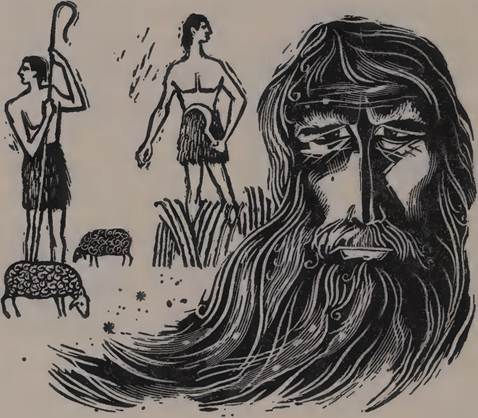
After their expulsion from Eden, Adam and Eve had children. The eldest, Cain, was a farmer, and the second, Abel, was a herdsman tending sheep.
Both went through certain rituals of worship, as described at the beginning of the fourth chapter of Genesis:4:3. And in process of time it came to pass, that Cain brought of the fruit of the ground an offering unto the Lord.
4:4. And Abel, he also brought of the firstlings of his flock and of the fat thereof....
It is customary in many religions to offer gods a portion of man’s food. To the primitive man, gods might be viewed as eating after the fashion of men. Therefore, by offering them food, one could be bribing them to treat their worshipers well.
It was also customary to burn the food since the fire and smoke traveled upward in the direction where people imagine gods to be. The offering was therefore a “burnt offering” and the ceremony took place on a special structure called an “altar.”
To the Jews later on, of course, such a burnt offering was by no means an attempt at bribing God, who did not eat and could not be bribed. Instead, it was considered an expression of gratitude for God’s bounty, of repentance for one’s shortcomings, and so on. What was important was not the object being offered but the attitude of mind of the one who was offering it.
Anything placed on the altar as a burnt offering was, of course, separated from ordinary objects and dedicated to God. It was, therefore, holy. It could also be said to be “sacred,” a word coming from the Latin sanctus, which means “holy.” The word “sacred” is not used in the Authorized Version, which uses “holy” or “sanctified” instead. It does occur in a few places in the Revised Standard Version, however.
Another word directly connected with “sacred” is, on the other hand, commonly used in the Authorized Version.
This is “sacrifice,” which comes from Latin words meaning “to make sacred.” This is the term usually used for a burnt offering.As is true of many words connected with religion, “sacrifice” has lost some of its force in everyday use. Naturally, when you conduct a sacrifice you are not only dedicating something to God; you are also giving up something yourself. You might, after all, have kept the food being sacrificed and eaten it. Therefore, “sacrifice” has come to mean any act of giving up something for any purpose, even when nothing sacred is involved. A move in chess in which you give up a piece in order that you may gain an advantage later on in the game is a “sacrifice.” In baseball, hitting the ball in such a way that you yourself are out at first, while allowing another man to advance a base (giving up your own advance for his) is a “sacrifice hit.”
The word “sacred” has come down to us in a num-
THE DESCENDANTS OF ADAM / 69 ber of other ways. For instance, it is particularly wicked to take anything that is sacred; that is, which is dedicated to God. To steal from God is worse than to steal from man, and it deserves a special name. This is “sacrilege,” from Latin words meaning “to take what is sacred.” The word has also come to mean the misuse of holy things. Using a Bible to prop up the short leg of a table would be a form of sacrilege.
Among the Hindus of India, cows may not be eaten or even harmed. They are treated as though they were sacred. This seems silly to Westerners, so the expression “sacred cow” has come to mean any belief or custom that is foolishly and blindly adhered to against reason.
No one is certain why, but the ancient Romans seemed to think the bone at the base of the spine was of special value in connection with sacrifices. It was called the “sacrum” for that reason. The sacrum is closely connected with the ilium, or hipbone, and the two together form the “sacroiliac” bone. People who suffer pains in the sacroiliac region are not likely to feel there is anything very holy about it, however.
But it is time to get back to the offerings to God presented by Cain and Abel. For some reason the Bible doesn’t make clear, God found Abel’s offering
acceptable, while Cain’s offering was not. Presumably Cain’s attitude of mind was improper.
In any case, this aroused Cain’s anger and made him envious of his brother. God felt it necessary to warn him about the consequences of these emotions. He said to Cain:
4:7. If thou doest 'well, shalt thou not be accepted? and if thou doest not well, sin Heth at the door....
This is the first mention of “sin” in the Bible. It is a translation of a Hebrew word which has the meaning of “missing the mark.” The mark referred to is the rule of conduct set up by God. When you fail to follow that rule, you miss the mark and are sinful. In short, sin is disobedience to God.
The first act of disobedience to God was that of Adam and Eve in eating of the fruit of the tree of knowledge of good and evil. That is therefore called the “original sin.” It is commonly thought among Christians that this original sin marked not only Adam but all mankind of which he was the representative. The effect was so to twist man’s nature, it was felt, as to place all men, ever since, under the continuous temptation to sin. This temptation is sometimes referred to as the “old Adam” within us.
Again, the force of the word has weakened. Nowa-
THE DESCENDANTS OF ADAM /71 days, “sin” can be applied to any kind of offense. In the expression “it’s a sin and a shame,” the two words mean about the same; “sin” is no stronger than “shame.”
Cain’s sin, however, was horrible enough. His anger against Abel grew to the point where Cain killed his brother. God, of course, knew of this and Genesis relates:
4:9. And the Lord said unto Cain, Where is Abel thy brother? And he said, I know not: Am I my brother's keeper?
Cain’s question, “Am I my brother’s keeper?” implied that Abel was old enough to take care of himself and required no guardian (which is what “keeper” means).
This question has become a common phrase in the English language as a way of expressing a particular type of heartlessness — the cruel man’s feeling that every man need look out only for himself and should feel no responsibility to help others.God’s punishment for Cain was to make it impossible for him to continue as a farmer. He was condemned to wander from place to place on the earth. Cain protested that the punishment was too great; that, as a homeless wanderer, he would be killed by anyone who met him. God protected him against
too great a punishment as follows:
4:15.... And the Lord set a mark upon Cain, lest any finding him should kill him.
There is no indication of what the mark was, but while intended to protect Cain, it also served to brand him as a murderer. For that reason, a murderer nowadays is said to have the “mark of Cain” upon him.
Less common is the use of “cain-colored” for red hair. Red hair has always been taken to be the sign of a fiery temper and it was felt that in order for Cain to kill his brother he must have had a fiery temper and therefore he must have had red hair.
Cain’s punishment began at once:
4:16. And Cain went out from the presence of the Lord, and dwelt in the Land of Nod, on the east of Eden.
This doesn’t sound as though he was a homeless wanderer, but Nod is not actually the name of a real place and is mentioned nowhere else in the Bible. Actually, it is a Hebrew word meaning “wandering.” “To live in the land of Nod” is a way of saying “to be a wanderer.” The Douay Bible doesn’t use the phrase “live in the land of Nod” but says instead “dwelt as a fugitive on the earth.”
Naturally, the chance of a pun here is irresistible, and to say someone is in the land of Nod, these days,
THE DESCENDANTS OF ADAM /73 is a joking way of saying he is asleep.
The fourth book of the Bible continues with a quick rundown of Cain’s descendants. As an example of the way in which this was done:
4:18.
And unto Enoch ivas born Irad: and had begat Mehujael: and Mehujael begat Me- thusael: and Methusael begat Lantech.Although the Bible includes, among other things, a history of all of mankind’s existence, it is particularly interested in those parts of history where man’s relationship to God is at a crisis. There are long periods where this does not come up and the Bible skips over those periods quickly.
However, the ancient Hebrews were very interested in genealogy, as were all ancient peoples. They were interested in knowing from whom they were descended and from whom their neighbors were descended. The writers of the Bible therefore included lines of descent in different places and used it to fill in the empty places.
To us, in modern times, this rattling off of genealogies seems quite dull. What often strikes us most sharply about it is the use of the old-fashioned word “begat,” which means “was the father of.” Sometimes these sections are humorously called “the be- 74 / WORDS IN GENESIS gats.” The Revised Standard Version has eliminated this word and uses instead “bore” or “was the father of.”
The fourth book ends with the description of the birth to Adam of a third son, Seth, and the fifth book is given over to the listing of his descendants. This is given more attention than the line of Cain, because Seth is the ancestor of the Hebrews and it is the Hebrews with whom the Bible is mainly concerned. In describing the descendants of Seth, the ages of the men mentioned are given, and they turn out to be great indeed according to modern notions.
For instance, Adam’s life is quickly summarized as follows:
5:3. And Adam lived an hundred and thirty years, and begat a son in his own likeness, after his image; and called his name Seth:
5:4. And the days of Adam after he had begotten Seth were eight hundred years: and he begat sons and daughters:
5:5. And all the days that Adam lived were nine hundred and thirty years: and he died.
Seth is then reported to have lived over nine hundred years, as likewise did his son Enos and his grandson Cainan, and so on. Starting with Adam, there are ten generations listed in the fifth chapter, ending with
THE DESCENDANTS OF ADAM /75 Noah. The men listed are all, as I said, far-off ancestors of the Hebrews, according to the Biblical story, and are therefore “patriarchs,” from a Greek word meaning something like “ancestral chiefs.”
These generations lived before the Flood, so that the times are “antediluvian,” from Latin words meaning “before the flood.” The men from Adam to Noah are therefore the “antediluvian patriarchs.”
In Christian times, the bishops of Constantinople, Alexandria, Antioch, and Jerusalem, as important heads of groups of Christians, to whom they were the spiritual fathers, were called “Patriarchs” and such a section of the church was a “patriarchate.”
Nowadays, any head of a family, particularly if he is unusually old and his family unusually numerous, is called a “patriarch." An old woman who is head of a family is sometimes called a “matriarch,” and societies in which the women rather than the men run affairs are called “matriarchies.” (In Latin, you see, while pater means “father,” mater is “mother.”)
Nor is the matter of the Flood forgotten in our common speech. Anyone whose views seem, to the modern generation, to be extremely old-fashioned — any old fogy, in other words — is said to be “antediluvian.”
The most unusual of the antediluvian patriarchs
was Enoch, the great-great-great-great-grandson of Adam. The Bible says of him:
5:23. And all the days of Enoch were three hundred sixty and five years:
5:24. And Enoch walked with God: and he was not; for God took him.
Enoch was the one antediluvian of whom it was not said “and he died,” but “God took him”; and he was the only antediluvian to live less than 750 years. This gave rise to theories among the Jews that he was so virtuous (having “walked with God”) that he was taken up alive to heaven.
As a result, several books were written about the visions of Enoch when he went to heaven. These tell things that men are only supposed to be able to find out through special revelation from God. Such books are called “apocalyptic,” from a Greek word meaning “to uncover.” They uncover truths ordinarily hidden to men.
There are a few books in the Bible that are apocalyptic. The book of Daniel in the Old Testament is partly apocalyptic and the Revelation of Saint John in the New Testament is entirely so. In the Douay Version, in fact, the latter book is called the “Apocalypse of Saint John.”
However, the books of Enoch were not considered
THE DESCENDANTS OF ADAM /77 divinely inspired by the Jews and were not accepted into the official canon. The books of Enoch belong to the “Apocrypha” therefore. The word comes from a Greek term meaning “hidden” because the apocryphal books were kept out of the Bible and therefore hidden away.
Since the Apocrypha are considered as not really inspired by God, the word “apocryphal” has come to mean anything not really written, said, or done by the person to whom the writing, saying, or deed is attributed. It has become a synonym for “spurious” or “fake.”
Enoch’s son was Methuselah, who had a distinction of his own:
5:27. And all the days of Methuselah were nine hundred sixty and nine years: and he died.
This makes Methuselah the oldest of all the patriarchs and, in fact, the oldest of anyone mentioned in the Bible. To say that anyone or anything is “as old as Methuselah” is therefore to say that he or it is very old indeed.
The fifth chapter of Genesis ends with Noah and his sons, and that leads on into the story of the Flood. Before going into this, however, I would like to say a few words about Biblical names.
The names in the Bible are Hebrew names, written originally in the letters of the Hebrew alphabet. To write those names in the letters of another alphabet, such as that of Greek or Latin, is not always easy. One language often has sounds that another language does not.
For instance, the Hebrew alphabet has a letter for the jZj sound, but the Greek and Latin alphabets do not. The Greeks and Romans simply did not use the sound in their speech. (We do, but we inherit the Latin alphabet and so have no letter for it. We have to combine two letters, s and h, in order to represent the sound.)
This means that whenever a Hebrew name with an sh was written in Greek or Latin, the Hebrew letter for the sh sound had to be represented by the Greek or Latin letter for the 5 sound. It was the closest approach possible.
Thus, Adam’s third son is “Sheth” in Hebrew, and his grandson is “Enosh,” but those names come down to us as “Seth” and “Enos.” In this connection, the Douay Version sticks closer to the Latin usage than does the Authorized Version, which sometimes switches back to the Hebrew sh since, after all, English does have the sound. Thus, Noah has a son who is called “Sem” in the Douay Version and “Shem” in the Authorized Version.
THE DESCENDANTS OF ADAM /79
Another example of difficulty in transcribing a sound is the guttural German ch (as in their exclamation A ch du Heber} which English does not have. The Scottish dialect has the sound also, as m “Loch Lomond” which we usually pronounce “Lok Lomond” because the k sound is the closest we can come to the German ch.
It isn’t even easy to write the sound because the letter combination ch, which is used for the consonant in German, represents the sound tsh in English. To prevent confusion, the guttural consonant is sometimes written kh, as I did for instance, in Chapter 1, when I gave ruakh as the Hebrew word for “breath.”
The Hebrew language has the kh sound and so does Greek, but the Latin does not. In using the Latin alphabet, difficulty therefore arises. Sometimes, the sound is written ch, sometimes it is written h, and sometimes it is left out altogether.
For instance, the name of the father of Methuselah, in Hebrew, is pronounced “Khanokh.” In the Authorized Version, the first kh is omitted and the second is written as ch (and pronounced k) so that it becomes Enoch. In the Douay Version, the first kh is represented by an h and the name becomes Henoch.
Again, one of the sons of Noah is “Kham” in He-
brew. This is written “Ham” in the Authorized Version and “Cham” in the Douay Version.
Noah, himself, represents still another example. In Hebrew, the name is “Noakh’ but in the Authorized Version it is “Noah.” And this time, it is the Douay Version that drops the kh altogether so that there the name becomes “Noe.”
These changes in letters and pronunciation make no difference as far as the spiritual and religious message of the Bible is concerned, of course, but they can make a difference in the traces they leave in our language. It is because this book is about those traces that I am making so much of this point.
For instance, the Flood described in Genesis is not the only story of a flood in Western tradition. The Greek myths spoke of a flood, too. In order to specify the Flood described in the Bible, one speaks of the “Noachian Flood.” Without knowing of the changes in letters from Hebrew to English, one might wonder where the ch came from.
Again, the descendants of Shem, of whom I shall speak in the next chapter, are referred to as Semites, not Shemites. The h vanishes because the Greek- Latin version of Shem’s name is used, not the Hebrew-English.