The Garden of Eden
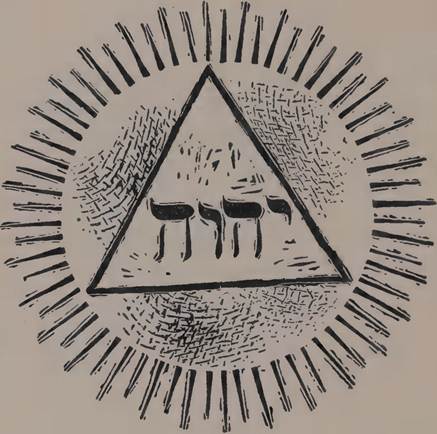
Genesis 2:4 begins an account of the Creation from a new angle. It concentrates on mankind instead of on the universe.
And almost at once this new account strikes a different note by using a second name for God.2:4. These are the generations of the heavens and of the earth when they were
THE GARDEN OF EDEN / 43 created, in the day that the Lord God made the earth and the heavens.
For the first time God is referred to as “Lord God.” People who study the Bible find that God is referred to in several different ways in the first few books of the Bible. They believe that this marks several different strands of tradition that have been woven into one by some later Biblical editor. I won’t go into this but instead will concentrate on the word “Lord.”
The Hebrew word, used wherever “Lord” is found in the Authorized Version, is equivalent, in our alphabet, to the letters YHVH. This is called the “Tetragrammaton,” a Greek expression meaning simply “four letters.”
Now many primitive people have a superstitious fear of names. They believe a name is so personal a thing, it is actually part of you, and through its use you can be hurt by your enemies. The name of a god is particularly powerful, for by knowing that name and exactly how to use it, you can force the god to obey you. This means you can bend nature to your wishes and cast spells.
The ancient Hebrews weren’t entirely free of that superstition and they were very cautious as to how they used the name of God. (If it were used improperly, the person using it could be hurt or even killed.) To be sure, the Jewish scholars later on didn’t believe that heathen gods had any sort of power or even that they existed. Nor did they believe that God could be forced to obey a human being. Still, they felt that it was wrong to use the name of God for any foolish or useless purpose (this is called “blasphemy,” from a Greek word meaning “to speak ill of” and which is the root of the word “blame”).
They felt that it should only be used for the most important reasons and with the greatest reverence. The safest thing was to avoid using the name at all times.We ourselves still have this feeling about holy names. Many Christians commonly use the name of Jesus Christ as a useless exclamation of anger or surprise, but this is not considered the right thing to do. Instead a variety of expressions that are something like Jesus Christ are used instead. One is “Jiminy Christmas” and another is the childish “gee whiz.” And instead of exclaiming “God!” we will say “gosh” or “golly.”
Another habit is to use God’s dwelling-place, “Heaven,” in place of the word “God,” just as we will say “the White House” instead of “the President.” In this way, we can say “By Heaven” or “Heaven help me! ” without using God’s name.
To be sure, very few people these days seriously try to use the name of God in magic formulas, but
THE GARDEN OF EDEN / 45 there were people in ancient and medieval times, both Jews and Christians, who did. The Tetragrammaton was considered a very potent charm. (In fact, even the word “tetragrammaton” is a way of avoiding saying the name itself.)
Anyway, the Jewish scholars, in an attempt to avoid saying the name of God even when reading the Bible substituted the word adonay. This means “my lord.” When the Bible was translated into the various European languages it was the word adonay that was translated and not YHVH itself. In German it becomes Herr Gott; in French, le Seigneur Dieu; in English, “Lord God.”
But adonay had an adventure outside the Bible, too. There was a Babylonian god named Tammuz, who was described as having died and then having been restored to life. This is supposed to represent the death of vegetation in the fall and its rebirth in the spring. Such myths were very popular throughout the ancient world and Tammuz was referred to as “lord” by people who spoke languages related to Hebrew. When the myth reached Greece, the name became “Adonis,” which is almost the Hebrew word, except for the final j.
(The Greeks usually added an s to names taken from foreign languages because Greek names very often end in s.) Because Adonis was always pictured by the Greeks as extremelyhandsome, the word “Adonis” is used nowadays to mean any especially good-looking young man.
Now the Hebrew language is made up of consonants only, and vowels are not indicated. Most people don’t feel the need of vowels if they know the language well. For instance, I could write the previous sentence this way: Mst ppi dnt fl th nd f vwls f thy knw th Ingg wll, and you would probably get the drift, especially if that were the only way you ever saw such words written.
After the destruction of Jerusalem, however, and the scattering of the Jewish people, it became difficult for them all to keep up a complete knowledge of the Hebrew language. One of the jobs of the Masoretes (whom I mentioned in the Introduction) was to preserve the correct pronunciation of Hebrew. They did this by putting special little signs indicating the vowel sounds for each word in the Bible.
It is as though we were forgetting English and needed special marks to help us understand when “bt” was “beat” and when it was “bate,” “bite,” “bit,” “bet,” “but,” “abate,” “abet,” and “obit.” These Masoretic marks are called “diacritical marks,” from Greek words meaning “distinguish through,” since different words made up of the same consonants could be distinguished through them.
Now the Masoretes were faced with a problem when they came to the word YHVH. No Jew ever read it as anything but adonay so there was no use putting in the particular diacritical marks for the word YHA H. Instead, they put in the diacritical marks for the word that was actually read — for adonay.
Non-Jewish translators, trying to read YHVH itself, using the diacritical marks they saw before their eyes, decided it must be pronounced something like YeHoVaH. But that is certainly the wrong pronunciation because it is based on the wrong diacritical marks.
In English, there is a second distortion. In Latin, names that start with a Y sound, were written with an initial 1. As time went on it was felt that it was rather sloppy to have one letter both a vowel and a consonant, for i was a vowel when it was inside a word and a consonant when it began a word.
For that reason, a form of i was introduced especially for use at the beginning of the word. It was the J. The German language, particularly, uses the J at the beginning of a word and pronounces it like our y. The English language adopted the German usage in the 1600’s but, under French influence, the sound it had was dzh, like a soft g. The Tetragrammaton, YHVH, was therefore written Jehovah and pronounced “dzhe-hoe'vah.
This same distortion in English takes place for a number of Biblical names. For instance, there is a name in the Bible which, in Hebrew, is pronounced “Yo-kha'nan.” The Greeks changed it by adding a final s, as you might expect, and their version is written, in our letters, loannes. In Latin it became lohannes, pronounced “Y o-han'nes.” In German the name stayed the same except that the Initial / became a J. In English it became a J, too, the name being shorted a little to John, and you know how that is pronounced.
Well, then, what is the real pronunciation of YHVH? No one can be certain any longer, but Biblical scholars seem to think that it is “Yahveh:
However, we nowadays still prefer to speak of “the Lord” or of “God” rather than to use His actual name, whether Yahveh or Jehovah.
There is a famous story about the American, Ethan Allen, who, during the American Revolution, demanded that the British surrender the fortress of Ticonderoga. According to the legend, he demanded it “in the name of the great Jehovah and the Continental Congress.” It sounds irreverent to put God and a mere group of men into the same breath like that. It even sounds rather unusual to use the name of God.
The most common use of the name these days is in the case of a Christian sect, founded about 1879, that
THE GARDEN OF EDEN / 49 have been calling themselves “Jehovah’s Witnesses” since 1931.
They have published a version of the Bible in which YHVH is translated as “Jehovah” throughout, so that instead of saying “the Lord God,” they constantly say “Jehovah God.”Now begins the story of mankind:
2:7. And the Lord God formed man of the dust of the ground, and breathed into his nostrils the breath of life; and man became a living soul.
The Hebrew word used for “man” in this verse is adam. In the Authorized Version, this word is sometimes translated as “man,” as it is here, and sometimes it is left in the Hebrew form and spelled “Adam.” When it is given as Adam it is treated as the actual name of this first man. It is as though we were to say that the name of the first human being created was Human.
The role of Adam as the first man and the ancestor of all future human beings is indicated by the fact that to speak of a “son of Adam” is to mean a human being. Then, just to show that Adam and Man mean one and the same thing, there are places in the Bible, particularly in the book of Ezekiel, where “son of man” is used to mean “human being.”
Adam can also be considered to represent the
human race in general. There is the expression, for instance, “I wouldn’t know him from Adam.” This means you couldn’t tell a particular person from any other human being. In other words, you haven’t the faintest notion of what he looks like.
This is the first reference to the “soul” in the Bible. The Hebrew word is nephesh, which is still another expression for “breath,” and, of course, the verse also speaks of the “breath of life” which was “breathed” into Adam’s nostrils by God. The soul is thus a kind of Spirit of Life given by God to man and to no other creature. (The Revised Standard Version has the verse end: “... and man became a living being.” It thus avoids the use of the word “soul.”)
God next builds a home for man:
2:8. And the Lord God planted a garden eastward in Eden; and there he put the man whom he had formed.
Now the word “Eden” in Hebrew means “delight” so the Garden of Eden is a “garden of delight.” The Bible was written by men living in an area of the world that was semidesert and near which were real deserts.
Occasional oases where the ground water was near enough to the surface to support date palms and other vegetation were a heavenly site to travelersTHE GARDEN OF EDEN / 51 crossing the desert, and an oasis would naturally be thought of as a “garden of delight.”
Placing it “eastward” was also natural, for east of the land inhabited by the ancient Hebrews was the plain of Babylonia which, at the time, was fabulously fertile and well irrigated.
The wonders of Eden are described briefly:
2:9. And out of the ground made the Lord God to grow every tree that is pleasant to the sight, and good for food; the tree of life also in the midst of the garden, and the tree of knowledge of good and evil.
Neither tree is described any further than that. Four rivers are described as originating in Eden. The names of the first two mentioned are unknown, but the third and fourth are familiar to modern man.
2:14. And the name of the third river is Hiddekel: that is it which goeth toward the east of Assyria. And the fourth river is Euphrates.
The Hiddekel must be the Tigris, for that flows to the east of the ancient land of Assyria. Between the Tigris and the Euphrates lie the rich and fertile Babylonian plains. This mention of the Tigris and Euphrates shows again that the Hebrews were think-
ing of the Babylonian plain in connection with Eden.
Adam is given free permission to eat of anything in Eden with the single exception of the fruit of the tree of knowledge of good and evil. Following that, God decides that Adam had better have a companion.
2:18. And the Lord God said, It is not good that the man should be alone; I will make him an help meet for him.
Here is an example of people being misled by an old- fashioned meaning of a word that is no longer familiar. One of the meanings of the word “meet” is “suitable” or “fitting” (though this meaning has gone out of fashion). Therefore, “an help meet for him” is “someone suitable to help him.” The Revised Standard Version makes that part of the verse read: “I will make him a helper fit for him.”
People, however, not remembering the meaning of the word “meet” and knowing that God proceeded to create a wife for Adam, decided that the words “help meet” must mean “wife” and ran it together into one word, thus, “helpmeet.” Then, as “helpmeet” didn’t make much sense and as “mate” is another word for “wife,” they changed the expression further to “helpmate.” That is now a recognized word for “wife.” It is the result of a double mistake, but it is a fine word just the same.
The creation of the “help meet” for Adam is described:
2:21. And the Lord God caused a deep sleep to fall upon Adam, and he slept: and he took one of his ribs, and closed up the flesh instead thereof;
2:22. And the rib, 'which the Lord God had taken from man, made he a 'woman, and brought her unto the man.
These are important verses in the history of medicine. When anesthetics first began to be used in the 1840’s and 185O’s there were people who felt that this was interfering with the intentions of God, and that God meant man to suffer pain. However, when the British physician James Simpson decided to use chloroform on Queen Victoria to help her give birth without pain, he pointed out that God had caused “a deep sleep to fall upon Adam” before removing his rib, so that God used the principle of anesthesia Himself.
Many people have thought that men were missing a rib and had one fewer than women because one rib had been removed from Adam. This is not so, of course. Both men and women have exactly 12 ribs on each side of the chest. Just the same, the word “rib” is still used sometimes as a humorous reference to one’s wife.
When first formed, Adam and the woman (she is not given a name until afterward) were completely innocent:
2:25. And they were both naked, the man and his wife, and were not ashamed.
At various stages in history there have been small sects that felt it was necessary to return to such a state of innocence and have therefore practiced nudism. Such sects are often referred to as “Adamites.”
As another sign of the simple life led by Adam, there is the phrase “Adam’s ale” or “Adam’s wine,” which means “water” since that is all Adam had to drink. And “Adam’s profession” signifies “gardening” since that is all there was to do in Eden.
Eden has always seemed to readers of the Bible to be a place of perfect bliss. An even more common word for a place of bliss is the Persian word for “garden” which is “Paradise.” The Greeks borrowed the word and it was used in place of Eden in the Septuagint. The word “Paradise” doesn’t occur in the Old Testament in the Authorized Version, which returned to the Hebrew “Eden,” but it does occur in the New Testament, which was written in Greek in the first place..
Paradise itself is now usually thought of as being the place where virtuous human beings go when they
THE GARDEN OF EDEN /55 die. Since the Garden of Eden was here on the earth, it is often referred to as the “Earthly Paradise.” Throughout the Middle Ages, people felt it still existed somewhere and that it might be found if one were daring enough and lucky enough.
In the early 1500’s, the beautiful plumage of certain birds were shown to Europeans exploring the eastern oceans. So beautiful were the birds that it seemed they must come from Paradise. The creatures are still called “birds of Paradise” but, in actuality, they come from Australia and New Guinea.
Of course, Paradise was known not to exist in the plains of Babylonia, which the Bible’s testimony made the logical place. (Besides, that area was in Mohammedan hands from the 600’s onward.) Many supposed that God had moved it to some out-of-the- way place. The Italian poet Dante, in his great poem The Divine Comedy, written about 1310, placed the Earthly Paradise on the other side of the earth, exact;; opposite the city of Jerusalem.
The best-known use of the word in the English language, however, is in a long poem by John Milton, published in 1667. Its title is Paradise Lost, and it deals with the story of Adam.
For Paradise was lost. There was trouble waiting for Adam in the form of the serpent. The third chapter of Genesis begins:
3:1. Now the serpent was more subtil than any beast of the field which the Lord God had made....
The word “subtil” is more commonly spelled “subtle” (and is spelled that way in the Revised Standard Version). It means “crafty” or “sly” and it is not surprising that snakes should be considered so. Long, thin, and crawling, they slide stealthily and silently through the grass, and a poisonous snake may strike and kill in a flash before it is seen. This makes the snake symbolic of treachery, too, of striking without warning, of stabbing in the back. In fact, we have a common phrase describing a back-stabbing sneak. He is a “snake in the grass.”
In Genesis 3, the serpent tempts the woman to disobey the commandment of God. This is one of the very few talking animals in the Bible and this, in itself, made it unusual.
In later times, the Jews picked up the notion from the Persians of the existence of some powerful spirit of evil who was always fighting God and attempting to win man away from God. To the Jews this spirit of evil was “Ha Satan” (meaning “the adversary”).
The writers of the Old Testament did not seem to feel Satan to be a great danger and he is hardly even mentioned, and then only in the later books. In the book of Job, Satan is described as a servant of God,
THE GARDEN OF EDEN /57 one who talks with Him and is used as a means of testing man’s virtue, acting only under God’s instructions.
As time went on, however, Satan came to be considered more and more evil and powerful. Perhaps this was the result of continuing Persian influence, for from 520 b.c. to 320 b.c., a period of two centuries, Judea was part of the Persian Empire. Perhaps, also, it was the result of the attempt made by the Jewish scholars to avoid blaming God for the existence of evil in the world.
In any case, a number of dramatic stories (not found in the Bible) were worked out concerning Satan. He was described as the chief of the angels who had rebelled against God after the creation of man and was defeated and cast out of heaven. In revenge, he took the form of the serpent and entered Eden in order to tempt mankind into disobedience to God. (Milton, in Paradise Lost, works out this theory in great detail and makes Satan the central character of the poem.)
The Greek word for an evil spirit was diabolos, from a word meaning “slanderer.” This is a good name for Satan, one of whose functions was to speak evil of God to man, and to speak evil of man to God, so that he slandered in every direction. The word has come down to us as “devil” and this is a very com- 58 / WORDS IN GENESIS mon synonym for Satan. The adjective “diabolical” refers to anything particularly evil, to something “devilish,” in other words.
But Satan has many other names, too. The general fear of the power of names certainly extends to evil spirits. Many superstitious people felt that the careless use of such a name might unexpectedly cause the spirit involved to materialize, bringing destruction with him. (We have the familiar saying, “Speak of the devil and in he comes.”) Consequently, men preferred to refer to the devil in all sorts of indirect ways. One of the synonyms harks back to the third chapter of Genesis, for he is sometimes referred to as the “Old Serpent.” This term is used twice in Revelation, the last book of the New Testament.
The serpent succeeds in tempting the woman to disobedience, for he urges the woman to eat of the fruit of the tree and she does.
3:6. And when the woman saw that the tree was good for food, and that it was pleasant to the eyes, and a tree to be desired to make one wise, she took of the fruit thereof, and did eat, and gave also unto her husband with her; and he did eat.
Because of this verse, anything which is immoral or illegal, but is tempting just the same and seems to be
THE GARDEN OF EDEN / 59 very desirable, is called “forbidden fruit.”
Now the Bible doesn’t say what the fruit of the tree of knowledge of good and evil actually was. It might easily be thought that since it was the only tree of its kind, it would have fruit like no other on earth. However, different groups of people believed the fruit to be something familiar. To the Europeans of the Middle Ages, the apple was the most common fruit and they decided that it was an apple that the woman ate. Perhaps they were influenced by the fact that another apple, the ‘apple of discord,” started the troubles that led to the Trojan War.[‡]
This belief has influenced the name of a part of the body. The larynx or voice box is larger in a man than in a woman (which is why a man has a deeper voice than a woman). It is large enough to be clearly seen projecting forward in a man’s throat. It moves up and down when a man swallows, but stays put as though it were stuck there. The popular legend has it that it represents a piece of the apple which Adam tried to swallow but couldn’t quite get down. The larynx is still called the “Adam’s apple” for that reason.
The results of the disobedience were felt at once:
3:7. And the eyes of them both 'were opened, and they knew that they were naked; and they sewed fig leaves together, and made themselves aprons.
This verse had an influence on art. The Greeks and Romans (and some modern artists, too) had an easygoing attitude toward nudity. They produced sculptures of naked men, which shocked later spectators. As a result it became customary to cover up parts of the statue which were felt to be immodest.
Because of the verse just quoted, metal cutouts in the shape of leaves were used. Therefore, “fig leaf” has come to mean an unnecessary or insincere modesty, because, after all, the leaves just attracted attention to the parts they were supposed to be hiding.
God at once set about punishing the three creatures involved in the disobedience. He condemned the serpent to crawl on its stomach, and then it was the woman’s turn.
3:16. Unto the woman he said, I will greatly multiply thy sorrow and thy conception; in sorrow thou shalt bring forth children...
The Revised Standard Version makes the punishment plainer to modern ears for it reads: “I will greatly multiply your pain in childbearing; in pain you shall bring forth children..
It was this verse which was used by those who felt that anesthetics should not be used on Queen Victoria when she was bearing children.
The man had suffering reserved for him, too:
3:17. And unto Adam he said... cursed is the ground for thy sake; in sorrow shalt thou eat of it all the days of thy life;
3:18. Thorns also and thistles shall it bring forth to thee...
3:19. In the sweat of thy face shalt thou eat bread...
In other words, Adam was no longer to be a gardener taking care of a lovely garden, with food for the gathering. He was to become a hard-working farmer trying to wrest a living out of rocky ground in which weeds grew as readily as grain. (The Revised Standard Version has Genesis 3:17 read “in toil you shall eat of it.”)
This picture of Adam as a farmer was used on occasion to counter the arguments of aristocrats who felt they were better by birth than were the mass of the people. After all, said those who opposed the “gentlemen,” all men are descended from Adam, the farmer.
When peasants in England rose in rebellion in 1381 under the leadership of Wat Tyler, a priest named John Ball roused them to fury with the rhyme: “When Adam delved and Eve span/Who was then the gentleman?” (By “delved” is meant to spade up the earth for planting.) Tyler was stabbed, however, and Ball executed, and the uprising was a complete failure.
The word “curse” is used here for the first time in the Bible. It is the opposite of “bless.” If “bless” means “to hallow,” that is, to separate from ordinary objects and join with God — “curse” means “to separate from God, to remove from God’s care.”
The ground was removed from God’s care by the curse in Genesis 3:17 so that it would no longer bear food of itself. Someone else had to care for it in order to make it do so, and that meant the backbreaking toil of Adam and his descendants.
Nowadays, both “bless” and “curse” have become much weaker in meaning. The use of the word “bless” usually implies merely a hope for good or a guard against evil. For instance, it is an old superstition that during a sneeze, an evil spirit may slip into your body and get you under control. (During a sneeze, your eyes close, you can’t talk; you seem generally helpless to protect yourself.) Consequently, it
THE GARDEN OF EDEN / 63 has become automatic to say “God bless you” whenever someone sneezes in your hearing. That is a kind of charm against the evil spirit.
On the other hand, to “curse” has come to mean “to wish evil on” someone. A superstitious person would believe that in order to do so, one should call upon the name of some powerful spirit. For that reason, anyone who uses the name of God improperly, or the name of the devil, or, in fact, any language at all that is considered improper, is said to be “cursing” or “cussing.”
It is only after God’s punishment that Adam gives the woman a name.
3:20. And Adam called his wife’s name Eve...
“Eve” meant “life,” and just as a man is a “son of Adam,” so a woman is a “daughter of Eve.”
The final punishment was that Adam and Eve were forced out of Eden and return was forever barred to them.
3:24. So he drove out the man; and he placed at the east of the garden of Eden cherubim, and a flaming sword which turned every way, to keep the way of the tree of life.
Presumably, if man could reach the tree of life and
eat of its fruit he could live forever. Those who, in later times, thought of finding the Earthly Paradise assumed the tree of life was still there and that they would be finding immortality as well. They never found either Eden or the tree, of course.
There is a tree, often grown in gardens as an ornamental plant, which is called the “arborvitae.” This is Latin for “tree of life,” but the arborvitae is certainly no highway to immortality, despite its name.
This verse also mentions the “cherubim.” Now the suffix “-im” in Hebrew signifies the plural (as was the case with Elohim, remember). It is one cherub, but two cherubim. To English-speaking people this is a strange way of forming a plural and it is often not recognized as such. Shakespeare, for instance, uses the word “cherubin” (misspelling it) as a singular. It isn’t uncommon to have people speak of more than one cherub as “cherubims,” making a double plural of it.[§]
The form of the cherubim is not described here, but obviously it must be something powerful and mighty. The Babylonians and Assyrians used winged lions and other such monsters at the gateways of
THE GARDEN OF EDEN / 65 their temples, and the prophet Ezekiel (who lived in Babylon during the exile) describes cherubim in ways that make them sound something like these mythological creatures of the Babylonians.
This is not, however, the picture that the word arouses in our minds these days.
It was customary, you see, for medieval artists to paint winged spirits about holy men and women. Some of these were in the shape of winged infants and, somehow, those began to be thought of as representing the cherubim. Cherubim, in other words, began to be considered as a sort of “baby angels.”
As a result, a sweet little infant is called a “cherub ’ and to have a round baby-face (like Winston Churchill) is to have a “cherubic” countenance.