Aesthetics and the arts
In the later urban age, and especially by the time of the Guptas, the arts were flourishing and fundamental principles which informed artistic expression were in place. Clearly art was not an afterthought or an appendage to the creativity of the period; rather it was a consistent part of the total landscape, if not a driving force in the shaping of that landscape.
Whether in Mahayana Buddhist or brahmanical hands, human expression, like much of nature itself, assumed a sacral character. Especially in the hands of brahmanical synthesizers the expression of art was a form of ritual; further, it represented the incorporation of themes and motifs from the pluralistic landscape including borrowings from Buddhist and “folk” sources which were in turn linked to vaidika motifs. It is as if all of culture was sacralized.Aesthetic expression made several statements about the nature of the universe and the human being’s place in it. For one thing, the arts were a celebration of the material world and of life itself. The world was increasingly seen as lila - the playground of the gods. Matter and society had become an arena in which the sacred (whether brahman or buddhahood) was present. Further, the body, for example, in dance or icon, was affirmed. The body was used as the medium through which the sacred was depicted; the body and its gestures and pose replicated the reciprocity between body and cosmos insofar as in the body, cosmic rhythms and sacred moods could be re-enacted. Moreover, sound and speech as used in drama, music, or ritual chant were intended to have resonance with the creative process of the universe itself. At the same time, the stories told in drama ennobled the stories found in “folk” culture and enacted emerging mythologies. Creativity itself became a form of “yogci’ - a means of bringing both artist and audience closer to the realm of the sacred.
That is, the artist became an embodiment or conduit of brahman and sought to evoke an enlightening experience on the part of the “audience.” In that sense, the audience was to become the “actor” and the artist the “prompter” in such a way as to enable all participants to experience the “flavor” (rasa) of brahman.These principles are at work in the very use of the Sanskrit language itself. By the time of Asoka, Magadha was already a multilingual area. Indigenous dialects known as the Prakrits abounded - some of these died out; some were eventually systematized into distinct languages in their own right; most were incorporated in various ways into the Sanskrit language. By the fourth century bce, what was once the exclusive language of the priests had been systematized by the brilliant grammarian Panini, who wrote a definitive, scientific grammar for Sanskrit called the Astadhyayi (book of eight chapters). Therein we find the articulation of six types of grammar (might these be in response to the six perfections of the Sarvastivadins?) One of the “types” of grammar was ritual.
The use of Sanskrit often had a religious character. Not only had earlier forms of oral Vedic Sanskrit been used liturgically; even in its written form it assumed a sacred aura. Samskrta means “well-formed, polished or perfected”; it was written in the devanagiri script - literally, the writing of the “city of the gods.” Rendering something in Sanskrit, whether orally or in written form, became a way of linking “new” expressions to a sacred past. J. A. B. van Buitenen once noted that, among other things, the Sanskrit language “carried with it associations of a sacral character” and served to refine or correct “one’s nature and conduct by ritual means.” That which was “Sanskritic” therefore was perceived to be that which was “most ancient,” “most pure,” and “hierarchically the most elevated,” assuring “correct descent” “by relating oneself to an ancient lineage or myth and safeguarding the purity of future offspring.”33
In sum, to chant or write in Sanskrit was to engage in ritual; it became the instrument by which all elements of a changing landscape could be linked to the vaidika tradition.
If Pali was the language of the court in Asoka’s time and continued to be the language used in Theravada Buddhism, Sanskrit was the lingua franca in the Gupta courts and the basic language of Mahayana Buddhism.Much of the Sanskritic literature then was perceived to be sacred. More specifically, this literature took many forms: poetry, for example, included the early form known as mahakavya, which used various principles of aesthetics - different meters, similes, tropes, and ornamentation. The work of the great dramatist Kalidasa reflected this genre well. Folk tales also found their way into classical dress. The Pancatantra, for example, was the Sanskritic compilation of oral fables and folk tales that may date back to several centuries bce and which eventually influenced folk tales told in Europe by way of Arabia and the Islamic world. Similarly, the Jataka Tales were folk tales and fables purporting to tell anecdotes from Buddha’s life, and served a didactic purpose. Myth was ascribed an aura of historicity (itihasa); it embodied anecdotes and motifs derived from folk and other sources and found its way into the epics and eventually into the Puranas - collections which began around the fourth century ce and continued to be written and collected even into the seventeenth century. The Puranas drew upon the social landscape and became a means for anonymous authors to address major themes and describe the exploits of the deities.
The aesthetic principles informing not only literature but all the other arts were recorded eventually in the Natyasastra, the core of which was written around the second to sixth centuries ce and enhanced in subsequent years. Based on oral principles handed down by theatrical troupes, the Natyasastra offered considerable detail about the role of the artist. central to this role is bhava - that which conveyed the meaning intended through words, physical gestures, and facial expressions.34 The art was “successful” insofar as its audience shared in the fundamental moods intended. Art enacted mythologies; speech, sound, and bodily gestures became expressions of the sacred.
The expression of art, in short, was ritual.There were three basic principles informing artistic expressions by the Gupta period. The first was rasa - literally, flavor, essence, taste, sentiment, orientation. Rasa was the flavor of brahman. Eventually, rasas became the eight major “moods” which both body and cosmos embodied: love, heroism, disgust, wrath, mirth, pleasure, pity, and wonder.35 By the eleventh century (and the work of Abhinavagupta), gentleness and quiescence were added to these moods. Rasa was acted out in art, drama, music, and literature - the artist was the “conduit” who sought to enable the listener to be a participant, to experience the “flavor” of the universe.
Another fundamental aesthetic principle was alamkara - ornamentation or embellishment - it entailed the use of metaphors, puns, and other appropriate means to enhance the beauty and power of an artistic expression. “Ornamentation” could take many forms. In literature, it was the use of tropes, similes, and images which embellish meaning.36 A woman’s eyes, for example, were likened to “darting fish.” In acting, alamkara included the use of costuming, makeup, headwear, and especially the use of such primary colors as white, blue, red, and yellow (colors which also evoked certain rasas). Similarly, when priests are dressing an icon in the typical Hindu temple even today they are performing alamkara - an aesthetic as well as religious enterprise.
A third aesthetic principle was silpa - the “art of appearance.” Silpa included the guidelines for crafts and architecture from indigenous clay art to sculpting, iconography, temple and city building. These arts were practiced by silpis who handed down their traditions from father to son. Architectural texts, which were not written until much later, often started by reciting a myth of creation as if to remind the builder that building a city or a temple was like the re-creating of a world.
These principles were expressed not only in literature, iconography, and architecture but in dance, drama and music.
Dance, for example, embodied the story of the gods and fundamental moods, both human and cosmic. It was intended to “carry” rasa to the audience. In fact, the term abhinaya, the “performing” of rasa, meant literally “carrying to” an audience. Later, dance was combined with music to create its own art form. Dance included the use of stylized “hand gestures” (mudras). By the fourth century ce some thirtyseven mudras were listed, as well as many other poses.37 Abhinaya or “carrying to an audience” could include verbal expressions - for example, the use of sound, rhythm or plot; bodily gestures from head to feet; ornamentation - for example, painting the face, costuming, or makeup; and the re-creation of emotions (Natyasastra Chapters VII ff.).Music, for its part, encompassed at least three components. First was meter or beat (tala) - some twenty-two were enumerated in the Natyasastra with many more added later (Chapter XXXI). Meter was sustained by a drone and the beat of a drum in such a way as to replicate the rhythm of the cosmos. The second element of music was the “tune” (raga) - the raga consisted of
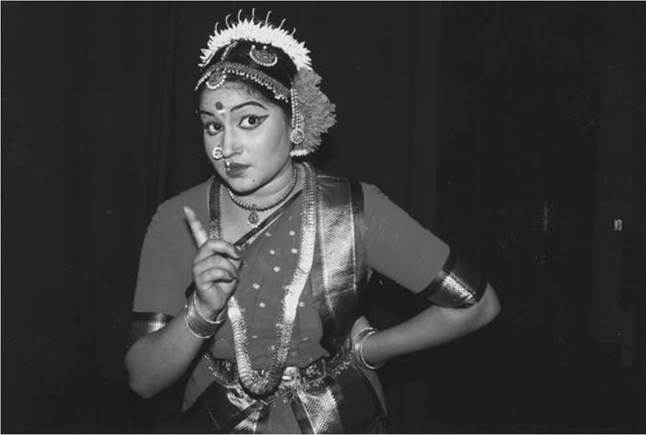
Figure 1 Yashoda scolds her mischievious son Krsna as expressed in the Kuchipudi dance form. Dancer: Suvarchala Somayajalu. Photograph by Dr. Raman Venkataraman.
at least five notes; each mga evoked a particular rasa, each suitable for a particular time of day. The raga Bhairava (Siva in his fierce form), for example, was the mga for dawn, the raga of rage, awe, or fear. In this period of musical production there were said to be six basic ragas;38 now there are many. A final component in music was the scale, grama (Natyasdstra Chapter XXVIII). The scale is probably traceable to the old Samaveda singers who were multi-tonal in their chanting. Over twenty-two microtones were developed, each part of a scale that was thought to comprehend the universe.
It is useful to recall that sound was thought to be primordial and cosmogonic in the Vedic period; hence, the scale was congruent to the totality of the universe and to satya (being itself). Music, like dance, had ritual overtones, evoking cosmic rhythm, embodying rasa, the flavor of brahman, and inviting the hearer to participate in the human-cosmic ambience.Drama became an increasingly popular art form in the classical settings in the first century ce, though classical performance no doubt grew out of the enactments of myths, folk tales, epics, and village dramas.39 Though Asvaghosa, a Buddhist, was the first to mention drama, it is Kalidasa who became known as the most popular dramatist of the period. Most early plays included elements from one or more of the epic tales, material often familiar to the audience, and used both prose and verse. Sanskrit was used for the lead male roles, representing authority figures, while Prakrits were used for lesser roles. Drama was intended not merely for the amusement of audiences, but also to instill or evoke one or more of the fundamental rasas. Drama was instructive, whether in re-enacting the themes of folk heroes and mythological figures, or in presenting the spectrum of human emotion. Invariably, plays of this period presented a conflict and its eventual resolution.
The Natyasastra made explicit the ritual character of early drama. The playhouse was likened to a temple or the old sacrificial hut of the Vedic period. The drama was an oblation, a sacrifice, acted out at a miniature cosmos (Chapter III). Its characters were often depicted as representations of the ideas of dharma. Usually performed at a festival or other ceremonious occasion, the costumes, stage props, masks, colors - all eventually stylized - were intended to enhance the mood or rasa portrayed in the drama itself. Clearly drama as it was made part of the classical Sanskritized tradition like the other arts was closely aligned to ritual.