American religious history began some 30,000 to 50,000 years ago when, according to archaeologists, the first human beings set foot on the North American continent.
An Ice Age expansion of the Arctic ice cap reduced sea levels sufficiently to expose an area of land currently submerged beneath the Bering Sea and called Beringia. This tundra region attracted eastward-moving hunters from northeastern Siberia, who brought with them their Paleolithic Asiatic cultures and belief systems.
The Beringian crossing ended when milder climatic conditions and rising sea levels obliterated the land bridge, perhaps 10,000 years ago. By then the descendants of the Siberian migrants had spread over the tundra, grasslands, deserts, plateaus, and forests of the Americas, adapting to a wide range of environments and developing their Paleolithic religiosity into a correspondingly wide variety of forms. Meanwhile, Indonesian, Micronesian, and Melanesian peoples of south Asian origin carried other Paleolithic religious forms eastward across the Pacific Ocean to the islands of Polynesia and, by about 500 CE, northward from Tahiti and the Marquesas Islands to the Hawaiian Islands. By the time of European colonization, about 75 million people inhabited the Americas, perhaps 10 million of them in what is now the United States. They were divided into hundreds of ethnic groups, spoke hundreds of languages, practiced an array of subsistence techniques, developed many different patterns of social organization, interacted with each other through trade, migration, and warfare, and devised a kaleidoscopic range of religious systems to address the circumstances of existence. In shaping and reshaping their religions in response to experiences of migration, adaptation, and intercultural exchange, they established enduring patterns of American religious life.
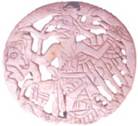
This Southeastern shell gorget from about 1000 CE depicts a shaman, suggesting the retention of Northern hunting traditions in Southern agricultural religious practice.
This diversity complicates any attempt to present indigenous American religions in general terms, but historians and anthropologists have identified several broad characteristics and constructed models by which to make sense of their variety. Perhaps the most basic point about Amerindian religion is that those behaviors and attitudes we term “religious” were for them the central orienting mechanism in a single seamless reality of cosmos, landscape, culture, society, and economy. American aborigines understood themselves as participants in a world of spiritual power at once natural and supernatural—called Wakan by the Sioux, Orenda by the Iroquois, Manitou by the Algonkians, and Mana by Hawaiians—upon which they depended for survival and which they encountered mainly through its effects in the natural world. This spiritual force infused humans, animals, plants, landscape features, and natural phenomena and bound them into an integrated web of existence. Humans were only one—and by no means the most powerful—of nature’s active powers.
Native Americans expressed such beliefs in their various origin myths, intended to explain cosmically their geographic location, their relationship to the environment, and their social and cultural systems. These myths were expressed in rituals, which differed from group to group but aimed through sacred words, songs, gestures, and objects to align humanity with the spiritual world and to harness its powers for personal or group welfare. The assurances of ritual were particularly important at crucial junctures in the life of the group (before and after hunts and wars, for example, or at the time of planting and harvest) or of the individual (puberty, illness, or death). Many groups identified certain individuals, called shamans (usually but not always men), as possessing special spiritual gifts that gave them authority to conduct rituals, but most groups also emphasized ordinary people’s connection to the spiritual world and encouraged personal ritual encounters with it, as men might do before hunting or women when menstruating.
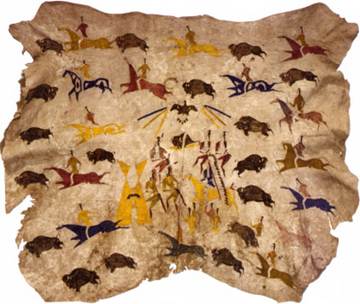
This Shoshone hide painting of a buffalo dance suggests the importance of the buffalo and hunting to ritual life on the Plains.
In addition to such broad commonalities, scholars have identified two broad and interpenetrating “traditions” within North America’s precontact indigenous religions. The first was a Paleolithic “northern hunting tradition” that came to the continent with the first Siberians and spread eastward and southward; the other was a younger “southern agrarian tradition” that accompanied the development of settled agricultural economies in Mesoamerica and spread northward with maize cultivation. After contact with white Europeans and Americans, Amerindian groups developed a spectrum of religious responses, often categorized into “revitalization” and “accommodation” movements, by which they resisted or adapted to an expanding Euro-American presence and rethought their relations with the land.