Northern Hunting Religions
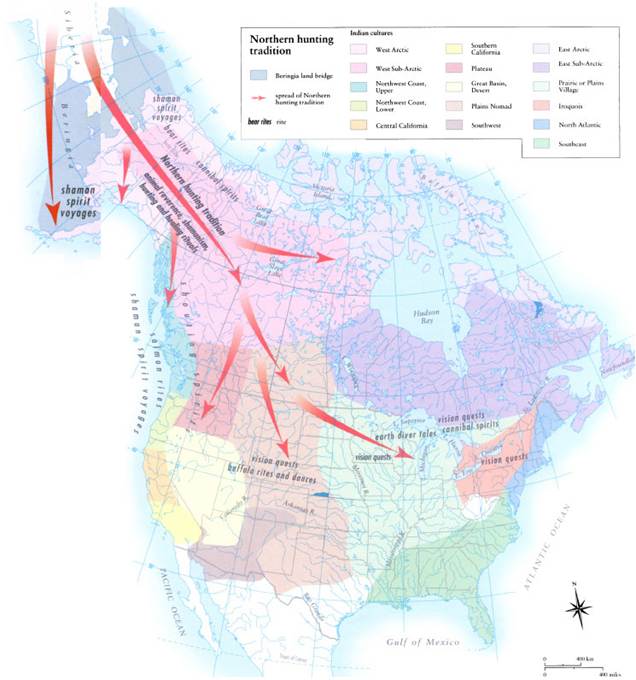
Northern hunting religions developed from those of Paleolithic Siberia and Beringia. Their features were evident wherever hunting was common but remained most pronounced in northern North America.
America’s hunting peoples regarded animals, on which they depended for survival and which appeared well adapted to environmental conditions, as superior in wisdom and power and deserving of respect and reverence. Their origin myths typically featured local animals as earth’s shapers and first inhabitants. Great Lakes tribes, for instance, attributed hills, valleys, and streams to a Great Beaver that dredged soil from a primeval sea and a hawk that flapped its wings to dry it. A Great Hare then summoned human beings into existence and taught them to survive. Many northern tribes were divided into clans claiming descent from animal ancestors.
Hunting and animals dominated ritual life as well. Throughout the Northeast and on the Plains, hunters sought the supernatural aid of bear, eagle, and badger spirits in dramatic vision quests. Shamans conducted collective rites that used imitative gesture and costume to petition desired animals prior to hunting and offered ceremonial thanks to the animal spirits afterward. Arctic Eskimo solemnly addressed Grandfather Bear, while tribes of the Pacific Northwest returned the skeletons of a season’s first salmon catch to rivers in order to ensure continued supplies. On the Plains, Sioux, Pawnee, and Osage ritual reflected dependence on buffalo.
The shaman was particularly important in most hunting tribes. Most shamans of the Americas beckoned spirits to approach and possess them, but those of the Arctic, Bering, and north Pacific Coast regions retained the Siberian practice of spirit flight, their souls traveling great distances to contend with powerful spirits and ensure successful hunting. Other groups looked less to shamans than to medicine men or secret societies for healing magic.
Hunting groups dealt gingerly with the female power of fertility, thought harmful to the spiritual power men required for hunting. Tlingit men, for instance, considered continence a prerequisite for prehunt visions, and men of whaling tribes sometimes avoided their wives for the entire whaling season. Menstruating women were ceremonially isolated from the group and forbidden contact with all objects touched by the men. Young women learned of their power in rites of passage at first menses.
Native religions often symbolized environmental hazards as spirits. Many Eskimo peoples, like their Siberian ancestors, feared a cannibal spirit representing what was probably a grim reality of Arctic life. The Ojibwa of the Great Lakes likewise hoped that the cannibal spirit Windigo would not visit in nightmares. Eskimo hunters also imagined a half-human, half-animal spirit that, like the vast whiteness of the landscape, threatened to hypnotize and destroy them. Harmful shouting spirits might bedevil hunters in the cold, windy forests of western Canada and the Pacific Northwest. Such were the challenges, difficulties, and religious expressions of hunting life in the North.