Southern Agricultural Religions
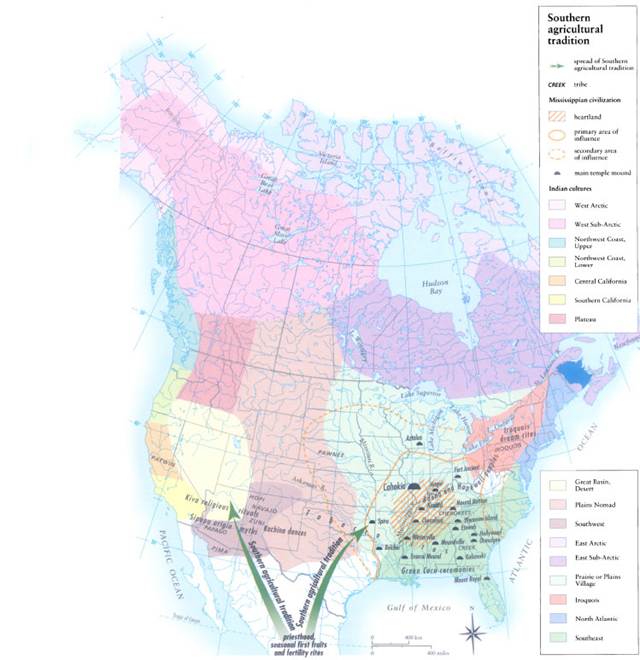
Maize agriculture, developed in Mesoamerica about 3000 BCE, sparked settled village life, complex social structures, an intensified astronomical and meteorological awareness, and characteristic religious patterns in which priesthoods and rich collective rites fostered community bonding and addressed the challenges of agricultural life.
Such patterns spread gradually northward into what is now the United States.Evidence of urban centers and ceremonial burial mounds among the Adena and Hopewell peoples of the Ohio Valley suggests that agricultural religion had reached the region by 1000 BCE. It was more fully developed by the Mississippi Valley civilization, which flourished about 1250 CE, cultivated corn, constructed temple mounds for collective rituals, and centered on the city of Cahokia. This civilization disappeared long before Europeans arrived, but it left behind what are now the oldest religious structures on the American landscape and powerfully shaped subsequent cultures in the lower Mississippi Valley.
Planting tribes revered and expressed in myth the power of agriculture. The Hopi and Zuni of the Southwest imagined that their ancestors emerged from holes in the earth (sipapu) after Father Sky or Father Sun brought rain to Mother Earth and that they learned to plant corn from Corn Mothers. They conducted many rituals in subterranean kivas in recognition of these origins. Southeastern peoples also explained human origins in terms of descent from the sky and understood Father Sun as the source of life.
Agricultural ritual celebrated and sought to control plants, planting, harvest, rain, and sun. Petitions to Father Sun at summer and winter solstices were common in the Southeast. Cherokee and Creek Green Corn ceremonies and similar rites thanked and perpetuated seasonal rhythms by sacrificing the “first fruits” of important crops.
Ceremonial cornmeal offerings likewise characterized the Southwest. Many Southern tribes considered tobacco a particularly effective means of petition. On the Plains, the hunter-gatherer Pawnees and others smoked it through calumets to honor the Corn Mother and the Keeper of Buffalo. In the Southwest, where rain was rare, the Hopi and Zuni held summer kiva rituals and public ceremonies invoking rain-bringing ancestral spirits (kachinas) through cornmeal, pollen, and dance. Near the current Mexican border, the Papago and Pima sought rain through song and ritually consumed cactus cider—tribes farther south used corn liquor—every June.Agricultural religions never ceased resembling the hunter traditions from which they evolved. Indeed, the common roots of the two traditions, the migration of peoples, and variations in physical and cultural environments produced a complex reality in which agricultural and hunting rites were more often than not mixed. The Creeks of Alabama and Georgia, who hunted and planted, retained shamans and hunting rituals alongside their fertility observances. The Iroquois, who migrated northward to New York from the Ohio Valley around 1200 CE, retained Mississippian features rare in the North: complex social organization, a full ceremonial calendar, and a priesthood that conducted rituals for corn, beans, and maple syrup. The Navajo, who migrated southward from the subarctic to the Desert Southwest, combined the visions, healing magic, and cold-weather concerns of Northern hunters with the priests and rain ceremonies more typical of the region. Such systems suggest the dynamism and complexity of pre-Columbian American religion.

A Zuni kachina doll. These figures were used by tribes in the desert Southwest to summon rain-bringing spirits.